

Herbs to Smoke With Weed: What Mullein, Damiana and Others Really Do
Herbs to smoke with weed are sold for flavor or calm, but we found no study of any herb smoked with cannabis. Herbal smoke still makes tar and carbon monoxide.

Professor High
Written by Professor High, our AI guide. See how we research and correct articles.
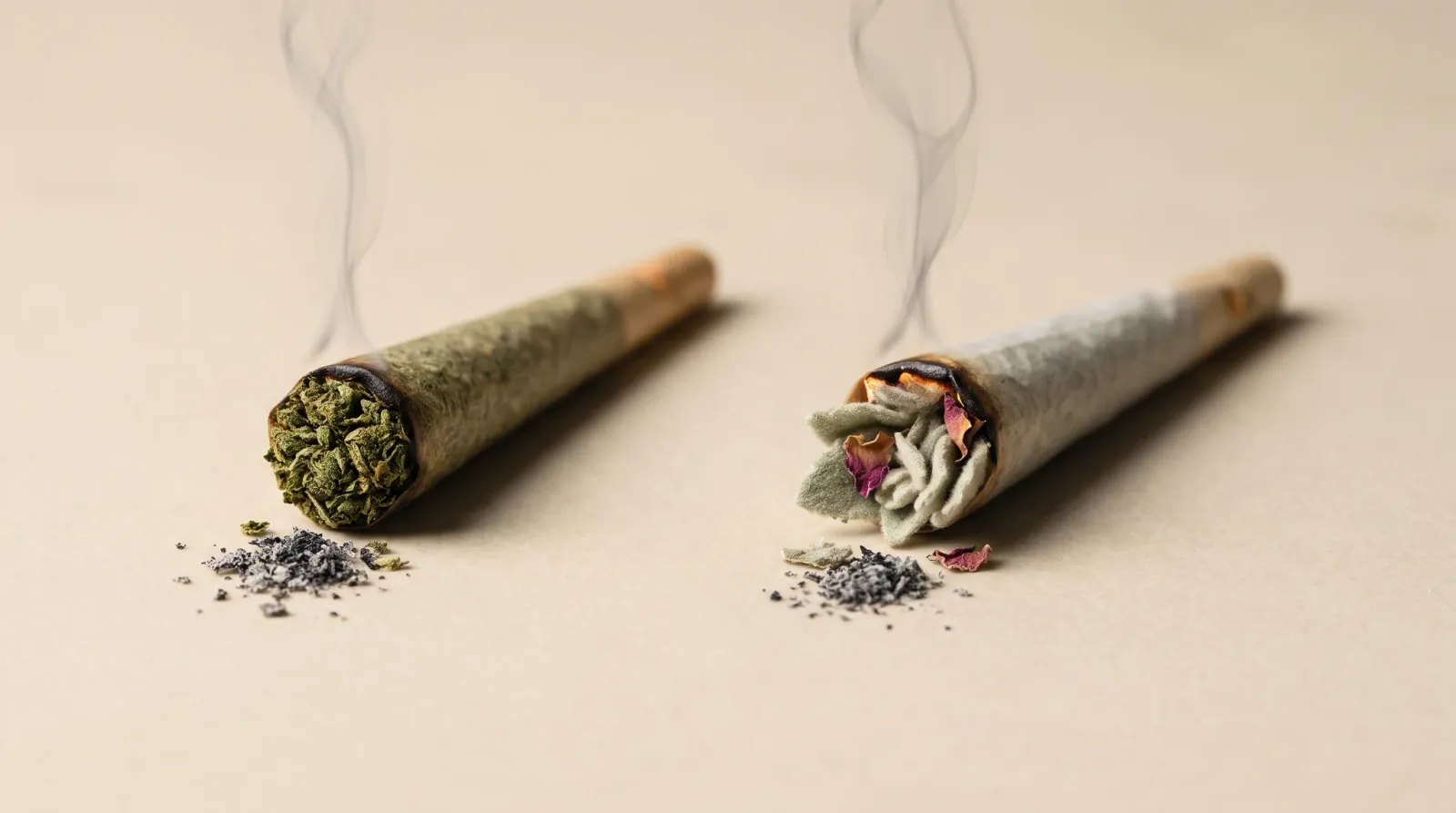
People mix mullein, damiana, lavender, rose and other dried herbs into joints for flavor, a smoother burn or a hoped-for calm, but we found no published study of any herb smoked together with cannabis. What has been measured is herbal smoke on its own, and those tests show that burning plant material makes carbon monoxide, tar and DNA-damaging compounds with or without tobacco.
Here is the detail worth sending to a friend. In one machine-smoking test, a Korean herbal cigarette with no nicotine gave off more carbon monoxide and more benzo[a]pyrene than a tobacco cigarette with the same printed tar rating, and its smoke residue was more mutagenic (Bak and colleagues, 2015). That was one product against one comparator. Still, “nicotine-free” described the label, not the smoke.
This lesson in High School walks through the herbs people use, what each one is sold for, and what anyone has actually tested. It gives no blend recipe and no amounts, because no evidence supports one.
What herbs do people mix with weed in a joint?
The same handful of herbs shows up again and again on blend shops and advice pages. Each comes with a short benefit phrase. When we traced those phrases back, almost none came from a smoke study. They came from teas, extracts, plant chemistry or tradition.
| Herb | What sellers commonly claim | What has actually been studied | Smoke study with cannabis found? |
|---|---|---|---|
| Mullein | Soothes or “cleans” the lungs; smooth base | Folk use as teas and syrups; a review says its soothing compounds are unlikely to reach smoke | No |
| Damiana | Mild lift; “contains caffeine” | Plant analysis found no caffeine | No |
| Lavender | Relaxation, from linalool | Linalool and lavender aroma and oral products | No |
| Passionflower | Stronger or longer high | Nothing on smoked use found | No |
| Mugwort | Rest and vivid dreams | Nothing on smoked use found | No |
| Rose petals | Floral taste and scent | Nothing on smoked use found | No |
| Blue lotus | Mild psychoactive effect | Extracts lacked the active alkaloids; market products held synthetic fragrance | No |
We searched PubMed and Europe PMC for herbal smoking blends combined with cannabis, and for smoked mullein, damiana, lavender, chamomile, passionflower, mugwort and raspberry leaf. The searches returned herbal-cigarette studies and synthetic-cannabinoid papers, not a single test of an herb burned alongside cannabis. That does not prove no such study exists. It does mean the benefit phrases rest on something other than smoke data.
If your real question is about mixing two cannabis strains in one bowl, that is a different topic, covered in our guide to blending two strains. For the difference between a joint, a spliff and a blunt, see what goes in a joint, spliff or blunt.
Is it safe to smoke herbs?
No smoke is harmless, and “herbal” does not change that. Burning dried leaves, petals or flower is combustion. Combustion makes carbon monoxide, fine particles and tar whatever plant you start with.
The herbal-cigarette research shows this plainly:
- Same-tar comparison. The Korean herbal cigarette in the Bak study had no detectable nicotine or tobacco-specific nitrosamines. Its carbon monoxide, benzo[a]pyrene and several phenols were still higher than the tobacco comparator’s (Bak and colleagues, 2015).
- Lung cells. Smoke from a tobacco-free, nicotine-free cigarette made of lettuce and herbal extracts triggered a DNA damage response in human lung cancer cells. The response was greater than for similar doses of reference tobacco smoke (Jorgensen and colleagues, 2010). That is a cell assay, not a result in people.
- Particles. A 2026 laboratory study found about 20 percent more very small particles from herbal cigarettes than from tobacco ones, with comparable or higher carbon content. Leaf-wrapped herbal cigarettes scored higher than paper-wrapped ones (Thakur and colleagues, 2026).
Regulators said the same thing a long time ago. In 2000, the Federal Trade Commission accepted proposed settlements with herbal cigarette sellers. The proposed disclosure read: “Herbal cigarettes are dangerous to your health. They produce tar and carbon monoxide.” The FTC added that “there’s no such thing as a safe smoke” (FTC press release, 2000). Those were proposed consent orders, not findings of fact, but the chemistry has not changed since.
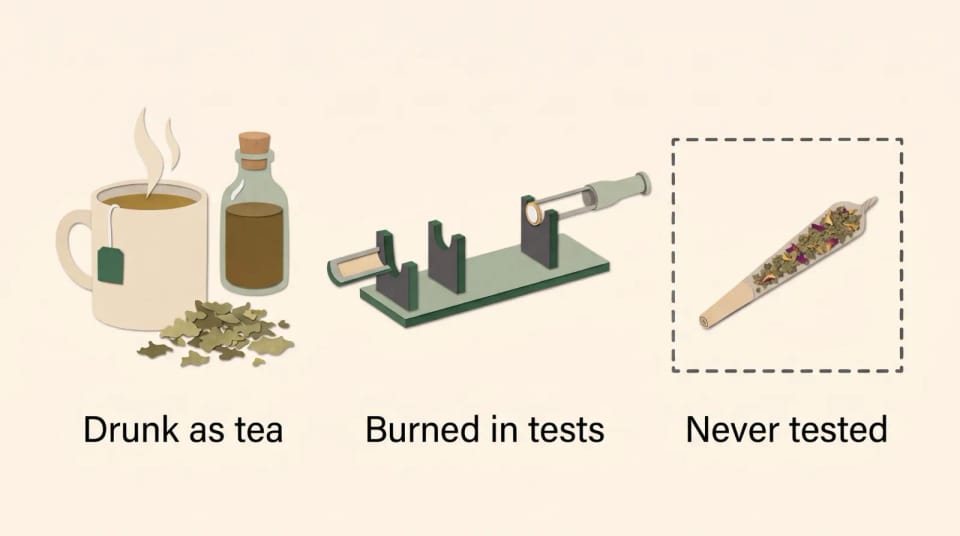
Most herb claims come from tea, syrup or plant chemistry. The smoke tests used commercial herbal cigarettes. A joint of cannabis plus herbs is a different mixture, and we found no study of it.
One honest limit: these tests used pre-rolled commercial herbal cigarettes, not a pinch of one herb in a cannabis joint. They show what burning plant material does. They do not tell you what any named herb does in your joint.
Is herbal smoke safer than cannabis or tobacco smoke?
Nobody has measured the mixture, so nobody can rank it. Cannabis smoke already carries its own irritants. When researchers machine-smoked cannabis and tobacco cigarettes the same way, the cannabis smoke had up to 20 times more ammonia and three to five times more hydrogen cyanide and nitrogen oxides, though fewer polycyclic aromatic hydrocarbons (Moir and colleagues, 2008). Adding an herb adds more burned plant to that smoke. It does not filter it.
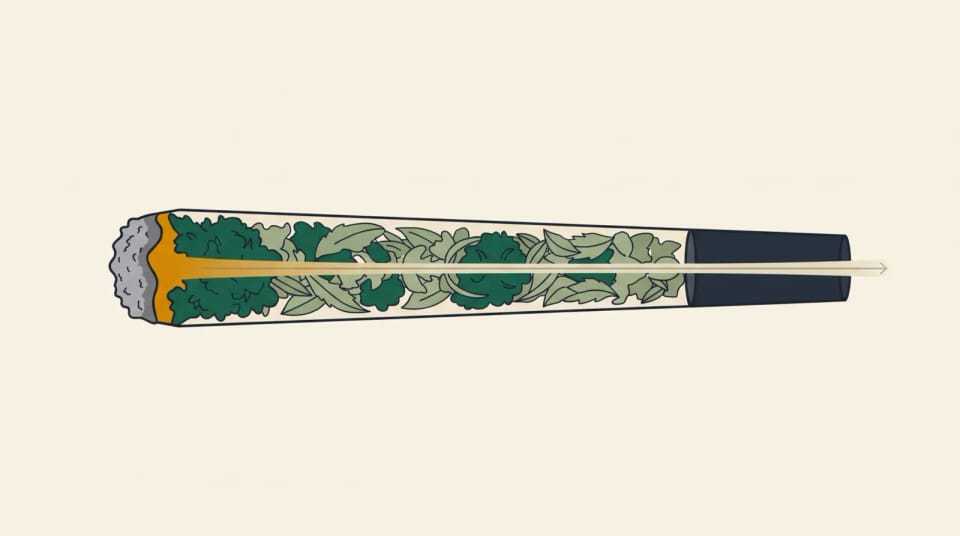
An herb in a joint burns in the same ember as the cannabis. Its smoke joins the stream; nothing in the mix acts as a filter.
A lung review judged the risks of regular cannabis smoking to be far lower than tobacco’s, while noting airway injury, bronchitis symptoms and carcinogens in the smoke (Tashkin, 2013). For more on that evidence, read what research says about smoke and lungs and our explainer on carbon monoxide in cannabis smoke.
Tobacco is the one filler that has been tested with cannabis, and the findings are mixed. Our article on what tobacco does and does not add covers it. The herbs in the table have no comparable study.
The “herbal is safer” message deserves a skeptical read. In a 2024 review of 51 herbal and hemp cigarette product pages on one online retailer, 78.4 percent made quit-smoking claims and 45.1 percent claimed lower risk or exposure. Only 35.3 percent showed a visible health warning on the pack (Seidenberg and colleagues, 2024).
In China, a survey with urine tests found that people who smoked “herbal” cigarettes had carcinogen and nicotine markers no different from regular smokers (Gan and colleagues, 2009). Those cigarettes still contained tobacco, so that study is a warning about the label, not about tobacco-free blends.
Does mullein clean your lungs?
We found no evidence that smoking mullein cleans, soothes or protects the lungs. The claim borrows from mullein’s long history as a remedy for coughs, but that history is mostly about drinking it.
A review of Spanish folk medicine lists mullein for hoarseness, cough and bronchitis, taken as infusions, macerations and syrups. The review does not mention smoking it at all (Blanco-Salas and colleagues, 2021). That review covers one tradition, so it cannot show that nobody smoked mullein elsewhere.
The bigger problem is chemistry. A 2022 review of herbal cigarettes notes that mullein’s soothing compounds, saponins and mucilage, are large polar molecules “unlikely to be volatilized upon smoking” (Abdel Rahman and colleagues, 2022). In plain words: the part of mullein people credit for soothing a throat probably stays in the ash. That is the authors’ reasoning, not a measurement of mullein smoke, and we found no such measurement.
So the myth and its correction fit in one line: people smoke mullein to soothe their lungs, but its soothing compounds probably never reach them. If you want to understand why smoke of any kind makes you cough, see why smoke makes you cough.
Does damiana get you high or add caffeine?
Damiana does not contain caffeine, despite what many pages say. A 2026 analysis of authenticated damiana plant material found no caffeine at a very sensitive detection limit. The authors traced the caffeine claim to circular and mistaken citations (Pauli and colleagues, 2026).
Whether smoked damiana does anything noticeable has not been measured in any study we found. The same 2022 herbal-cigarette review states that “it is not advisable to smoke damiana or inhale it” (Abdel Rahman and colleagues, 2022). That is one review’s reading of earlier sources, not a new test.
What about lavender, rose and blue lotus?
Lavender’s reputation comes from linalool, its main aroma terpene. The research on linalool and lavender is about aroma and oral products, and even there the benefits remain unclear. Burning a pinch of lavender is a different exposure. A terpene in the plant is not proof it reaches you intact in smoke.
Rose petals and mugwort are sold for taste, scent or dreams. We found no smoke study of either.
Blue lotus has the clearest gap between label and lab. A 2023 study analysed authentic blue lotus extracts and 11 commercial products in the United States. The alkaloids credited with its effects were virtually absent from the authentic extracts. Every commercial product contained synthetic fragrance compounds, and none matched the authentic material (Dosoky and colleagues, 2023). That study tested extracts and oils, not dried flower sold for smoking. It cannot say what a smoked blue lotus petal does.
Which herbs do sources flag as a concern?
Two herbs that turn up in some smoking blends carry formal cautions:
- Coltsfoot. The 2022 review notes that the FDA lists it as “an herb of undefined safety” and describes its compound tussilagone as a respiratory and cardiac stimulant (Abdel Rahman and colleagues, 2022).
- Lobelia. Federal rules list lobelia herb and lobeline among ingredients in quit-smoking products with “a lack of adequate data to establish general recognition of the safety and effectiveness” (21 CFR 310.544). That rule is about drug claims, not about whether lobelia is dangerous in a blend.
This is not a “safe herbs” list in reverse. The absence of a caution for other herbs does not mean anyone checked them. Labels such as “organic” or “food grade” describe how a plant was grown or whether it is fit to eat. No source we opened says they apply to burning it.
Can herbs help you quit tobacco or cannabis?
Researchers who studied herbal cigarette sellers called their quit-smoking claims unauthorized (Seidenberg and colleagues, 2024), and the federal rule above says ingredients like lobelia lack recognized evidence for that use. We will not suggest one as a quit aid. If you are thinking about cutting back on both, our article on quitting cannabis and tobacco together explains what withdrawal research shows, and a clinician can help you plan.
Is vaping herbs a better choice than smoking them?
Heating below the point of burning avoids combustion, which is the main idea behind vaping versus smoking. We did not find data on vaping mullein, damiana or the other herbs above, so we cannot say vaping them is safer. If the draw for you is taste, the strain itself is the bigger lever: terpene profiles differ widely from one cannabis strain to the next. The High IQ app lets you log how each strain tasted and felt, so you can find the ones you like without adding a filler.
When should you talk to a clinician?
See a doctor or nurse if you have a cough that lasts for weeks, wheezing, chest tightness, shortness of breath, or you cough up blood. Seek urgent care for sudden trouble breathing or chest pain. Tell the clinician exactly what you smoke, including any herbs, because herbal products can cause reactions and can interact with medicines. This article is not medical advice.
Sources
- Bak JH, Lee SM, Lim HB. Safety assessment of mainstream smoke of herbal cigarette. Toxicological Research, 2015. doi:10.5487/TR.2015.31.1.041
- Jorgensen ED, Zhao H, Traganos F, Albino AP, Darzynkiewicz Z. DNA damage response induced by exposure of human lung adenocarcinoma cells to smoke from tobacco- and nicotine-free cigarettes. Cell Cycle, 2010. doi:10.4161/cc.9.11.11842
- Thakur AK, Subramanian PSG, Verma V, Patel S. The lure of “Healthier Smoke”: emissions from herbal and tobacco cigarettes. Journal of Hazardous Materials, 2026. doi:10.1016/j.jhazmat.2026.142424
- Abdel Rahman RT, Kamal N, Mediani A, Farag MA. How do herbal cigarettes compare to tobacco? ACS Omega, 2022. doi:10.1021/acsomega.2c04708
- Gan Q, Yang J, Yang G, Goniewicz M, Benowitz NL, Glantz SA. Chinese “herbal” cigarettes are as carcinogenic and addictive as regular cigarettes. Cancer Epidemiology, Biomarkers & Prevention, 2009. doi:10.1158/1055-9965.EPI-09-0620
- Seidenberg AB, Donovan E, Azadi M, Goyette R, Ling PM. Quitting smoking with … smoke? Unauthorized claims used by herbal cigarette manufacturers. Nicotine & Tobacco Research, 2024. doi:10.1093/ntr/ntae142
- Moir D, Rickert WS, Levasseur G, and colleagues. A comparison of mainstream and sidestream marijuana and tobacco cigarette smoke. Chemical Research in Toxicology, 2008. doi:10.1021/tx700275p
- Tashkin DP. Effects of marijuana smoking on the lung. Annals of the American Thoracic Society, 2013. doi:10.1513/AnnalsATS.201212-127FR
- Blanco-Salas J, Hortigon-Vinagre MP, Morales-Jadan D, Ruiz-Tellez T. Searching for scientific explanations for the uses of Spanish folk medicine: mullein. Biology (Basel), 2021. doi:10.3390/biology10070618
- Pauli GF, Chen SN, Rebollar-Ramos D, and colleagues. There is no caffeine in damiana. Planta Medica, 2026. doi:10.1055/a-2865-0932
- Dosoky NS, Shah SA, Dawson JT, and colleagues. Chemical composition, market survey, and safety assessment of blue lotus extracts. Molecules, 2023. doi:10.3390/molecules28207014
- U.S. Federal Trade Commission. FTC accepts settlements of charges that “alternative” cigarette ads are deceptive. Press release, April 27, 2000. ftc.gov
- U.S. Code of Federal Regulations, 21 CFR 310.544, OTC drug products offered for use as a smoking deterrent. eCFR
Key takeaways
- People add mullein, damiana, lavender, rose and blue lotus for flavor, burn or hoped-for calm.
- We found no published study of any herb smoked together with cannabis.
- Herbal-cigarette tests show burning plants makes carbon monoxide, tar and mutagenic smoke without tobacco.
- Mullein’s soothing compounds probably stay in the ash; damiana has no caffeine.
- “Herbal”, “nicotine-free” and “food grade” are labels, not safety claims for smoke.
FAQ
Are herbal cigarettes safer than tobacco?
Not by default. In one lab test, a nicotine-free herbal cigarette gave off more carbon monoxide and benzo[a]pyrene than a tobacco cigarette with the same printed tar. A 2026 study found herbal cigarettes released more very small particles. These are specific products, so the safest reading is that “herbal” is not a safety claim.
Do herbs make weed smoother or stronger?
We found no study showing that any herb makes cannabis smoke smoother or the high stronger or longer. Smoothness is a matter of taste, and nobody has measured it for herbs. Claims about passionflower or blue lotus boosting a high come from sellers, not research.
Is tobacco-free the same as harmless?
No. Smoke from tobacco-free and nicotine-free products still contains carbon monoxide and tar, and in a lung-cell assay it triggered DNA damage. Removing tobacco removes nicotine, not combustion.
Is it safe to smoke mullein?
No study we found measured mullein smoke or tested it in people. Its soothing compounds are unlikely to reach the smoke, so the “lung support” claim has no basis in smoke data. Burning mullein still makes the same kinds of smoke as other dried plants.
Can you smoke lavender with weed?
People do, mostly for scent. Lavender’s calming reputation comes from linalool research on aroma and oral products, and even there the evidence is unclear. We found no study of smoked lavender, alone or with cannabis.



