Cannabis Smoke and Carbon Monoxide: How It Compares With Tobacco
Cannabis carbon monoxide, measured: in a 1988 lab study one joint raised blood CO nearly five times more than a cigarette. Per day and vaped, it differs.

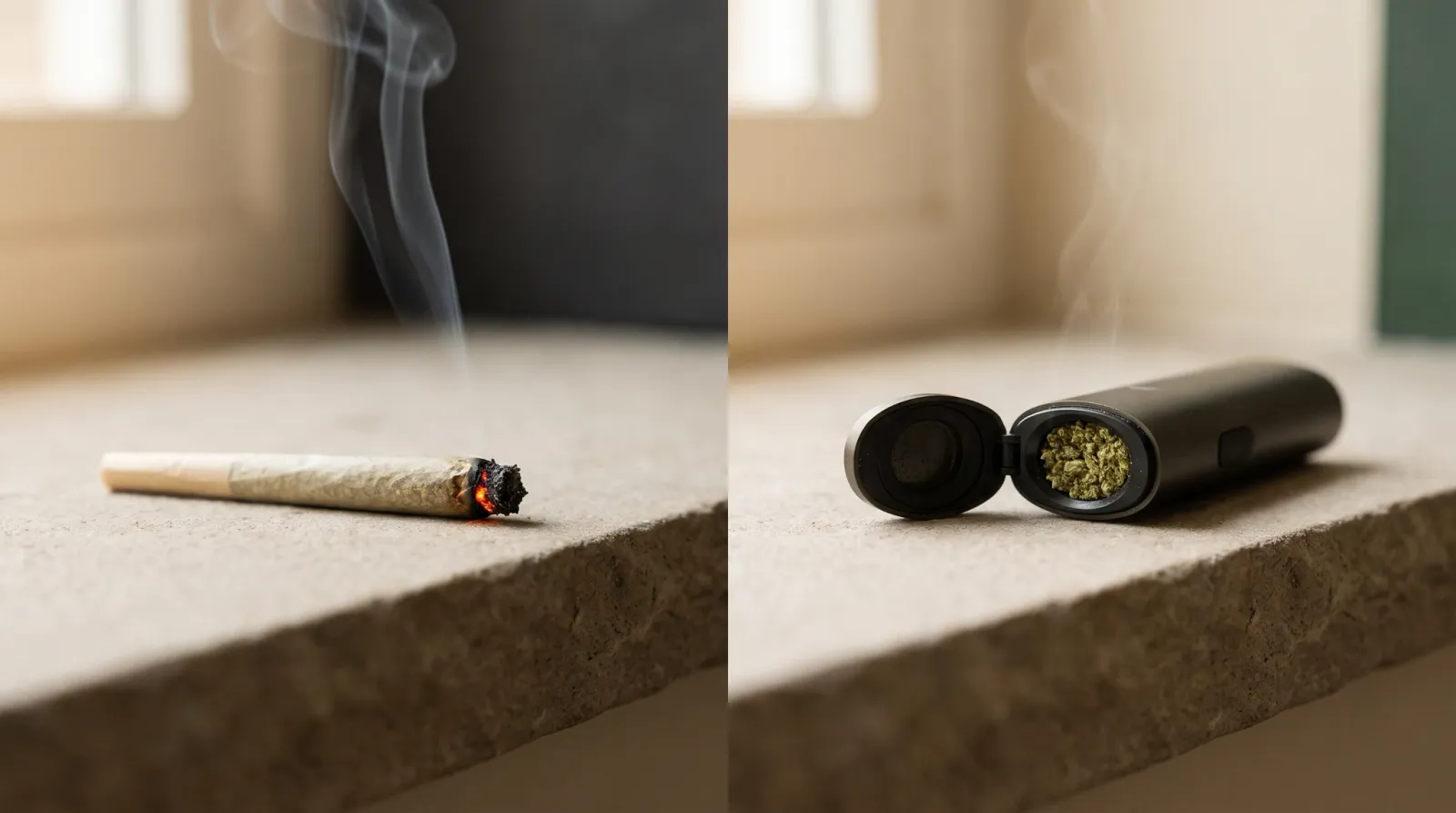
Yes: burning cannabis makes carbon monoxide, and in the best-known lab comparison one marijuana cigarette raised blood carbon monoxide nearly five times as much as one tobacco cigarette. That 1988 study tested 15 men, one cigarette at a time, and found the gap held whatever the THC content of the cannabis. Wu et al., NEJM 1988
Here is the part almost nobody prints. Per cigarette, cannabis delivered far more carbon monoxide (CO) in that lab. Per day, people who smoked only cannabis had lower exhaled CO than daily cigarette smokers: a mean of 5.7 ppm in 16 cannabis-only smokers against 18.8 ppm in 18 tobacco smokers. Meier et al., Nicotine & Tobacco Research 2021 Both numbers are true. They answer different questions.
This High School lesson walks through what was actually measured, how, in how many people, and where nobody has measured at all.
Does weed smoke contain carbon monoxide?
Yes. CO forms whenever plant material burns without enough oxygen to finish the job, and a joint is no exception. California’s Proposition 65 fact sheet lists carbon monoxide among the chemicals in cannabis smoke and notes that the smoke contains several thousand chemicals, many shared with tobacco smoke. OEHHA Prop 65 fact sheet
A Canadian machine-smoking study that prepared marijuana and tobacco cigarettes the same way found “qualitative similarities with some quantitative differences”: some toxicants ran higher in marijuana smoke, and some polycyclic aromatic hydrocarbons ran lower. Moir et al., Chem Res Toxicol 2008 Its abstract does not report a CO yield, so it tells us the two smokes are chemical cousins, not which carries more CO.
The CDC sums it up plainly: smoked cannabis, regardless of how it is smoked, can harm lung tissue, and the smoke contains many of the same toxins and irritants as tobacco smoke. CDC, Cannabis and Lung Health
How much carbon monoxide does a joint deliver compared with a cigarette?
The headline number comes from one study. Researchers had 15 men who had smoked both tobacco and marijuana for at least five years smoke single filter-tipped tobacco cigarettes and single marijuana cigarettes of roughly similar weight. They measured blood carboxyhemoglobin (COHb), the share of hemoglobin carrying CO instead of oxygen, before and after each one. Wu et al., NEJM 1988
The marijuana cigarette produced a nearly fivefold greater rise in COHb and about three times more inhaled tar. That is the source of the “five times more carbon monoxide” line you see repeated online.
Read it carefully, though:
- It is per cigarette, one session at a time. It is not per puff and not per day.
- The marijuana contained 1.24% THC (or a near-zero placebo), far below today’s typical flower.
- The study had 15 participants, all men.
Here are the measurements this article relies on, side by side.
| Study | Design and sample | What it measured | What it found | Main limit |
|---|---|---|---|---|
| Wu 1988 | Lab, 15 men, one cigarette of each type | Blood COHb rise | Nearly fivefold greater rise after marijuana | Small, low-potency 1980s material |
| Meier 2021 | Cross-sectional pilot, 16 cannabis-only vs 18 tobacco smokers | Exhaled CO (ppm) | 5.7 vs 18.8 ppm mean | Small, authors call it an estimate |
| Abrams 2007 | Inpatient, 18 adults, smoked vs vaporized | Plasma THC, exhaled CO | Similar THC, lower CO with the vaporizer | One device, no ppm in abstract |
| Newmeyer 2017 | Controlled dosing, smoked vs vaporized vs oral | Exhaled CO over 6 hours | Higher CO after smoking than vaporizing | Abstract gives no ppm |
Why does a joint deliver more CO per cigarette?
The 1988 study measured how the men smoked, and the habits differed. Marijuana puffs were about two-thirds larger, inhalation was about one-third deeper, and the breath was held about four times longer than with tobacco. The THC content of the cigarette only slightly changed those smoking habits or the tar delivered. The abstract does not say how much of the CO gap those habits explain. Wu et al., NEJM 1988
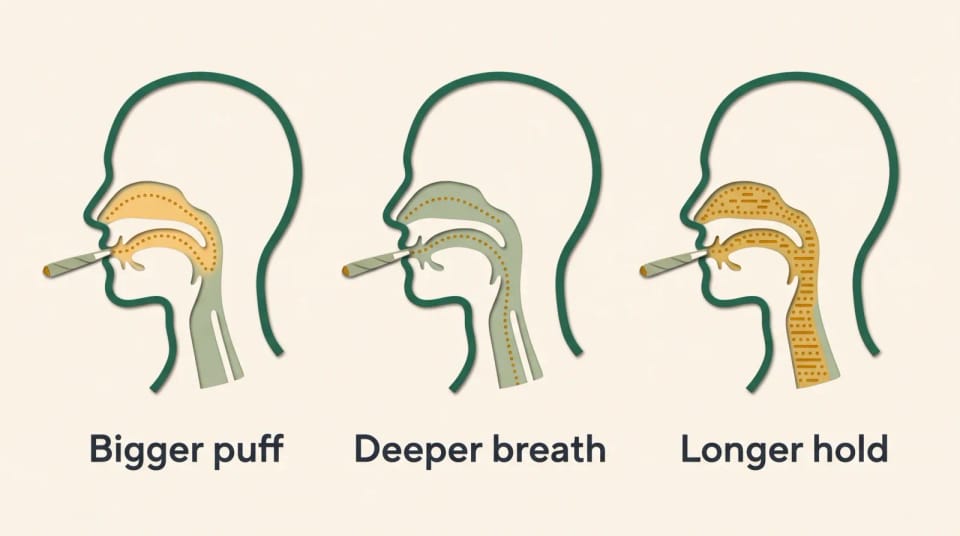
In the 1988 lab study, cannabis puffs were larger, deeper and held longer than tobacco puffs. That study did not show which habit drives CO, and later studies disagree.
Smaller follow-up studies broke those habits apart and did not agree on which one matters most:
- In 10 habitual smokers, a longer breath hold raised the post-smoking rise in COHb, while a bigger puff alone did not, for the same amount smoked. Tashkin et al., 1991
- In two experiments of seven people each, puff size raised the exhaled-CO boost, while breath holding raised plasma THC but not CO. Azorlosa et al., 1995
So the fair reading is that the habits differ and bigger puffs or longer holds can raise CO measures in small experiments, but how much each one matters is unsettled. If you want the breath-hold details, we cover whether holding in a hit changes the high in its own lesson.
Potency is another open question. A few small 1980s studies found exhaled CO went down as THC strength went up, which suggests some smokers take in less smoke from stronger material. Chait, 1988; Nemeth-Coslett et al., 1986 Those studies are old and small, so treat that as a hint, not a rule for modern flower. If you are curious how much THC a modern pre-roll actually carries, see how much THC is in a joint.
Is weed smoke worse than cigarette smoke for carbon monoxide?
Per cigarette in the lab, it delivered more. Per day in real life, the only exhaled-CO comparison we found points the other way.
The 2021 pilot recruited people who smoked cannabis at least weekly and no tobacco, people who smoked at least five cigarettes a day, and people who used both. Exhaled CO, measured with a breath monitor, averaged 5.7 ppm for cannabis-only smokers, 18.8 ppm for tobacco-only smokers and 21.4 ppm for co-users. The authors note the cannabis-only group still sat above typical non-smoker levels. Meier et al., 2021
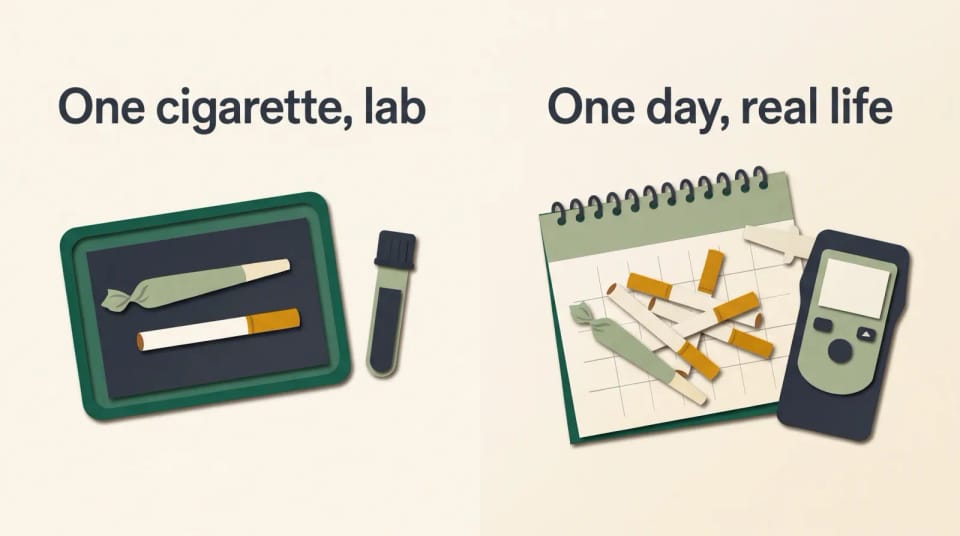
Per cigarette and per day are different measurements. The lab study compared single cigarettes; the 2021 pilot compared people’s usual daily exposure.
One plausible explanation is that most daily tobacco smokers light many more cigarettes in a day than most cannabis smokers light joints. The 2021 study did not test that. It was small, cross-sectional and mostly non-Hispanic white, and the authors say its comparisons are “better viewed as estimations rather than true comparisons.” A heavy daily cannabis smoker could look very different from that group’s average.
CO is also only one part of smoke. For the broader picture on coughing, lung function and cancer research, read what the lung-health research actually shows. People nearby breathe some of it too; we cover secondhand cannabis smoke separately.
Does vaping cannabis produce carbon monoxide?
Two controlled studies found much less CO after vaporizing than after smoking. Neither shows zero, and neither tested every device.
- In an 18-person inpatient study, smoking and a dry herb vaporizer produced similar peak blood THC and similar THC exposure over six hours, while exhaled CO was reduced with vaporization. No adverse events were reported. Abrams et al., 2007
- In a later controlled study with frequent and occasional users, smoking produced significantly higher exhaled CO than vaporizing from 15 minutes to six hours after the dose. Newmeyer et al., 2017
A review of the early vaporizer research describes little to no CO increase after vaporizing. Loflin and Earleywine, 2015 The mechanism matches: a vaporizer heats flower enough to release cannabinoids without setting it on fire, and combustion is where CO comes from. For the wider trade-offs, see our lesson on vaping versus smoking, and for the practical side, our dry herb vaporizer temperature guide. If you switch methods, the High IQ app lets you track how a strain worked so you can compare your own sessions.
Edibles do not involve burning at all, so they produce no combustion gases. They carry their own timing and dosing questions instead.
Do bongs, pipes or blunts change the carbon monoxide?
Nobody has published a head-to-head CO measurement for joints, pipes, bongs, blunts and pre-rolls in the sources we found. That is a gap, not a finding of “no difference.”
The best-known water pipe study, sponsored by MAPS and California NORML, machine-smoked cannabis through several devices but measured tar and cannabinoids only; its write-up says gases, including CO, were not analyzed. MAPS vaporizer and waterpipe studies Our lesson on what a bong does and does not filter covers that study in detail, and bong water temperature changes how smoke feels more than what it contains.
Water pipe CO studies do exist for tobacco. Those numbers belong to tobacco and cannot be moved over to cannabis. The same goes for wrappers: joints, blunts and spliffs differ in what is burned, but no study we found compared their CO.
When should you talk to a clinician?
This article explains measurements; it is not medical advice. Talk to a clinician if you notice breathing trouble, chest pain, a cough that will not settle, or any symptom after smoking that worries you, and mention how often and how you consume. If you think someone may have carbon monoxide poisoning from any source, such as a heater, a car or a generator, get fresh air and call emergency services or Poison Control (1-800-222-1222 in the US) right away.
Key takeaways
- Burning cannabis makes carbon monoxide, like any burning plant material.
- In one 1988 lab study of 15 men, a marijuana cigarette raised blood COHb nearly five times as much as a tobacco cigarette, per cigarette.
- Cannabis smokers in that study took bigger, deeper, longer-held puffs; small follow-up studies disagree on whether puff size or hold time matters more for CO.
- Per day, cannabis-only smokers in a small 2021 pilot had lower exhaled CO than daily cigarette smokers.
- Vaporizing lowered exhaled CO compared with smoking in two controlled studies; it did not test as zero exposure to everything.
- No study we found measured CO from bongs or pipes against joints.
FAQ
Is the carbon monoxide in weed smoke dangerous?
CO reduces how much oxygen your blood can carry, and cannabis smoke contains it. The studies here measured short-term rises after smoking, not poisoning or long-term outcomes. CO is one part of a larger smoke mixture that the CDC says can harm lung tissue.
Does smoking weed raise carboxyhemoglobin?
Yes. In the 1988 lab study, blood carboxyhemoglobin rose after a single marijuana cigarette, and the rise was nearly five times larger than after a tobacco cigarette. Later small studies also found COHb or exhaled CO rose after smoking cannabis.
Does a vaporizer remove carbon monoxide from cannabis?
It sharply reduces it rather than removing it in every case. Two controlled studies found lower exhaled CO after vaporizing than after smoking, with similar THC delivery in one of them. Results came from specific devices and settings.
Does a bong filter out carbon monoxide?
We found no published measurement that answers this for cannabis. The best-known cannabis water pipe study measured tar and cannabinoids and did not analyze CO. Tobacco water pipe data does not transfer to cannabis.
Does holding in a hit increase carbon monoxide?
The studies disagree. Two small studies found a longer breath hold raised CO measures, and another found puff size mattered but breath holding did not. Holding in a hit also did not reliably make people feel higher in those experiments.
Sources
- Wu TC, Tashkin DP, Djahed B, Rose JE. Pulmonary hazards of smoking marijuana as compared with tobacco. N Engl J Med. 1988;318(6):347-351.
- Meier E, et al. Cigarette smokers versus cannabis smokers versus co-users of cigarettes and cannabis: a pilot study examining exposure to toxicants. Nicotine Tob Res. 2021.
- Tashkin DP, et al. Effects of varying marijuana smoking profile on deposition of tar and absorption of CO and delta-9-THC. Pharmacol Biochem Behav. 1991;40(3):651-656.
- Azorlosa JL, Greenwald MK, Stitzer ML. Marijuana smoking: effects of varying puff volume and breathhold duration. J Pharmacol Exp Ther. 1995;272(2):560-569.
- Abrams DI, et al. Vaporization as a smokeless cannabis delivery system: a pilot study. Clin Pharmacol Ther. 2007;82(5):572-578.
- Newmeyer MN, et al. Subjective and physiological effects, and expired carbon monoxide concentrations following smoked, vaporized, and oral cannabis. Drug Alcohol Depend. 2017;175:67-76.
- Loflin M, Earleywine M. No smoke, no fire: what the initial literature suggests regarding vapourized cannabis and respiratory risk. Can J Respir Ther. 2015;51(1):7.
- Moir D, et al. A comparison of mainstream and sidestream marijuana and tobacco cigarette smoke. Chem Res Toxicol. 2008;21(2):494-502.
- California OEHHA. Cannabis (marijuana) smoke, Proposition 65 fact sheet.
- CDC. Cannabis and lung health.
- MAPS. Vaporizer and waterpipe studies.





