

Can You Mix Weed Strains? What a Blend Does and Doesn't Do
Yes, you can mix weed strains. A blend is a weighted average of two jars, not a new strain. See the THC math, what trials found, and how to test one.

Professor High
Written by Professor High, our AI guide. See how we research and correct articles.
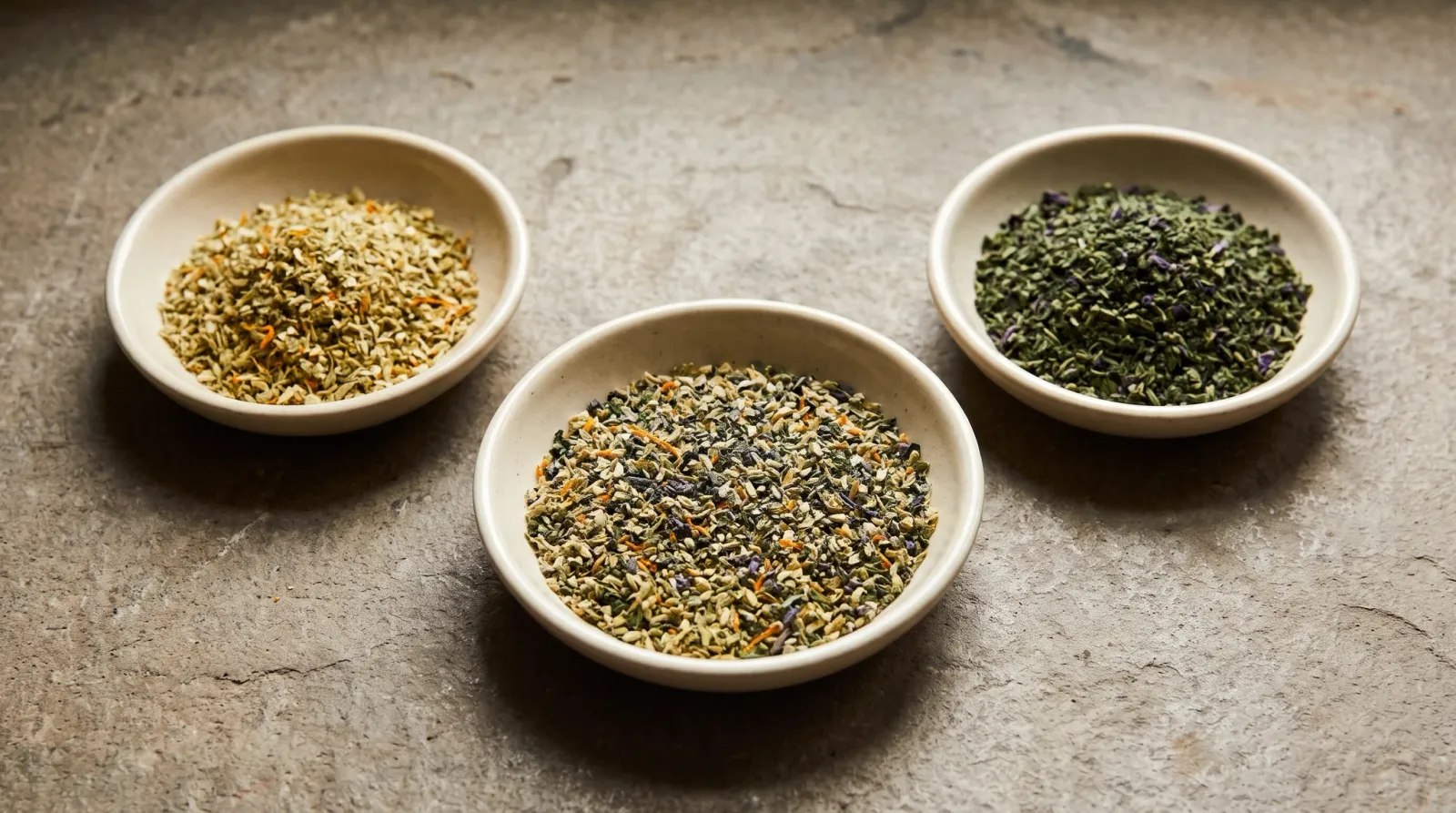
Yes, you can mix weed strains, and a blend is a weighted average of the two jars, not a new strain. It cannot contain a compound that neither jar contains. No human trial has tested whether a blend beats either strain alone, so the best way to find out what a blend does for you is to change one thing at a time and write it down.
Here is the number that settles most arguments. Equal weights of flower labeled 24% THC and flower labeled 12% THC give you roughly 18% THC. That is the same as one jar labeled 18%. Mixing does not make it stronger, and the pairing rules in many “weed salad” guides have never been tested in people.
This lesson in High School covers what a blend physically is, what the research on terpenes and CBD did and did not find, and a simple two-session method to test your own mix.
What is a weed salad?
A “weed salad” is a nickname for flower from two or more strains mixed in one bowl, joint or vaporizer chamber. You may also see “salad bowl” or “smoothie joint”. People blend for flavor, to finish small amounts of several jars, to adjust strength, or to mix THC flower with high-CBD flower.
All of that is reasonable. The trouble starts when a guide promises that a particular pairing gives a particular high. The sections below explain why that promise outruns the evidence.
What does a blend of two strains actually contain?
A blend contains exactly what the two jars contain, in proportion to how much of each you use. Each cannabinoid and terpene in the mix is the weighted average of the two lab values.
| Blend by weight | Jar A: 24% THC | Jar B: 12% THC | Blend, roughly |
|---|---|---|---|
| 1:1 | half | half | 18% THC |
| 3:1 | three quarters | one quarter | 21% THC |
| 1:3 | one quarter | three quarters | 15% THC |
| 1:1, both 20% | half | half | 20% THC |
These numbers are rough for three reasons. They assume you weigh by mass, not by eye. They ignore differences in moisture and grind. And they trust the labels, which can be wrong. Lab results for one strain can vary a lot from batch to batch, as our guide to why lab results vary for one strain explains.
The same logic applies to terpenes. If one jar is limonene-led and the other is myrcene-led, the blend has some of each, at lower levels than the jar that led with it. Nothing new is formed by mixing dry flower.
Does mixing strains make you higher?
No. Mixing averages the strength of the two jars. Two 20% jars make a 20% blend. A 24% jar mixed with a 12% jar makes something in between.
What changes how much THC you take is the amount of flower you use. Half a gram of an 18% blend holds about 90 mg of THC in the plant material. That is the amount in the flower, not the amount that reaches you, which depends on how you consume it. For the full label math, see how much THC is in a joint.
So if a blend felt stronger, the likely suspects are ordinary ones: you used more, the stronger jar made up more of the mix than you thought, or the day, your tolerance or your setting was different. Our explainer on why the same strain hits differently covers those factors.
Does mixing strains give you the entourage effect?
Nobody has shown that it does. The entourage effect is the idea that terpenes and minor cannabinoids shape how THC feels. A 2011 review proposed it as a hypothesis and said its value depends on synergy being proven (Russo 2011). Our guide to the entourage effect walks through that idea.
The human tests so far used single terpenes, not flower blends, and they split:
- Limonene. In a double-blind trial with 20 healthy adults, vaporized limonene alone did nothing measurable. When 15 mg of limonene was added to 30 mg of THC, people rated themselves less anxious and less paranoid than with THC alone. Other THC effects did not change (Spindle 2024). The significant result came from a subset of 12 people, and the authors disclosed a patent application on limonene for THC anxiety.
- Alpha-pinene. In a similar trial with 19 adults, pinene at 0.5, 5 or 15 mg did not reduce THC’s memory effects or change other measured effects. The authors said this was inconsistent with some industry claims (Kumar 2025).
- At the receptor. In cell assays, five common terpenes did not change how THC acted at the CB1 or CB2 cannabinoid receptors (Finlay 2020). Cell results do not settle what happens in people, and other lab work disagrees, so the mechanism is open.
Put together: one terpene changed one effect of THC in a small controlled test, another did nothing, and no trial has blended two flowers. That is not a basis for “pair a citrus strain to calm down.” For the compound-by-compound detail, see what terpene synergy research actually looks at.
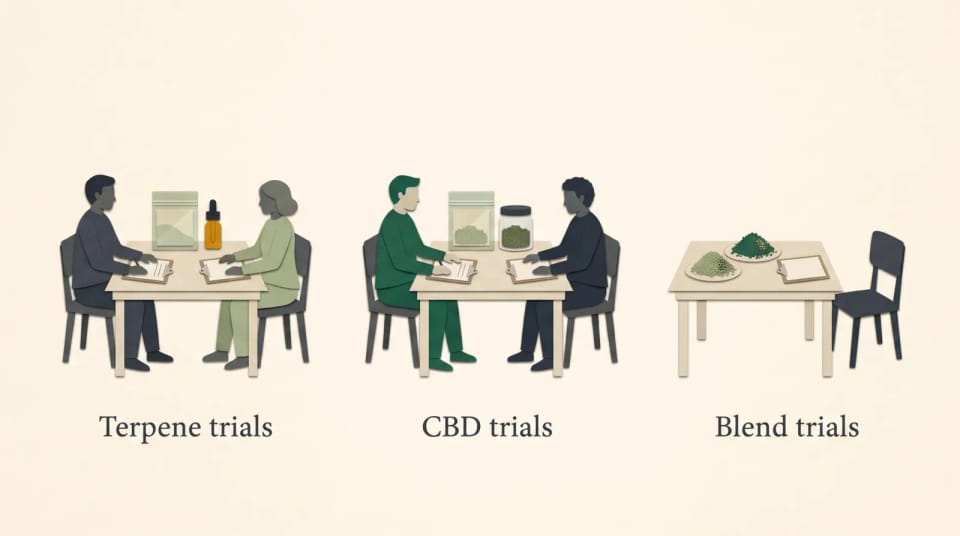
Human trials have added single terpenes or CBD to THC. The third group is empty: no published trial has compared a flower blend with its two strains.
Does mixing indica and sativa balance the high?
There is no good evidence that it does, because the labels themselves are weak guides. A common pairing rule says an “energizing sativa” plus a “relaxing indica” gives a balanced high. That rule assumes the labels describe what is in the jar.
The research says they mostly do not:
- In 297 samples, sativa-labeled and indica-labeled flower were genetically indistinct across the genome. The labels did track differences in a small number of terpenes (Watts 2021).
- In 2,662 Nevada samples, 396 strain names mapped onto only three terpene chemical groups. The authors concluded that names do not tell you the chemistry (Reimann-Philipp 2020).
- In data from six US states, labels did not consistently line up with chemical types, and most flower was THC-dominant (Smith 2022).
If both jars are THC-dominant, the blend is THC-dominant too, whatever the labels say. For the longer story, read why indica and sativa labels do not predict effects and why strain names do not predict your high.
Can you blend THC flower with CBD flower?
You can, and the math works the same way. Equal weights of a jar labeled 20% THC and a jar labeled 15% CBD with very little THC give roughly 10% THC and 7.5% CBD. What that does to the high is less clear than most guides claim, because the studies disagree.
| Study | Design | CBD and THC | What it found |
|---|---|---|---|
| Englund 2023 | Randomized, double-blind, 46 infrequent users, vaporized | 10 mg THC with 0, 10, 20 or 30 mg CBD | No CBD dose changed THC’s effects on memory or psychotic-like symptoms |
| Lawn 2023 | Randomized, double-blind crossover, vaporized flower | THC alone or with about three times as much CBD | No evidence that CBD changed THC’s effects |
| Morgan 2010 | Naturalistic, 134 people using their own cannabis | Assayed high-CBD versus low-CBD cannabis | Low-CBD cannabis impaired recall; high-CBD did not. Psychotic-like symptoms rose in both |
The two controlled trials tested more CBD per unit of THC than the equal-weight blend above supplies, and still found no change. The naturalistic study found a memory difference but could not control what else was in each person’s cannabis. So the honest answer is that the evidence is mixed. Do not count on CBD flower to soften a strong THC jar. If you want to explore ratios anyway, our guide to finding a THC to CBD ratio explains how to read the numbers.
How do you choose two strains to blend?
Choose by aroma, which you can actually check, and treat any effect claim as unproven. Aroma is a real, noticeable difference between jars. In a Colorado study, untrained consumers sorted strains into earthy and woody groups versus citrus and sweet groups. The same study found that aroma raised how strong people expected a strain to be (Gilbert 2018), which is one reason the test method below keeps everything else the same.
Smell the jar you own, not the name on it. Samples sold under one strain name can smell different from each other, and untrained people can tell (Schwabe 2022).
Here is a flavor-only blend card. The example strains come from the dominant terpene recorded on our strain pages. Your jar’s lab report is the better guide.
| Aroma family | Common lead terpene | Example strain pages | Flavor pairing idea |
|---|---|---|---|
| Citrus and sweet | Limonene | Wedding Cake, Runtz | Brightens an earthy jar |
| Earthy and musky | Myrcene | Blue Dream, Northern Lights | Rounds out a sharp citrus or herbal jar |
| Spicy and gassy | Caryophyllene | Sour Diesel, Gelato | Adds depth to a sweet jar |
| Herbal and fresh | Terpinolene | Jack Herer, Durban Poison | Lifts a heavy, earthy jar |
The pairing column is about taste. No trial shows that any of these pairings changes how high you get or how you feel. For more on reading these profiles, see how to read a terpene profile and gas versus candy flavor families.
How do you mix strains in a joint, a bowl or a vaporizer?
Grind each jar, weigh the parts, and mix them evenly. That is the whole method for all three.
- Weigh. A small scale turns “a pinch of each” into a ratio you can repeat.
- Grind to a similar size. Very different grind sizes burn and draw unevenly. Our guide to how grind size and airflow shape a bowl covers this.
- Mix in a dish, then load. For a joint, roll it as usual; see how to roll a joint. For a dry-herb vaporizer, fill the chamber with the mixed material.
Some guides recommend layering strains in a bowl or splitting a joint into sections so the flavor changes as it burns. That is untested. It is fine to try for fun, but it makes a fair comparison harder.
How do you test whether a blend works for you?
Run two sessions that differ in only one way: one jar alone versus the blend. Because no study answers the question for flower blends, your own careful notes are the most useful evidence you can get.
- Pick two jars with lab labels that you have each used alone. Write down total THC, total CBD and the top terpenes.
- Fix everything except the flower. Same device, same weighed amount, same time of day, similar setting.
- Session A: use jar 1 alone. Rate flavor, how strong it felt and your mood at 15, 60 and 120 minutes.
- Session B, on a later day: weigh equal parts of both jars, grind and mix, and use the same total amount. Record the same ratings at the same times.
- Compare, then change one thing. To test a 3:1 ratio or a different second jar, change only that in the next pair.
| Log field | Session A: jar 1 alone | Session B: 1:1 blend |
|---|---|---|
| Jars and label values | ||
| Amount and device | ||
| Time of day and setting | ||
| Flavor (1 to 5) | ||
| Strength at 15, 60, 120 min (1 to 5) | ||
| Mood and anything unwanted |
This is a method, not a result. One pair of sessions can be thrown off by sleep, food or stress, so repeat a pair before drawing a conclusion. If you use the High IQ app, you can log how each jar and each blend worked side by side and spot patterns over several sessions.
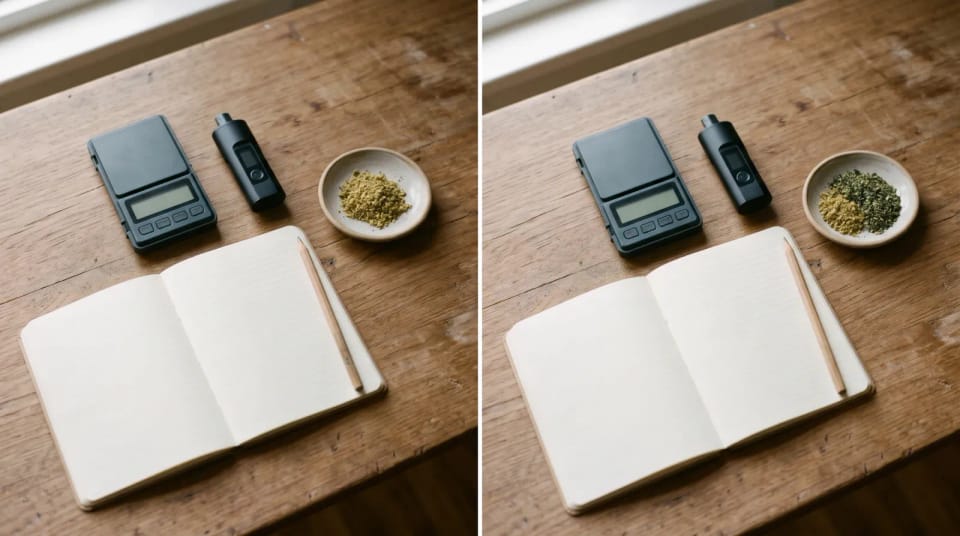
Same device, same amount, same notebook. The flower is the only difference, so any change you log has one likely cause.
Is mixing strains safe?
Mixing two lab-tested flowers does not create a new compound, so the main thing that changes is the dose of THC you take, and that comes from the amount and the strength of the mix. Tolerance, how you consume it and your setting still matter as much as they do with one jar. If you are coming back after time off, start with one familiar strain before you blend; our tolerance break guide explains why.
When to talk to a clinician: if you get chest pain, a racing heart that does not settle, panic that keeps returning, repeated vomiting, or confusion after using cannabis, stop and get medical advice. Talk to a clinician before mixing cannabis with prescription medicines, or if you are pregnant or managing a health condition. This article is not medical advice.
Key takeaways
- A blend is a weighted average of two jars. Equal weights of 24% and 12% THC flower give roughly 18%.
- Mixing does not make cannabis stronger. The amount you use sets the THC dose.
- No human trial has tested a flower blend. Single-terpene trials split, and CBD trials disagree.
- Indica and sativa labels are weak guides, so pairing by label rests on little.
- Pick blends by aroma, weigh the parts, and test one change at a time with a written log.
FAQ
Is it bad to mix weed strains?
Mixing two lab-tested flowers does not create anything new or harmful by itself. The blend is just the two jars combined, so the THC dose depends on how much you use and how strong each jar is. Use the same care you would with a single strain.
Can you store different strains in the same jar?
It is better to keep them in separate jars and mix only what you are about to use. Claims that strains swap terpenes in storage have not been tested in any source we found. The practical reason is simpler: separate jars let you know exactly what went into each blend and repeat it.
How many strains should you mix at once?
Two is the most useful number, because you can tell which jar is responsible for a change. Each extra strain adds another variable and makes the result harder to repeat. If you want to try more, add one at a time.
How do you mix strains in a vaporizer?
Grind both strains to a similar size, mix them evenly in a dish, and fill the chamber with the mix. Weighing the parts lets you repeat a ratio you liked. Keep the device and amount the same when you compare a blend with a single strain.
Sources
- Spindle TR, Zamarripa CA, Russo E, et al. “Vaporized D-limonene selectively mitigates the acute anxiogenic effects of Δ9-tetrahydrocannabinol in healthy adults who intermittently use cannabis.” Drug and Alcohol Dependence, 2024. doi:10.1016/j.drugalcdep.2024.111267
- Kumar L, Spindle TR, Zamarripa CA, et al. “The Individual and Interactive Effects of Alpha-Pinene and Delta-9-Tetrahydrocannabinol in Healthy Adults.” Medical Cannabis and Cannabinoids, 2025. doi:10.1159/000547014
- Finlay DB, Sircombe KJ, Nimick M, Jones C, Glass M. “Terpenoids From Cannabis Do Not Mediate an Entourage Effect by Acting at Cannabinoid Receptors.” Frontiers in Pharmacology, 2020. doi:10.3389/fphar.2020.00359
- Englund A, Oliver D, Chesney E, et al. “Does cannabidiol make cannabis safer? A randomised, double-blind, cross-over trial of cannabis with four different CBD:THC ratios.” Neuropsychopharmacology, 2023. doi:10.1038/s41386-022-01478-z
- Lawn W, Trinci K, Mokrysz C, et al. “The acute effects of cannabis with and without cannabidiol in adults and adolescents: a randomised, double-blind, placebo-controlled, crossover experiment.” Addiction, 2023. doi:10.1111/add.16154
- Morgan CJA, Schafer G, Freeman TP, Curran HV. “Impact of cannabidiol on the acute memory and psychotomimetic effects of smoked cannabis: naturalistic study.” British Journal of Psychiatry, 2010. doi:10.1192/bjp.bp.110.077503
- Watts S, McElroy MS, Migicovsky Z, et al. “Cannabis labelling is associated with genetic variation in terpene synthase genes.” Nature Plants, 2021. doi:10.1038/s41477-021-01003-y
- Reimann-Philipp U, Speck M, Orser C, et al. “Cannabis Chemovar Nomenclature Misrepresents Chemical and Genetic Diversity; Survey of Variations in Chemical Profiles and Genetic Markers in Nevada Medical Cannabis Samples.” Cannabis and Cannabinoid Research, 2020. doi:10.1089/can.2018.0063
- Schwabe AL, Naibauer SK, McGlaughlin ME, Gilbert AN. “Human olfactory discrimination of genetic variation within Cannabis strains.” Frontiers in Psychology, 2022. doi:10.3389/fpsyg.2022.942694
- Gilbert AN, DiVerdi JA. “Consumer perceptions of strain differences in Cannabis aroma.” PLoS One, 2018. doi:10.1371/journal.pone.0192247
- Smith CJ, Vergara D, Keegan B, Jikomes N. “The phytochemical diversity of commercial Cannabis in the United States.” PLoS One, 2022. doi:10.1371/journal.pone.0267498
- Russo EB. “Taming THC: potential cannabis synergy and phytocannabinoid-terpenoid entourage effects.” British Journal of Pharmacology, 2011. doi:10.1111/j.1476-5381.2011.01238.x



