How a Cannabis Label Scanner Reads Your Package (and What It Can't Verify)
A cannabis label scanner turns a package photo into text, a strain-name lookup and a High Family. It reads the label, not the product inside.

Professor High
Written by Professor High, our AI guide. See how we research and correct articles.
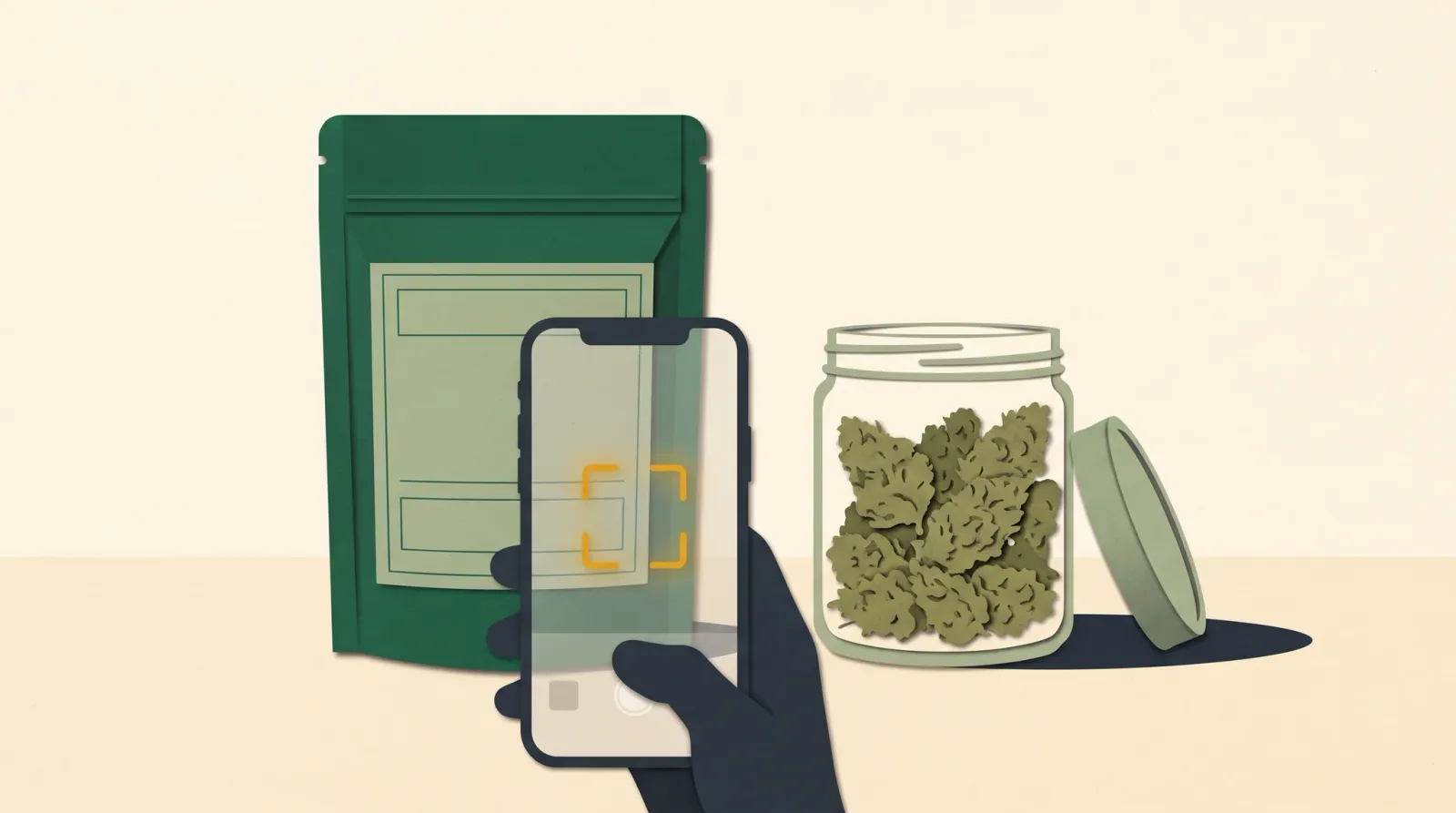
A cannabis label scanner photographs the package, has an AI vision model copy the printed fields into structured data, looks up the printed strain name in a strain database, and sorts any terpene numbers into a High Family. That is the whole trick. It is only as good as the photo it gets and the label it reads.
So here is the line worth sending to a friend: a scanner reads the number on the label, not the number in the jar. In a Colorado purchase study of 277 products from 52 dispensaries, only 56.7% of flower products tested within plus or minus 15% of their labeled THC, against 96.0% of concentrates (Giordano et al., Scientific Reports, 2025). A perfect scan of a flower label still copies whatever the label says.
This lesson in High School walks through what happens between “photo” and “result” in our own label scanner, where its reach ends, and what to check yourself. We describe how the tool is built, from its code. We have no published accuracy measurement for it, so we do not quote one.
Scanner behavior checked against the website code and scan page on October 29, 2026.
How does a cannabis label scanner work, step by step?
It runs five steps in order. Each one can only pass along what the step before it found.
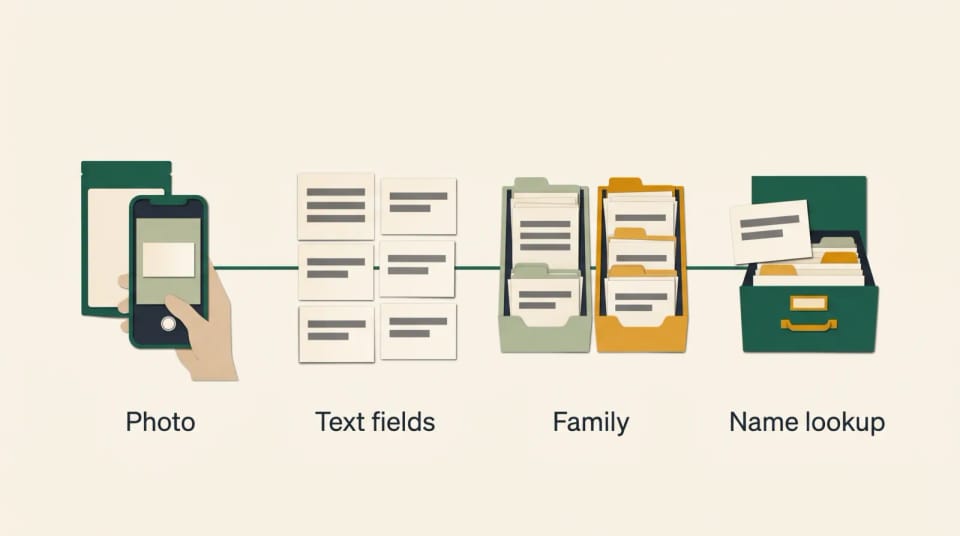
A simplified view: the check that compares several photos of one package is left out. Every stage works on text read from the label, and none of them tests the product.
- Capture. Your browser shrinks the photo to at most 1,920 pixels on its longest side before sending it. One web scan can read up to three photos of the same product, and each photo uses one of the three free daily scans.
- Read. An AI vision model returns named fields: strain or product name, brand, product type, cannabinoids (THC, THCA, total THC, CBD, CBDA, CBG, CBN), each listed terpene, batch or lot number, lab name, test date, harvest and package dates, and dose per serving for edibles. Its instructions say to leave blurred, curved, glared or hidden characters empty, to ignore size words like “EIGHTH” or warning text as a strain name, and never to fill a gap from outside knowledge.
- Reconcile. When you send several photos, the scanner compares them field by field. More on that below, because it is the part most people never see.
- Classify. The terpene and cannabinoid numbers go through the same classifier our strain pages use, which places the product in a High Family.
- Match. The printed name is looked up in our strain database by text. A hit links you to that strain’s page.
After the scan, the photo is not kept. The text read from it is, such as the strain name and its numbers, along with basic device details and a one-way hash of the network address, as the scan page states.
What happens when two photos of the same package disagree?
The scanner leaves that value blank and flags a conflict instead of picking one. If the front of a package says one thing and the lab sticker says another, you see an empty field and a note to review the original labels.
It is stricter about identity. If two photos name a different strain, brand, product or batch number, the scan halts with a message that the labels describe different products or batches. It will not quietly blend two jars into one result.
Terpenes get one extra check. Labels print terpenes as a percent or as milligrams per gram, and 1% equals 10 mg/g. When a label prints both and they do not agree, both values go blank. The overall confidence of a multi-photo scan is the lowest confidence of any single photo, not the average.
Can a label scanner misread a number?
Yes, it can. Telling a model to leave doubtful characters blank is an instruction, not a guarantee. Researchers testing vision-language models on degraded ID cards and invoices found that the models can produce plausible text instead of admitting a character is unreadable (He et al., arXiv, 2025). A “1” and a “7” on a glossy, curved label are exactly that kind of case.
Machine reading of clean printed labels can be very good, but it is not perfect. A study that combined optical character recognition with a language model on plant specimen labels reported 95.4% field-level accuracy on printed labels, with handwritten ones less reliable (Wen, Biodiversity Data Journal, 2026). That is a different tool on a different kind of label, so the figure does not transfer to cannabis packaging. Food-label work points the same way: extraction quality changed with the language and layout of the label (Assiri et al., Journal of Imaging, 2025).
The practical rule follows: check any number you plan to act on against the package itself.
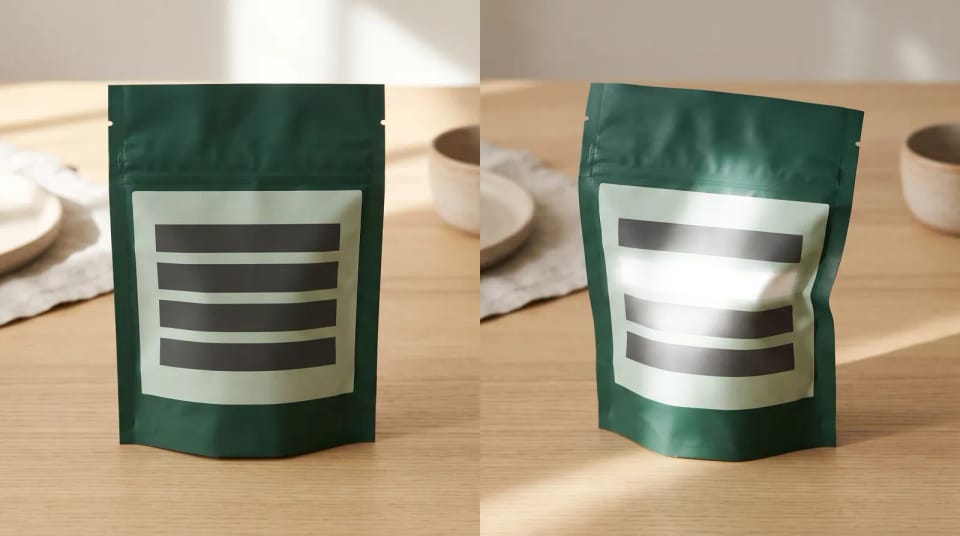
Same label, two photos. The glare on the right hides characters, so those fields can only come back blank.
Does a scan tell you how strong the product really is?
No. It tells you what the label claims. The label’s own number can sit some distance from what is in the jar.
| What the scan reads | What it cannot tell you |
|---|---|
| The THC percent printed on the label | Whether the flower inside matches that percent |
| The batch or lot number | Whether that batch exists, passed testing or was recalled |
| The lab name and test date | Whether the lab report is genuine or still current |
| The printed strain name | Whether the plant has that strain’s genetics |
| Listed terpene values | How the product will feel to you |
The Colorado study above found that measured THC came in lower than labeled for both flower and concentrates (Giordano et al., 2025). A smaller independent re-test of 23 flower samples from 10 Colorado dispensaries found a mean of 14.98% THC, 23.1% below the lowest label values, with about 70% of samples more than 15% below label (Schwabe et al., PLOS ONE, 2023). Both studies come from one state, so treat them as a warning sign, not a national figure. Our article on label THC versus lab results for flower and concentrates goes deeper.
The lab number itself carries uncertainty. In a NIST exercise where many laboratories measured the same plant materials, most labs repeated their own results well, but agreement between different labs mostly fell short of the benchmark criteria, partly because labs used different methods (Phillips and Wilson, NIST IR 8519, 2024). Those samples were low-THC reference materials, not retail flower. For more, see our guide to measurement uncertainty on lab reports.
To check the batch a scan only reads, use matching a COA to the package in your hand and checking recalls by batch or lot number. A scan saves typing. It does not replace either check.
Why does a retail label give a thin result?
Because the scanner can only read what the state requires or the brand chooses to print. California’s regulator lists what a flower label must carry: product identity, net weight, the universal symbol, a unique identifier, licensee details, packaging date and the government warning. Total THC can be added before testing or by the distributor after the batch’s lab results, and any cannabinoid at 5% or more of total cannabinoids gets labeled after testing (California DCC labeling checklist). That checklist does not list a terpene percentage. Other states set their own rules.
That matters for the family step. With a full terpene list, the classifier sorts on the whole profile. With only a dominant terpene and the product type, it uses fewer clues. With only THC and CBD, it has very little to go on. A lab or compliance sticker usually reads best because it lists terpene amounts. Our guide on how to read a cannabis COA explains each section of that sticker.
Is a strain-name match proof of the strain?
No. A match means the printed name matched a name in our database. It does not confirm the same genetics, grower or batch.
The lookup scores the match. An exact name match scores 1.0. A partial match, where one name contains the other, scores 0.85, so a short printed name can resolve to a longer database name that contains it. A label reading “Blue Dream” that resolves to Blue Dream has matched a name, nothing more. Shared words score between 0.5 and 0.85. Below 0.5, the scan reports no match.
Names on labels are market names. A genetic study of 30 strains from dispensaries in three states found that most contained at least one genetic outlier, a sample that did not match the rest of its name (Schwabe and McGlaughlin, Journal of Cannabis Research, 2019). Our lesson on whether strain names match the genetics covers that work, and why the same strain name tests differently explains batch variance.
How does a scan pick a High Family?
It sorts the label’s terpene and cannabinoid numbers, not the “indica” or “sativa” tag. Genome-wide work found that sativa- and indica-labeled samples were not genetically distinct, while the labels tracked a small number of terpenes (Watts et al., Nature Plants, 2021). A German study of 140 medicinal flowers found no link between terpene profiles and the sativa, indica or hybrid labels, and grouped them into terpene clusters instead (Herwig et al., Cannabis and Cannabinoid Research, 2025).
High Families build on that idea. They are a product classification from chemistry. They are not a prediction of how you will feel: the German authors left the link between clusters and effects to future clinical studies. Our explainer on the study behind High Families has the details.
How do you get a clean scan?
Five habits do most of the work.
- Find the panel with the numbers. The lab or compliance sticker usually lists cannabinoids, terpenes, batch number and test date.
- Flatten and light the label. Hold a curved label flat, turn away from overhead lights, and fill the frame with the text.
- Add the other sides of the same package. Front and back help. Do not mix two products or batches in one scan.
- Read the blanks and conflicts. A blank is an unread field, not a zero. A conflict means the photos disagree.
- Check key numbers against the package. THC, terpenes, batch number and test date are worth a second look.
The result also tells you how many of eight common label fields it found. A low count usually means a thin label or a hard photo, not a weak product. If you want to keep scans with your stash and compare how products worked for you over time, the High IQ app adds that with High IQ Pro.
When to talk to a clinician. A scan cannot explain a reaction. If a product made you feel unwell, keep the package and talk to a clinician or a poison control center. For edibles, the scan reports only what is printed; our article on edible milligram labels explains why printed doses can miss.
Sources
- Giordano G, et al. “Accuracy of labeled THC potency across flower and concentrate cannabis products.” Scientific Reports, 2025. PubMed 40592871
- Schwabe AL, et al. “Uncomfortably high: Testing reveals inflated THC potency on retail Cannabis labels.” PLOS ONE, 2023. PubMed 37043421
- Phillips MM, Wilson WB. “Cannabis Laboratory Quality Assurance Program: Exercise 2 Cannabinoid Final Report.” NIST IR 8519, 2024. DOI 10.6028/NIST.IR.8519
- Schwabe AL, McGlaughlin ME. “Genetic tools weed out misconceptions of strain reliability in Cannabis sativa.” Journal of Cannabis Research, 2019. PubMed 33526091
- Watts S, et al. “Cannabis labelling is associated with genetic variation in terpene synthase genes.” Nature Plants, 2021. PubMed 34650264
- Herwig N, et al. “Classification of Cannabis Strains Based on their Chemical Fingerprint.” Cannabis and Cannabinoid Research, 2025. PubMed 39137353
- He Z, et al. “Seeing is Believing? Mitigating OCR Hallucinations in Multimodal Large Language Models.” arXiv, 2025. arXiv 2506.20168
- Wen J. “Automated information extraction from plant specimen labels using OCR and large language models.” Biodiversity Data Journal, 2026. PubMed 41608164
- Assiri FY, et al. “Extract Nutritional Information from Bilingual Food Labels Using Large Language Models.” Journal of Imaging, 2025. PubMed 40863481
- California Department of Cannabis Control. “Labeling requirements: Non-manufactured products in final form.” cannabis.ca.gov
Key takeaways
- A label scanner copies printed text into fields, looks up the name and sorts terpenes into a family.
- It reads the label, not the jar; in one Colorado study, 56.7% of flower tested within 15% of labeled THC.
- Doubtful or conflicting values come back blank; different batches are refused.
- A name match is a text match, not proof of genetics.
- A scan does not verify a COA, a batch, a recall or how a product will feel.
FAQ
Can an app identify a cannabis strain from a photo of the bud?
Our scanner does not try; it reads printed labels only. We found no peer-reviewed validation of identifying a strain from a consumer photo of dried flower. Strain names on labels already vary genetically, so a picture of the bud has even less to anchor it.
Is a cannabis label scan accurate?
It can only be as accurate as the photo and the printed label. Unreadable or conflicting values stay blank, but models can still misread a character. Check any number you plan to rely on against the package.
Is my label photo stored?
No. The photo goes to an AI vision model to read the text and is not kept. The extracted text, basic device details and a one-way hash of the network address are kept, as the scan page states.
Does a scan prove the product was tested or is safe?
No. A scan reads text and does not check a state tracking system or a recall list. Match the COA to your package’s batch and search the official recall list for that.
Is the label scanner free?
Yes, on the website. You get three free scans a day without an account, and each photo uses one scan. Scanning in the High IQ app is part of High IQ Pro.