

How Many Cannabis Strains Are There? Names, DNA and Chemistry Give Different Answers
How many cannabis strains exist depends on what you count: thousands of names, hundreds of distinct genotypes, five genetic clusters, three terpene groups.

Professor High
Written by Professor High, our AI guide. See how we research and correct articles.
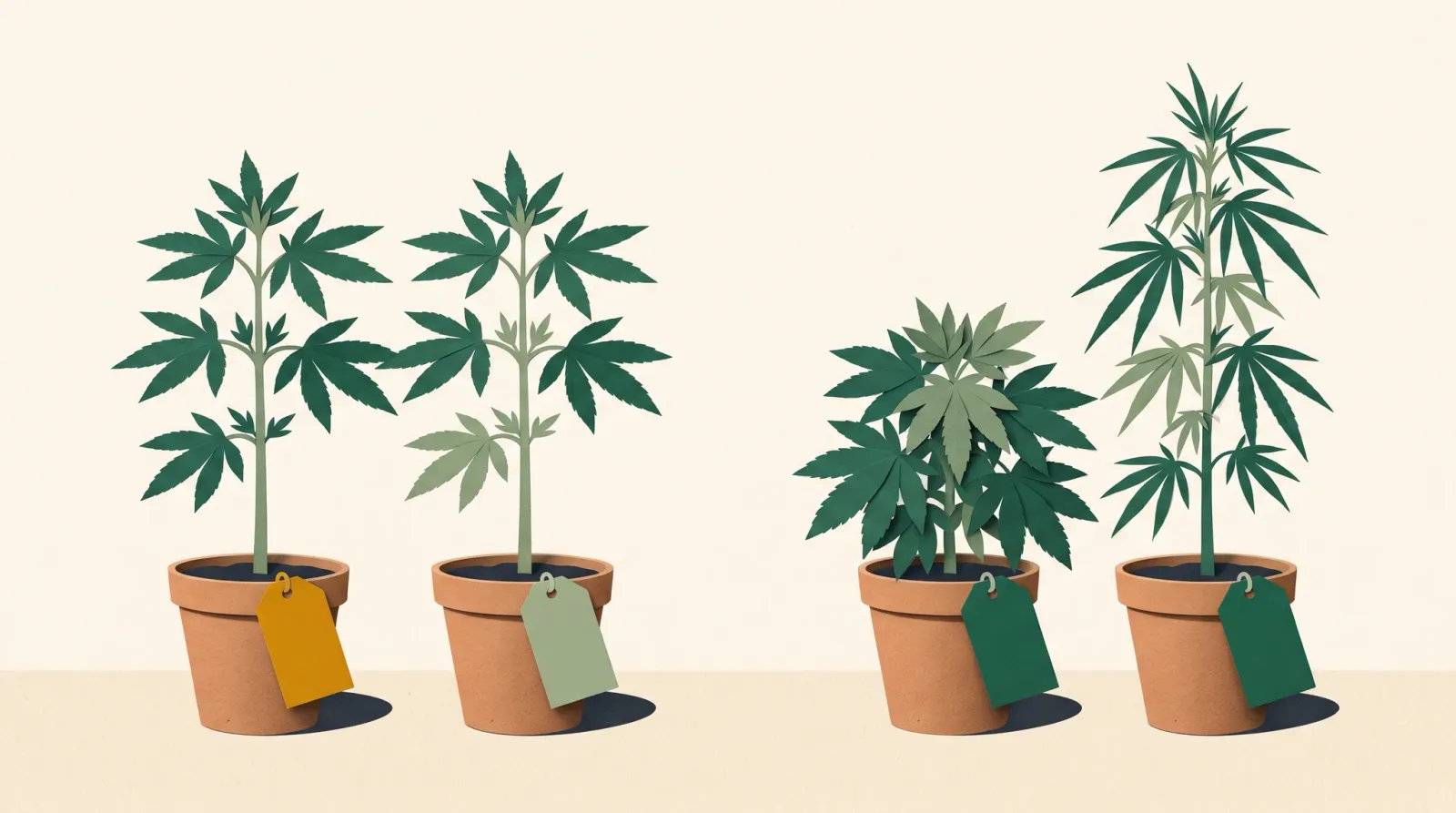
There is no single number, because “strain” is a market name, not a measured unit: one US lab dataset of 89,923 flower samples carried 3,087 cultivar names, a genotyping study of 420 plants found 361 distinct genotypes in five genetic clusters, and lab chemistry sorts THC-dominant flower into three terpene groups. Each figure is accurate. Each one counts something different.
That is why one page tells you “about 700” and another says “thousands”. Nobody keeps an official master list, and the answer moves depending on whether you count names, plants or chemistry.
Here is the whole answer on one screen. We call it the counting ladder.
| What you count | Count | Source |
|---|---|---|
| Strain names on our list | 22,130 (as of 29 October 2026) | Our strain database |
| Names with a researched profile on our list | 3,127 (14 percent) | Our strain database |
| Cultivar names in US lab-test records | 3,087 names in 89,923 samples | Smith et al., PLOS ONE, 2022 |
| Distinct genotypes in a genotyping study | 361 genotypes in 420 samples | Henry et al., Journal of Cannabis Research, 2020 |
| Genetic clusters in that same study | 5 | Henry et al., 2020 |
| Terpene groups in THC-dominant flower | 3 | Smith et al., 2022 |
Read it top to bottom and the number shrinks. That shrink is the real story, but it does not mean the market holds only five or three different plants. It means names, genes and chemistry are three different ways to sort the same jars.
How many cannabis strains are there?
Thousands of names exist, and nobody counts them all. The best peer-reviewed name count we found comes from lab-test records. Researchers pooled 89,923 flower samples from testing labs in six US states, collected between December 2013 and January 2021. “There were 3,087 unique cultivar names represented in the dataset before cleaning.” Smith et al., 2022
Hold that number loosely. It counts standardized name spellings that turned up in lab paperwork, not plants and not products on a shelf today. The data were shared by an industry cannabis information company, and one author works for it (disclosed in the paper). The same paper found that 81.5 percent of samples carried one of the popular names, so a small group of names does most of the selling.
There is also no single referee. The word “strain” is not a botanical unit; breeders, growers and stores apply it. If the vocabulary trips you up, our guide to strain, cultivar, chemotype and chemovar separates the four words. And for where all those names come from, see what strain names actually mean.
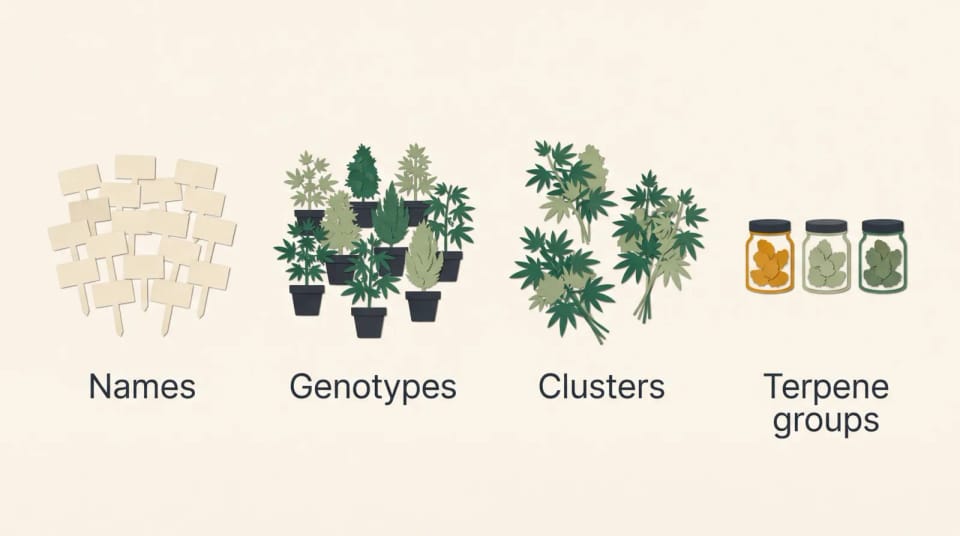
Counting names returns thousands. Counting distinct plants in a study returns hundreds. Sorting by broad genetic or chemical similarity returns a handful. Each count is honest about a different unit.
Why do the numbers you see online disagree?
They disagree because almost no page says what it is counting. The figures readers run into range from “about 700” to several thousand, and the ones we checked named no study or method. A seed catalogue counts what it sells, a strain database counts every name it has ever indexed, and a lab dataset counts names that appear on test reports.
We could not find a peer-reviewed study that counts “700 genetic lineages”, or any published estimate of the total number of cannabis genotypes on the market. Even researchers use round background figures: one 2019 genetics paper opens by mentioning “more than 2000 named strains” without giving a count method. Schwabe and McGlaughlin, 2019
Part of the reason is that nobody verifies names at the source. The same 2019 paper says “currently there is no way to verify the ‘true’ genotype of any strain.” Schwabe and McGlaughlin, 2019 Without a reference sample, a name is whatever the grower says it is.
How many cannabis strains are genetically different?
More than the “only a few genotypes” claim suggests, and fewer than the name count. The largest genotyping set we found tested 420 accessions from licensed cultivators in Saskatchewan, Manitoba, British Columbia and Nevada. The team counted 361 distinct multilocus genotypes, so most samples were genetically different from every other sample. About 59 were genetic repeats of another sample. Henry et al., 2020
The collapse happens one rung up. Those 361 genotypes fell into five broad clusters: industrial hemp, resin hemp, and three THC-resin groups. Other studies find the same pattern of few broad groups:
- A 2015 study of 81 marijuana and 43 hemp samples found two main genetic groups, hemp and marijuana. Sawler et al., PLOS ONE, 2015
- A 2019 study of 122 dispensary samples from 30 strains found two genetic groups that did not match the sativa and indica labels. Schwabe and McGlaughlin, 2019
- A 2021 whole-genome study of 23 strains sold in Canada sorted them into five groups that lined up with cannabinoid type. Jin et al., PLOS ONE, 2021
Two cautions. First, a cluster is a family resemblance, not a single plant. Saying “there are five clusters” is like saying there are a few dog groups; it does not mean there are only five dogs. Second, several of these teams have industry ties. Authors of the Henry and Jin papers hold shares in, work for, or were funded by testing and genetics companies, as their papers disclose. Our article on what the genotyping studies found walks through each study in detail.
How many strains are the same plant under different names?
Some, and nobody knows the total. In the 420-sample study, the authors report that “mislabelled accessions with identical multilocus genotypes were frequently detected.” Their examples include Atomical Haze sharing a genotype with Tangerine Dream, and “UK Cheese” with “Jamaican Ten Speed”. Henry et al., 2020 “Mislabelled” is the authors’ word. The paper does not say which name is the right one, and a 23-marker test resolves clones, not fine family detail.
It also runs the other way. One name can cover different plants. In the 2015 study, in 6 of 17 comparisons a sample looked more like a sample with a different name than like one sharing its own name. Sawler et al., 2015 In the 2019 study, roughly half the strains held a fairly stable genetic identity across most samples, and many others had outliers. Schwabe and McGlaughlin, 2019
So the name count overstates diversity in one direction and hides it in another. That is also why indica and sativa labels fail as a guide: a 2021 study found sativa- and indica-labelled samples were genetically indistinct on a genome-wide scale. Watts et al., Nature Plants, 2021
Does chemistry shrink the count even further?
Yes, at the level of broad groups. In the 89,923-sample lab dataset, 96.5 percent of samples were THC-dominant, 2.2 percent were balanced, and 1.4 percent were CBD-dominant. Among THC-dominant samples with terpene data (42,843 of them), the terpene profiles fell into three main clusters, and two of those clusters held 87.4 percent of the samples. Smith et al., 2022
A Nevada study found something similar on a smaller scale. Across 2,662 medical cannabis samples, three terpenoid groups carried 396 breeder-reported names. A limited genotyping run on representative samples found 12 clades, and the genotypes did not line up with the chemical groups. The authors wrote that the names “imply a false sense of diversity.” Reimann-Philipp et al., Cannabis and Cannabinoid Research, 2020 Those authors are affiliated with a drug developer and a testing lab.
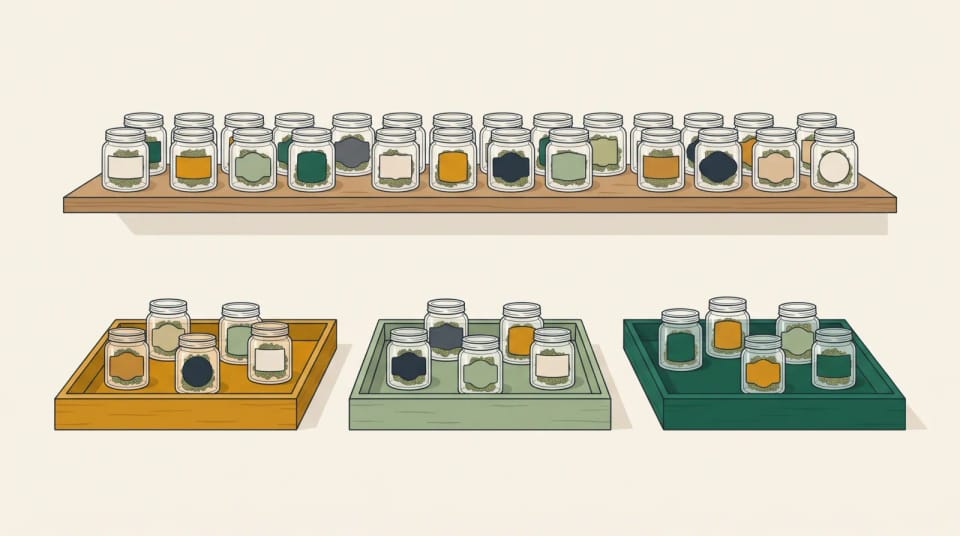
Lab chemistry sorts most THC-dominant flower into three broad terpene groups, and jars with very different names share a group. A shared group does not mean two flowers feel the same.
Keep the evidence boundary in view. These are chemical groupings. They do not show that two flowers in the same group feel the same, and they say nothing about treating any condition. Batch matters too; our guide to batch-to-batch lab variation explains why one name can test differently from harvest to harvest.
How many strains do we list?
As of 29 October 2026, our strain list holds 22,130 names, and 3,127 of them (14 percent) have a researched profile. The rest are placeholders: 2,672 come from an older version of our database, and 16,331 are names found in other public listings that we have not researched yet. These counts come from read-only queries of our own database on that date, and they change daily as our sync and research jobs run.
So “22,130 strains” would be the wrong way to say it. It is 22,130 names, and only the researched profiles carry terpene and cannabinoid data you can compare. Our own alias registry maps 3,880 alternate names onto 1,843 strains, which shows how often one entry goes by several names. Those mappings are name records (nicknames, retired spellings, manual audits), not DNA proof that two names are the same plant.
Our list also labels 2,416 researched strains hybrid, 476 indica and 263 sativa. That is the label the strain carries in the market, and the studies above show those labels do not track genetics. We sort by terpene chemistry in our own High Families classification, which is a product grouping, not a clinical prediction.
Does the count change how you pick a strain?
It changes what you trust. If thousands of names map onto far fewer chemical groups, the name on the jar is the weakest clue you have. The batch’s own lab report is a stronger one: it shows that harvest’s THC and CBD and, when tested, its terpenes. Our guide to why the same strain hits you differently covers the other half: dose, setting and your own body matter as much as the plant.
One practical habit helps. Note what you tried, the batch, and how it went, then compare. The High IQ app lets you log how a strain worked and compare strains side by side, which is easier than remembering a name that may mean a different plant next month.
If a product ever leaves you with chest pain, a racing heart that will not settle, fainting, severe vomiting or confusion, stop and talk to a clinician or call emergency services. No strain count or label tells you how your body will respond.
Key takeaways
- No one number is correct. “How many strains” depends on whether you count names, genotypes, clusters or chemistry.
- One US lab dataset held 3,087 cultivar names; a 420-sample genotyping study found 361 distinct genotypes in five clusters.
- Different names can share a genotype, and one name can cover different plants.
- Chemistry sorts most THC-dominant flower into three terpene groups; that is not an effect prediction.
- Our strain list has 22,130 names and has researched 3,127 of them (as of 29 October 2026).
FAQ
How many weed strains are there in total?
Nobody has a complete count, because there is no official registry and “strain” is a market name. One peer-reviewed analysis of US lab records found 3,087 cultivar names in 89,923 samples. Name lists that pull from many sources run into the tens of thousands, but most of those entries are only names.
How many cannabis strains are genetically unique?
No study has tested the whole market. In the largest genotyping set we found, 361 of 420 samples had distinct genotypes, so most plants were genetically different. Those genotypes still fell into only five broad clusters.
Is there an infinite number of possible strains?
There is no studied upper limit. Every cross between two plants can produce new seedlings, and every keeper can get a new name, so the list can keep growing. The research here counts only what has been sampled.
Who decides what counts as a strain?
Breeders, growers and sellers do, informally. One 2019 genetics paper notes there is currently no way to verify the “true” genotype of a strain, so names are not checked against a reference plant. For the related words, see our guide to strain, cultivar, chemotype and chemovar.
Sources
- Smith CJ, Vergara D, Keegan B, Jikomes N. The phytochemical diversity of commercial Cannabis in the United States. PLOS ONE, 2022.
- Henry P, et al. A single nucleotide polymorphism assay sheds light on the extent and distribution of genetic diversity, population structure and functional basis of key traits in cultivated north American cannabis. Journal of Cannabis Research, 2020.
- Schwabe AL, McGlaughlin ME. Genetic tools weed out misconceptions of strain reliability in Cannabis sativa: implications for a budding industry. Journal of Cannabis Research, 2019.
- Sawler J, et al. The genetic structure of marijuana and hemp. PLOS ONE, 2015.
- Jin D, Henry P, Shan J, Chen J. Classification of cannabis strains in the Canadian market with discriminant analysis of principal components using genome-wide single nucleotide polymorphisms. PLOS ONE, 2021.
- Watts S, et al. Cannabis labelling is associated with genetic variation in terpene synthase genes. Nature Plants, 2021.
- Reimann-Philipp U, et al. Cannabis chemovar nomenclature misrepresents chemical and genetic diversity; survey of variations in chemical profiles and genetic markers in Nevada medical cannabis samples. Cannabis and Cannabinoid Research, 2020.
- Our strain database, read-only counts taken 29 October 2026.



