

Chemotype vs Chemovar vs Strain: Which Word Predicts Your High?
A cannabis chemotype sorts flower by THC and CBD, and a strain is a market name. No study shows any of the four words predicts how you will feel.

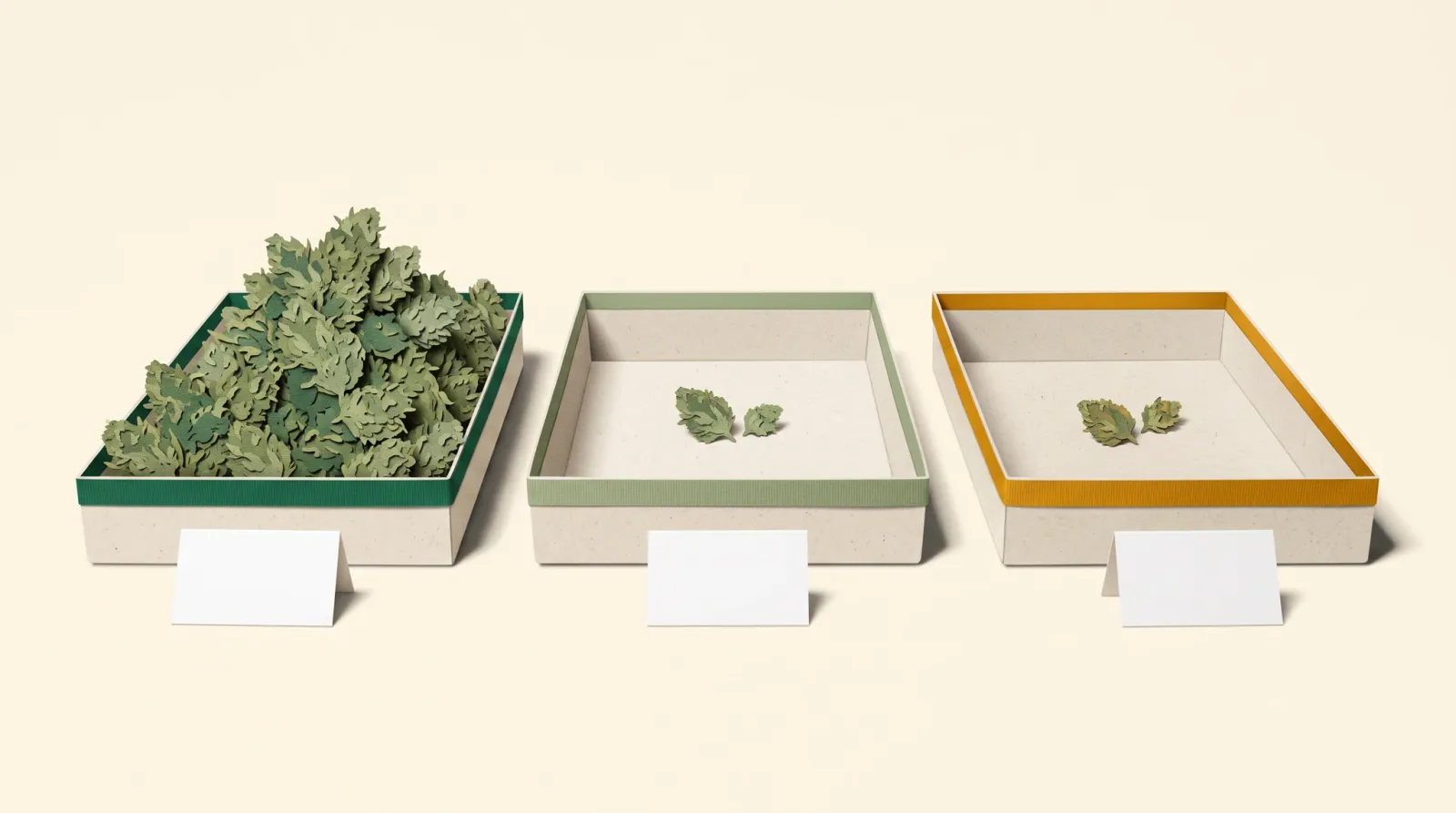
A strain is a market name, a cultivar is a named plant variety kept stable on purpose, a chemotype groups plants by their dominant cannabinoid, and a chemovar usually adds terpenes on top, but no study shows that any of the four words predicts how a product will feel to you. The chemistry words are more honest than the name on the jar. They describe what is in the flower. They do not promise what happens in your head.
Here is the number that settles most arguments. In a large analysis of lab-tested flower from six US states, 96.5 percent of samples were THC-dominant, 2.2 percent were balanced and 1.4 percent were CBD-dominant (Smith et al., 2022). So “just buy by chemotype” puts almost everything on a legal shelf into the same box.
This High School lesson defines the four words from primary sources, shows where scientists use them differently, and then lays out what the trials actually tested.
What is the difference between a strain and a cultivar?
A cultivar is a formal plant category. A strain is the everyday name on the menu.
The International Code of Nomenclature for Cultivated Plants defines a cultivar as a group of plants selected for a particular character that stays distinct, uniform and stable when propagated. Plants from one clone can form a cultivar. The same code says the word “strain” must not be used for “cultivar” when you apply the code (ICNCP, 9th edition, Articles 2.2 and 2.3).
That rule governs formal plant names, not what you say at a dispensary counter. A botanist writing for non-botanists offered a practical middle path. Use proper cultivar names for plants that have a formal description, and call undescribed commercial varieties “strains”, with the note that those names have no taxonomic standing (Pollio, 2016).
The practical gap is uniformity. A formal cultivar must be uniform and stable. A retail name has never been shown to meet that standard:
- A genetic study of 30 named strains from dispensaries in three states found that most strains had at least one genetic outlier (Schwabe and McGlaughlin, 2019).
- In Nevada, 2,662 medical flower samples carried 396 breeder-reported names. Their terpene profiles fell into only three chemical groups (Reimann-Philipp et al., 2020).
For more on the names themselves, read what strain names tell you, why two batches of one strain differ, and what DNA tests of named strains found.
What is a cannabis chemotype?
A chemotype is a group defined by chemistry, not by name or ancestry. In cannabis, the classic scheme sorts plants by the ratio of THC to CBD.
| Chemotype | What leads | Example cut point (one study) |
|---|---|---|
| Type I | THC-dominant | THC at least 5 times CBD |
| Type II | THC and CBD both present | Between the two cut points |
| Type III | CBD-dominant | CBD at least 5 times THC |
| Type IV (proposed) | CBG is the main cannabinoid | Not set in this scheme |
| Type V (proposed) | Little or no cannabinoids | Not set in this scheme |
The cut points in that table come from the six-state analysis (Smith et al., 2022). Other papers draw the lines in different places, so treat them as one example, not a rule. Types IV and V appear as extensions in newer phytochemistry papers (Salamone et al., 2022). Our lesson on chemotype V and the five-type scheme covers the rare end of the list.
The ratio idea is old. A 1973 letter in Nature already described sorting drug and non-drug cannabis by THC and CBD content (Small and Beckstead, 1973).
The same six-state dataset adds a second surprise. Of the samples labelled CBD-dominant, 84.5 percent still had total THC above 0.3 percent, the US hemp line (Smith et al., 2022). That figure covers that dataset only, but it shows that “CBD-dominant” does not mean “THC-free”. If the ratio itself is your question, see choosing a THC to CBD ratio.
What is a chemovar, and how is it different from a chemotype?
A chemovar is a “chemical variety”. Most writers use it for a fuller fingerprint: the main cannabinoids plus the two to four leading terpenes. A 2012 paper framed the shift as moving “from cultivar to chemovar”, after 28 cannabinoids and terpenes sorted samples into distinct chemical groups (Hazekamp and Fischedick, 2012).
Here is the part most definition lists skip. Scientists do not use the two words consistently.
| Paper | Word used | What it named |
|---|---|---|
| Fischedick, 2017 | “terpenoid chemotypes” | Terpene groups across 30 cultivars |
| Lewis, Russo and Smith, 2018 | “Type I, II, III chemovars” | The THC to CBD ratio scheme |
| Reimann-Philipp et al., 2020 | “chemovars” | Three terpene-only groups |
| Herwig et al., 2025 | “chemovars” | Six terpene groups, layered on THC to CBD chemotypes |
So one paper’s chemotype is another paper’s chemovar. The fair summary: chemotype is the older word tied to the cannabinoid ratio, chemovar is the newer word that usually adds terpenes, and the papers sometimes swap them. No single accepted definition of chemovar turned up in the research for this lesson.
The terpene groups in the German chemovar study of 140 flowers are a classification proposal. The authors themselves say that clinically validated effects still need to be mapped onto those groups (Herwig et al., 2025).
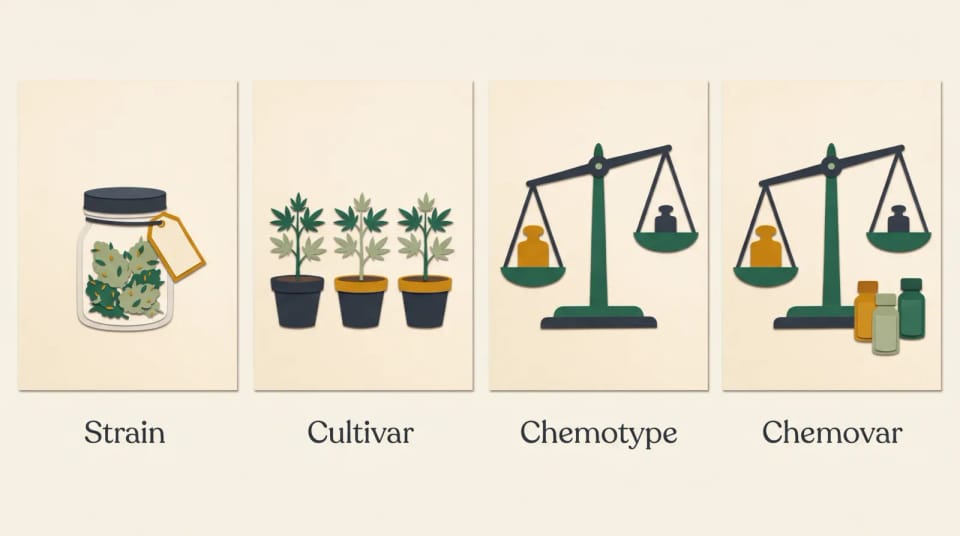
Strain names a product, cultivar names a stable plant variety, chemotype sorts by the THC to CBD balance, and chemovar usually adds the terpene fingerprint. Papers do not always keep the last two apart.
Do chemotypes or chemovars predict effects?
Not in the studies available so far. Some parts of the idea have been tested, and the results do not support using these words to forecast your high.
What controlled trials show
THC drives the acute effects. In placebo-controlled trials, vaporized THC impaired memory and raised the “feel drug effect” rating (Englund et al., 2023; Lawn et al., 2023). That is a finding about THC dose, not about chemotype.
Adding CBD did not reliably change THC’s acute effects. In a double-blind crossover trial with 46 healthy infrequent users, CBD at 1:1, 2:1 and 3:1 CBD to THC did not significantly change THC’s effects on memory, psychotic symptoms, or how pleasurable the cannabis felt (Englund et al., 2023). A second trial in 24 adults and 24 adolescents found no evidence that CBD at 3:1 changed THC’s acute effects (Lawn et al., 2023).
One trial points the other way. In 20 fibromyalgia patients, CBD raised THC blood levels but reduced THC’s pain-relief effect. In the same trial, no variety, whether THC-dominant, balanced or CBD-dominant, beat placebo on the primary pain measures (van de Donk et al., 2019). That null result matters. It means even a head-to-head test of all three classic chemotypes did not show one clearly winning.
A terpene added to THC changed nothing measurable. In a crossover trial with 19 adults, vaporized alpha-pinene had no effect on its own and did not reduce THC’s memory impairment or change other acute effects (Kumar et al., 2025). That is one terpene at a few doses. It does not rule out every terpene, but it is a direct, controlled test of the idea.
These trials were short, single sessions of inhaled cannabis, mostly in healthy volunteers. They say nothing about edibles, long-term use, or other doses and ratios.
What observational studies hint at
Observational studies hint at differences, but they cannot show cause:
- A two-week field study of 101 regular users found small links between a cultivar’s label or primary terpene and reported effects. The terpene and label came from a consumer strain database, not from testing what people actually used, and the authors call it preliminary (Okey et al., 2023).
- An app study of 204 users and 6,309 sessions found that self-reported outcomes differed across five common chemovars. The users chose themselves, there was no control group, and the paper calls itself a proof of concept (Vigil et al., 2023).
A systematic review of 28 reports, published this month, concluded that terpene-effect evidence “remains preliminary” and does not justify terpene-based or label-based prescribing rules (Zoobi et al., 2026). Even the large six-state paper describes chemovars as “hypothesized” to cause distinct effects (Smith et al., 2022).
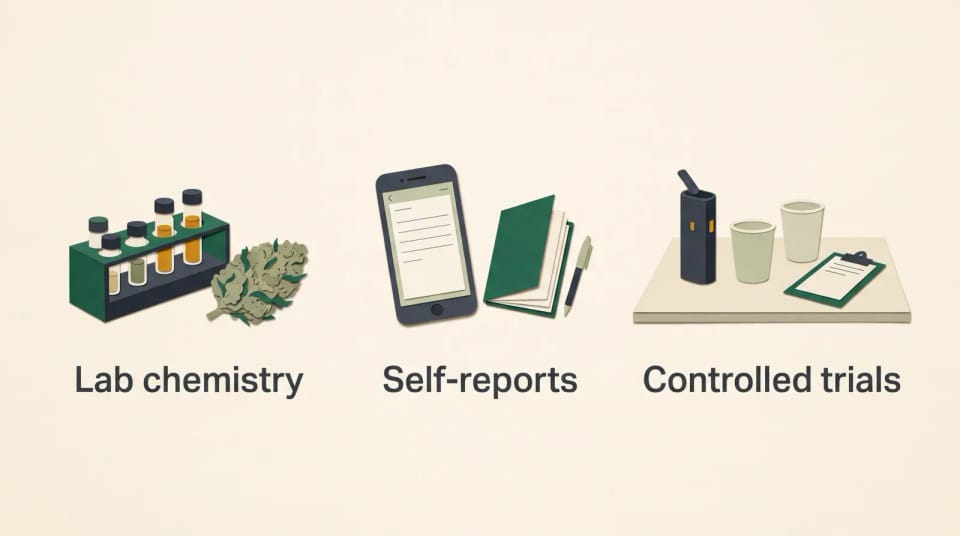
Lab work measures what is in the flower. Self-report studies hint at patterns. The few controlled trials found THC drives the acute effects, while added CBD or pinene did not reliably change them.
So which word should you use?
Use the word that matches what you actually know.
- Say “strain” when you mean the name on the menu. It is the shopping word, and that is fine.
- Say “cultivar” only when you mean a formally described, stable plant variety, or a clone line a grower keeps on purpose.
- Say “chemotype” when you know the THC to CBD balance from a lab result.
- Say “chemovar” when you also know the leading terpenes, and say which definition you mean.
The chemistry words beat the name because they come from a measurement of the batch in your hand. That is why the indica and sativa labels fail and lab numbers do better. Just do not turn a better description into a promise about your experience. High School groups products by terpene chemistry with High Families, and that is a way to sort products, not a forecast of what you will feel.
How do I find a product’s chemotype and chemovar?
You can read both off a lab report in a few minutes.
- Find total THC and total CBD. Use the totals on the package or the certificate of analysis, not only the THCA or CBDA line.
- Work out the ratio. Divide the larger total by the smaller one. That tells you whether THC or CBD leads, or whether they sit close together.
- Note the top terpenes. Write down the two or three terpenes with the highest values. Our guide on how to read a terpene panel explains the names.
- Record how it went. Write down the product, the batch, how much you took and how you felt. Over time, your own notes are the only test of whether a fingerprint suits you. The High IQ app can hold those notes and compare two strains side by side.
To go one step further, see how to compare cannabis products beyond THC percentage.
If cannabis of any chemotype brings on a racing heart, chest pain, panic, confusion or symptoms that do not settle, talk to a clinician. The same applies before you use cannabis for a health condition or alongside other medicines.
Key takeaways
- A strain is a market name; a cultivar is a formal, stable plant variety under the plant-naming code.
- A chemotype sorts by the THC to CBD balance; a chemovar usually adds terpenes, but papers swap the two words.
- In one six-state dataset, 96.5 percent of lab-tested flower was THC-dominant, so the three-box scheme barely separates what is sold.
- Controlled trials show THC drives acute effects; added CBD or pinene did not reliably change them.
- No study shows that any of the four words predicts how a product will feel to you.
FAQ
What are the three chemotypes of cannabis?
Type I is THC-dominant, Type II has THC and CBD in similar amounts, and Type III is CBD-dominant. Newer papers propose Type IV, led by CBG, and Type V, with little or no cannabinoids. The exact cut points between types differ from paper to paper.
Is a chemovar the same as a strain?
No. A strain is a name, and the same name can hold different chemistry from batch to batch. A chemovar is defined by measured chemistry, usually the main cannabinoids plus the leading terpenes. In one Nevada dataset, 396 names collapsed into just three terpene groups.
Is “strain” the wrong word for cannabis?
For everyday shopping, no. The plant-naming code bars “strain” as a synonym for “cultivar” in formal plant names, and one botanist suggests keeping “strain” for undescribed commercial varieties. That is a rule about formal naming, not about what you say at the counter.
What is the difference between phenotype, genotype and chemotype?
Genotype is a plant’s genetic makeup. Phenotype is what you can observe in the grown plant, which depends on genes and growing conditions. Chemotype is the slice of phenotype that describes chemistry, classically the THC to CBD balance.
Can a chemovar tell me how a product will feel?
Not reliably. Controlled trials found that THC drives the acute effects, while added CBD or pinene did not reliably change them. Studies linking chemovars to effects are observational and preliminary, so treat a chemovar as a description of the flower, not a forecast.
Sources
- International Code of Nomenclature for Cultivated Plants, 9th edition, 2016. International Society for Horticultural Science, Scripta Horticulturae 18. ISHS PDF
- Pollio A. (2016). The name of Cannabis: a short guide for nonbotanists. Cannabis and Cannabinoid Research, 1(1), 234-238. PubMed doi:10.1089/can.2016.0027
- Small E, Beckstead HD. (1973). Cannabinoid phenotypes in Cannabis sativa. Nature, 245, 147-148. Nature doi:10.1038/245147a0
- Lewis MA, Russo EB, Smith KM. (2018). Pharmacological foundations of cannabis chemovars. Planta Medica, 84(4), 225-233. PubMed doi:10.1055/s-0043-122240
- Smith CJ, Vergara D, Keegan B, Jikomes N. (2022). The phytochemical diversity of commercial Cannabis in the United States. PLoS ONE, 17(5), e0267498. PMC doi:10.1371/journal.pone.0267498
- Herwig N, Utgenannt S, Nickl F, et al. (2025). Classification of cannabis strains based on their chemical fingerprint: a broad analysis of chemovars in the German market. Cannabis and Cannabinoid Research, 10(3), 409-419. PubMed doi:10.1089/can.2024.0127
- Reimann-Philipp U, Speck M, Orser C, et al. (2020). Cannabis chemovar nomenclature misrepresents chemical and genetic diversity. Cannabis and Cannabinoid Research, 5(3), 215-230. PubMed doi:10.1089/can.2018.0063
- Fischedick JT. (2017). Identification of terpenoid chemotypes among high (-)-trans-delta9-tetrahydrocannabinol-producing Cannabis sativa L. cultivars. Cannabis and Cannabinoid Research, 2(1), 34-47. PubMed doi:10.1089/can.2016.0040
- Salamone S, Waltl L, Pompignan A, et al. (2022). Phytochemical characterization of Cannabis sativa L. chemotype V. Plants, 11(16), 2130. PMC doi:10.3390/plants11162130
- Englund A, Oliver D, Chesney E, et al. (2023). Does cannabidiol make cannabis safer? A randomised, double-blind, cross-over trial of cannabis with four different CBD:THC ratios. Neuropsychopharmacology, 48(6), 869-876. PubMed doi:10.1038/s41386-022-01478-z
- van de Donk T, Niesters M, Kowal MA, et al. (2019). An experimental randomized study on the analgesic effects of pharmaceutical-grade cannabis in chronic pain patients with fibromyalgia. Pain, 160(4), 860-869. PubMed doi:10.1097/j.pain.0000000000001464
- Kumar L, Spindle TR, Zamarripa CA, et al. (2025). The individual and interactive effects of alpha-pinene and delta-9-tetrahydrocannabinol in healthy adults. Medical Cannabis and Cannabinoids, 8(1), 144-157. PubMed doi:10.1159/000547014
- Lawn W, Trinci K, Mokrysz C, et al. (2023). The acute effects of cannabis with and without cannabidiol in adults and adolescents. Addiction, 118(7), 1282-1294. PubMed doi:10.1111/add.16154
- Okey SA, Waddell JT, Shah RV, et al. (2023). An ecological examination of indica versus sativa and primary terpenes on the subjective effects of smoked cannabis. Cannabis and Cannabinoid Research, 8(5), 857-866. PubMed doi:10.1089/can.2022.0213
- Zoobi G, Marco M, Foraida KJ, Tandon S, Zhornitsky S. (2026). Do consumer-facing “Indica,” “Sativa,” and “Hybrid” labels predict cannabis composition or effects? A systematic review. Journal of Cannabis Research. Springer doi:10.1186/s42238-026-00528-3
- Vigil JM, Stith SS, Brockelman F, Keeling K, Hall B. (2023). Systematic combinations of major cannabinoid and terpene contents in Cannabis flower and patient outcomes. Journal of Cannabis Research, 5(1), 4. PubMed doi:10.1186/s42238-022-00170-9
- Schwabe AL, McGlaughlin ME. (2019). Genetic tools weed out misconceptions of strain reliability in Cannabis sativa. Journal of Cannabis Research, 1(1), 3. PubMed doi:10.1186/s42238-019-0001-1
- Hazekamp A, Fischedick JT. (2012). Cannabis: from cultivar to chemovar. Drug Testing and Analysis, 4(7-8), 660-667. PubMed doi:10.1002/dta.407





