

How to Spot Counterfeit THC Edibles and Copycat Candy Packaging
Fake THC edibles give themselves away by copying snack brands and by where they are sold. Symbols, holograms and QR codes are easy to fake. Here is what works.

Professor High
Written by Professor High, our AI guide. See how we research and correct articles.
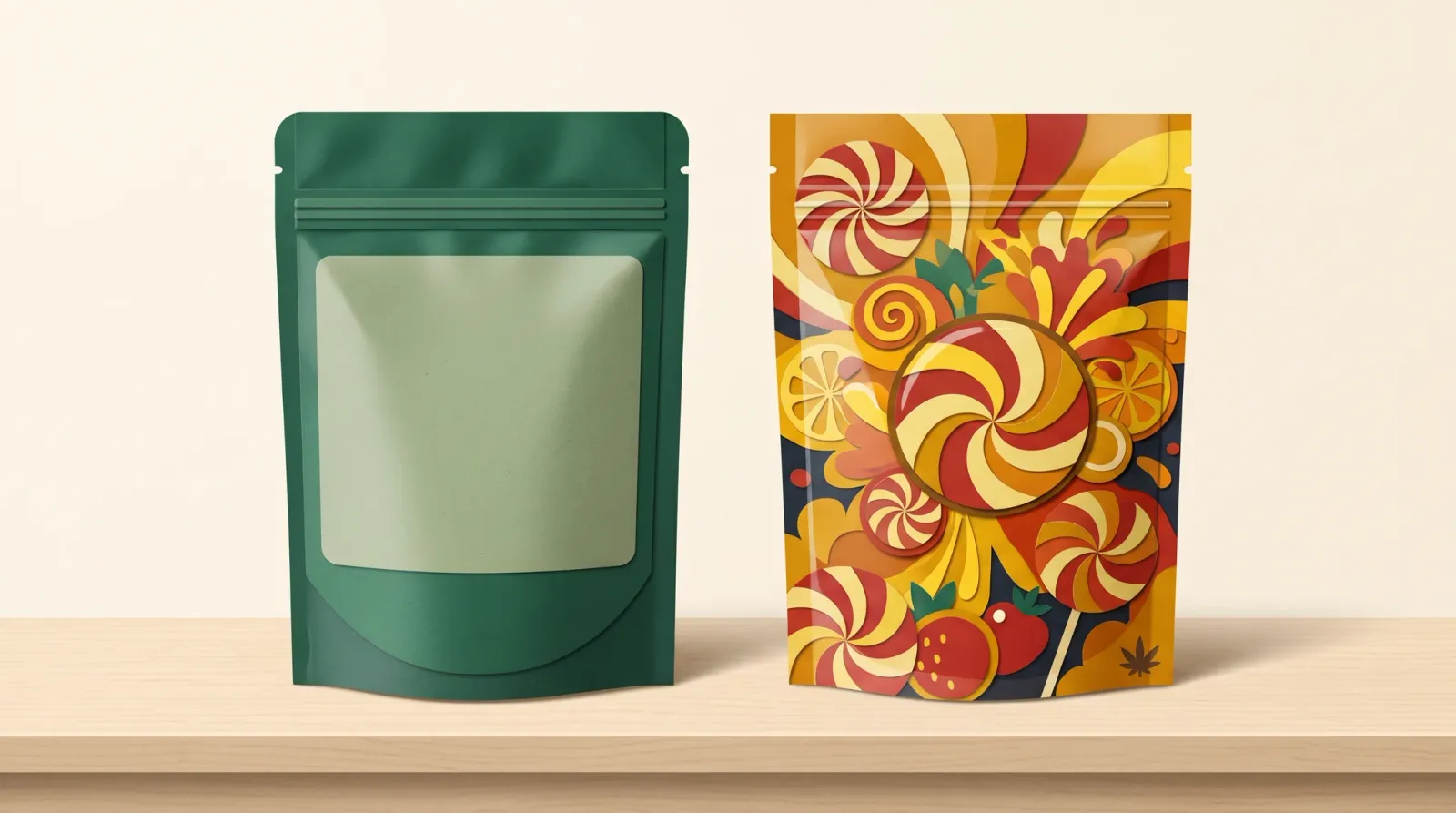
You spot a fake THC edible first by whether the package imitates a snack brand and by where you bought it, because no food company sells THC and a forged symbol, hologram or QR code costs a counterfeiter almost nothing. The label details still matter, but they come second. A complete-looking label tells you a product could be legal; it cannot tell you it is.
Here is the line worth sending to a friend. The California Attorney General put it plainly: “no major candy or food companies manufacture or sell cannabis or CBD products.” So a THC gummy dressed as a famous candy is a copycat by definition. And the state symbol is not proof either: in one 2024 Los Angeles operation, California seized 2,279,900 illicit packages already printed with the universal cannabis symbol, many of them styled as children’s candy.
This High School guide covers the checks that hold up, the ones that do not, and what the lab data show is inside seized fakes. Label rules below are California’s, read from the state regulator’s site on October 29, 2026. Other states differ, so check your own regulator.
What counts as a fake THC edible?
“Fake” covers three different problems, and each one needs a different check.
| Problem | What it looks like | The tell that works |
|---|---|---|
| Licensed product | A plain, regulated package with your state’s required label | It came from a verified licensed seller, and the batch matches its lab report |
| Copycat or lookalike | THC edible styled as a real candy, chip or cereal brand | The food-brand imitation itself; no food company sells THC |
| Counterfeit of a cannabis brand | A copy of a real licensed cannabis brand’s package | Where it was sold, plus a batch and lab report that do not line up |
Copycats get the most attention because they look like snacks. In a 2022 study of 731 cannabis product photos, researchers found 13 unique copycat or lookalike edibles. The packages copied an average of 3.9 out of 6 brand features, such as the name, logo and colors, and some used the snack’s exact name. The cannabis signals were there but subtle. The sample was a convenience sample, so it does not tell you how common fakes are.
Counterfeits of real cannabis brands are harder. They copy a package that is already legal, so the snack test does not catch them. That is where the seller and the batch check do the work.
Which signs actually give a fake edible away?
The strongest signs are about imitation and source, not about print quality. Rank your checks in this order.
- It looks like a snack you know. California law bars licensed cannabis packaging from imitating candy or snack packaging, and bars edibles shaped like people, animals, insects or fruit. California DCC guidance So in California, a licensed edible should never look like a candy bar.
- It was sold somewhere unlicensed. The Attorney General says lookalikes are sold mainly online and at unlicensed shops. California AG alert Some stores that look legitimate are not licensed, which is why California tells buyers to check the license before buying.
- The cannabis wording is tucked onto a food design. Words like “medicated”, “THC” or “keep out of reach of children and animals”, or a small leaf image, on a snack-style bag point to a copycat. California AG alert
- The label is missing required parts. In a 2025 New York study by Becker and colleagues, comparing licensed and unlicensed products, unlicensed packages carried fewer essential label details and safety features, and often used another state’s symbol. That study covered flower and vapes, not edibles, but the pattern is worth knowing.
- The brand name is misspelled. UK police described a seized gummy bag that copied a popular pastille pack with a misspelled name and a cannabis leaf on it. BBC News
A further warning sign is a dose far above your state’s limits. The 2022 copycat study found packages listing an average of 459 mg of THC per package, well above California’s 100 mg package limit. Ompad et al., 2022
Can you trust the THC symbol, hologram or QR code?
No. Each one helps rule a product out when it is missing, but none proves a product is real.
The universal symbol is the clearest case. California’s 2024 seizure was packaging already marked with the symbol, and the state says only licensees, or businesses with invoices from a licensee, may legally store or sell that packaging. Governor’s office release Blank branded bags are also bought online; a University of Bath researcher told the BBC that copycat packaging comes from online providers. BBC News Our guide to what the THC symbol does and does not prove covers the symbol rules state by state.
QR codes cannot replace required label text in California. DCC labeling checklist A code can point anywhere its printer chooses, so scan it as a lead, then confirm the lab and batch on your own.
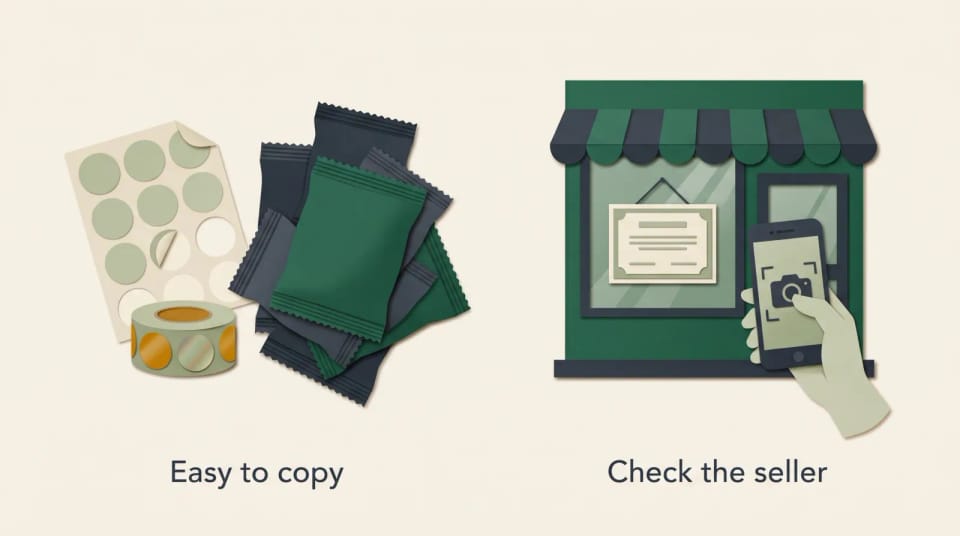
Symbols, seals and printed bags can be bought in bulk. A license you can verify with your state regulator is much harder to fake.
What does a licensed edible label show in California?
A licensed California edible label carries a fixed set of elements. Use them as a minimum: a missing element is a red flag, but a counterfeiter can print every one of them.
According to the DCC final-form labeling checklist, the label shows:
- The universal symbol, at least half an inch, on the main panel
- “Cannabis-Infused” above the product name
- THC and CBD in milligrams per package and per serving
- The manufacturer named on its license, with a phone number or website
- The packaging date and the government warning statement
- A UID number and a batch or lot number
- Ingredients, allergens and nutrition facts
Edibles must also come in opaque packaging, and California packaging must be child-resistant, tamper-evident and resealable. Governor’s office release For what that child-resistance test measures, see what child-resistant packaging actually tests.
Does a matching COA prove an edible is real?
No. A batch that matches its lab report is necessary, not sufficient. A missing batch number, or a lab report for a different batch, disqualifies the product. A match only removes one way it could be fake.
The full steps live in our guide on how to match a COA to the package in your hand, and how to read cannabis lab results explains the report itself. The short version: find the report through the lab, not only through a link on the package, and check that the batch number and product type agree. Forged lab reports are documented for carts in our guide to spotting a counterfeit vape cart, which uses the same source-first logic.
What is actually inside fake edibles?
The best lab evidence comes from the UK, where THC edibles are illegal. A 2026 study in Addiction tested 79 edibles from 31 products seized by two UK police forces in 2024. Of 24 uniquely designed products, 19 imitated popular sweet brands.
The labels were mostly wrong. Of 68 edibles that claimed a dose, 65 held less than 55% of it. Items labelled 75 mg held between 6.07 and 29.22 mg. In 8 of 25 packs, the dose differed by more than 5 mg between pieces from the same pack. One product held no THC at all, but a synthetic cannabinoid, MDMB-4en-PINACA, at a mean of 11.27 mg per edible.
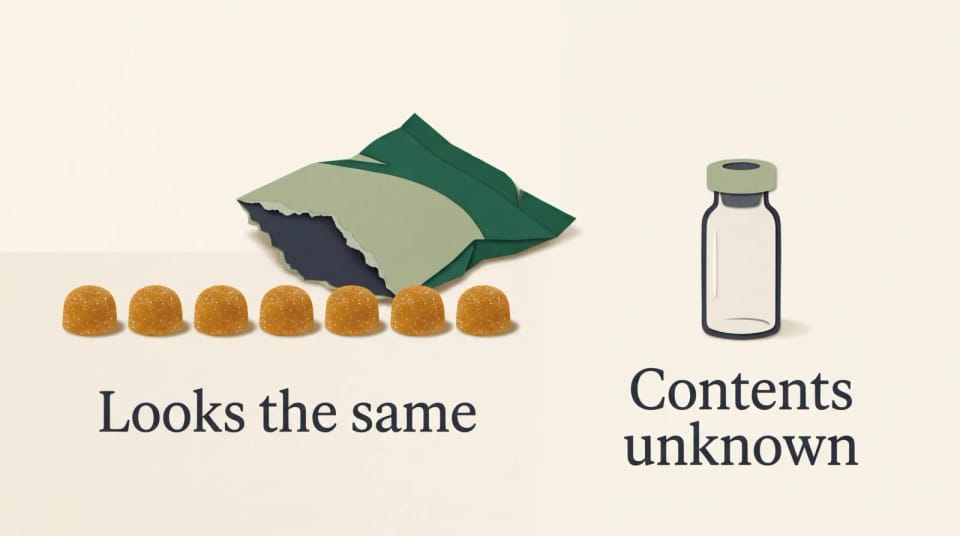
In UK police seizures, pieces from the same pack sometimes differed by more than 5 mg of THC, and one product held a synthetic cannabinoid instead of THC.
Keep three limits in mind. This was a convenience sample from two UK police forces, so it is not a rate for any market. Only one of 31 products held a synthetic cannabinoid, so copycats do not usually contain one. And the figures describe seized illicit products, not US licensed edibles, whose own variation is a separate topic covered in why even a licensed edible’s milligrams vary.
Why does a synthetic cannabinoid matter? It is a different drug, not a stronger version of THC, and our explainer on why a synthetic cannabinoid is a different drug walks through how it acts at the same receptor. That mechanism does not predict the effect of any one gummy. It does show why a THC label cannot warn you about what is really inside.
Are delta-8 and hemp gummies fake?
Not by default. Hemp-derived THC snacks sold at gas stations and smoke shops sit in a separate legal category, and their status depends on federal and state law. See where delta-8 stands legally.
Copycats exist there too. By August 2024, the FDA and FTC had sent warning letters to 11 companies selling copycat delta-8 food products. FDA Update, 2024 The same rule applies: a hemp gummy dressed as a famous snack is still a copycat.
What should you do if you already have one?
Do not eat it. Put it where children and pets cannot reach it, and report the seller. In California, you can file a complaint with DCC against licensed or unlicensed businesses. DCC consumer page
If a child may have eaten one, the FDA advises calling Poison Control at 1-800-222-1222, or 911 for serious effects, and not waiting for symptoms. FDA advisory No antidote is approved for THC intoxication. FDA Update, 2024 Our guide on what parents need to know about child exposure covers storage and prevention.
When to talk to a clinician: if an adult who ate an unknown edible has chest pain, a racing heart, confusion, vomiting that will not stop, seizures or trouble breathing, get medical help right away and bring the package. Unknown products can contain unexpected drugs, and a clinician can only work with what they know. For context on emergency visits, see what the ER data show about edible overdoses.
If you use the High IQ app to scan a label, treat the result the same way as a QR code: it helps you read the package, but it cannot authenticate it.
Sources
- Ompad DC, Snyder KM, Sandh S, et al. “Copycat and lookalike edible cannabis product packaging in the United States.” Drug and Alcohol Dependence 235:109409. 2022. PMC9106923
- Gardner M, Proctor K, Old M, et al. “Identification and quantification of delta-9-THC and the synthetic cannabinoid MDMB-4en-PINACA in edible products seized by United Kingdom police in 2024.” Addiction. 2026. PubMed 42866963
- Becker TD, Menzi PJ, Olfson M, et al. “Labeling of Cannabis Products From Licensed and Unlicensed Retailers in New York.” American Journal of Preventive Medicine. 2025. doi.org
- US Food and Drug Administration. “FDA Warns Consumers About the Accidental Ingestion by Children of Food Products Containing THC.” Updated June 16, 2022. fda.gov
- US Food and Drug Administration. “FDA, FTC warn of risks to children from copycat food products containing delta-8 THC.” FDA Update, October 1, 2024. fda.gov
- California Attorney General. “Cannabis-Infused Edibles Packaged as Popular Food and Candy Products Are Unsafe and Illegal.” October 28, 2021. oag.ca.gov
- Office of the Governor of California. “California seizes over 2.2 million illicit cannabis packages, many marketed as children’s candy.” August 13, 2024. gov.ca.gov
- California Department of Cannabis Control. “Cannabis products that are attractive to children are prohibited.” Accessed October 29, 2026. cannabis.ca.gov
- California Department of Cannabis Control. “Labeling requirements: Manufactured cannabis products in final form.” Revised June 6, 2024. cannabis.ca.gov
- California Department of Cannabis Control. “What’s legal.” Accessed October 29, 2026. cannabis.ca.gov
- Robertson K. “The cannabis-laced gummies with fake packaging.” BBC News, July 28, 2026. bbc.com
Key takeaways
- A THC edible that copies a snack brand is a copycat; no food company sells THC.
- Where you bought it matters more than how the package looks. Verify the seller’s license.
- Symbols, holograms and QR codes help rule products out, but none proves a product is real.
- A batch that matches its lab report is necessary, not sufficient.
- Seized UK fakes rarely matched their labels, and one held a synthetic cannabinoid.
FAQ
How can I tell if a THC gummy is real?
Start with the seller: buy only from a retailer you can find in your state regulator’s license lookup. Then check that the package does not copy a snack brand, that it carries your state’s required label elements, and that the batch number matches a lab report. No single check proves a gummy is real; together they rule out the common fakes.
Are fake edibles dangerous?
They can be, because you cannot know the dose or the drug. In UK police seizures, most edibles held far less THC than labelled, doses varied within the same pack, and one product held a synthetic cannabinoid instead. Copycats styled as candy also put children at risk of eating them by mistake.
Does a QR code or COA prove an edible is legit?
No. A QR code can link anywhere, and California does not let it replace required label text. A COA helps only when you find it through the lab and its batch number matches the package; a mismatch disqualifies the product, but a match does not prove it is genuine.
What should I do if my child ate a THC gummy?
Call Poison Control at 1-800-222-1222 right away, or 911 if the child has serious symptoms, and do not wait for symptoms to appear. Keep the package to show responders. The FDA notes that no antidote is approved for THC intoxication.
How do I report copycat edibles?
Report them to your state cannabis regulator. In California, DCC takes complaints about licensed and unlicensed businesses, and the Attorney General’s office also accepts consumer complaints. Note where you bought the product and keep the package and receipt.



