

How to Tell If Weed Is Laced: What Lab Testing Actually Found
You can't tell if weed is laced by looking or smelling. Lab tests of 118 seized flower samples found no fentanyl, but cocaine traces in one in five.

Professor High
Written by Professor High, our AI guide. See how we research and correct articles.
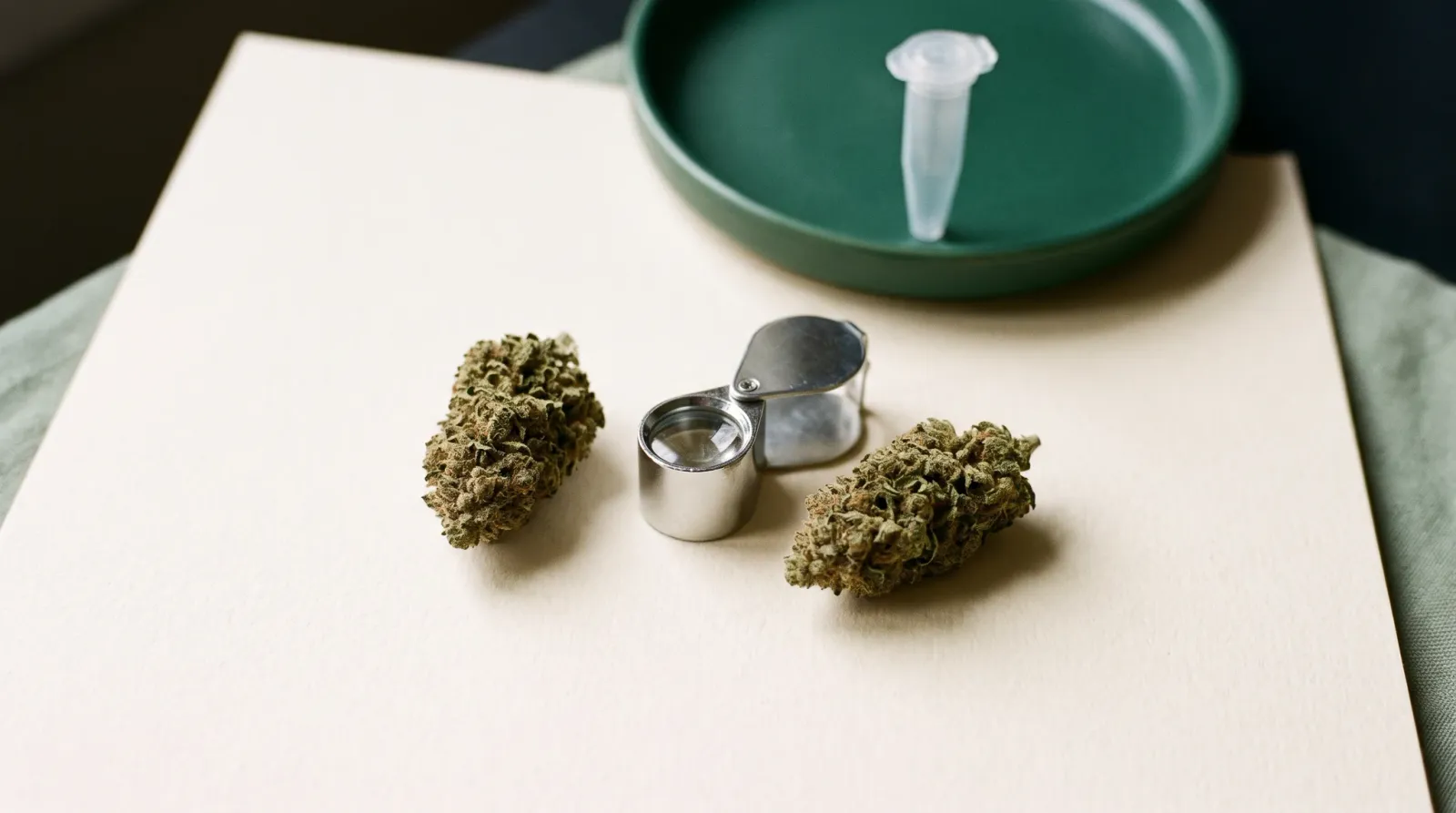
You cannot tell if weed is laced by looking at it, smelling it or smoking it; only a laboratory test can, and the lab data we have show fentanyl in flower is rare. When researchers tested 118 seized illicit-market flower samples from Arizona and California for 16 drugs, none contained fentanyl. About one in five carried traces of cocaine, most likely from dirty scales and packing tables. Andersano et al., J Forensic Sci 2026
That is the number to send the next time someone forwards a “fentanyl weed” warning: 0 of 118 for fentanyl, 24 of 118 for cocaine, 4 of 118 for methamphetamine. The one lab-confirmed fentanyl-in-cannabis case officials keep citing, Connecticut in 2021, was a single sample that the regional drug task force later judged accidental cross-contamination. NBC Connecticut, 2022
Rare is not zero, and illicit flower has real contamination problems. They just are not the ones the scary checklists describe. Here in High School, let’s sort what is confirmed from what is rumored.
What does laced weed look like?
It looks like ordinary weed. No source we reviewed shows that fentanyl, cocaine or methamphetamine on flower can be spotted by eye, nose or texture. In the Arizona and California study, the median cocaine level was 133 parts per million, a trace amount spread across a sticky, frosty plant. J Forensic Sci 2026
The “white specks mean fentanyl” claim has no lab study behind it. White specks on a bud are usually trichomes, mineral residue or mold. Our guide to telling mold from trichomes covers that visual check properly, and the cannabis quality inspection guide explains what smell and cure can and cannot tell you. Those checks catch spoiled weed. They do not catch lacing.
Effects are not a reliable test either. Feeling “too high” has many ordinary causes: a stronger batch, an empty stomach, a big edible. And if a contaminant does change how you feel, you have already used it.
Is fentanyl-laced weed real?
There is one lab-confirmed case on record in public reporting, and it was judged unintentional. In late 2021, Connecticut public health officials reported naloxone-reversed overdoses in people who said they had smoked only marijuana. One sample from a scene in Plymouth tested positive for THC and fentanyl at the state forensic lab, which officials called “possibly the first confirmed case in the United States.” CT-ORS bulletin, 2021
The follow-up told a different story. That sample was the only cannabis sample positive for fentanyl in five months of police submissions. Investigators judged it cross-contaminated through shared equipment, not deliberately laced. Of the 39 overdoses first linked to it, 30 involved people with a history of opioid use. NBC Connecticut
That does not make the Connecticut case a hoax. The sample was real. What was never proven is that fentanyl-laced weed caused that wave of overdoses.
National seizure data point the same way. US forensic labs analyzed nearly 12 million drug samples from 2013 to 2023. Fentanyl turned up with cannabinoids in under half a percent of them (0.4 percent in 2023). It turned up with heroin about half the time. Lim et al., Lancet Reg Health Am 2024
Confirmed versus rumored cases
| Case | What a lab confirmed | What was not confirmed | Status |
|---|---|---|---|
| Connecticut, 2021 | One cannabis sample with fentanyl | That it caused the overdoses; it was the only positive in five months | Confirmed, isolated, judged accidental |
| Michigan, 2021 | Nothing; eight “suspected” cases from EMS records | Any product testing (Wayne State alert) | Suspected only |
| Single-patient case reports | Fentanyl in a patient’s urine or blood after reporting only cannabis (JAPhA 2020, Cureus 2023) | That the cannabis itself contained fentanyl | Exposure confirmed, source unproven |
| Illinois, 2018 | Rat poison (brodifacoum) in patients’ blood | Not cannabis flower; the products were synthetic cannabinoids | Confirmed, different product |
| Arizona and California seizures, 2023 to 2024 | 0 fentanyl, 24 cocaine, 4 methamphetamine, 1 MDMA in 118 samples | Whether any of it was deliberate; markets elsewhere | Confirmed contamination, no fentanyl |
The case reports matter. In one, a man in opioid treatment kept testing positive for fentanyl until he changed his cannabis source. The authors noted there is “no systematic monitoring or reliable data on its frequency.” Hopwood et al., 2020 That is the honest position: possible, documented in individual cases, and rare in the testing that exists.
What can weed actually be laced with?
The contaminants that show up in lab tests are mostly not the ones in the warnings. In the 2026 seizure study, cocaine was the most common illicit drug, followed by methamphetamine and one MDMA hit. The authors blame most of it on dirty scales and packing tables. They think deliberate spiking is rare. One sample, at 1.2 percent cocaine by weight, may have been on purpose. At the median level, half a gram of flower holds about 0.065 mg of cocaine. The authors put that more than a hundred times below the lowest dose they cite with an observed effect. J Forensic Sci 2026
The bigger documented problem is farm chemistry. Health Canada scientists compared 50 legal and 50 illegal-market flower samples. Pesticides turned up in 94 percent of the illegal samples, often several at once, compared with trace levels in 2 percent of legal ones. Yeast and mold exceeded limits in 73 percent of illegal samples, and mycotoxins appeared in 12 percent of illegal samples and none of the legal ones. Fiering et al., J Cannabis Res 2026 Our explainer on reading pesticide results on a COA shows where those numbers live on a lab report.
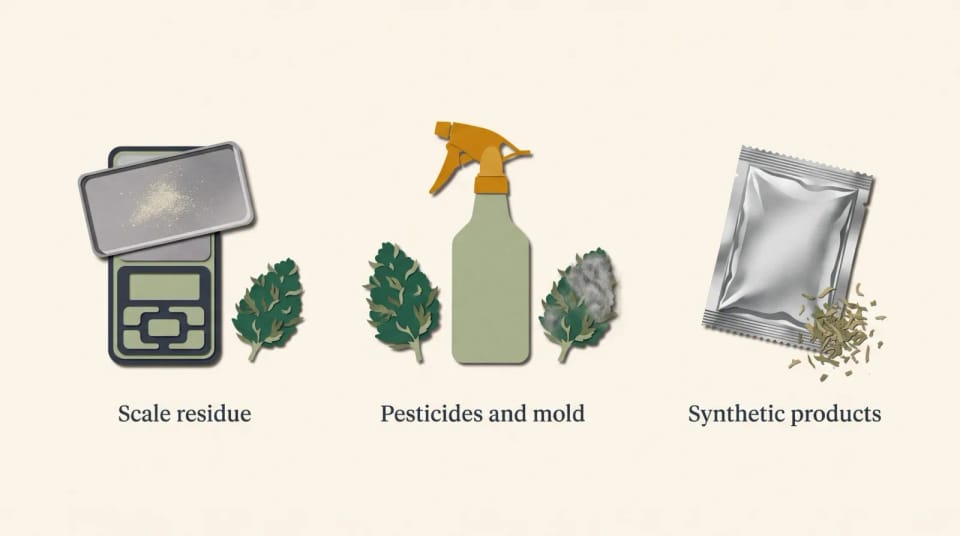
What testing finds in illicit flower is mostly cross-contamination from equipment, pesticides and mold. The 2018 rat poison outbreak involved synthetic cannabinoid products, not cannabis.
The rat poison story is real, but it belongs to a different product. In spring 2018, Illinois saw 155 cases and 4 deaths from severe bleeding linked to brodifacoum in synthetic cannabinoid products sold as “fake weed.” CDC MMWR, 2018 A hospital series found brodifacoum in all 15 patients it tested. Kelkar et al., NEJM 2018 Synthetic cannabinoids are different drugs from cannabis; our lesson on Spice and full versus partial agonists explains why. Vape cartridges are another category with documented fakes, covered in how to spot a counterfeit vape cart.
Do fentanyl test strips work on weed?
Not in any validated way. Fentanyl test strips were made for drugs dissolved in water, such as powders and pills. New York’s cannabis regulator says “reliable testing protocols for the presence of fentanyl on cannabis flower remain unknown.” NY Office of Cannabis Management, 2023 New York’s addiction services agency goes further and does not recommend using strips on cannabis at all. NY OASAS guidance, 2023
Strips have known limits even on the drugs they were made for. They show presence, not amount. A negative result does not rule fentanyl out, partly because fentanyl can be unevenly spread through a batch. Methamphetamine, MDMA and diphenhydramine can trigger false positives. NY OASAS
A 2024 lab study of five manufacturing lots of one strip brand found that three newer lots detected fentanyl only at concentrations ten times higher than the labeled cutoff. Some lots also gave false positives with lidocaine at high concentrations. Halifax et al., Harm Reduct J 2024 That testing was done in water, not on plant material.

Strips were built for drugs dissolved in water. No validated method exists for testing cannabis flower with them, and New York health agencies advise against it.
Even the 2026 seizure study needed liquid chromatography and tandem mass spectrometry to measure its results. That is the honest answer to “can you test weed for fentanyl at home”: not reliably.
Is dispensary weed safe from lacing?
It is the lower-risk option, with one caveat worth knowing. Licensed cannabis in US legal states is tested for pesticides, metals, microbes, mycotoxins and solvents. Jameson et al., Environ Health Perspect 2022 Fentanyl and other illicit drugs were not part of the standard state panels in that review. So a certificate of analysis (COA) is not a fentanyl screen. What licensed supply does give you is a traceable chain. The Canadian study also showed how much cleaner legal flower was on pesticides, mold and mycotoxins.
Legal labels are not perfect either. In the same Canadian study, 48 percent of legal products were more than 20 percent off their labeled THC. J Cannabis Res 2026 Our guide to why lab testing standards are failing consumers explains that gap.
What should you do if you are worried?
Here is what the evidence supports, in order.
- Drop the look-and-sniff tests. White specks, odd smells and harsh smoke do not identify lacing. Keep visual checks for mold and quality, which they can catch.
- Reduce risk at the source. Buy from a licensed seller and match the COA to your package’s batch number. Our guide to reading cannabis lab results walks through each panel, and the dispensary red flags guide covers sellers to skip.
- Do not rely on a fentanyl test strip for flower. A negative strip on a bud tells you very little, for the reasons above.
- Know the opioid overdose signs and keep naloxone nearby. This is the advice Connecticut officials gave in their own alert: know the signs of an opioid overdose, do not use alone, carry naloxone and call 911. CT-ORS bulletin
If you buy licensed, the High IQ app can log the product and batch you used and how it went, so a bad session points back to a specific package instead of a guess.
When to talk to a clinician
Opioid overdose is an emergency, not a wait-and-see moment. If someone cannot be woken, breathes very slowly or not at all, or has blue or grey lips, call 911 right away. Unusual bleeding or bruising after using a synthetic “fake weed” product also needs urgent medical care; that was the warning sign in the Illinois outbreak. For anything less clear, such as symptoms that feel nothing like your usual reaction or that do not settle, contact a clinician or your local poison center. Tell them exactly what you used and where it came from. Also remember that cannabis showing up in an overdose report does not mean cannabis caused it; our explainer on whether you can overdose on weed covers that distinction.
Key takeaways
- You cannot see, smell or taste lacing. White specks are usually trichomes, residue or mold.
- In 118 seized illicit flower samples, lab tests found no fentanyl and cocaine traces in about one in five, mostly from dirty equipment.
- The one lab-confirmed fentanyl-in-weed case on record, Connecticut 2021, was judged accidental.
- Pesticides, mold and mycotoxins are the documented, common problem in illicit flower.
- Fentanyl test strips are not validated for cannabis flower.
- Licensed products cut contamination risk, but a COA is not a fentanyl test.
FAQ
How can you tell if marijuana has been laced with fentanyl?
You cannot without a laboratory test. Fentanyl on flower has no reliable look, smell or taste, and field strips are not validated for plant material. Lab testing of seized illicit flower found no fentanyl in 118 samples, and the one confirmed case on record was judged accidental contamination.
What are the symptoms of laced weed?
There is no single symptom set, because it depends on the contaminant and the amount. Trace cross-contamination at the levels measured in the 2026 study is far below the doses those authors cite for observed effects. Signs of opioid overdose, such as being unable to wake, very slow breathing and blue lips, are an emergency: call 911.
Can edibles be contaminated?
Yes, any product can be contaminated during manufacturing, and illicit edibles have no required lab testing. The studies discussed here tested dried flower, not edibles, so they do not give an edible contamination rate. Licensed edibles carry a batch number and a lab report you can match to the package.
Is weed laced with fentanyl common?
No, based on the testing that exists. US forensic lab data show fentanyl alongside cannabinoids in well under 1 percent of samples, and a 2026 study of 118 seized flower samples found none. Individual case reports exist, so it is rare, not impossible.
What does it mean if my weed has white specks?
Usually it means trichomes, mineral residue or mold. No study shows white specks indicate fentanyl or other drugs. Fuzzy, grey or web-like patches point to mold, which is a real reason not to use the flower.
Sources
- Andersano B, et al. Evaluation of illicit drug contaminants in seized cannabis in Arizona and California, 2023-2024. J Forensic Sci, 2026.
- Lim TY, et al. Temporal and spatial trends of fentanyl co-occurrence in the illicit drug supply in the United States. Lancet Reg Health Am, 2024.
- Connecticut Overdose Response Strategy and Department of Public Health. Marijuana with fentanyl awareness bulletin, 2021.
- NBC Connecticut. State slow to correct fentanyl-laced cannabis report, 2022.
- Michigan Poison and Drug Information Center. Public health alert regarding fentanyl-laced marijuana, 2021.
- New York State OASAS. Fentanyl test strip guidance, revised 2023.
- New York State Office of Cannabis Management. Cannabis and fentanyl: facts and unknowns, 2023.
- Halifax JC, et al. Testing the test strips: laboratory performance of fentanyl test strips. Harm Reduct J, 2024.
- Hopwood T, et al. Unintentional use of fentanyl attributed to surreptitious cannabis adulteration. J Am Pharm Assoc, 2020.
- Le Q, et al. A rare case of diffuse alveolar hemorrhage caused by fentanyl-laced marijuana. Cureus, 2023.
- Kelkar AH, et al. An outbreak of synthetic cannabinoid-associated coagulopathy in Illinois. N Engl J Med, 2018.
- Moritz E, et al. Outbreak of severe illness linked to brodifacoum and use of synthetic cannabinoids, Illinois. MMWR, 2018.
- Fiering Q, et al. Comparative analysis of contaminants and THC potency in illegal and regulated cannabis in Canada. J Cannabis Res, 2026.
- Jameson LE, et al. Comparison of state-level regulations for cannabis contaminants. Environ Health Perspect, 2022.



