

Is It Illegal to Mail Weed? What the Postal Service Actually Allows
Yes. Mailing weed is illegal under federal law, even between legal states. See the USPS rule behind it, the narrow hemp exception and what 2026 changed.

Professor High
Written by Professor High, our AI guide. See how we research and correct articles.
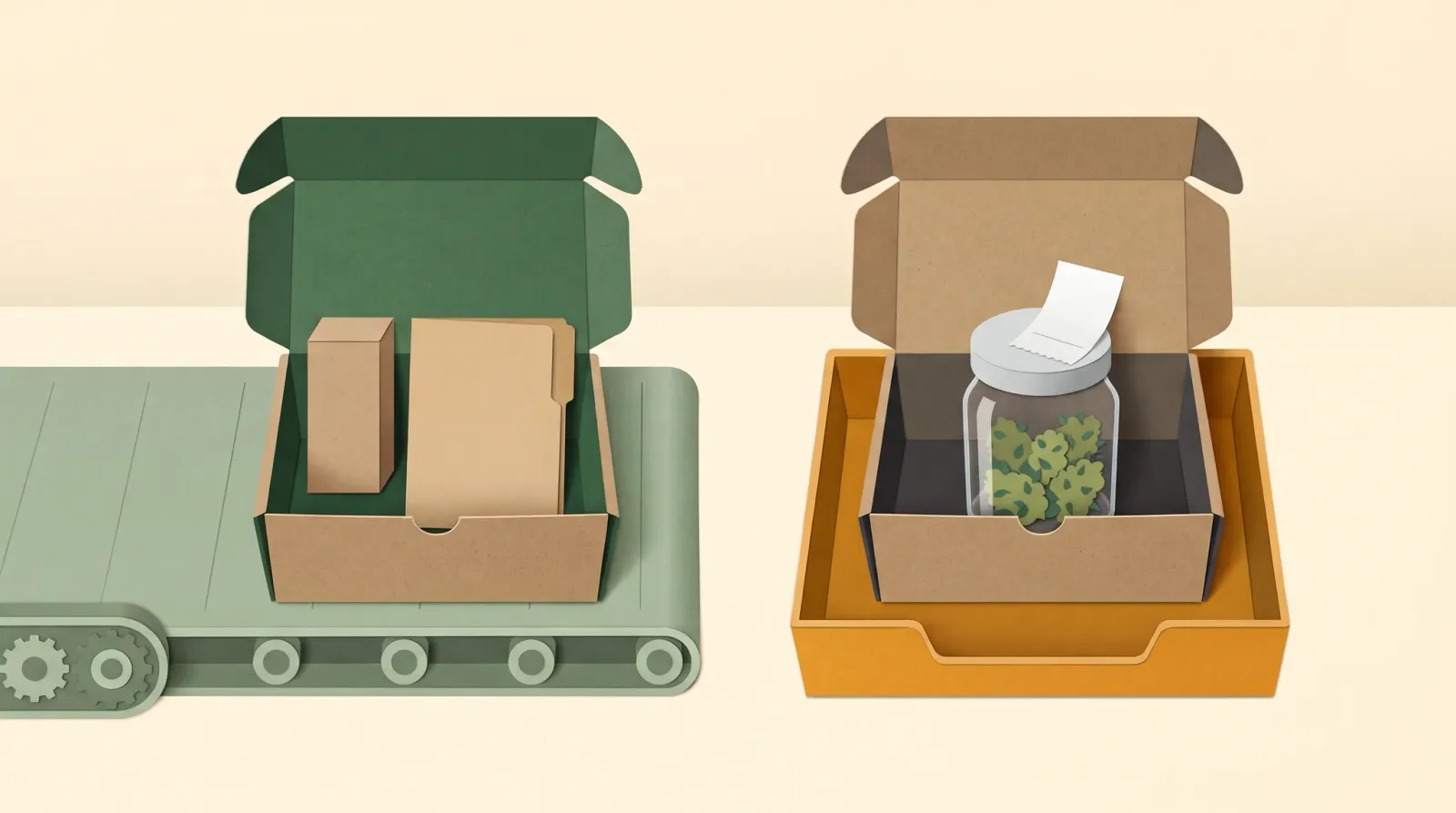
Yes. Mailing marijuana is illegal under federal law, even when you send it from one legal state to another. The Postal Service’s rule is one sentence long: if distributing a controlled substance is unlawful under federal law, then mailing it is unlawful too. A state license, a medical card or a dispensary receipt does not change the federal part. USPS Publication 52, section 453.31
There is one narrow cannabis-plant exception. Hemp and hemp-based products, CBD included, at or under 0.3 percent THC can go in the domestic mail if the sender follows federal, state and local law and keeps compliance records. They can never go to a military address. Publication 52, section 453.37
Here in High School we show the rule, not just the verdict: the federal law, the 2026 medical rescheduling, the two hemp dates and what happens to a flagged package. This is general information, not legal advice.
Rules checked October 29, 2026. The Publication 52 page was last modified October 6, 2026. Two parts are moving: Georgia’s medical mail rule and the December 11 hemp date.
Why is mailing weed illegal even between legal states?
Because the U.S. mail runs on federal law, and federal law still controls marijuana. Publication 52 links the two directly: “If the distribution of a controlled substance is unlawful under 21 U.S.C. 801-971 … then the mailing of the substance is also unlawful under 18 U.S.C. 1716.” Publication 52
The same section says who may mail controlled substances at all. Both the sender and the receiver must be registered with the DEA or exempt from registration. The other routes are mail-back programs and prescription medicines sent by manufacturers, pharmacies, practitioners or other authorized dispensers. A shopper with a receipt from a licensed store fits none of those.
The Postal Service has also said in writing that state law does not enter the decision. In a 2021 final rule, it wrote that THC substances outside hemp are Schedule I and “nonmailable in most instances.” It added that this ban is “unaffected by whether the mailing of THC-containing substances violates state or local law.” It is also unaffected by the federal budget rider that limits the Justice Department’s spending on medical marijuana cases. 86 FR 20287
The Postal Service’s own administrative judges said the same in 2018. One decision held that state laws allowing medical or recreational marijuana do not change the outcome. Another said that mailability “depend[s] entirely on whether a package contains a controlled substance that is unlawful under federal law.” Sansouci v. USPS; KAB, LLC v. USPS
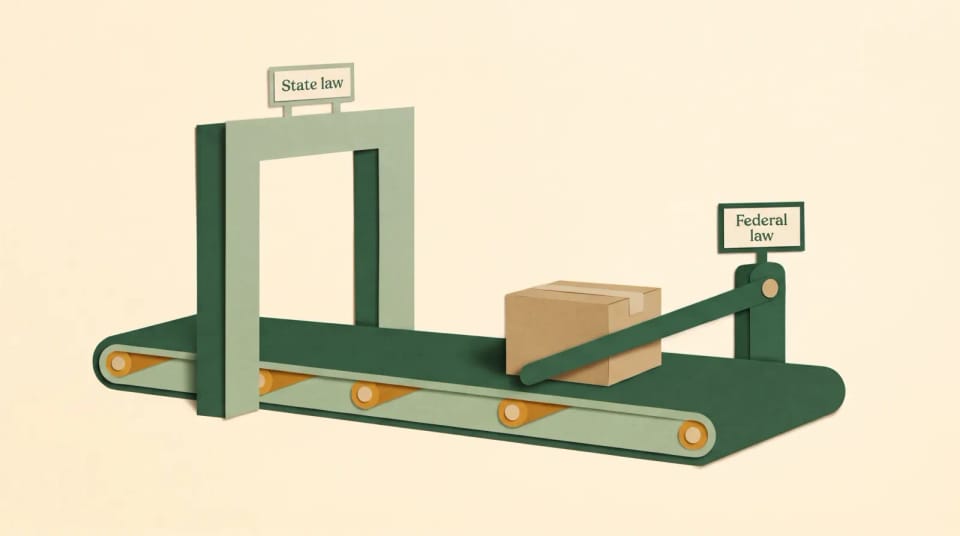
State legalization opens the state checkpoint. The mail still has to pass the federal one, and for marijuana it stays closed.
The same logic covers mail inside one state; Publication 52 has no in-state exception. For why licensed shops cannot ship across state lines either, see our guide to interstate cannabis commerce. For possession rules in each state, see the state-by-state cannabis laws.
What are the federal penalties for mailing marijuana?
Three federal statutes can apply to one package, and each sets a different maximum. These are ceilings written into the law. A real sentence depends on the amount, a person’s record and what prosecutors decide to charge.
| Statute | What it covers | Maximum the statute sets |
|---|---|---|
| 18 U.S.C. 1716(j) | Knowingly mailing something the law declares nonmailable | Up to 1 year, a fine, or both |
| 21 U.S.C. 843(b) | Using a “communication facility,” which includes the mail, to commit or help commit a federal drug felony | Up to 4 years per use (up to 8 after a prior conviction) |
| 21 U.S.C. 841(b)(1)(D) | Distributing less than 50 kilograms of marijuana | Up to 5 years and a fine of up to $250,000 for an individual |
Section 843(b) has a detail that matters if someone mails more than once: “Each separate use of a communication facility shall be a separate offense.” Two packages can mean two counts.
Section 841 also has a narrow carve-out: distributing “a small amount of marihuana for no remuneration” is treated as simple possession. That does not make a mailed gift legal. It changes the penalty, and the section 1716 mailing offense remains.
One correction to a common claim: the rules we read do not call this mail fraud. The Postal Service ties marijuana in the mail to the drug laws and to section 1716.
Can you mail medical marijuana after the 2026 rescheduling?
Not on the rules as written today, and the Postal Service has not said otherwise. A DEA final rule took effect on April 28, 2026. It moved FDA-approved marijuana drug products and marijuana “subject to a state medical marijuana license” to Schedule III. It also told dispensaries that they “must register with DEA as practitioners” and created a faster registration process for state medical licensees. DEA final rule, 91 FR 22714
The same rule says that “any form of marijuana other than in an FDA-approved drug product or marijuana subject to a state medical marijuana license remains a schedule I controlled substance.” Adult-use weed did not move. Our explainer on what the April 2026 Schedule III rule actually covers has the full picture. A separate article tracks where broader rescheduling stands.
The rule text we searched says nothing about mail or carriers. Meanwhile, Publication 52 still limits controlled-substance mail to DEA-registered parties and authorized dispensers. The usps.com shipping page still lists “Marijuana (medical or otherwise)” as a domestically prohibited item. USPS shipping restrictions
Georgia is now testing the gap. Its medical cannabis commission adopted a rule that allows medical marijuana delivery by the Postal Service and private carriers, with certified mail or equivalent tracking and a signature from the patient, caregiver or institution. Asked whether it would carry those deliveries, a USPS spokesperson pointed to the “if distribution is unlawful” rule and said “we have nothing additional to offer at this time.” The same report noted that patients have no DEA registration process. Marijuana Moment, October 1, 2026
On October 27, two U.S. senators wrote to the Postmaster General and urged the Postal Service to keep its ban, according to a report on October 29, 2026. So the honest status is “open question, no answer from USPS.” Do not mail medical cannabis on the assumption that rescheduling made it legal.
If you rely on medical cannabis and cannot get it where you live, talk with your clinician and your state medical program about lawful options. Do not use the mail as a workaround.
Can you mail hemp, CBD or delta-8?
Yes, within limits. Publication 52 section 453.37 allows hemp and hemp-based products, including CBD, with THC “not exceeding a 0.3 percent limit.” The conditions are strict. Publication 52
- Domestic mail only. Hemp products cannot go to international addresses, including APO, FPO and DPO military mail.
- Full legal compliance. The sender must follow federal, state and local law, including USDA hemp production rules.
- Records. The sender must keep compliance records “for no less than 3 years after the date of mailing.”
USPS gives two different record periods. The consumer page at usps.com says at least two years. USPS shipping restrictions Publication 52 is the rule text and says three. Keep them for three.
Hemp has federal protection in transit. The 2018 Farm Bill says no state may “prohibit the transportation or shipment of hemp or hemp products” through the state, if the hemp was produced under the federal hemp program. Pub. L. 115-334, section 10114 That protects hemp passing through a state. It does not make a product legal to sell or possess where it arrives.
For a delta-8 or delta-9 hemp gummy ordered online, the question is whether it still meets the federal hemp definition. That target moves, as our guide to delta-8 legality by date and state explains.
| What is in the box | Mailable by USPS? | Why |
|---|---|---|
| Dispensary flower, vape or edible (adult-use) | No | Schedule I; distribution is unlawful, so mailing is unlawful |
| State-licensed medical marijuana | Not established | Schedule III since April 28, 2026, but USPS has not changed its rule or answered |
| Hemp or CBD at or under 0.3% THC, with records | Yes, domestic only | Publication 52 section 453.37 exception |
| Any hemp product to a military or foreign address | No | Publication 52 bars international mail, including APO, FPO and DPO |
What changes for mailed hemp on November 12 and December 11?
The federal definition of hemp tightens on two dates, and the Postal Service’s hemp exception points to that definition. Publication 52 defines hemp by federal law “or any successor provision.” That means the exception follows the law, not a fixed number. Publication 52
Section 781 of Pub. L. 119-37 rewrites the definition. It changes the 0.3 percent test from delta-9 THC to total THC, which includes THCA. Finished hemp-derived cannabinoid products no longer count as hemp if they contain cannabinoids the plant cannot naturally make, cannabinoids made outside the plant, or “greater than 0.4 milligrams combined total per container.” Pub. L. 119-37
Section 781 was set to take effect on November 12, 2026. A later law says that until December 11, 2026, it applies only to products with cannabinoids “not capable of being naturally produced” by the plant. Cannabinoids made outside the plant, the total-THC test and the 0.4 mg container cap wait until December 11, 2026. Pub. L. 119-103, section 2019 Our guide to the November 12 and December 11 hemp dates walks through which products fall where.
What this means for the mail: a product that met the old delta-9 test may stop meeting the federal hemp definition. When that happens, the hemp exception no longer describes it. We found no USPS notice that updates Publication 52 for these dates, so check the live rule on the day you mail. The math behind the change is in total THC versus delta-9. THCA flower versus delta-9 flower and hemp THC drinks and the 0.4 mg cap cover the two product types most affected.
Do UPS and FedEx ship weed?
No. Private carriers set their own rules, and the major ones restrict marijuana. Using a private carrier does not avoid federal drug law either. Sections 841 and 843 are not limited to the Postal Service.
FedEx’s prohibited-items list names “Marijuana, including marijuana intended for recreational or medicinal use and cannabidiol (‘CBD’), any product that contains any amount of tetrahydrocannabinol (‘THC’) and synthetic cannabinoids.” It prohibits raw hemp and hemp derivatives except as U.S. regulations allow. We could read only FedEx’s Cayman Islands version of that list, dated March 1, 2021, so treat it as FedEx’s stated policy, not its exact U.S. domestic rule. FedEx prohibited items
We could not open UPS’s hemp shipping page to confirm its terms. If you ship hemp through any private carrier, read that carrier’s current policy page first.
What happens if the Postal Service flags a package?
The best public account is a federal audit of the Postal Inspection Service from 2020. In fiscal year 2019, inspectors processed 54,877 packages suspected of containing marijuana. Of those, 9,701 (18 percent) turned out to hold mailable items and went on to the addressee. The other 45,176 held 95,491 pounds of illicit drugs, mainly marijuana, and were removed from the mail. USPS OIG report 19-014-R20
The same audit describes the process. Inspectors ask the sender or the addressee for consent to open the package. If nobody responds within 21 days, the package is declared abandoned. It can then be opened, and the contents are seized and disposed of.
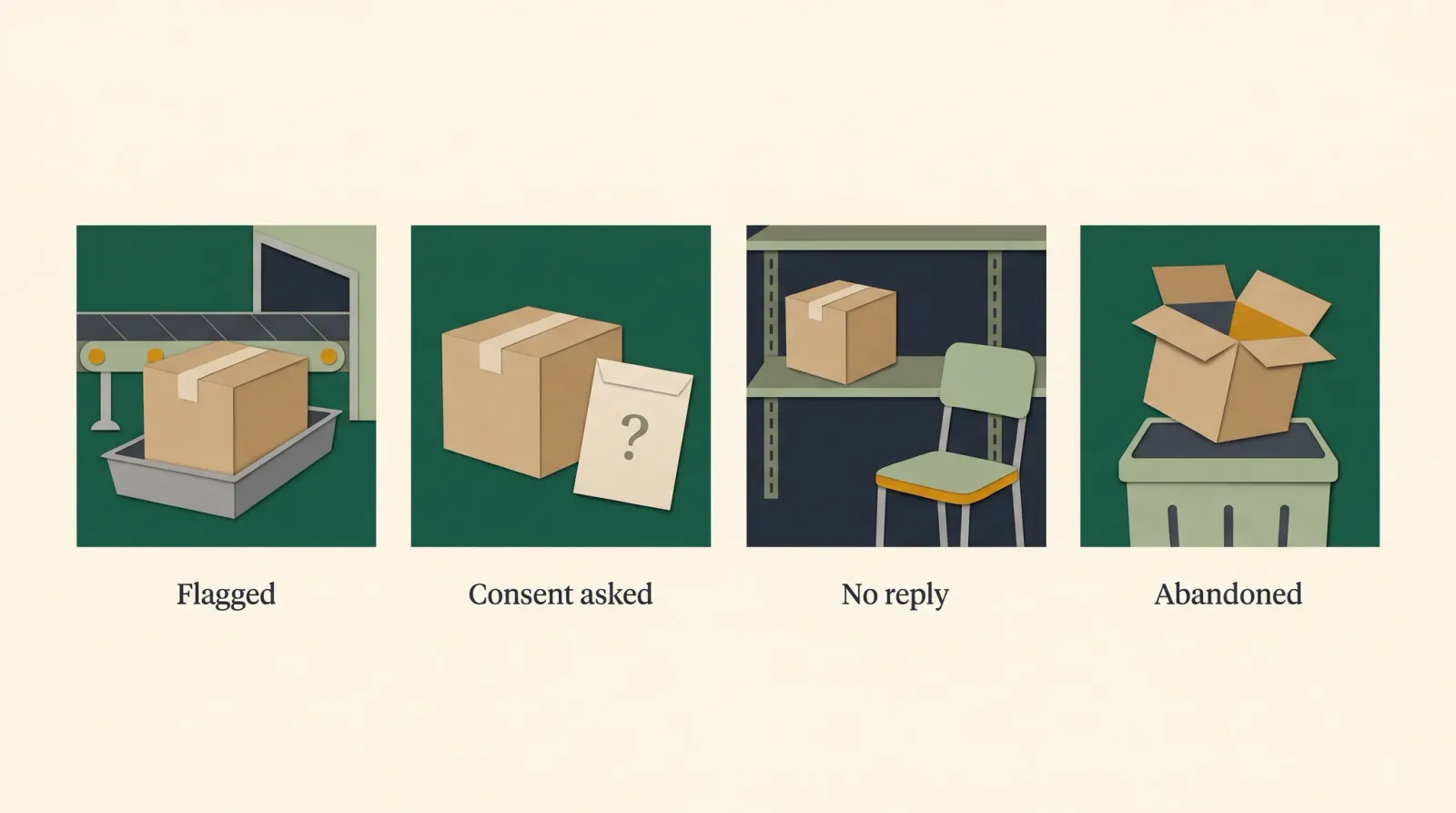
The 2020 audit describes a consent-and-abandonment process. Packages that hold mailable items go on to the addressee. The strip shows an administrative path, not the odds of a prosecution.
These numbers describe one year’s volume, seven years ago. They do not give the chance that a single package gets flagged, and they say nothing about prosecutions. If you face a seizure or a charge, speak with a licensed attorney.
If you want cannabis with you in another state, the in-person rules are different again. See our guide to taking cannabis with you when you travel. The hemp side of the split is covered in hemp versus cannabis rules.
Key takeaways
- Mailing marijuana is a federal offense, even between legal states and within one state.
- Publication 52’s rule: if distribution is unlawful under federal law, mailing is unlawful too.
- The April 2026 Schedule III rule has not been shown to make patient mail legal, and USPS has not answered.
- Hemp and CBD at or under 0.3 percent THC can go in the domestic mail, with records kept for three years, never to military or foreign addresses.
- The federal hemp definition tightens on November 12 and December 11, 2026, and the mail exception follows it.
FAQ
Can you mail edibles?
Not marijuana edibles. Adult-use THC edibles are Schedule I, and medical ones have no USPS route yet, so mailing them is unlawful under Publication 52. A hemp-derived edible can be mailed only if it still meets the federal hemp definition on the mailing date. After December 11, 2026, that includes the 0.4 milligram per-container limit.
Can you mail weed within the same state?
No. The Postal Service is a federal agency, and its rule depends on federal law, not on whether the package crosses a state line. Publication 52 has no in-state exception for marijuana.
Is mailing weed considered mail fraud?
Not under the rules we read. The Postal Service links marijuana in the mail to the Controlled Substances Act and to 18 U.S.C. 1716, the nonmailable-matter law. Prosecutors can also use 21 U.S.C. 843(b), which counts each use of the mail to help commit a drug felony as a separate offense.
Can you mail CBD oil?
Yes, if it is hemp-derived, at or under the federal THC limit and legal under federal, state and local law. Keep the compliance records for at least three years, and send it only to domestic, non-military addresses. Marijuana-derived CBD stays nonmailable, as a 2018 USPS decision held.



