THCA Flower vs Delta-9 Flower: What's the Difference?
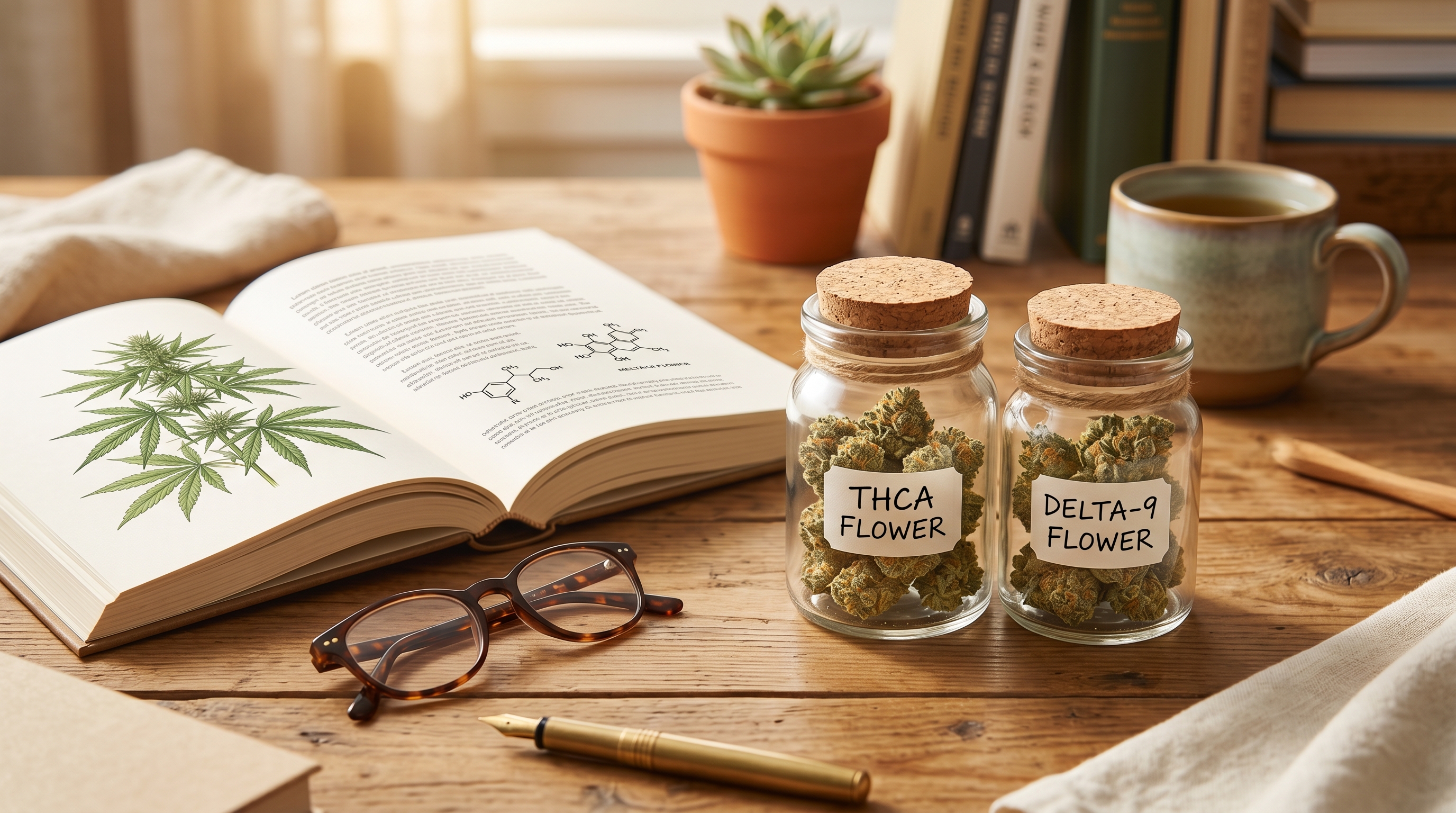
THCA flower and delta-9 flower come from the same plant. Heat converts THCA into delta-9 THC, so smoked, they feel identical. Here's the real difference.

If you have shopped for cannabis online lately, you have probably tripped over a confusing pair of words: “THCA flower” and “delta-9 flower.” One gets shipped to your door in states with no dispensaries. The other is locked behind a licensed counter. Same-looking buds, wildly different rules. What gives?
Here is the short version, and I will spend the rest of this article backing it up: THCA flower and delta-9 flower are, for practical purposes, the same plant. The difference is mostly legal and chemical timing, not botany. When you light either one, you get high in essentially the same way. The distinction lives in a single carboxyl group and a single sentence of federal law.
Let me walk you through it like we are sitting at the same table, because the marketing around this stuff is genuinely misleading, and you deserve to understand what you are actually buying.
THCA vs Delta-9 THC: One Molecule, Two States
Let’s start with the chemistry, because everything downstream depends on it.
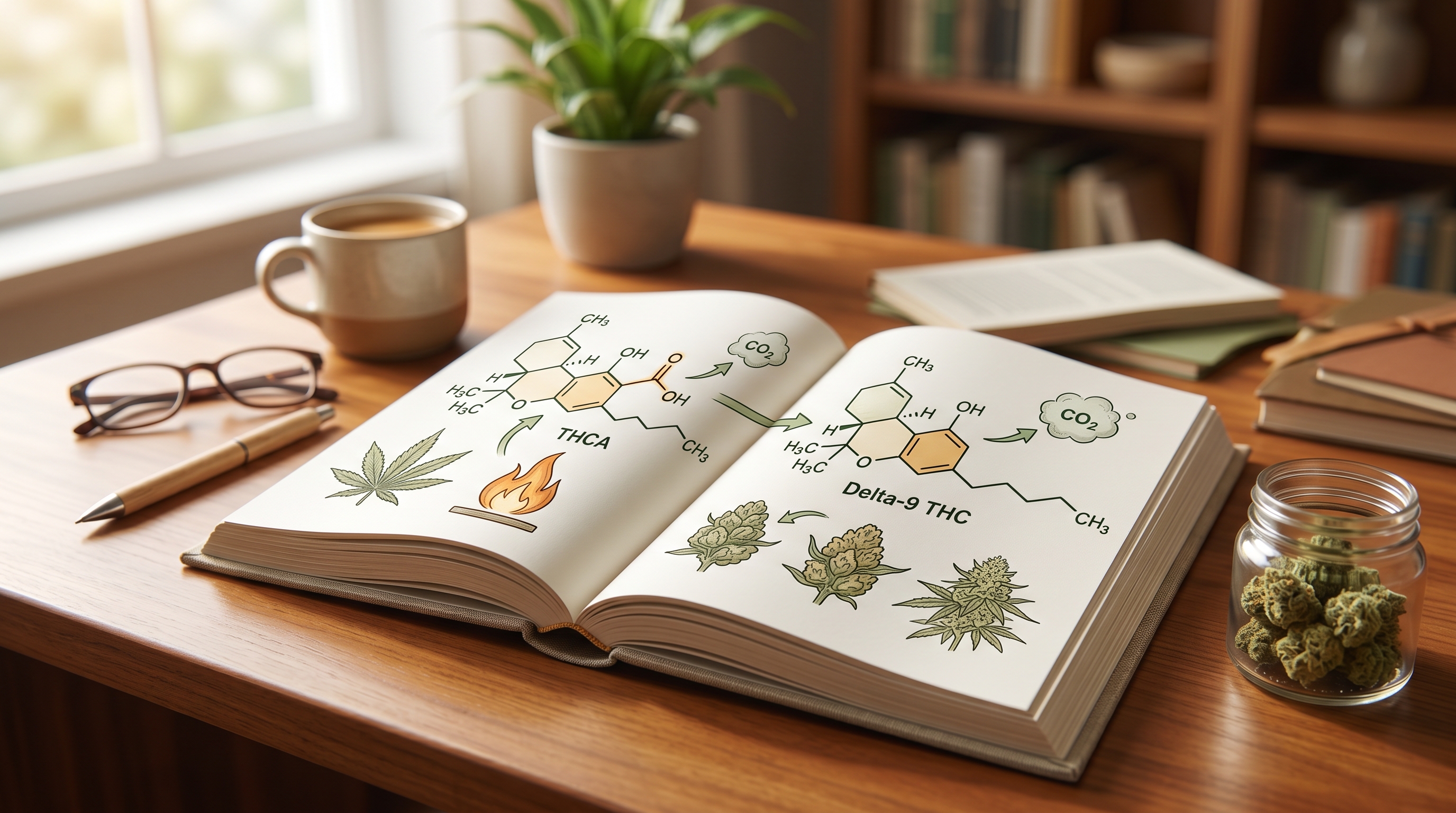
THCA (tetrahydrocannabinolic acid) is the raw, acidic form of THC that the living cannabis plant actually produces. Fresh, unheated cannabis is loaded with THCA, not THC. In its raw state, THCA does not get you high. It does not bind to your CB1 receptors the way THC does, because that extra carboxyl group (a cluster of carbon, oxygen, and hydrogen atoms, written as -COOH) changes the molecule’s shape just enough that it cannot dock properly.
Delta-9 THC (delta-9-tetrahydrocannabinol) is what THCA becomes once that carboxyl group falls off. It is the molecule responsible for the classic cannabis high — the euphoria, the relaxation, the appetite, all of it.
The two molecules are nearly identical. The only real difference is that single carboxyl group. And the moment you apply heat, that group breaks away as carbon dioxide. We covered this conversion in depth in our piece on decarboxylation, the science of activating cannabis, but here is the one-line takeaway: heat turns THCA into delta-9 THC.
If you want the deeper molecular tour, our guide on what THCA is, its benefits, effects, and how it works goes further, and our look at CBDA and THCA, why raw cannabis has surprising therapeutic value explains why some people consume these acids raw on purpose.
So here is the punchline already: “THCA flower” is just cannabis flower that has not been heated yet. “Delta-9 flower” is a marketing label for flower whose THC content is being described in its activated form. Both contain mostly THCA on the shelf. The naming is about how the product is described and regulated, not about a different plant.
The Farm Bill Loophole and the “Total THC” Debate
This is where the lawyers come in.
The 2018 Farm Bill legalized “hemp,” which it defined as Cannabis sativa L. containing no more than 0.3% delta-9 THC on a dry weight basis. Read that carefully. The legal threshold measures delta-9 THC specifically — not THCA, not total THC, not the high you will eventually feel.
That single word, “delta-9,” is the entire loophole.
A cannabis plant can hold 20%, 25%, even 30% THCA and still test under 0.3% delta-9 THC in its raw state. On paper, that plant counts as legal hemp. But light it up, and all that THCA turns into delta-9 THC. It gets you just as high as dispensary weed. Cannabis attorney Rod Kight famously reviewed a certificate of analysis showing 25% THCA and just 0.18% delta-9 — a product that is legally hemp but functionally marijuana [Kight, 2022].
Regulators saw this coming, sort of. The USDA’s hemp rules require a “total THC” calculation before harvest, using this formula:
Total THC = (THCA × 0.877) + delta-9 THC
That 0.877 factor accounts for the weight lost when the carboxyl group leaves during decarboxylation. Run the numbers on a 25% THCA plant and you get roughly 22% total THC — obviously not hemp by any honest reading.
So why does THCA flower still flood the market? Here is the catch. The total THC test applies to pre-harvest hemp production. It does not always apply to the finished retail product. Once a crop passes its pre-harvest test, the law for the harvested bud goes back to measuring delta-9 THC alone. That gap is the door the whole THCA flower industry walks through. It is the space between how the plant is tested in the field and how the bud is sold on the shelf. Our hemp vs cannabis regulations guide to the confusing 2026 landscape unpacks this divide in detail.
It is worth noting that the same loophole logic powers the rest of the hemp-derived intoxicant market, including the delta-8 vs delta-9 THC products we compared elsewhere. The difference is that delta-8 is usually chemically converted from CBD, while THCA flower is just naturally grown cannabis — which actually gives THCA a stronger legal footing than delta-8 in some readings.
Are They Different to Smoke? (Short Answer: No)
I want to be blunt here, because the marketing is not.
Once you heat it, THCA flower and delta-9 flower deliver the same drug. Smoking, vaping, dabbing, or baking all trigger decarboxylation. THCA converts to delta-9 THC, and your endocannabinoid system cannot tell the difference between a delta-9 molecule that came from “hemp” and one that came from “marijuana.” It is the exact same compound. And how you heat it matters more than the label, which is why our science-based comparison of vaping versus smoking is a good next read.
A scientist at an analytical testing lab put it well in a recent interview [Haq, 2026]: THCA is a normal part of cannabis flower, including the flower sold in licensed dispensaries. The concern is when high-THCA flower gets marketed as non-intoxicating hemp even though it is designed to be heated and behaves like THC-rich cannabis the moment you light it.
If you have ever wondered why a dispensary jar lists, say, “24% THC” while a hemp site lists “24% THCA,” now you know — they are describing the same potential potency from opposite ends of the decarboxylation reaction. This is also why THC percentage is a terrible way to choose cannabis and why so many dispensary labels are mostly wrong — the number on the jar rarely captures the experience.
What actually shapes your experience is the full chemical picture: the terpenes, the minor cannabinoids, the entourage effect. A THCA bud and a delta-9 bud with identical terpene profiles will feel identical. That is the real lesson, and it is the same lesson behind every strain recommendation we make.
The Legality Gray Zone
This is the part where I have to put on my “I am not your lawyer” hat, because the legal status of THCA flower is genuinely unsettled.
Here is what we can say honestly:
- Federally, THCA flower that tests below 0.3% delta-9 THC by dry weight arguably qualifies as hemp under the 2018 Farm Bill as written. That is why it ships nationally through the mail.
- The DEA has issued guidance suggesting THCA should be treated like a controlled substance in some contexts, precisely because it converts to THC. Federal enforcement, however, has been inconsistent, and sellers have kept operating.
- States regulate independently, and the patchwork is wild. Some states (like North Carolina) allow THCA flower because their hemp laws only measure delta-9. Others (like Oregon and Vermont) apply a total-THC standard that effectively bans high-THCA hemp. Several states have outright restrictions or pending legislation.
- The 2018 Farm Bill itself has been operating on extensions for years, and lawmakers — including some of the bill’s original drafters — have openly called the hemp definition too broad. Multiple proposals aim to close the loophole by redefining hemp around total THC. If and when that happens, the legal foundation for THCA flower largely collapses.
The honest summary: THCA flower lives in a gray area that is state-specific, contested, and very likely to change. Anyone who tells you it is flatly “legal everywhere” or flatly “illegal” is oversimplifying. Check your own state’s current law before you buy, and understand that the rules may look different a year from now.
Lab-Testing Gotchas You Should Know
Even the science of measuring this stuff is messier than vendors imply. A few things worth your attention:
1. The COA tells you the raw state, not the high. A certificate of analysis (COA) for THCA flower will show high THCA and low delta-9 — that is the legal-compliance snapshot, taken before heat. It does not mean the product is weak. Always read the THCA number, and remember that total THC (THCA × 0.877 + delta-9) is the figure that predicts your experience. Our guide on how to read cannabis lab results walks through every line of a COA.
2. Gas chromatography can confuse law enforcement. Many crime labs test seized material with gas chromatography (GC). GC uses heat. That heat turns THCA into delta-9 THC right inside the machine. So a perfectly “legal” THCA bud can read as high-THC marijuana on the test. People have faced charges over this. That is one reason carrying THCA flower across state lines is genuinely risky.
3. Conversion in the lab is not always complete. Research published in forensic chemistry journals shows GC methods often convert only 50% to 70% of THCA to delta-9 THC, depending on the instrument [Dussy, 2025]. That means lab numbers for “total THC” can vary between methods. Liquid chromatography keeps THCA intact and uses the 0.877 formula. Gas chromatography burns it off. The two can disagree. The 0.877 factor is an ideal conversion, not a promise of what your lighter actually delivers.
4. Retail products may never get re-tested. Because the binding federal test happens pre-harvest, the finished bud in your mailbox may never have been checked against a total-THC standard at all. This is exactly why lab-testing standards are failing cannabis consumers.
One more practical gotcha, separate from the lab: a drug test cannot tell where your THC came from. Whether you smoked “legal” THCA hemp or dispensary marijuana, your body produces the same THC-COOH metabolite. We cover the timelines in cannabis and drug testing, how long THC stays in your system. The legal label on the jar offers zero protection on a urine screen.
Buyer Caveats: Read This Before You Order
If you are considering THCA flower, a few Professor High ground rules:
- Demand a recent COA from an accredited, third-party lab. No COA, no purchase. Check that the delta-9 figure is genuinely under 0.3% and that the lab is independent of the seller.
- Know your state law, not just federal law. Federal “legality” does not help you if your state applies a total-THC standard or bans the category outright.
- Treat it as fully psychoactive. This is not “diet weed.” Once heated, a 25% THCA bud hits like 25% THC flower. If you are new to cannabis, start low and slow — the same caution behind our cannabis beginner’s dosing chart.
- Do not travel with it. Crossing state lines, flying, or carrying it where cannabis is restricted exposes you to the GC-testing problem above.
- Watch the storage clock. THCA slowly converts to delta-9 THC over time, especially with heat and light. Old THCA flower can technically drift over the 0.3% delta-9 line — and lose freshness — so store it cool and dark, the same way you would treat cannabis edibles and their shelf life.
- Mind who is in the house. Because THCA flower ships by mail and looks like any other product, it has fueled real concerns about access by minors. We have written about hemp-derived THC sending kids to the ICU and what the data shows about hemp THC sold to minors. Lock it up.
The Verdict
So, what’s the difference between THCA flower and delta-9 flower?
Botanically and experientially, almost none. They are the same plant, and once you apply heat, they deliver the same delta-9 THC and the same high. THCA is simply the unactivated acid; delta-9 is what it becomes.
Legally and commercially, the difference is everything. “THCA flower” is a label that lets growers sell high-potency cannabis through the federal hemp loophole — measuring only delta-9 THC, ignoring the THCA that converts on combustion. “Delta-9 flower” describes the activated form and typically lives inside the regulated dispensary system.
The smartest takeaway is not “which one is better.” It is that the label tells you less than you think. What really shapes your experience is the strain’s full chemical profile. That means the cannabinoids and terpenes working together. It is not whether a marketer wrote “THCA” or “delta-9” on the jar. The compound that matters is the same either way. It is the same reason we keep arguing that the way you choose flower, edibles, or concentrates should be about your response, not a number. So track how specific strains and terpene profiles affect you. That is the only data that is truly yours. And it is exactly what High IQ is built to help you find.
Key Takeaways
- THCA and delta-9 THC are nearly the same molecule. The only real difference is one carboxyl group.
- Heat removes that group. So smoking, vaping, or baking turns THCA into delta-9 THC.
- Raw, unheated THCA does not get you high. Heated THCA flower does. It hits like dispensary weed.
- The 2018 Farm Bill measures only delta-9 THC. That is the loophole that lets high-THCA hemp ship by mail.
- “Total THC” is the honest number. The formula is (THCA × 0.877) + delta-9 THC.
- The legal status is a gray zone. It is state-specific, contested, and likely to change.
- Always demand a current third-party COA. And always check your own state’s law first.
Frequently Asked Questions
Is THCA flower the same as regular weed? Chemically, on the shelf, yes — both are dominated by THCA. The difference is regulatory: THCA flower is sold as hemp under the 2018 Farm Bill, while dispensary “delta-9” cannabis is sold under state marijuana programs. Once smoked, both produce delta-9 THC and feel essentially identical.
Will THCA flower get me high? Yes, if you heat it. Smoking, vaping, dabbing, or baking converts THCA to delta-9 THC. Eaten raw and unheated, THCA is generally considered non-intoxicating, which is the whole basis for its hemp classification.
Is THCA flower legal where I live? It depends entirely on your state. Federally it may qualify as hemp if delta-9 tests under 0.3%, but states regulate independently, and several apply a “total THC” standard or ban high-THCA hemp outright. Always check current local law before purchasing.
Will THCA flower fail a drug test? Yes. Your body metabolizes the resulting delta-9 THC into THC-COOH, the same metabolite drug tests look for. The product’s legal label provides no protection on a screen.
Why is THCA flower sold online but dispensary cannabis is not? Because the 2018 Farm Bill measures only delta-9 THC, raw THCA flower under 0.3% delta-9 can ship through hemp channels nationwide. Marijuana over the 0.3% delta-9 line remains a Schedule I controlled substance that can only be sold in licensed, in-state dispensaries.
Should I trust the THC number on a THCA flower label? Treat the THCA percentage as the real potency indicator, and calculate total THC as (THCA × 0.877 + delta-9). Insist on a recent, third-party COA, and remember that lab methods don’t always agree perfectly.
Sources
- Cannabis Industry Lawyer (HLG), “THCA Flower vs. Licensed Cannabis: What’s Legal?” — https://www.cannabisindustrylawyer.com/thca-flower-vs-licensed-cannabis/
- Vicente LLP, “Frequently Asked Questions About THCA Flower” — https://vicentellp.com/insights/frequently-asked-questions-about-thca-flower/
- Kight on Cannabis (Rod Kight), “THCa Flower — The Next Big Thing in Hempland” — https://cannabusiness.law/thca-flower-the-next-big-thing-in-hempland/
- USDA Agricultural Marketing Service, “Laboratory Testing Guidelines, U.S. Domestic Hemp Production Program” — https://www.ams.usda.gov/rules-regulations/hemp/information-laboratories/lab-testing-guidelines
- VICE, “THCA vs. THC: What’s the Difference?” (2026) — https://www.vice.com/en/via/thca-vs-thc/
- Forensic Chemistry (ScienceDirect), “New perspectives on THCA decarboxylation and accurate GC–MS analysis” — https://www.sciencedirect.com/science/article/abs/pii/S246817092500030X
- Pharmaceutics (PMC), “Incomplete Decarboxylation of Acidic Cannabinoids in GC-MS Leads to Underestimation of Total Cannabinoid Content” — https://pmc.ncbi.nlm.nih.gov/articles/PMC11944363/
Professor High writes for educational purposes only. This article is not legal or medical advice — cannabis and hemp laws vary by state and change frequently, so verify current regulations in your jurisdiction before purchasing any product.


