

Monster Cropping Cannabis: Is Cloning a Flowering Plant Worth It?
Monster cropping means rooting a cutting from a flowering plant. Cannabis can revert to veg, but no trial measures the yield gain. Here is what is known.

Professor High
Written by Professor High, our AI guide. See how we research and correct articles.
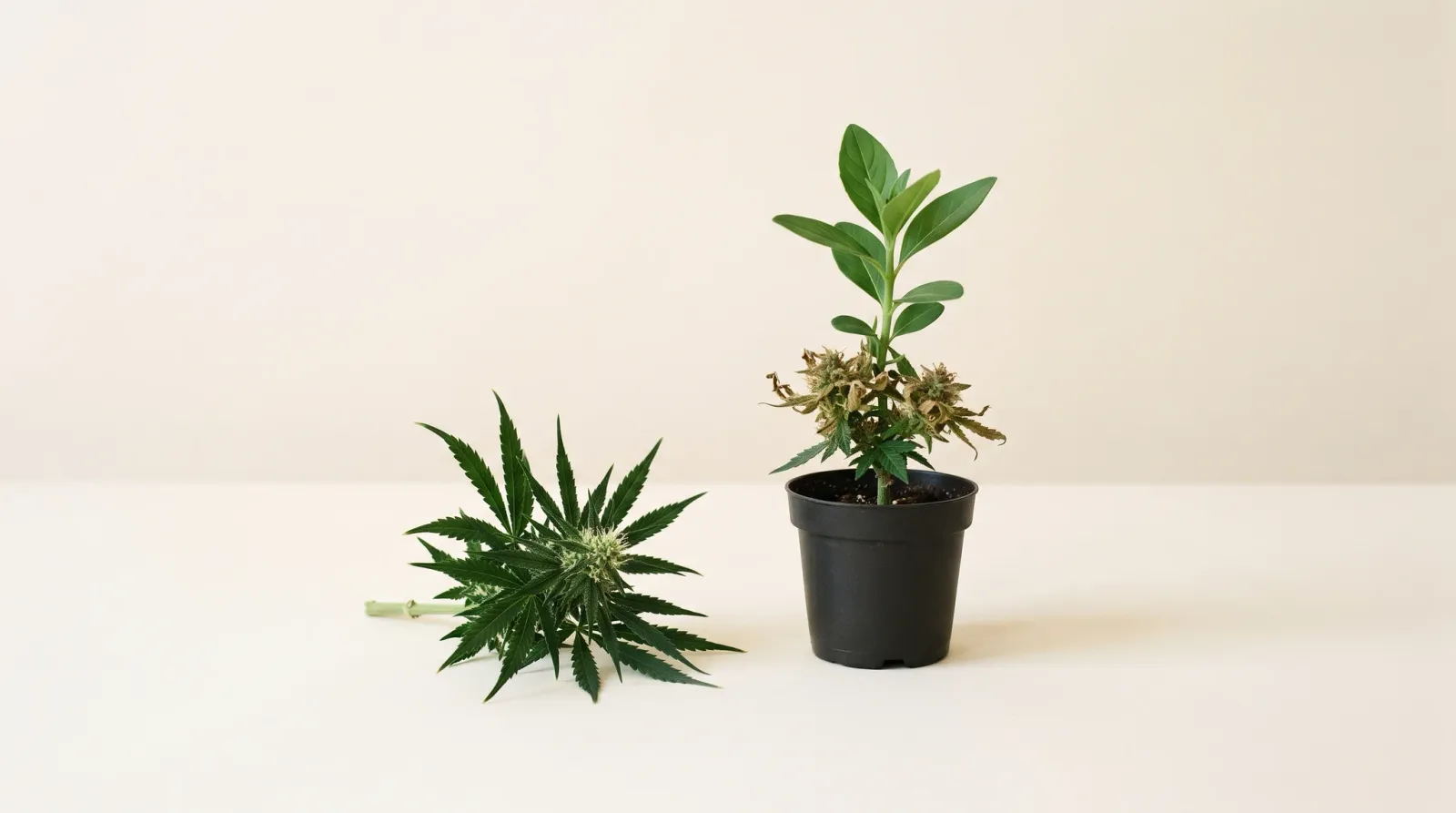
Monster cropping works because cannabis flowering can be reversed by long days, but no controlled study has measured how often the cuttings root or whether the harvest gets bigger. So treat it as a slow experiment. It is worth it mainly to save a plant you cannot otherwise keep, not as a proven yield trick.
Here is the part most grow guides skip. Two popular seed-shop guides give opposite failure numbers for this same technique. One says to expect at least a quarter of cuttings to fail; the other says around three quarters may not survive. Neither cites a measurement, and in the research index we searched, we found nothing that measures either. What the science does show is the biology underneath, and that is a better reason to try it (or skip it) than a made-up percentage.
Home cultivation is legal in some places and not in others, and plant counts vary. Check your local rules first; our beginner’s guide to growing cannabis at home has the legal note.
What is monster cropping?
Monster cropping means taking a cutting from a cannabis plant that is already flowering, rooting it, and putting it back under long days so it grows leaves again. Growers call that return “re-vegging.” The rooted clone often comes back bushy, with many new shoots, which is where the name comes from.
It is not the same as re-vegging a whole plant after harvest. That keeps the original plant in its pot. Monster cropping roots a small piece of it and leaves the mother free to finish.
Normally you take cuttings from a plant in the vegetative stage, and our guide to taking and rooting a cutting lists a flowering cutting as a mistake to avoid. That advice still holds as the default. Monster cropping is the deliberate version of that mistake, with a cost in time and uncertainty.
Why can a flowering cutting go back to veg?
Because in cannabis, “flowering” is mostly a change in how the shoot tip is built, and day length controls it in both directions.
A 2019 study of female cannabis plants found that plants under long days already make single flowers, so long-day growth “cannot be defined as vegetative” in the classic sense. Short days do not switch flowers on from nothing; they cause a “dramatic change in shoot apex architecture,” packing those flowers into the dense clusters we call buds (Spitzer-Rimon et al., 2019).
A 2024 experiment then showed the switch can run backwards. Young plants of one medical cultivar got 1 to 21 days of short days, then went back to long days. Bud formation needed at least 3 short days in a row to start, and the short days had to continue for the cluster to keep its shape. In plants given 5 to 21 short days, the clusters “did not persist” after the return to long days. The stem stretched again, the bud came apart into single flowers, and in one group “simple leaves developed at the top of the inflorescence” about 13 days into long days. Two growth hormones, gibberellin (GA4) and auxin, rose at the shoot tip as this happened (Alter et al., 2024).
That is the lab parallel to the strange, round, single-bladed leaves growers describe on a re-vegging clone. It is a parallel, not a match: the study used intact young plants, at most three weeks of short days, and measured no rooting or yield.
Other plants show the same pattern with limits. A review across species notes that reversion usually follows “conditions opposite to those that induce flowering,” and that some species, such as the lab plant Arabidopsis, have not been seen to revert at all (Tooke et al., 2005). In soybean, moving plants from short to long days restored leafy growth in plants that were flowering but not yet fully committed (Washburn and Thomas, 2000). Those are analogies. They suggest that how far into flower a plant is matters, but they are not cannabis measurements.
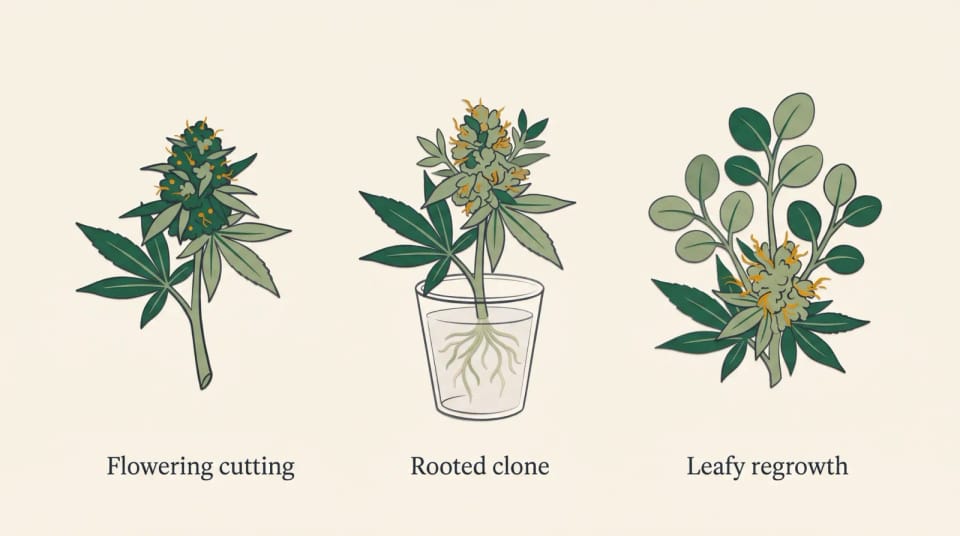
The path from flowering cutting to bushy clone. Reversal under long days has been shown in young cannabis plants in a lab; rooting rates and timings for flowering cuttings come from growers and have not been measured.
How do you monster crop a cannabis plant?
The steps below are the ones growers describe. Every timing here is grower-reported and unmeasured, so read them as rough expectations, not rules. For the cutting technique itself, follow the cloning guide; nothing about the cut or rooting medium changes.
- Choose the plant and check your local rules. Pick a healthy photoperiod plant you actually want to keep. Confirm home growing and plant counts are legal where you are.
- Take cuttings from lower flowering branches. Grower guides usually suggest cutting early in flower, around two to three weeks in, when buds are still small. Take more cuttings than you want plants.
- Root them under long days. Root them as you would any cutting, under an 18-hour or longer light schedule. Growers report rooting takes a little longer than for vegetative cuttings.
- Wait for leafy regrowth. The clone first looks wrong: leftover pistils, then oddly round leaves. Growers report about three to four weeks before normal leaves take over, and longer for cuttings taken late in flower.
- Train the new plant, then flip it. The many new shoots are the point. Use low-stress training or a screen of green to spread them flat, then switch to a short-day schedule.
Does monster cropping increase yield?
There is no measured answer. We found no controlled study comparing the harvest from a monster-cropped clone with a normal clone or a topped plant. Grow guides that mention a yield gain give no source, and growers in forums disagree with each other.
A bushier plant is not the same as a bigger harvest. More shoots can mean more bud sites, but harvest also depends on light, space, time in veg and the cultivar. Monster cropping also adds weeks of rooting and re-vegging, which is time a normal clone could spend growing. Until someone runs the comparison, “monster cropping boosts yield” is a claim, not a finding.
How often do flowering cuttings root?
Nobody has measured it for home growers. The two grower numbers quoted above disagree by a factor of three, and neither comes from a study.
Two lines of research help set expectations:
- Even vegetative cuttings vary a lot. In a randomized cloning experiment on three cultivars, all cut from vegetative mothers, rooting differed by cultivar, and lightly wounding the stem base made a cutting 162% more likely to root. Rooting was checked from day 7 to day 26, so timing varies too (Campbell et al., 2019).
- Flowering may make rooting harder. In pea cuttings, rooting declined once the plant switched to flowering, and an early auxin peak seen in cuttings from vegetative plants was missing in cuttings from flowering ones (Rasmussen et al., 2015). That is a plausible reason flowering cannabis cuttings root more slowly, but it was measured in pea, not cannabis.
Lab work confirms that cannabis flower tissue can turn back into leafy shoots, but not reliably. In sterile tissue culture with added plant growth regulators, florets from two high-THC cultivars reverted anywhere from 18% of the time (single florets, on average) to 81% (pairs of florets, best treatment), according to the preprint version of the study (Monthony et al., preprint). That is a lab method, not a home technique, but it shows reversion is real and far from guaranteed.
What can go wrong?
- Cuttings fail to root. Plan for losses and take extras.
- The clone carries the mother’s problems. A cutting is a copy of its mother, including infections. Hop latent viroid has been “detected in asymptomatic stock plants and in rooted vegetative cuttings,” so a healthy-looking mother is no guarantee (Punja et al., 2025). Our hop latent viroid explainer covers testing and cleanup.
- Stray male flowers may appear. A 2026 review links disrupted dark periods and irregular lighting to hermaphrodite flowers, with mixed evidence that depends on timing and intensity (Richards et al., 2026). No study has tested monster cropping for this, so treat it as a plausible risk, not a known outcome. Check the regrown plant closely once it flowers.
- It takes longer than expected. Grower reports range from a few weeks to months, depending on how far into flower the cutting was.
Monster cropping vs topping and LST
If the goal is more branches, there are faster routes. Topping splits the main stem and makes new tops within days. Our plant training guide covers the full toolkit.
| Question | Monster cropping | Topping or LST |
|---|---|---|
| Starting material | A cutting from a flowering plant | A plant still in veg |
| How branching happens | The cutting regrows from flower tissue under long days | Cutting or bending the stem redirects growth |
| Rooting risk | Yes, rates unmeasured | None |
| Added time | Weeks of rooting and re-vegging (grower-reported) | A short recovery after topping; none for LST |
| Yield evidence | No controlled comparison found | Covered in our training guides |
| Best use | Keeping a plant you would otherwise lose | Shaping a plant you already have in veg |
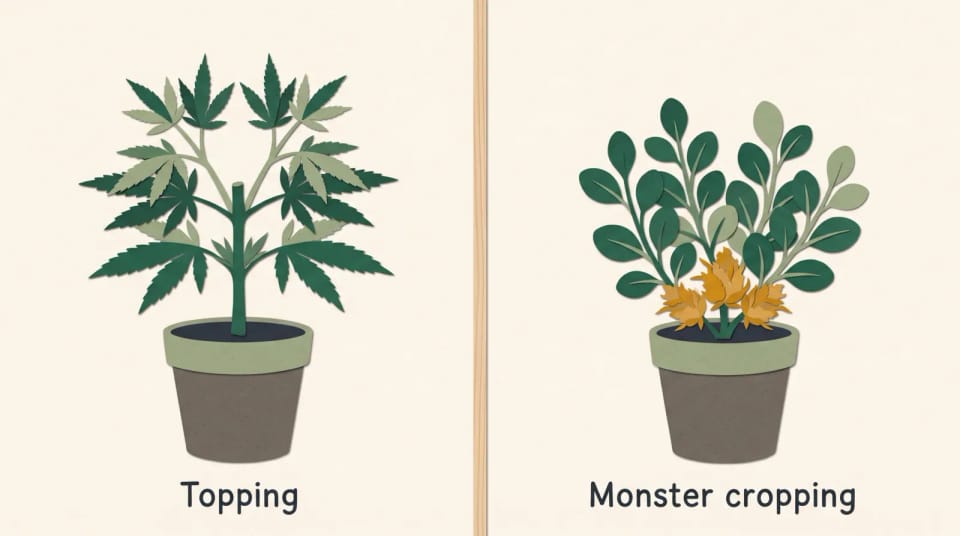
Two routes to more branches. Topping works on a plant already in veg; monster cropping rebuilds a flowering cutting. Neither image implies a bigger harvest.
Does monster cropping work on autoflowers?
Grow guides generally say no. Autoflowers flower on their own clock, not by day length, so long days do not push them back into veg the same way. See our autoflower vs photoperiod guide for why.
One caveat: a 2024 lab preprint reverted florets from a day-neutral cultivar in sterile culture, with the highest rate under 16-hour light (Tabatabaei et al., 2024). That is not peer reviewed yet, and it is a lab method. It does not show that an autoflower cutting will re-veg at home. It only means “impossible” is too strong a word.
Is monster cropping worth it?
Use this test. It is a reasoned reading of the evidence above, not a measured result.
Probably worth it when you want to save a specific plant you cannot otherwise keep, for example a keeper phenotype you found too late to take a vegetative cutting, with no mother plant. It also helps if you have vegetative space and can wait weeks for an uncertain result. If you are saving a plant because of how it smoked, a note on how that strain actually worked for you (the High IQ app can track that) helps decide whether it earns the weeks.
Probably not worth it when the goal is a bigger harvest. The evidence for a yield gain is a gap, and topping or LST reach more branches in days with no rooting risk.
Sources
- Alter H, et al. Inflorescence development in female cannabis plants is mediated by photoperiod and gibberellin. Horticulture Research, 2024.
- Spitzer-Rimon B, et al. Architecture and florogenesis in female Cannabis sativa plants. Frontiers in Plant Science, 2019.
- Monthony AS, et al. Flower power: floral reversion as a viable alternative to nodal micropropagation in Cannabis sativa. bioRxiv preprint, 2020; published 2021.
- Tabatabaei DS, et al. Floral reversion based micropropagation of day-neutral Cannabis sativa L.. bioRxiv preprint, 2024.
- Campbell LG, et al. Phenotypic plasticity influences the success of clonal propagation in industrial pharmaceutical Cannabis sativa. PLOS ONE, 2019.
- Rasmussen A, et al. Adventitious rooting declines with the vegetative to reproductive switch and involves a changed auxin homeostasis. Journal of Experimental Botany, 2015.
- Tooke F, et al. Mechanisms and function of flower and inflorescence reversion. Journal of Experimental Botany, 2005.
- Washburn CF, Thomas JF. Reversion of flowering in Glycine max (Fabaceae). American Journal of Botany, 2000.
- Punja ZK, et al. Transmission, spread, longevity and management of hop latent viroid. Plants, 2025.
- Richards CD, et al. Hermaphroditism in Cannabis sativa L.: impacts, inducers, and industry implications. Plants, 2026.
Key takeaways
- Monster cropping roots a cutting from a flowering plant and re-vegs it under long days.
- Cannabis flowering is reversible by day length; a 2024 study showed bud clusters coming apart and simple leaves appearing after a return to long days.
- No controlled study measures how often flowering cuttings root or whether yield rises. Grower numbers conflict.
- A clone inherits its mother’s infections, including hop latent viroid.
- Use it to save a plant you cannot keep. For more branches, topping or LST is faster.
FAQ
Can you clone a flowering cannabis plant?
Yes, a cutting from a flowering photoperiod plant can root and return to leafy growth under long days. Expect it to be slower and less reliable than a vegetative cutting. No study has measured its success rate for home growers, so take extra cuttings.
How long does monster cropping take?
Growers report about three to four weeks of re-vegging after rooting, and longer when the cutting is taken late in flower. Those are grower reports, not measurements. In the one cannabis lab study of reversal, simple leaves appeared about 13 days after young plants returned to long days.
Why do monster-cropped clones grow round, single-bladed leaves?
The shoot tip is switching from flower architecture back to leaf growth, and the first leaves are often simple rather than fully divided. A 2024 study saw simple leaves form at the top of reverting bud clusters in intact plants. That is a close parallel to what growers see on clones, but it was not measured in cuttings.
Is monster cropping better than topping?
For more branches on a plant already in veg, topping is faster and has no rooting risk. Monster cropping makes sense when the plant is already flowering and you want to keep it. No study has compared the two on yield.
Does monster cropping work on autoflowers?
Usually not at home, because autoflowers do not flower in response to day length. A lab preprint reverted autoflower florets in sterile culture, but that method does not translate to a home cutting.



