SCROG: The Screen of Green Method for Maximum Yield
Learn the SCROG (Screen of Green) method step by step: screen height, mesh size, when to install, and how to weave an even canopy for bigger yields.


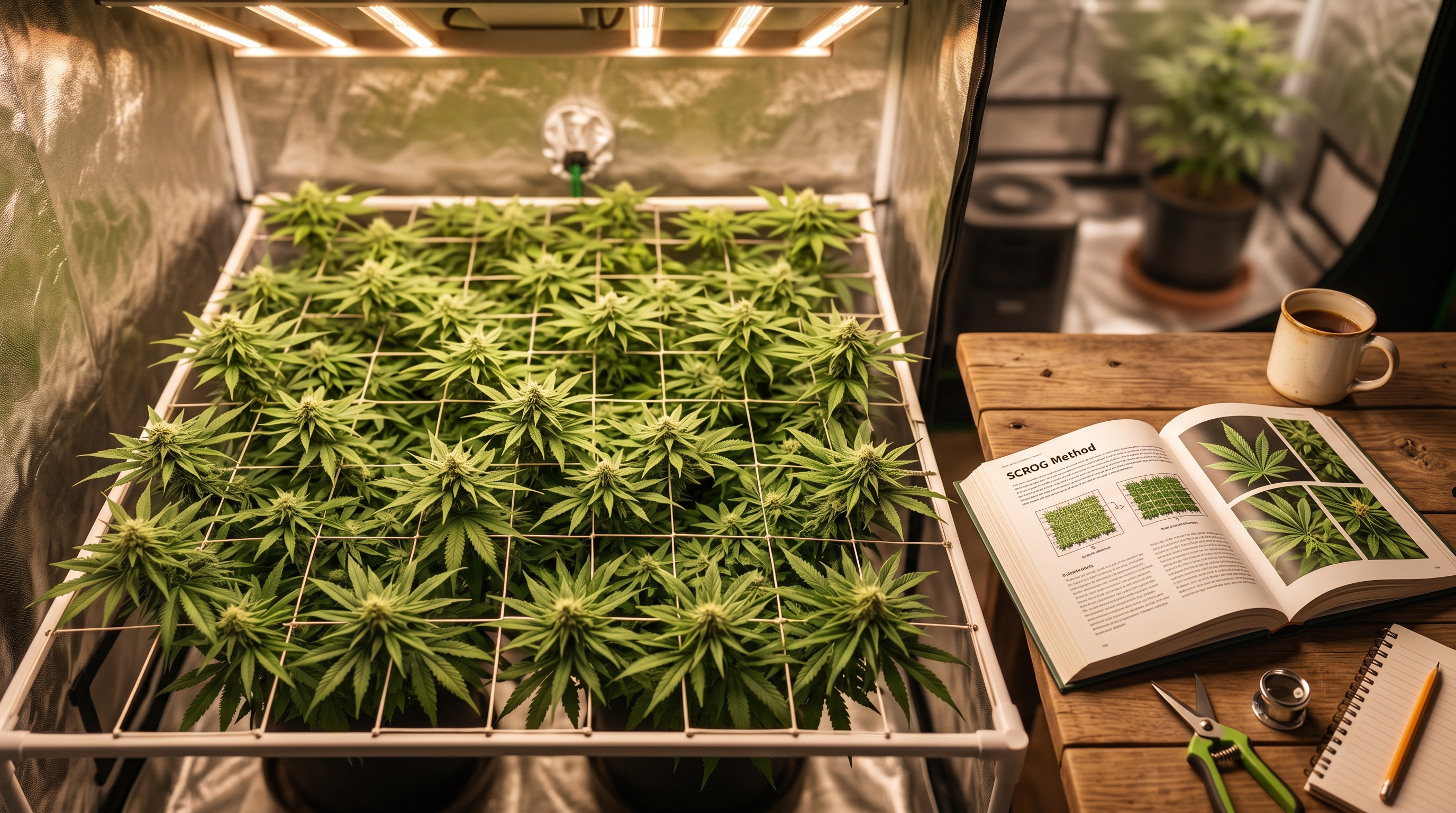
If you have ever pulled a single fat cola off the top of a plant and a fistful of sad, airy “popcorn” buds off the bottom, you have met the central problem of growing cannabis indoors: light is unfair. The top of the plant hogs the photons, and everything underneath fights for scraps. SCROG, short for Screen of Green, is the elegant fix. You stretch a horizontal screen above your plants, weave the branches through it to build one flat, even canopy, and suddenly every bud site sits in the bright zone instead of the basement.
The payoff is more weight from the same light and the same footprint. Instead of one dominant cola, you train the plant into a dozen or more evenly lit tops, each with room to swell. It is one of the highest-return techniques a home grower can learn, and the only real cost is a few minutes of tucking every couple of days. Let me walk you through exactly how to do it.
Why SCROG Boosts Yield
Cannabis, left alone, grows like a Christmas tree: tall and narrow, with a single apical cola and weaker side branches descending in a pyramid. Indoors, your light only travels so far before intensity drops off sharply, so those lower branches never get enough energy to produce dense flower.
SCROG flips the geometry. By bringing the lower branches up and pulling the upper branches down and outward across a screen, you convert that pyramid into a flat plane. Every shoot ends up roughly the same distance from the light, which means every bud site photosynthesizes at close to its full potential. More even light equals more even bud development, which equals more total weight. Growers routinely report pulling more from one well-scrogged plant in a small tent than from several untrained plants in the same space.
There is a bonus, too: that open, horizontal structure dramatically improves airflow through the canopy, which lowers the risk of mold and mildew. If you are still learning the fundamentals, my complete beginner’s guide to growing cannabis at home covers the groundwork SCROG builds on, and the cannabis growing stages timeline shows you where this training fits in the plant’s life.
The Gear: Screen Height and Mesh Size
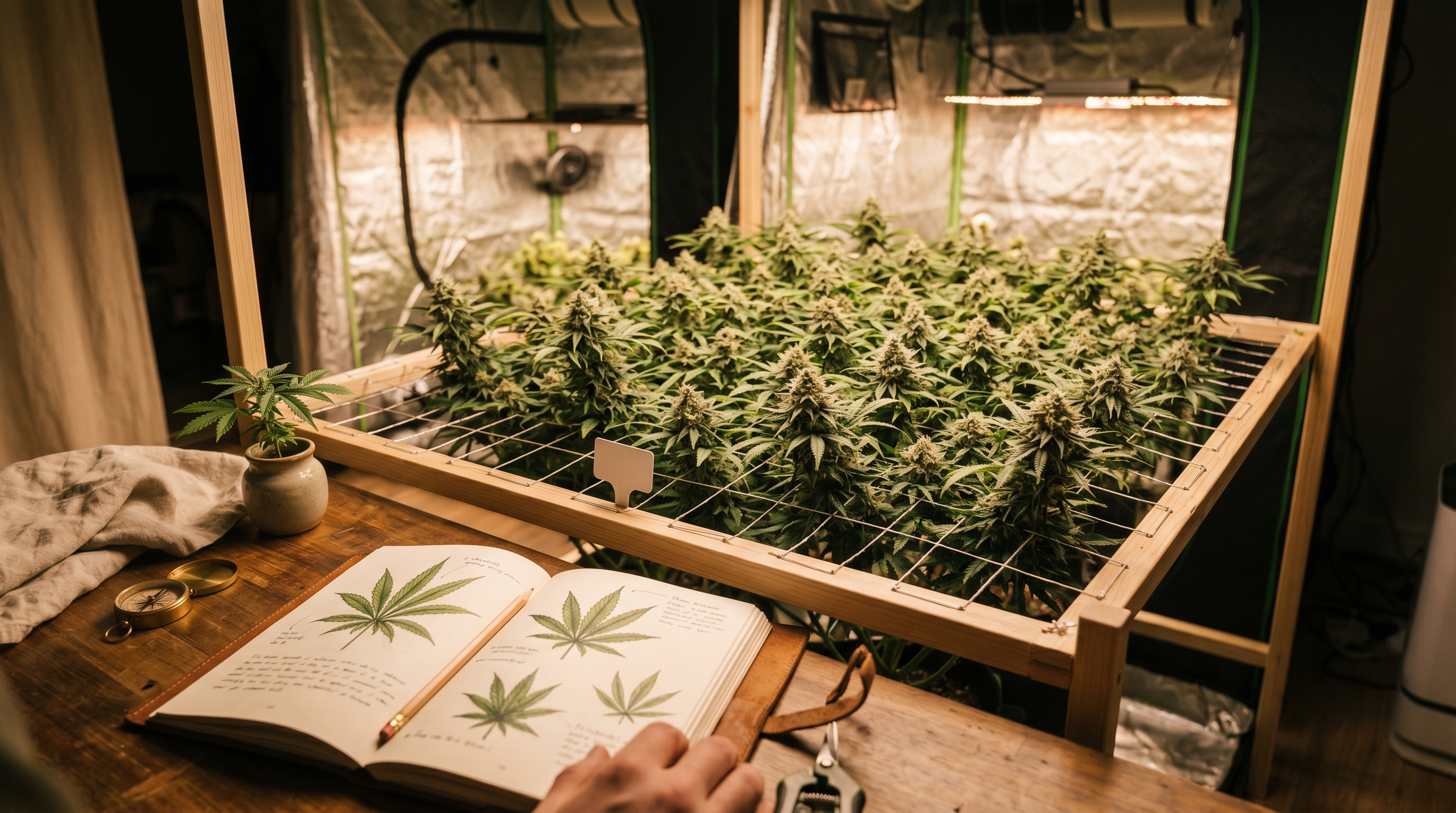
The screen itself is refreshingly low-tech. You can buy a ready-made trellis net or build a frame yourself out of timber or PVC strung with garden twine. If you have ever hung a picture or assembled flat-pack furniture, you are qualified.
Mesh size. Aim for grid squares around 2 inches by 2 inches (roughly 5cm x 5cm). That spacing gives you one branch per square without crowding. Many experienced growers prefer a sturdier, more rigid net (even metal mesh on a roll) over the floppy fabric trellises, because some of those soft nets have squares that are simply too large to train with and are only good for holding up top-heavy buds at the end [Dutch, 2023].
Screen height. This is where you will see a range of advice, and that is fine, because the right number depends on your plants and your light. Common targets:
| Source | Recommended height above the medium |
|---|---|
| Royal Queen Seeds | ~7.8 inches (20cm) |
| WeedSeedShop | 20–30cm (8–12 in) |
| Overgrow | 8–12 inches |
| Vivosun | 12–18 inches (30–45cm) |
| Humboldt Seed Co. | ~20 inches |
A practical sweet spot for most home tents is somewhere in the 8 to 18 inch band above the top of your pots [Royal Queen Seeds, 2020]. Lower screens force more aggressive training and a flatter canopy; higher screens leave more vertical room for the main stem. Whatever you pick, leave yourself some spare vertical space so you can raise the grow light later if your buds stretch taller than expected. Choosing the right light matters here too; my 2026 buyer’s guide to LED grow lights for cannabis and the full grow tent setup guide will help you dial in even coverage over the screen.
When to Install the Screen: Late Veg
Timing is the part beginners get wrong most often. The temptation is to start weaving the moment a plant looks bushy. Resist it.
You position the screen above your plants during the late vegetative stage, but you do not start tucking branches through it until the plant’s tips actually reach the mesh. Royal Queen Seeds suggests setting the screen so plants grow into it naturally, then beginning to tuck once each tip pokes about 2 inches above a square. Train too early, in the seedling or early veg phase, and your plants will simply outgrow the screen and leave you doing extra work, or worse, you will run out of grid squares.
The screen also doubles as your signal for when to flip the lights to a 12/12 cycle and trigger flowering. As a rule of thumb, wait until the screen is roughly 75% full of branches and shoots before flipping [Vivosun, 2023]. Why not 100%? Because of the stretch.
Weaving and Tucking Through the Stretch
When you switch to 12/12, your plants enter the flowering stretch, a roughly 2 to 4 week burst where they can double or even triple in height as they prepare to bud. This is the SCROG grower’s most active window, and the screen fills out fast.
Here is the process, step by step:
- Start as tips reach the screen. When a shoot grows about 2 inches above the mesh, gently bend it back down and tuck it under the screen, then guide it through the next empty square over.
- One branch per square. Aim to fill each opening with a single branch. This generally helps prevent overcrowding and tends to keep the canopy even.
- Spread, don’t pile. Direct branches outward in different directions to fill gaps and stop taller shoots from shading their neighbors. Cannabis branches are not vines, so they will not climb on their own; you weave every one by hand.
- Be firm but gentle. If a branch resists going where you want, do not force it to the point of snapping. Soft garden ties help hold a stubborn branch in place until it stiffens.
- Keep at it daily. During peak stretch you may spend a few minutes each day tucking new growth back under the net.
- Know when to stop. Most growers stop weaving once the screen is full or it starts getting difficult without damaging young buds, often around the first 2 weeks of stretch. The goal is to have your colas finish roughly 20–40cm above the net so the light stays close without scorching anything.

Combining SCROG with Topping and LST
SCROG plays beautifully with other training methods, and stacking them is where serious yields come from. SCROG fits into the broader world of plant training I cover in the complete guide to topping, LST, and SCROG together.
Topping. Many scroggers top their plants during veg, usually cutting the main growing tip at the third to fifth node. Removing the apex redistributes the plant’s growth hormone (auxin) to the side branches, creating the bushy, multi-headed structure that fills a screen perfectly. If you are deciding between techniques, my breakdown of topping vs. fimming explains the trade-offs.
Low-stress training (LST). LST means gently bending and tying branches down rather than cutting. It is the natural companion to SCROG, opening the plant up and starting the flat canopy before the branches even reach the mesh. My step-by-step LST guide walks through it in detail.
Lollipopping. Once the screen is full, the lower growth beneath it gets little light and only makes airy popcorn buds. Lollipopping strips that lower growth so the plant pours its energy into the well-lit tops above the screen, a perfect win-win with SCROG.
You don’t have to use all of these. A naturally stretchy, bushy plant can deliver a great SCROG with no topping at all. But on most hybrids, topping plus LST plus a screen is a reliable recipe for an even, heavy canopy.
Plant Count Strategy: Fewer Plants, More Training
SCROG inverts the usual instinct to cram in plants. The philosophy is the opposite of Sea of Green (SOG), which packs many small plants into tiny pots with minimal veg time. SCROG uses fewer plants, longer veg, and more training to maximize bud sites per plant.
How few? A well-managed grower can fill an entire 1m x 1m screen with a single plant given enough veg time and a larger pot (a 25L fabric pot gives the roots room to support that canopy). If you prefer multiple plants, you can run about four small-to-medium plants per square meter in smaller 11L pots. Fewer plants also means fewer seeds, simpler watering, and less to manage overall.
Strain choice matters. Stretchy, sativa-leaning genetics weave easily and fill a screen fast. Bushier indica-dominant plants have less stretch, so give them longer in veg to fully fill the net before you flip. If you want a primer on picking genetics, see my guide to cannabis seed types: feminized vs. autoflower vs. regular and where to source quality seeds. All that extra canopy is hungry, so dial in your nutrient feeding schedule and keep your grow room humidity and temperature in check to support the heavier yield.
A Caution for Autoflowers
Here is the catch with SCROG: it works best with photoperiod plants, because you control exactly how long they stay in veg. You keep training until the screen is full, then flip to flower whenever you are ready.
Autoflowers don’t give you that control. They switch to flowering on their own internal clock regardless of what you want, and their short, fixed life cycle leaves little room to fill a screen. If an autoflower starts budding before the net is full, you are stuck with a half-empty canopy and a chunk of wasted potential.
You can SCROG autoflowers, but it demands more diligence and faster reflexes. The tips that help: choose larger, more vigorous autoflower varieties (or sativa-leaning ones that stretch more in bloom), use a smaller screen that a single auto can realistically fill, and start your gentle LST early since you can’t lean on a long veg phase. Forcing aggressive training on a stressed autoflower late in its cycle usually backfires. For most beginners, I’d learn SCROG on a forgiving photoperiod plant first.
Frequently Asked Questions
When exactly should I flip to flowering in a SCROG? When the screen is roughly 75% filled with branches for an average hybrid. Flip earlier (around 50%) for very stretchy sativas, and later (nearly full) for low-stretch indica-dominant plants, since the flowering stretch will fill the rest.
What mesh size should a SCROG net be? Around 2 inches by 2 inches (about 5cm x 5cm). That gives you one branch per square. Avoid nets with very large, floppy squares; they are better for support than for training.
How high above my plants should the screen sit? Roughly 8 to 18 inches above the top of your pots is a workable range for most home tents. Lower forces a flatter canopy; higher leaves more vertical room. Leave space to raise your light if buds stretch.
Does SCROG actually increase yield, or just spread it out? It genuinely increases total yield by putting more bud sites in optimal light, not just rearranging the same weight. The trade-off is a longer grow (more veg time) and the daily effort of tucking.
Can I SCROG outdoors? Yes, though the technique shines indoors where light intensity drops off fast. Outdoors, the even-canopy and airflow benefits still apply. See indoor vs. outdoor growing for the bigger picture.
Key Takeaways
SCROG rewards patience over brute force. You are not just growing a plant; you are sculpting a flat, evenly lit canopy where every bud earns its keep. Set your screen in late veg, weave one branch per square through the stretch, stack it with topping and LST, and stop tucking before you bruise young flowers. Do that, and you’ll turn the same light and the same tent into a noticeably heavier harvest. When it comes time to bring it in, read your trichomes to nail the window, then let my guide on when and how to harvest cannabis and drying and curing carry you across the finish line. And if pests or deficiencies pop up along the way, common growing problems and how to fix them has your back.
Sources
- Royal Queen Seeds — Growing Cannabis With the SCROG (Screen of Green) Method
- Dutch Passion — SCROG: How to Grow Cannabis With the Screen of Green Method
- Vivosun — Mastering the SCROG (Screen of Green) Method
- WeedSeedShop — Screen of Green (SCROG): Complete Guide
- Humboldt Seed Company — The Ultimate Guide to SCROG Growing Method


