How to Low-Stress Train (LST) Cannabis for Bigger Yields
A step-by-step LST guide: bend and tie your cannabis branches to break apical dominance, build a flat even canopy, and grow more colas and bigger yields.


If your last grow gave you one fat top cola and a skirt of disappointing little popcorn buds underneath, the plant didn’t fail you. Its instincts did. Cannabis is wired to shoot one dominant stem skyward and let everything below it ride in the shade. Low-Stress Training (LST) is how you politely overrule that instinct, and it’s one of the highest-return things a home grower can do for free.
LST is exactly what it sounds like: a low-stress way to train your plant’s shape. You gently bend the branches outward and tie them down so the canopy spreads flat instead of growing tall. No cutting, no shock, no recovery time. The payoff is a wide, even table of bud sites where light reaches everything, not just the top. Done right, it’s one of the simplest paths to a noticeably bigger harvest. Let’s get into it.
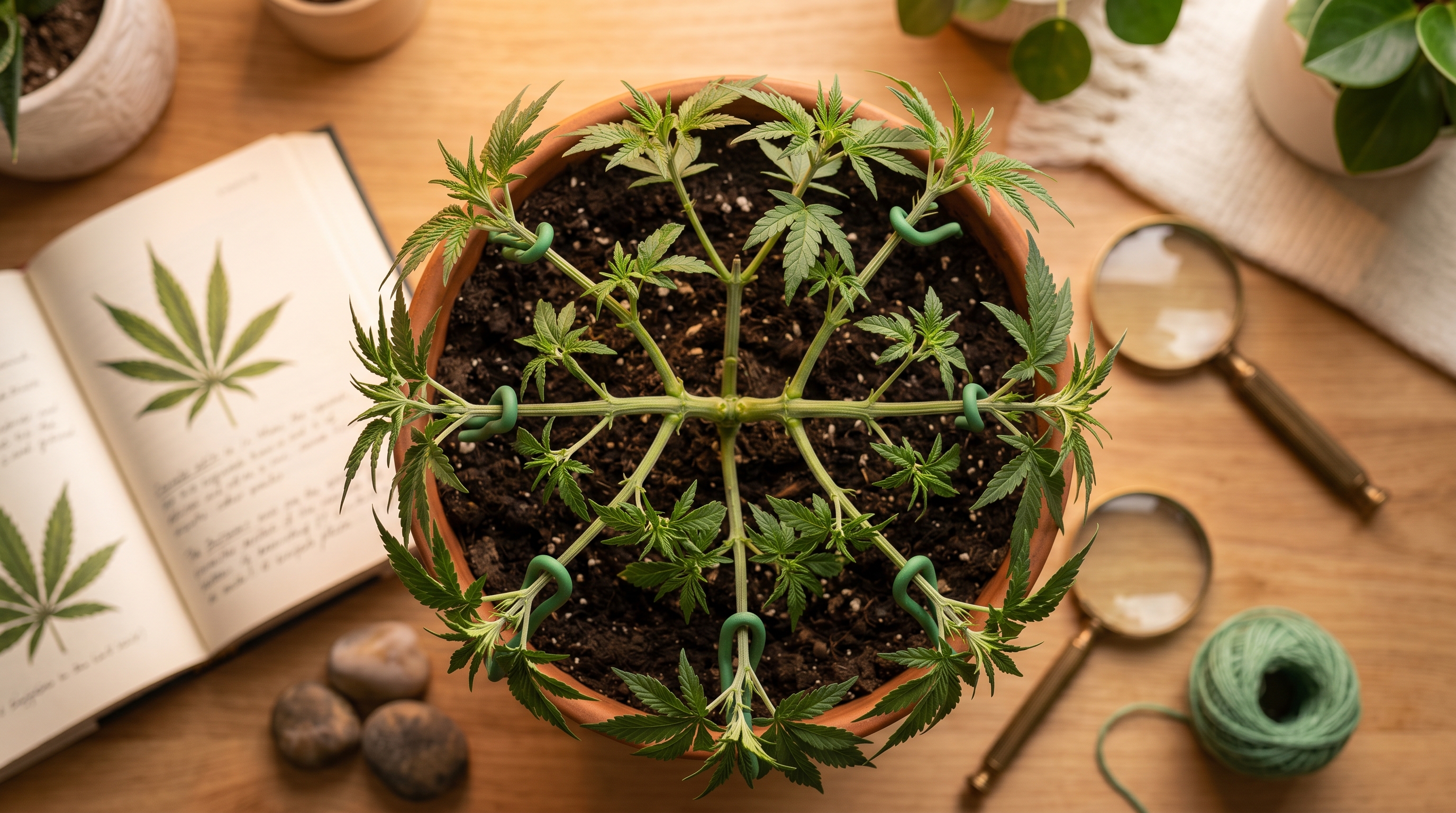
The Science: Apical Dominance and Why a Flat Canopy Wins
To understand why LST works, you need one piece of plant biology: apical dominance. Cannabis, like most plants, sends a hormone signal (auxin) from the top growing tip that tells lower branches to stay small. The plant pours its energy into that single tallest cola, the one closest to the sun, and leaves everything else as backup. Outdoors, with the sun directly overhead and consistent from top to bottom, that “Christmas tree” shape works fine.
Indoors, it’s a problem. Grow lights obey the inverse square law: light intensity drops off dramatically the farther you get from the bulb. A bud two feet below your light might receive only a fraction of the energy the top cola gets. So an untrained indoor plant produces one big top bud and a pile of fluffy, undeveloped lowers that never had a chance.
LST solves this by physically lowering the dominant stem to the same height as the rest. When no single branch is allowed to tower over the others, the plant quits playing favorites. It redistributes hormones and energy across many tops, and they all sit at the same distance from your light, in the “sweet spot” of maximum intensity. The result is many fat colas instead of one, and yields that growers commonly report running 20-40% higher than the same plant left untrained. For a deeper look at where this fits among other methods, see our complete cannabis plant training guide.
What You’ll Need
The beauty of LST is that the gear costs almost nothing. You likely have most of it already.
- Soft plant ties — the gardener’s twist ties with a soft foam or rubber coating are the gold standard. Gentle on stems, reusable, easy to reposition.
- Garden wire or pipe cleaners — soft-coated wire bends to any shape and holds. Pipe cleaners work great for tiny seedlings.
- Stakes or anchor points — bamboo stakes pushed into the soil, or small holes drilled around the rim of your fabric pot, give you something to tie to.
- A soft drill bit or hole punch (optional) — if you want clean tie-down points around your pot’s edge.
What to avoid: anything thin and sharp. Skip bare metal wire, fishing line, or chicken wire. As the stem thickens over the grow, a thin material cuts into the tissue like a cheese wire, creating wounds and entry points for pathogens. When in doubt, go softer and wider. If you’re still building out your space, our grow tent setup guide and LED grow light buyer’s guide cover the rest of the room.
When to Start LST
Earlier is better, and the reason is physical. Young stems are green, flexible, and forgiving; they bend like a fresh garden hose. Older stems turn woody and rigid, and woody stems snap.
The sweet spot is early vegetative growth, once your plant has 3-5 nodes (a node is the point where leaves and branches meet the main stem). At that age the main stem is tall enough to bend meaningfully but still soft enough to do it safely. You can start nudging seedlings even earlier with very gentle bends, but 3-5 nodes is when most growers begin in earnest.
Keep training throughout the entire veg stage. The moment you flip to flower, the plant enters its “stretch” and you’ll want the canopy mostly set. For the full timeline of when veg ends and flower begins, see our cannabis growing stages guide. If you’re brand new to the whole process, start with how to grow cannabis at home.
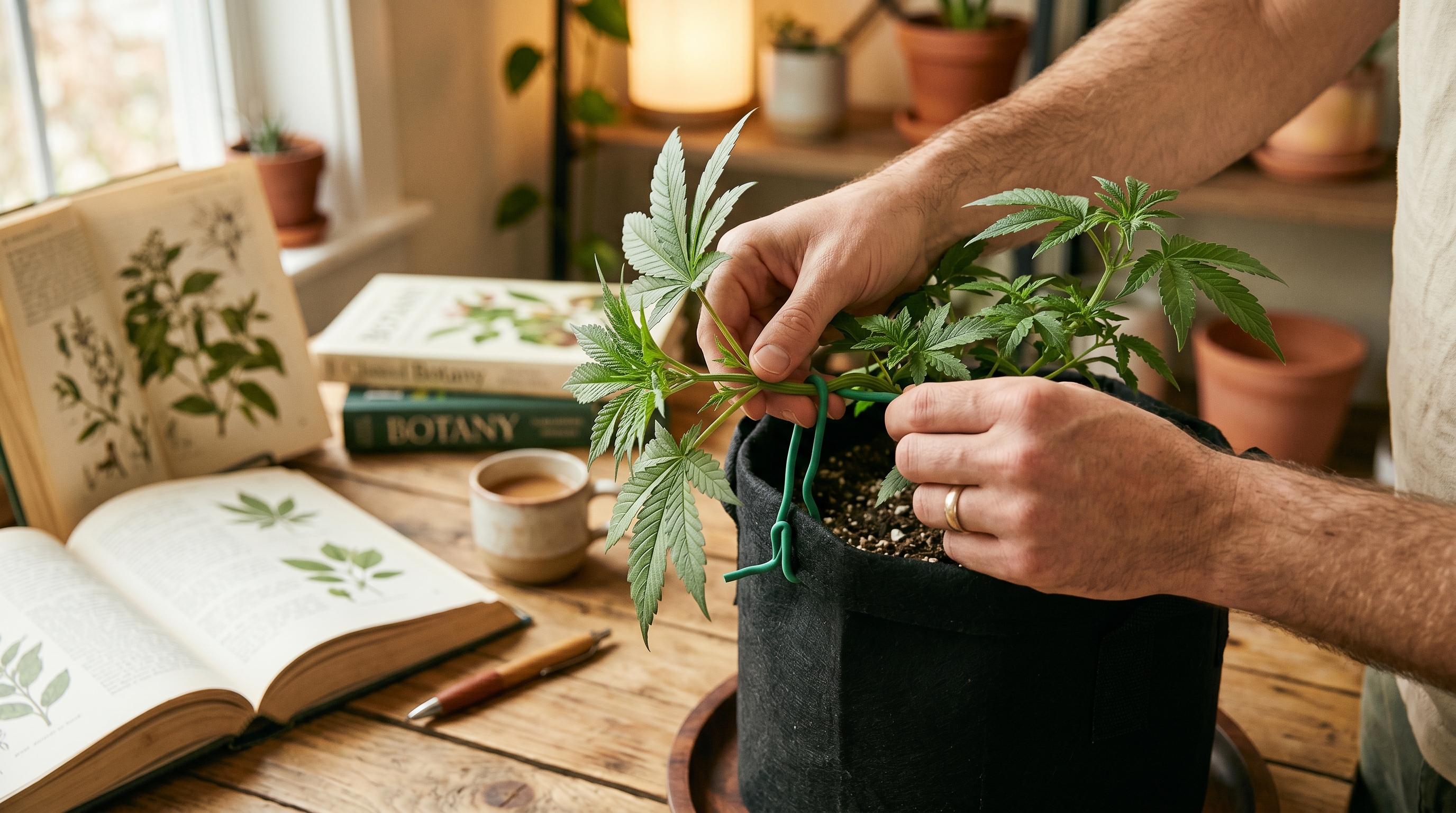
Step-by-Step: Bend, Tie, Retrain
LST is a rhythm, not a one-time event. Here’s the loop.
Step 1: Bend the main stem
Wait until your plant has 3-5 nodes. Gently grasp the top of the main stem and bend it sideways and downward, away from the center of the pot. Go slowly. You’ll feel the stem give; stop well before you feel resistance turn into a crack. The goal is roughly a 90-degree bend so the top is now growing horizontally rather than straight up.
Step 2: Tie it down
While holding the bend, loop a soft tie around the stem (not too tight) and anchor the other end to a stake or a hole in your pot’s rim. The main growing tip should now sit at the same height as, or even below, the side branches. This is the magic moment: you’ve just told the plant that nobody is the boss anymore.
Step 3: Watch the response
Within a day or two the plant reacts. Those side branches, freed from the shade of the dominant cola, surge upward to fill the gap. The bent main stem also tends to sprout new vertical shoots along its length. Suddenly you have four, six, eight competing tops instead of one.
Step 4: Retrain as it grows
This is the part beginners skip, and it’s where the yield actually comes from. As branches grow, the tallest ones will try to reclaim dominance. Every few days, bend the new tall growth back down and out, tying it to the edges. You’re always working toward a flat, even tabletop where every tip is at roughly the same height. Keep filling the gaps, spreading branches outward like spokes on a wheel, opening up the center so light and air reach the middle of the plant.
A well-trained plant by late veg looks almost unnaturally flat and wide. That’s the look you want. If something does go wrong, our guide to common cannabis growing problems covers recovery. Healthy roots make all of this easier, which is why many growers build a super soil base before they ever start training.
Combining LST with Topping and ScrOG
LST plays beautifully with other techniques.
Topping + LST is the classic combo. Topping means snipping off the very top growth tip, which forces the single main stem to split into two. It’s a high-stress method (you’re cutting tissue), but it permanently doubles your main colas. Top once or twice during veg to multiply your tops, then use LST to spread all those new tops flat and even. The two techniques attack apical dominance from different angles: topping removes the dominant tip, LST demotes it. For autoflowers, most growers skip topping entirely (more on that below).
ScrOG (Screen of Green) + LST is LST’s natural endgame. You suspend a horizontal screen (often just netting) above the canopy and weave branches through the squares as they grow, tucking any tip that pokes above the screen back under. The screen does the “tying down” for you and adds support for heavy flowering colas later. ScrOG is essentially LST with training wheels (and a frame). Our full training guide walks through both in more detail. To make all those new bud sites pay off, feed the plant well during the stretch; see the nutrients guide.
LST for Autoflowers: The Ideal Method
If you’re growing autoflowering plants, LST isn’t just an option, it’s the recommended training method. Here’s why.
Autoflowers run on a fixed internal clock. They flower based on age, not light schedule, and the whole life cycle is short, often 70-90 days from seed. That leaves almost no slack for recovery. High-stress techniques like topping, FIMing, or heavy defoliation can shock an auto so badly it stunts permanently, wasting precious days it can’t get back.
LST sidesteps all of that. Because you’re bending instead of cutting, there’s no wound to heal and no recovery period. You get the flat-canopy, multiple-cola benefits without ever stressing the plant.
Two rules for autos:
- Start early and stay gentle. Begin bending while the plant is young and pliable. With autos you can’t afford to wait for a recovery window.
- Bend, don’t cut. Skip topping and pinching. Pure LST only.
Curious where autoflower genetics come from? Read about the ruderalis autoflowering trait and how it compares to other seed types.
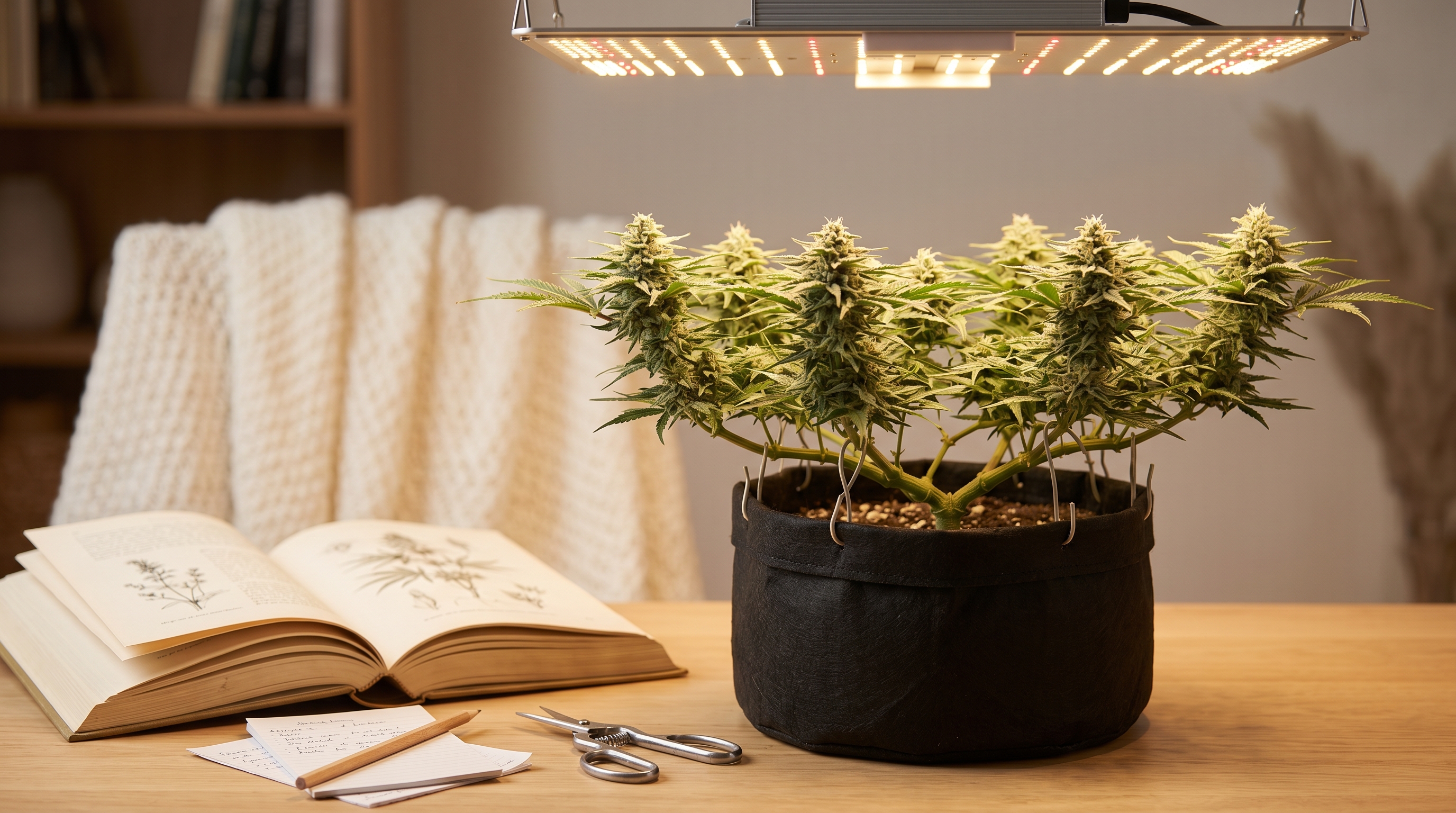
Common Mistakes to Avoid
- Snapping the stem. The most common rookie error. Bend slowly and stop at the first sign of real resistance. If you do hear a partial crack, don’t panic, tape the wound with plant tape or electrical tape and let it heal; cannabis often recovers and even forms a stronger knuckle there.
- Starting too late. Once a stem turns woody it won’t bend, it’ll break. If you missed the early window, work only with the newer, greener growth higher up the plant.
- Tying too tight. A tie that strangles the stem cuts off flow and leaves scars. Leave a little slack so the stem can keep thickening.
- Using sharp materials. Thin wire and fishing line cut in as the plant grows. Always go with soft, coated ties.
- Training into flower. Heavy bending after the stretch can stress flowering plants and snap brittle stems loaded with bud. Set your canopy in veg and only make minor tucks early in flower.
- Forgetting to retrain. One bend is not LST. The yield comes from the ongoing process of keeping the canopy flat as the plant fights back.
Dialing in your environment matters just as much; our grow room humidity, temperature, and CO2 guide and VPD guide help your trained canopy actually fill out. And whether you’re growing indoors or outdoors, the principle holds.
Frequently Asked Questions
Does LST really increase yield? Yes. By exposing more bud sites to strong, direct light and converting fluffy lowers into real colas, growers commonly report 20-40% more usable flower from the same plant compared to leaving it untrained.
Will LST hurt my plant? It shouldn’t, that’s the “low-stress” part. Unlike topping, you’re not cutting anything, so there’s no wound and no recovery time. The only real risk is bending too hard and snapping a stem, which gentle, gradual bending avoids.
When should I stop training? Mostly by the end of veg or the first week or two of flower. Once buds form, stems get brittle and the plant has finished its main stretch. Set the canopy early, then let those evenly lit colas fatten up until it’s time to harvest.
Can I LST a plant I already topped? Absolutely. Topping then LST is the classic combo. Topping multiplies your main colas; LST spreads them flat and even. Just give a topped plant a few days to recover before bending.
My plant is already tall and woody. Too late? For the bottom stem, probably. But you can still train the softer upper growth and gently lower whatever flexible branches remain. Next round, start at 3-5 nodes.
Once you’ve got the technique down, the real magic is matching the right genetics and effect to your goals. That’s where understanding why a strain hits you the way it does comes in, and why we track terpene profiles instead of relying on strain names alone.
Key Takeaways
- LST breaks apical dominance without cutting. You bend and tie branches so no single cola towers over the rest, building a flat, even canopy.
- A flat canopy beats the indoor inverse square law. Every bud site sits in the light’s sweet spot, which is why trained plants commonly yield 20-40% more.
- Start early, at 3-5 nodes, while stems are still green and flexible. Woody stems snap.
- It’s a repeating loop: bend, tie, watch the response, then retrain the new tall growth every few days.
- For autoflowers, LST is the ideal method because there’s no recovery time to lose, just bend, don’t cut.
Sources
- Royal Queen Seeds [RoyalQueenSeeds, 2024] — Low-Stress Training (LST) Explained and autoflower training guidance (royalqueenseeds.com)
- GrowWeedEasy [Cervantes, 2023] — Cannabis Plant Training: LST, Topping & ScrOG (growweedeasy.com)
- Horticultural literature on apical dominance and auxin distribution [Cline, 1997] and the inverse square law of light as applied to indoor canopy management


