

Set and Setting for Cannabis: What Mood, Place and Company Really Change
Set and setting for cannabis: a 2024 review of 29 studies found place, company and expectation did not significantly predict the high. Start with dose.

Professor High
Written by Professor High, our AI guide. See how we research and correct articles.
Mood, place and company line up with how a cannabis session feels in real-life studies, but a 2024 meta-analysis of 29 studies found that environment, company and expectation were not significant predictors of how high people felt, and its authors say the evidence is too weak to rule context out. That is the honest state of the science. “Set and setting” is a phrase borrowed from psychedelic research, and for cannabis it is better treated as a sensible frame than as a proven law.
Here is the line worth screenshotting. The review tested five contextual factors (environment, social group, expectancy, time of day and day of week), and none was a significant predictor of the subjective high once the studies were pooled (Ayyagari and colleagues, 2024). Meanwhile, in a small controlled stress test, changing the THC dose flipped the direction of mood (Childs and colleagues, 2017). So this lesson puts dose first, then people, place and mood, and labels each by how strong the evidence is.
What does set and setting mean?
Set is your mindset: mood, expectations and personality. Setting is the physical and social context: the room, the people and the wider culture. A 2025 analysis of the term calls the standard definitions vague and over-inclusive, and argues that researchers do better when they study one specific piece at a time (Patch and Smith, 2025). The same paper notes that set and setting interventions are “largely untested apart from a few, primarily observational studies,” and that paper is about psychedelic therapy, not cannabis.
The phrase comes from psychedelic research. Timothy Leary first published it in 1961, according to a history of the idea that traces it back through a 19th-century hashish club and 1950s drug research (Hartogsohn, 2017). That history argues that drug effects are partly built by social and cultural factors. It is an argument from history, not a cannabis experiment.
Set and setting also overlaps with placebo research. Both ask how beliefs, preparation and expectation shape a response to a drug. One difference: set and setting tells people what to do, while placebo research describes what happens (Hartogsohn, 2016). If you want the expectation side on its own, our lesson on expectation and the placebo high covers the balanced-placebo studies in detail.
Does set and setting actually change a cannabis high?
Not in a way the pooled studies could show. The 2024 review searched several research databases and kept 29 studies: 19 lab experiments and 10 daily-life tracking studies, where people answer short surveys on their phones during the day. Pooled together, environment, social group, expectancy, time of day and day of week were not significant predictors of the subjective effects of cannabis (Ayyagari and colleagues, 2024).
That is not the same as “context does nothing.” The authors call the research base methodologically weak. The samples were small, many lab studies are old and used weaker THC, the studies measured effects in different ways, and daily-life studies relied on people to report their own dose. Most participants were young North American university students, and 63 percent of the lab experiments enrolled only men. The authors state that it “may be premature to conclude” that context does not shape cannabis effects (full review).
Some single studies inside the review did find context effects, such as older lab studies of environment and threat, and of using alone versus in a group. Pooling did not confirm them. One more finding matters: study type was significant. Lab experiments showed a larger pooled effect than daily-life studies, so how a study is run changes what it finds.
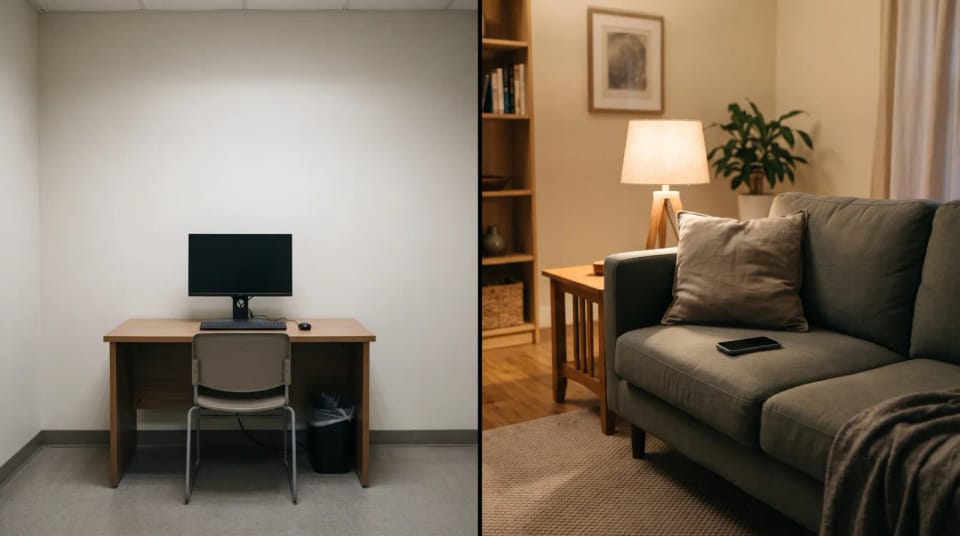
Lab experiments test people in controlled rooms; daily-life studies ask people on their phones at home. The 2024 review found the two study types produced different pooled results.
So when a guide tells you research “confirms” that set and setting drives your high, that goes further than the best pooled evidence. Our lesson on why the same strain can feel different between sessions covers the other factors, such as plant variation, your body and lab testing.
Does smoking alone feel different from smoking with friends?
In daily life, company and mood move together, but nobody has shown that one causes the other. A study that followed 200 adults in the Chicago area across two week-long periods found that positive mood was higher at times of cannabis use, alone or with others. Negative mood was higher at use times when people were alone and lower when they were with others (Denson and colleagues, 2023).
The difference was small. On a 1 to 10 scale, average negative mood at use times was 2.54 alone and 2.41 with others. Direction is also unknown: a person who already feels low may be more likely to use alone. The study measured mood at use times, not the change from before to after use.
A second phone-survey study of 96 adults who used cannabis weekly found that people reported feeling more high and liking the experience more when they used socially or took more THC than usual (Chang and colleagues, 2024). Dose and company also interacted, which is a reason to think about them together. Dose and potency were self-reported, and people chose when and with whom to use.
A college survey linked using alone to more later problems, partly through using to cope (Okey and colleagues, 2022). That study looked at patterns and reasons for use over time, not at how one session feels, and it cannot show that using alone causes harm.
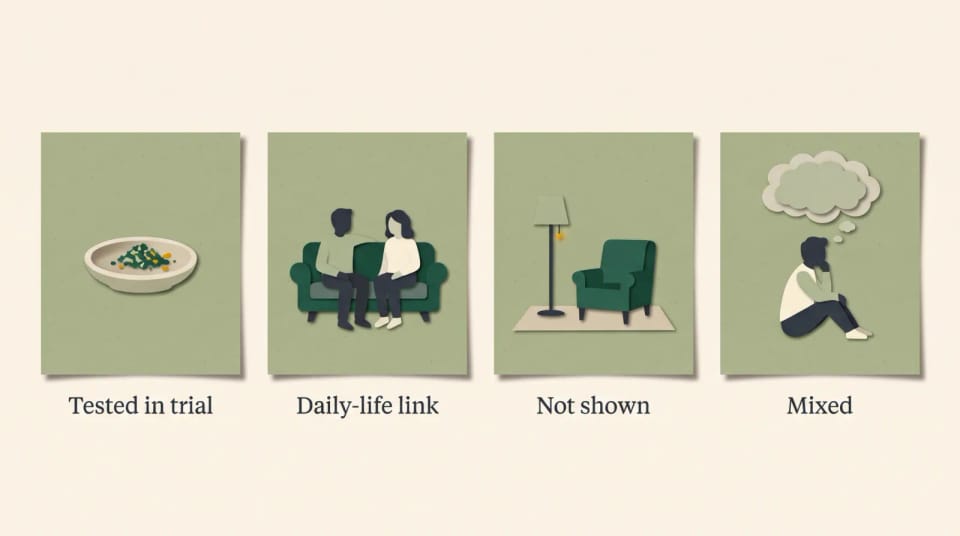
Dose has a small controlled trial behind it. Company has daily-life links that cannot show cause. Place was not a significant factor in pooled studies, and mood and expectation are mixed.
Does your mood before a session change how high you get?
No study we found tests a bad mood before use as the cause of a bad high. That idea is common, and it may be true for some people, but it is folklore until someone tests it. The 2024 review found expectancy was not a significant predictor once studies were pooled (Ayyagari and colleagues, 2024). Balanced-placebo trials do show that believing you got THC changes what people report, which is why we call the mood and expectation evidence mixed and send you to the placebo lesson for the details.
If sessions go badly when you start out anxious, that is your own pattern and worth respecting. Our guide to cannabis and anxiety covers what is known about THC and anxious feelings.
Why does dose belong at the top of the list?
Because dose is the one factor where a controlled trial showed a change in mood direction. In a randomized, double-blind, placebo-controlled study, 42 healthy adults with light cannabis experience took a capsule of placebo, 7.5 mg THC or 12.5 mg THC, then did a stressful public-speaking task or a calm task (Childs and colleagues, 2017).
The lower dose reduced reported distress after the stress task. The higher dose raised negative mood before and during the tasks, made the task seem more threatening and hurt performance. Neither dose changed the stress hormone cortisol (full study).
Read that result carefully. The groups had 13 to 15 people each. The THC was swallowed, not smoked or vaped, so these numbers do not translate to a joint, a vape or an edible from a store. It is not a recommended dose, and it is not a reason to use cannabis for stress. What it shows is direction: the same drug in the same lab setting moved mood one way at a lower dose and the other way at a higher one.
That matches what tends to go wrong in the worst sessions. Our lessons on greening out and start-low, go-slow dosing cover the amount side.
How strong is the evidence for each part of set and setting?
| Factor | What the evidence shows | Strength |
|---|---|---|
| Dose | In a lab stress test, a lower oral dose eased distress and a higher dose raised negative mood. New York regulators advise “start low, go slow.” | Small controlled trial plus official guidance |
| People | Negative mood was slightly lower at use times with others than alone. Social use was linked with feeling more high and liking it more. | Daily-life associations; cannot show cause |
| Place | Environment was not a significant predictor in the pooled review. Older single studies were small. | Weak or not shown |
| Mood and expectation | Expectancy was not significant in the pooled review. Balanced-placebo trials show belief changes reported effects. | Mixed |
A four-person 2026 pilot gave a high oral THC dose in a psychedelic-therapy style room and found it felt similar to psilocybin on the questionnaires used (Barrett and colleagues, 2026). It had no plain-room comparison, so it cannot tell us what the room added.
How do you set up a session using what the evidence supports?
Use this order. It puts the best-supported factor first and keeps the weaker ones as sensible comfort, not as guarantees.
- Decide the dose first. Choose a low amount before you start, and wait for it to take effect before you take more. New York’s cannabis regulator gives the same “start low, go slow” advice (NY Office of Cannabis Management).
- Choose your company. Decide who will be with you. The daily-life studies link use with others to slightly lower negative mood, but they cannot show that company causes it.
- Choose a place you can stay. Pick somewhere you can sit, rest and stay put, with no driving or work ahead. This is about safety and comfort; the pooled studies did not show that the room changes the high.
- Check your expectations. Notice what you expect to feel and why. Expectation can change what people report, so naming it helps you read the session honestly.
- Plan for discomfort. The New York regulator suggests a comforting activity, such as music or a show, calling someone you trust, and not adding other substances. In an emergency, call 911 or Poison Control at (800) 222-1222 (NY OCM consumer page). Our guide on what helps when you feel too high has more.
- Write down what happened. Record the product, amount, place, people and mood. A session journal turns guesses into your own pattern. If you prefer your phone, the High IQ app lets you track how a strain worked for you each time.
New to all of this? Our first-time guide walks through the same choices step by step.
When should you talk to a clinician?
Talk to a doctor or other clinician if sessions often leave you anxious, panicky or paranoid, if you use cannabis to manage low mood or stress, or if you take medicines or have a heart or mental health condition. For chest pain, trouble breathing, fainting or thoughts of harming yourself, get emergency help now. If a session turns frightening, our lesson on cannabis and paranoia explains what is happening and when to get help. This lesson is education, not medical advice.
Key takeaways
- “Set and setting” comes from psychedelic research. For cannabis, it is a frame, not a proven law.
- A 2024 review of 29 studies found that environment, company and expectancy were not significant predictors of the high, and its authors say the studies are too weak to rule context out.
- Company and mood move together in daily life, but those studies cannot show cause.
- Dose is the one factor where a controlled trial showed a change in mood direction.
- Plan dose first, then people, place and expectations, and write down what happened.
FAQ
Does set and setting work for weed the way it does for psychedelics?
The evidence for cannabis is thinner. The idea was built for psychedelics, and the best cannabis review found no significant pooled effect of environment, company or expectancy. That does not prove context is irrelevant, because the studies are small and mostly old. If you are curious how the two drug classes overlap, see our lesson on psychedelic co-use.
Does smoking alone make you more anxious?
Not proven. In a phone-survey study of 200 adults, negative mood was slightly higher at use times when people were alone than when they were with others. People who already feel low may simply be more likely to use alone, so the study cannot show that being alone causes anxiety.
Can you think your way into feeling high?
Partly. Balanced-placebo trials show that believing you received THC changes what people report, even when the drug is held constant. The pooled 2024 review still found expectancy was not a significant predictor across studies. Our placebo lesson explains how those trials work.
Is a bad mood a reason to skip a session?
It is a reasonable precaution, not a proven rule. No study we found tests a bad mood before use as the cause of a bad high. A lab study did find that a higher THC dose raised negative mood, so if you go ahead, keep the amount low and have a plan to stop.
What helps when a session turns uncomfortable?
New York’s cannabis regulator suggests a comforting activity such as music or a show, calling someone you trust, and not adding other substances. In an emergency, call 911 or Poison Control at (800) 222-1222. Seek urgent care for chest pain, trouble breathing or fainting.
Sources
- Ayyagari MM, Heim D, Sumnall HR, Monk RL. Contextual factors associated with subjective effects of cannabis: a systematic review and meta-analysis. Neuroscience and Biobehavioral Reviews, 2024.
- Denson RK, Hedeker D, Mermelstein RJ. Association between affect and cannabis use varies by social context. Drug and Alcohol Dependence, 2023.
- Chang YC, Magnan RE, Cleveland MJ, Ladd BO. Event-level associations among THC, CBD, social context, and subjective effects during cannabis use episodes. Journal of Psychopharmacology, 2024.
- Childs E, Lutz JA, de Wit H. Dose-related effects of delta-9-THC on emotional responses to acute psychosocial stress. Drug and Alcohol Dependence, 2017.
- Hartogsohn I. Constructing drug effects: a history of set and setting. Drug Science, Policy and Law, 2017.
- Hartogsohn I. Set and setting, psychedelics and the placebo response. Journal of Psychopharmacology, 2016.
- Patch K, Smith WR. What are set and setting: reducing vagueness to improve research and clinical practice. Journal of Psychopharmacology, 2025.
- Barrett FS and colleagues. Pilot study comparing high dose THC to high dose psilocybin and placebo in a classic psychedelic therapy setting. Psychopharmacology, 2026.
- Okey SA, Waddell JT, Corbin WR. I smoke alone: indirect effects of solitary cannabis use on negative consequences through coping motives. Journal of Studies on Alcohol and Drugs, 2022.
- New York State Office of Cannabis Management. Consumers. Consumer guidance page, accessed October 29, 2026.



