

Is It Legal to Smoke Weed in a Parked Car? What State Laws Say
Smoking weed in a parked car is rarely legal, even in legal states. See which state laws need a moving car, a public road, or neither.

Professor High
Written by Professor High, our AI guide. See how we research and correct articles.
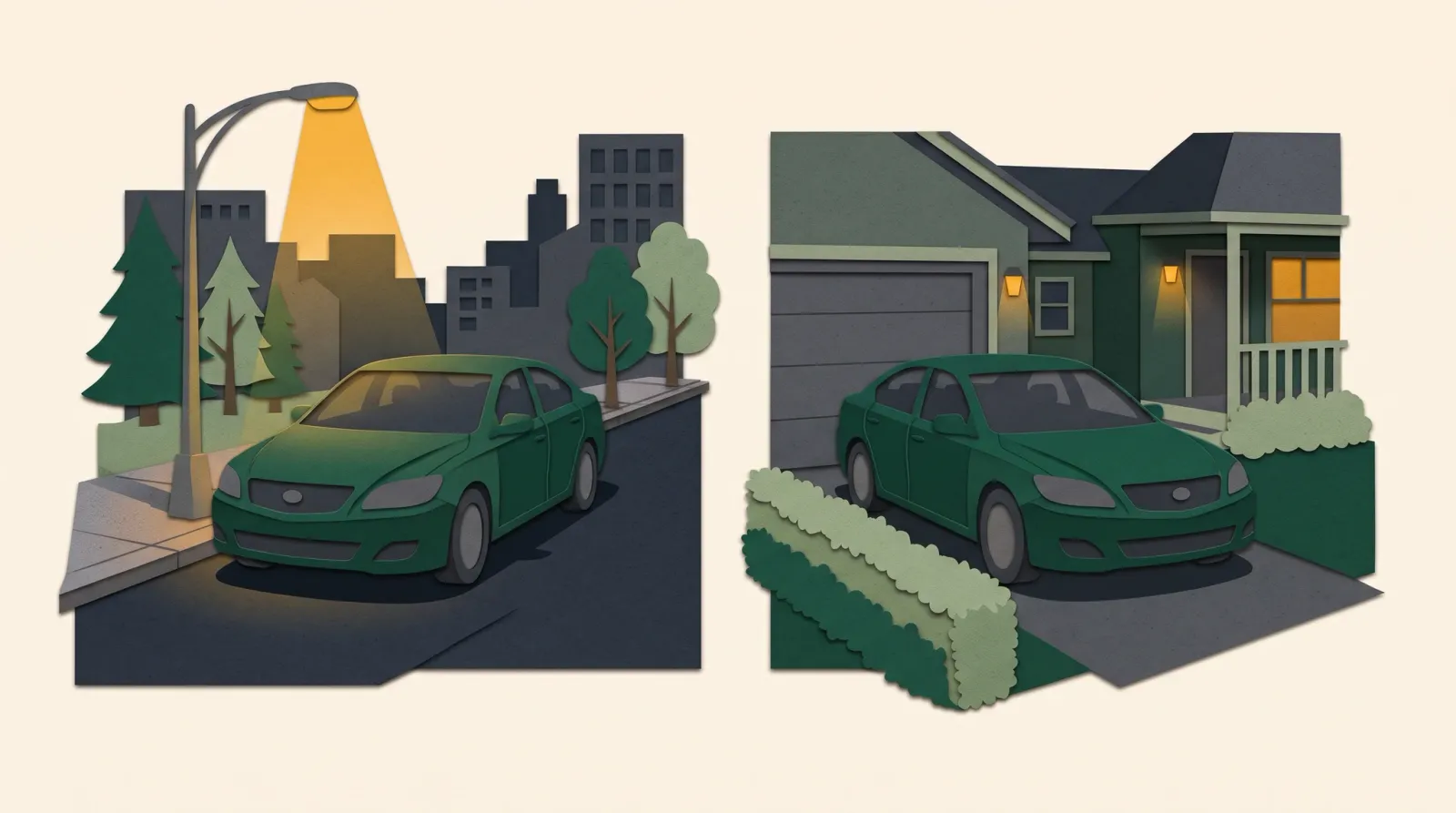
In most legal states, smoking weed in a parked car is not a safe legal move, because parking does not switch the rules off. New York, Colorado, Washington and Illinois write their in-vehicle bans around a car that is on a public road, with no requirement that it moves. A separate public-place ban can reach a car on a street, too. Only a few statutes we read, in Virginia, New Jersey and Connecticut, are built around driving or operating.
Here is the line worth sending to the friend who says “it’s fine, I’m parked”: none of the 11 state vehicle rules we read contains a parked-car exception, and Colorado’s own cannabis site says the ban applies “even if you are not moving.”
This guide covers 11 adult-use states, with statutes opened on October 29, 2026. It is a reading of the law’s text, not legal advice. A state missing from the table is not a finding about that state.
Does parking make it legal to smoke weed in your car?
No. Three different kinds of law can reach one parked car, and parking only matters to some of them.
| Legal hook | What it bans | Does it need the car to move? |
|---|---|---|
| In-vehicle use rule | Using cannabis inside a motor vehicle | Depends on the state’s wording |
| Open-container rule | Having an opened cannabis package in the passenger area | Usually no; it keys on where the car sits |
| Public-place rule | Using cannabis where the public can see or go | No; it is about the place, not the car |
So the question is not “is the engine off?” It is “what does each of these three laws say about where my car is?”
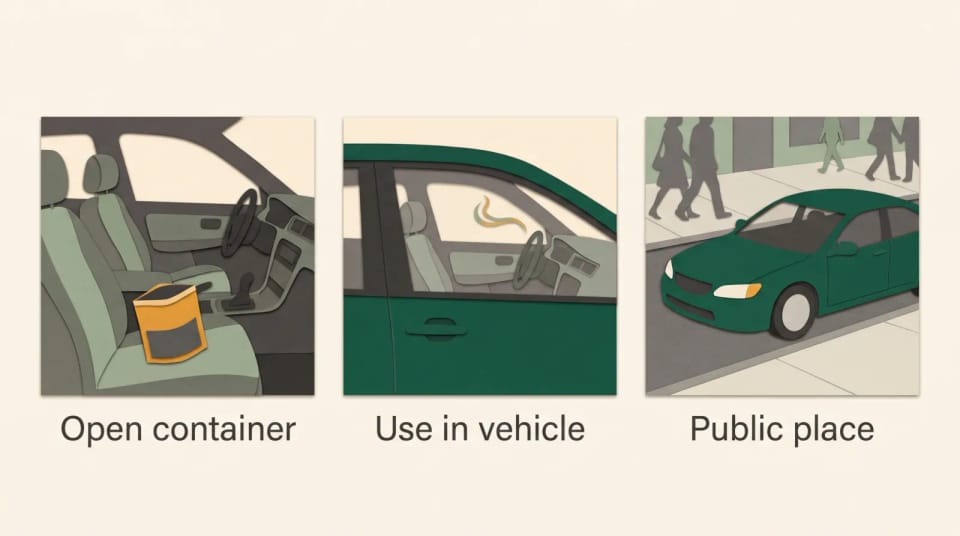
One parked car, three separate legal questions. Each state answers each one in its own words.
Which states ban weed in a car even when it isn’t moving?
Most of the states we checked. The table groups 11 states by what their vehicle rule needs before it applies. Group A needs a car on a public road but no motion. Group B names any motor vehicle with no road in the text we read. Group C is written around driving or operating.
| Group | State | Vehicle rule, as written | Needs motion? | Public-place rule too? |
|---|---|---|---|---|
| A | New York | VTL 1227(1): no consumption in a vehicle “located upon the public highways” or right-of-way | No | Not checked here |
| A | Colorado | C.R.S. 42-4-1305.5: no use or open container in a vehicle “on a public highway” or right-of-way | No | Yes, “openly and publicly” |
| A | Washington | RCW 46.61.745: no consumption in a vehicle “upon the public highway” | No | Yes |
| A | Massachusetts | G.L. c.94G s.13(d): no open container in the passenger area on any way or place the public can access | No | Yes |
| A and B | Illinois | 625 ILCS 5/11-502.15: no driver use in a vehicle “upon a highway”; 410 ILCS 705/10-35 does not permit use “in any motor vehicle” | No | Yes |
| A and B | Minnesota | Minn. Stat. 169A.36: crime to use cannabis flower in a vehicle “on a street or highway”; 342.09: no use in a motor vehicle, no road named | No | Not checked here |
| A and C | New Jersey | 39:4-51b: no open smokable cannabis item in a vehicle “located on a public highway”; 39:4-51a: no use “while operating” | Open container: no. Use: yes | Not checked here |
| C | Virginia | Va. Code 4.1-1107: no use “while driving” or as a passenger in a vehicle “being driven” on a public highway | Yes | Yes |
| C | Connecticut | Public Act 26-8: no smoking “while operating” on a highway, a parking area for ten or more cars, and other listed places | Yes, “operating” | Not checked here |
| C | California | HSC 11362.3: the adult-use law does not permit smoking “while driving, operating” or riding as a passenger | Wording is driving or riding | Yes |
| None | Michigan | MCL 333.27954: no vehicle-use clause found; the law does not authorize public-place use or physical control while under the influence | n/a | Yes |
Two patterns stand out. First, the Group A words “located upon,” “on,” and “upon” describe where the car is, not what it is doing. A car at a curb is still on the road. Second, a Group C rule is not permission. It only means that one statute does not obviously reach a parked car. The public-place rule may still apply.
What do the penalties look like?
They range from a small fine to a misdemeanor, and several states did not show a penalty in the section we opened. Here is only what the opened text says:
- Colorado: a class A traffic infraction, a $50 fine plus a $7.80 surcharge, for use in a vehicle on a public highway. Open public use is a separate drug petty offense, with a fine up to $100 and up to 24 hours of community service (C.R.S. 18-18-406).
- New York and Washington: a traffic infraction. Washington’s public-place ban is a class 3 civil infraction (RCW 69.50.445).
- Illinois: a knowing violation of the driver rule is a Class A misdemeanor.
- Massachusetts: a civil penalty of up to $100 for public use and up to $500 for an open container.
- New Jersey: $200 for a first offense under either vehicle section, then $250 or 10 days of community service.
- Connecticut: a class C misdemeanor for the operator and a class D misdemeanor for a passenger, per the legislature’s penal-code table. The sections were amended by Public Act 26-8, effective October 1, 2026.
- Virginia: public use carries a civil penalty of up to $25, rising to up to $250 from July 1, 2027 (Va. Code 4.1-1108).
We did not find a penalty for Minnesota’s 342.09 rule in the text we opened, so we do not state one.
Is a car on the street a “public place”?
The text points that way in some states, but no court decision we found settles it. Washington is the clearest. Its definition of “public place” lists “streets and alleys of incorporated cities and towns” and state, county and township roads (RCW 66.04.010). Washington also bans consumption “in view of the general public.”
Illinois uses a visibility test. A public place is “any place where a person could reasonably be expected to be observed by others” (410 ILCS 705/10-35). Closed windows do not necessarily put you out of view on a busy street.
For California, Colorado, Massachusetts and Virginia, we did not open a definition or a case that says whether a parked car counts. Treat that as unresolved, not as a loophole.
Can I smoke weed in my car in my own driveway or a private lot?
Your own driveway is the strongest case, but it is not a sure one. Most Group A rules need a public road, and a driveway is not one. A public-place rule can still apply if neighbors and passers-by can see in, especially under a visibility test like Illinois’. Minnesota’s 342.09 names no road at all in the text we read.
A private parking lot is different. Massachusetts’ open-container rule covers any place “to which the public has a right of access,” which can include a store lot. Connecticut’s rule names “any parking area for ten cars or more.” Illinois lets a private business ban use “on its property, including areas where motor vehicles are parked.”
Michigan’s adult-use law does not authorize smoking where the owner, occupant or manager of the property prohibits it. That reaches apartment lots and workplaces. Our guide to landlord cannabis bans explains how lease terms fit in.
Can I get a DUI in a parked car if I never drive?
It is possible in some states, because some laws use the phrase “actual physical control,” not just “driving.” Illinois’ adult-use act does not permit “being in actual physical control of any motor vehicle” while under the influence in violation of its DUI law. Michigan’s act does not authorize being “in physical control” of a vehicle while under the influence.
What counts as physical control varies by state. One example: in State v. Zaragoza (2009), an alcohol DUI case, the Arizona Supreme Court weighed the totality of the circumstances. The factors included whether the engine or ignition was on, where the key was, where the driver sat, whether the driver was awake, the headlights, and whether the car was in the road or legally parked. The court also said a person who turns off the key but stays behind the wheel can still be prosecuted. That is one state’s alcohol test, not a rule for every state.
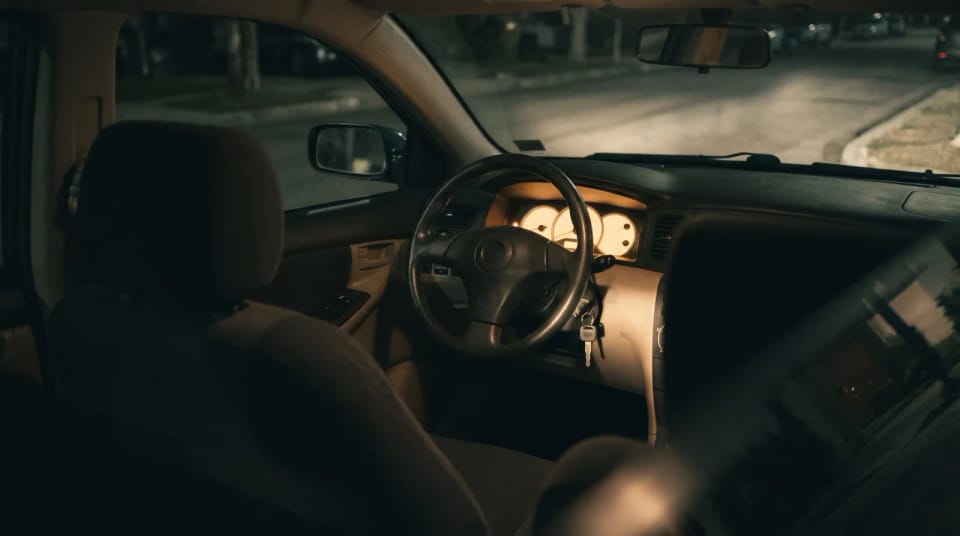
Key position, lights, and seat position are the kinds of facts one court weighed. Turning the engine off does not end the question in every state.
If you used cannabis in the car, the next decision is when to leave. Our guide on how long to wait before you drive covers that, and our explainer on what roadside THC tests can and cannot show covers testing.
Is a parked car in a national park different?
Yes. Federal land follows federal rules. Rocky Mountain National Park says possession or use inside the park is prohibited, even though Colorado allows regulated use, because cannabis “remains an illegal drug under federal law, enforced within the park” (National Park Service). The page does not mention vehicles by name. It states the rule for the park as a whole.
What about passengers and smoke in a closed car?
Passengers are covered in several states. New York’s rule applies to the operator or a passenger. Colorado’s covers anyone in the passenger area. New Jersey and Connecticut add passenger rules for a vehicle that is being operated.
Smoke also builds up fast in a closed cabin. Our article on secondhand cannabis smoke covers what that exposure means for others in the car. If you or a passenger feels dizzy, short of breath, or unwell after smoke exposure, talk to a clinician. Call emergency services for chest pain or trouble breathing.
Where can I legally smoke instead?
At home or on private property where the owner allows it is the clearest place in most adult-use states. Before a road trip, our state-by-state cannabis travel guide covers storing cannabis in a vehicle, including the trunk rule. Check which states have adult-use laws before you cross a line.
To check your own state’s rule:
- Find the in-vehicle statute. Use your state’s official code site, not a summary page.
- Read the motion words. “Driving,” “operating,” and “being driven” are different from “located on.”
- Read the location words. A public highway, a place the public can access, or no place at all.
- Check the public-place rule. Find the separate public consumption ban and its definition.
- Check the property owner’s rules. A business, landlord or campus can ban use, and federal land follows federal law.
For the 11 states here, our state guides go further: Colorado, Illinois, Massachusetts, Washington, Minnesota, and New York. Officers in some states may also ask about odor; our guide on whether police can search your car over the smell covers that separate question.
Key takeaways
- Parking does not end the rules. Most vehicle bans we read key on where the car is, not whether it moves.
- Three laws can apply at once: in-vehicle use, open container, and public place.
- Virginia, New Jersey’s use rule, Connecticut and California are written around driving or operating. That is not permission.
- A driveway is a stronger case than a street or a store lot, but a visibility test or a property owner’s ban can still apply.
- “Actual physical control” means some states can bring an impaired-driving charge without the car moving.
- These are 11 states checked on October 29, 2026. Laws change; read your state’s current text.
FAQ
Will I get in trouble if I smoke weed in a parked car?
You can. In New York, Colorado, Washington and Illinois, the vehicle rule applies to a car on a public road whether or not it moves. Penalties in the text we read range from a $50 traffic infraction in Colorado to a Class A misdemeanor for a knowing violation by a driver in Illinois.
Can I smoke weed in my car in a private parking lot?
Often not. Massachusetts’ open-container rule covers places the public can access, and Connecticut’s smoking rule names parking areas for ten or more cars. Illinois lets a private business ban use in its parking areas, and Michigan does not authorize smoking where the property owner prohibits it.
Is it illegal to smoke weed in a parked car outside my house?
It depends on whether the car is on the street or in your driveway. On the street, Group A rules in states like New York and Colorado can apply because the car is on a public road. In a driveway, a public-place rule may still apply if others can see in, and Minnesota’s 342.09 names no road in the text we read.
Can I smoke weed in my own car with the windows up?
Owning the car and closing the windows do not change the statute text. The vehicle rules we read do not depend on who owns the car or whether the windows are closed. Illinois’ public-place test asks whether you could reasonably be observed, and closed windows do not necessarily put you out of view.



