

Sour Diesel Cuts Explained: Is NYC Diesel the Same Strain?
No. NYC Diesel is a seed hybrid from an Amsterdam breeder, while Sour Diesel cuts are New York clones. See what each Diesel label means and how sure anyone is.

Professor High
Written by Professor High, our AI guide. See how we research and correct articles.
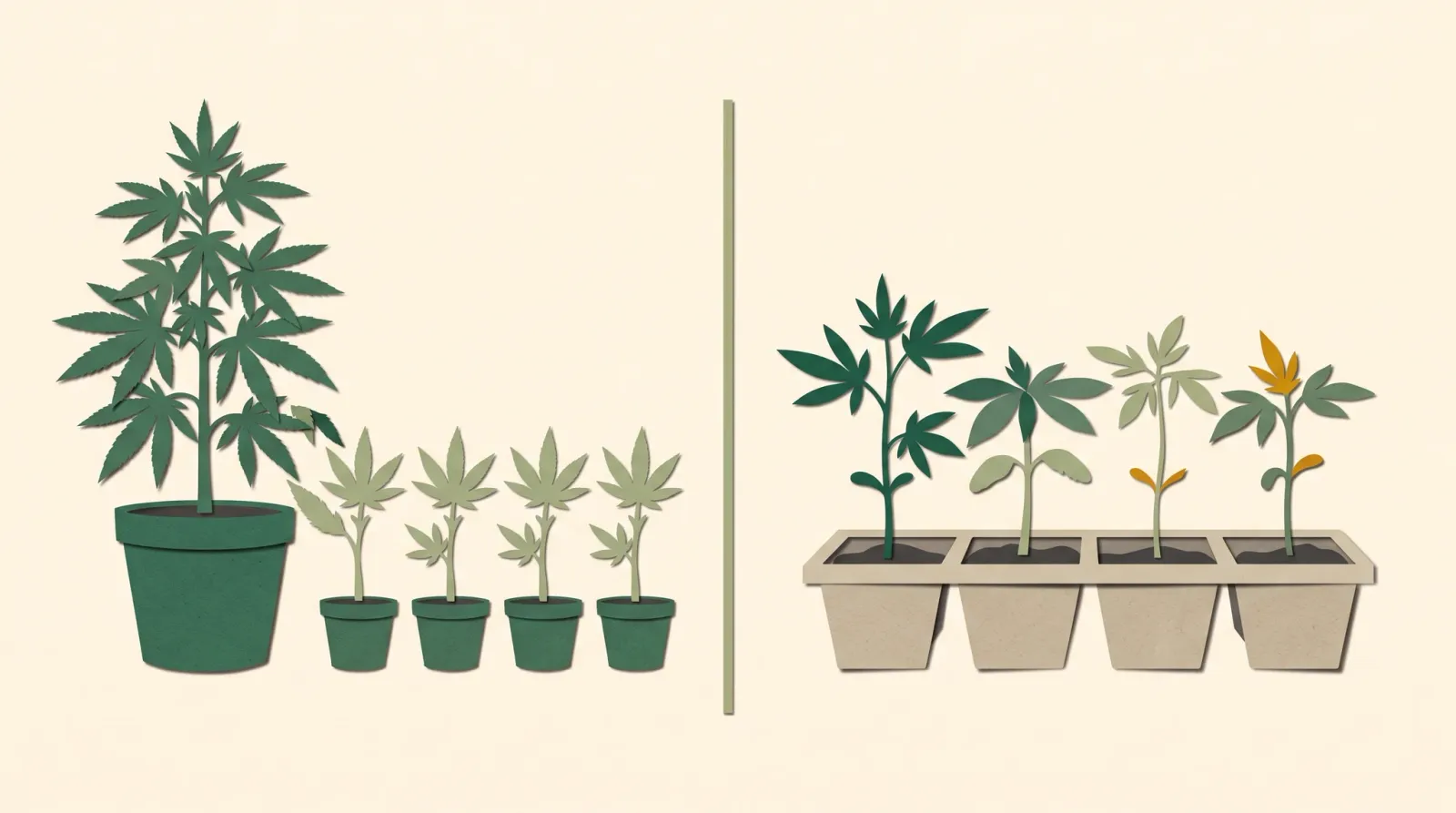
No: NYC Diesel is a seed hybrid from an Amsterdam breeder, while the Sour Diesel “cuts” are clone-only plants and seed lines from the New York Chemdawg 91 family, and the name on a jar does not tell you which one you have. The two names share a history, a smell family and some genes. They still point to different plants.
Here is the twist that confuses everyone. The best-known Sour Diesel seed line was built by crossing a Sour Diesel clone with Soma’s NYC Diesel, according to the breeder’s own description. Reservoir Seeds’ Sour Diesel IBL notes list “Sour Diesel Clone X Sour Diesel / Soma’s NYC Diesel” as one of its backcross steps. So some seed-grown “Sour Diesel” carries NYC Diesel genes, and NYC Diesel is still not a Sour Diesel cut.
And when researchers bought seven jars labeled “Sour Diesel” from dispensaries and tested their DNA, the seven did not come back as one plant. Schwabe and McGlaughlin, 2019
This lesson in High School sorts the Diesel names into what they most often mean, who makes each lineage claim, and how much weight each claim can carry.
What is a Sour Diesel “cut”?
A cut is one individual plant kept alive by cloning. A grower snips a branch, roots it, and grows a genetic copy of the mother. Do that for decades and one plant can live in thousands of gardens. Our guide to what a cut (clone) is walks through the process, and phenotype hunting explains how one keeper plant gets picked out of a pack of seeds in the first place.
A “clone-only” strain has no seeds that reliably reproduce it. If you want that exact plant, you need a cutting from someone who has it. That is why Diesel growers argue about cuts: the only proof of identity is the chain of hands the cutting passed through.
A seed line is different. Seeds from the same parents are siblings, and siblings vary. Two plants from one seed pack can smell and grow differently.
So “Sour Diesel” on a label can mean at least five different things:
- A clone-only cut, such as the plant sold as East Coast Sour Diesel.
- A seed line made from a cut, such as a breeder’s attempt to put the clone into seed form.
- A seed hybrid from another breeder that shares the word “Diesel”, such as NYC Diesel.
- A cross that uses a Diesel parent, with its own new name.
- A name with no published lineage at all.
Nothing on the jar tells you which one you have. That is the whole problem, and it is a common one. A 2015 genetic survey of marijuana and hemp found that “marijuana strain names often do not reflect a meaningful genetic identity.” Sawler et al., 2015 Our article on how strain names work covers the naming habits behind that.
Where did Sour Diesel come from?
Every account starts with Chemdawg 91 in the early-to-mid 1990s, and almost every other detail is disputed. The origin story is oral history. Treat each version as a claim from the people involved, not a settled fact.
- A 2016 High Times history reports that in late 1994, the grower known as AJ named “an accidental cross of Chem 91 and an unknown hermie from Weasel’s growroom ‘Diesel’.” Friends in Albany later called it “The Sour.” The same article says these origins “continue to be matters of much dispute.” High Times, 2016
- A 2006 Cannabis Culture account says Diesel came from a seed in a bag of Chemdawg, and that “a hermaphrodite Massachusetts Super Skunk pollinated the Diesel, and from the seeds created, the Sour Diesel was born.” Cannabis Culture, 2006
- In a 2025 interview on a seed retailer’s blog, AJ dates the seed to around 1996 and says the jar labeled “Our Diesel” became “Sour Diesel.” AJ interview, 2025
Notice the gaps. The dates run from 1994 to 1996. The second parent is a Massachusetts Super Skunk in one telling and an unknown hermaphrodite in another. These two outlets also draw on overlapping community sources, so they do not confirm each other independently. If you see “Chemdawg x Super Skunk, late 1990s” stated as plain fact, that is one version of a contested story.
What is documented is that the name was already a premium product in New York by the mid-2000s. An ethnographic study of 99 weighed marijuana purchases in New York City found that “designer brand names describing actual strains like Sour Diesel and White Widow were only found downtown.” Sifaneck et al., 2007
For the Chemdawg side of the family, see OG Kush and the Chemdawg family. You can also look up the Chemdawg and Super Skunk strain pages.
Is NYC Diesel the same as Sour Diesel?
No. NYC Diesel is a seed hybrid sold by Soma Seeds in Amsterdam, and the breeder never presents it as a Sour Diesel cut. Soma’s current listing gives its parents as “Mexican Sativa x Afghani” and says it began with seeds from “a friend” who called them “the best pot he had ever smoked.” Soma Seeds, NYC Diesel
That listing does not settle the parents, though. Older grower forum posts describe NYC Diesel as a bagseed “Diesel” mother crossed to an Afghani/Hawaiian male, and some posters insist that “absolutely no Sour Diesel was used.” ICMag thread, 2006 Those are anonymous claims, not evidence. The honest summary: NYC Diesel is a Soma seed hybrid, and its exact parents are not agreed on.
| East Coast Sour Diesel (the cut) | NYC Diesel | |
|---|---|---|
| What it is | A clone-only plant passed hand to hand | A seed hybrid you can buy as seeds |
| Where the claim starts | New York growers, early-to-mid 1990s | Soma Seeds, Amsterdam |
| Claimed parents | Chem 91 x a disputed second parent | “Mexican Sativa x Afghani” per the breeder; forum accounts differ |
| Do two plants match? | Yes, if the cutting is authentic | Not always; seed siblings vary |
| Who vouches for it | Oral history and the chain of cuttings | The breeder’s own listing |
Two things blur the line.
First, the words “NYC Diesel” have been used for the New York Chem line too. The 2016 High Times history says the original cut “eventually became famous as the NYC Diesel, AJ Sour Diesel or East Coast Sour Diesel.” High Times, 2016 A seed shop’s history page also credits a different New York breeder with an “Original New York City Diesel” made from Chem 91. Alchimia, 2025 So when an older post says “NYC Diesel”, it may not mean Soma’s plant.
Second, the seed line many growers know as Sour Diesel IBL was made by crossing a Sour Diesel clone to Soma’s NYC Diesel and then backcrossing, according to the breeder’s description. Its stated goal was “the Perfect Representation of the World-famous Sour Diesel Clone, in seed form.” Reservoir Seeds’ description That is how the two names ended up sharing genes.
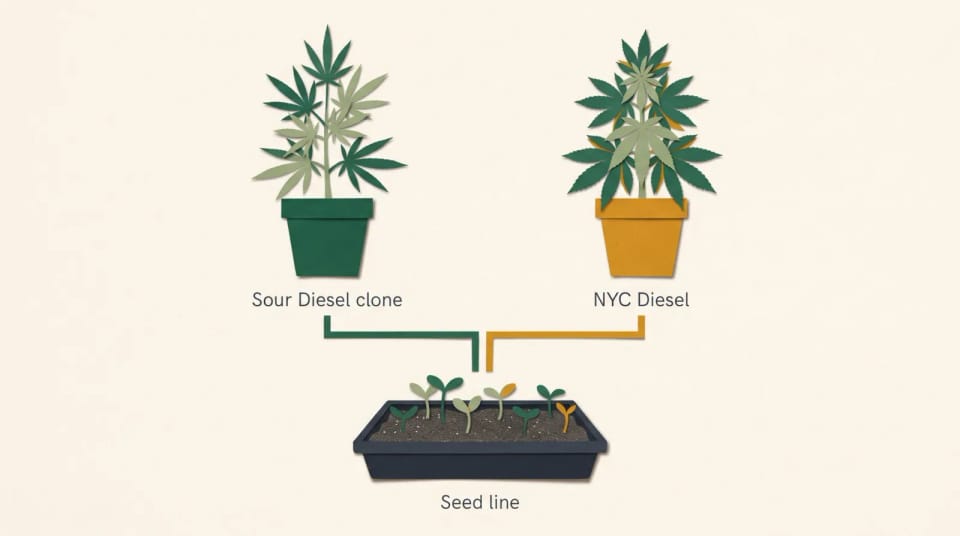
According to the breeder’s notes, one well-known Sour Diesel seed line came from a Sour Diesel clone crossed with NYC Diesel. Shared genes, different plants.
What separates East Coast, AJ, Amherst and the other Diesel cuts?
Mostly the story attached to each one, because no named Diesel cut has been genotyped in a published study. The table below sorts the common labels by what they most often mean and who makes the lineage claim. The confidence column uses this scale:
- Medium: one named breeder states it in their own listing, with no independent check.
- Low: oral history or forum accounts that conflict.
- Name only: no published lineage found.
No row reaches “High”, which would need two or more independent, checkable sources such as a lab genotype.
| Name on the label | What it most often means | Claimed lineage, and who claims it | Confidence |
|---|---|---|---|
| Sour Diesel (no qualifier) | Anything sold under the plain name | Chem 91 x a second parent that accounts disagree on: Massachusetts Super Skunk, an unknown hermaphrodite, or other pollen | Low |
| East Coast Sour Diesel (ECSD) | A clone-only cut said to be the original | The same oral history; several named sub-cuts circulate, and growers say they are not identical | Low |
| AJ Sour Diesel | The cut tied to the grower AJ | AJ’s account: an accidental seed from Chem 91 in New York, kept as “Our Diesel” | Low |
| Sour Diesel IBL and cuts picked from it | A seed line built from an ECSD clone | The breeder’s listing: Sour Diesel clone crossed to NYC Diesel, then backcrossed | Medium for the seed line, Low for any cut from it |
| Amherst Sour Diesel | One breeder’s seed line from a clone | Humboldt Seed Organization lists “Chemdawg (pre-90’s) X Amherst Super Skunk” and says the clone came from New York in the early 1990s | Medium |
| NYC Diesel (Soma) | A seed hybrid, not a cut | Soma lists “Mexican Sativa x Afghani”; older forum accounts give different parents | Medium that it is a Soma hybrid, Low on the parents |
| “NYC Diesel” for the New York Chem line | An older use of the same words | A 2016 history and a seed shop’s history page both use it for Chem-family plants | Low |
| OG Sour Diesel | Unclear: a cross, a renamed cut or a label | No breeder source found | Name only |
| California Sour Diesel | A west-coast selection or label | No breeder source found | Name only |
Sources for the table: the Humboldt Seed Organization listing, the breeder notes and histories cited above, and grower forum threads for the conflicts.
Even the people closest to the cut say identity is hard to confirm. In his 2025 interview, AJ says that in 2022 he grew five cuts sold to him as his Sour Diesel, and “none of them were authentic.” AJ interview, 2025 That is one person’s statement, made in a promotional setting, so weigh it as a claim. It still shows the core problem: a cutting’s name travels more easily than its proof.
Age is not proof either. A clone kept for decades is a living plant that can pick up problems along the way. Researchers have found hop latent viroid in stock plants and rooted cuttings that looked healthy. Punja et al., 2025 That study did not test any Diesel cut. It shows only that “old cut” and “unchanged cut” are not the same claim.
Does a DNA test show which Sour Diesel is real?
No published study has tested a named Diesel cut, but one study did test retail “Sour Diesel”, and the jars did not match each other. In 2019, researchers used ten genetic markers on flower bought from dispensaries in three states. Schwabe and McGlaughlin, 2019
For the seven “Sour Diesel” samples:
- The authors list Sour Diesel among strains with “more than one divergent sample.”
- Of the sample pairs compared, 12 were as closely related as parent and child or full siblings, or closer. Six showed low or no relationship.
- Average relatedness across all seven was 0.44. It rose to 0.60 only after the two outliers were removed.
Read that carefully. It does not prove that any jar was fake, or that one was “the real one.” The researchers had no information beyond the label, and ten markers are far fewer than a full genome. What it shows is narrower and more useful: buying a jar called “Sour Diesel” did not guarantee buying one genetic plant. Our guide to DNA tests of strain names covers this study alongside others.
Chemistry tells a similar story. A study of one California medical dispensary from 2015 to 2016 measured terpenes in ten batches sold as Sour Diesel. Fischedick, 2017 The averages, in milligrams per gram, were limonene 4.4 (plus or minus 1.1), beta-caryophyllene 4.0 (plus or minus 1.3) and myrcene 2.8 (plus or minus 1.1). The author reports “poor clustering for Sour Diesel likely due to high variation in the sample set,” and left Sour Diesel out of the later classification models.
Those batches came from several producers, so no one knows which cuts they were. The numbers are one dispensary’s example, not a standard Sour Diesel profile. If you want to see why the same strain name tests differently from batch to batch, read why the same strain tests differently. For the “gas” smell people link with Diesel, see the gas flavor family.
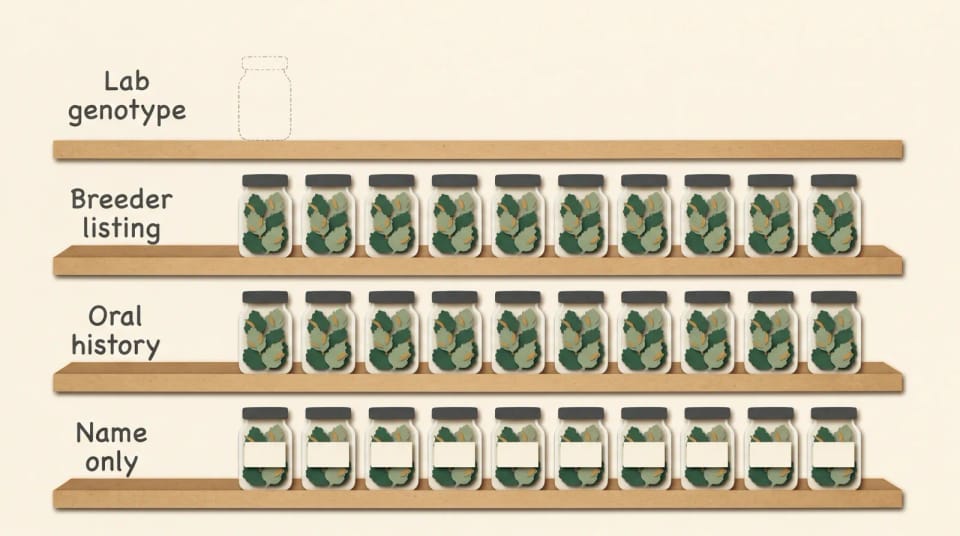
No published study has genotyped a named Diesel cut. Every claim in the table above sits on one of the three lower shelves.
How do you tell which Diesel is in your jar?
You usually cannot confirm the cut, but you can learn what this batch actually is. These steps move you from the name to the evidence.
- Read the exact name on the label. Write down the full name, including any qualifier such as East Coast, AJ, Amherst or NYC. A plain “Sour Diesel” label tells you the least.
- Ask whether it came from a clone or from seed. Ask the budtender or grower whether the plant was a named clone-only cut or grown from a seed line, and which breeder or source they name. “We don’t know” is an honest answer.
- Match the lab results to the package. Find the certificate of analysis for the batch or lot number on your package. Our guide shows how to match the COA to your jar.
- Read the terpene panel, not the name. Learn to read the COA and compare the measured terpenes with batches you have tried. Our terpene profile guide explains what the numbers mean.
- Keep notes by batch. Record the batch, the source and how it worked for you. The High IQ app lets you log a strain and batch and track how it worked, so your next choice rests on a batch you know rather than a label.
Online reviews will not settle the question for you, because reviewers rarely know which cut they had. Our piece on why reviews blur the names explains why.
Key takeaways
- NYC Diesel is a Soma Seeds hybrid, not a Sour Diesel cut. Its exact parents are disputed.
- One popular Sour Diesel seed line was bred from a Sour Diesel clone crossed with NYC Diesel, which is why the names share genes.
- Every Sour Diesel origin story traces to Chemdawg 91, but the second parent and the date are disputed.
- No published study has genotyped any named Diesel cut. Seven retail “Sour Diesel” jars in one study did not test as one plant.
- The batch’s lab panel tells you more than the name on the jar.
FAQ
Is East Coast Sour Diesel the same as Sour Diesel?
Sometimes, but not reliably. East Coast Sour Diesel usually refers to a clone-only cut said to be the original New York plant, while a plain “Sour Diesel” label can mean that cut, a seed-grown plant or something else. Growers also describe several ECSD sub-cuts that are not identical. Without a source and a chain of cuttings, the two labels cannot be told apart.
What is Amherst Sour Diesel?
It is a seed line from Humboldt Seed Organization, sold from a clone. The breeder lists it as “Chemdawg (pre-90’s) X Amherst Super Skunk”, with “Amherst” referring to a Super Skunk from Amherst, Massachusetts. That is a single breeder’s claim with no independent check.
Is OG Sour Diesel a cross of Sour Diesel and OG Kush?
Nobody has published a reliable answer. We found no breeder source for OG Sour Diesel, and pages that describe it disagree on whether it is a cross, a renamed cut or simply a label. Treat it as a name without a documented lineage until a breeder states one.
Is the original Sour Diesel cut gone?
There is no way to say from published evidence. No study has genotyped a cut that anyone could compare with a confirmed original, and even AJ says the cuts sold to him as his were not authentic. What you can check is the batch in front of you: its source, its lot number and its lab results.
What is the difference between Sour Diesel and New York Sour Diesel?
“New York Sour Diesel” and “NYC Diesel” are often used loosely. Some people mean the East Coast cut from the New York Chem line, and others mean Soma’s NYC Diesel seed hybrid. Ask the seller which one they mean and where their plant came from.
Sources
-
Schwabe AL, McGlaughlin ME. “Genetic tools weed out misconceptions of strain reliability in Cannabis sativa: implications for a budding industry.” Journal of Cannabis Research. 2019. DOI: 10.1186/s42238-019-0001-1 (Primary source)
-
Fischedick JT. “Identification of terpenoid chemotypes among high (-)-trans-Δ9-tetrahydrocannabinol-producing Cannabis sativa L. cultivars.” Cannabis and Cannabinoid Research. 2017. DOI: 10.1089/can.2016.0040 (Primary source)
-
Sawler J, Stout JM, Gardner KM, et al. “The genetic structure of marijuana and hemp.” PLoS One. 2015;10(8):e0133292. DOI: 10.1371/journal.pone.0133292
-
Sifaneck SJ, Ream GL, Johnson BD, Dunlap E. “Retail marijuana purchases in designer and commercial markets in New York City: sales units, weights, and prices per gram.” Drug and Alcohol Dependence. 2007. DOI: 10.1016/j.drugalcdep.2006.09.013
-
Punja ZK, Scott C, Tso HH, Munz J, Buirs L. “Transmission, spread, longevity and management of hop latent viroid, a widespread and destructive pathogen affecting cannabis (Cannabis sativa L.) plants in North America.” Plants. 2025. DOI: 10.3390/plants14050830
-
Danko D. “25 Years of Chem Dog.” High Times. 2016. hightimes.com (Oral history)
-
King J. “The Diesel Breakdown.” Cannabis Culture. 2006. cannabisculture.com (Oral history)
-
Soma’s Sacred Seeds. “NYC Diesel.” somaseeds.nl (Breeder listing)
-
Reservoir Seeds. “Sour Diesel IBL” description, as hosted on a seed database. seedfinder.eu (Breeder listing)
-
Humboldt Seed Organization. “HSO Amherst Sour Diesel (Amherst 81st).” 2014. humboldtseeds.net (Breeder listing)
-
“AJ Sour Diesel: an interview with cannabis breeder AJ Sour Diesel and the history of the Sour line.” Carters Cannabis blog. 2025. carterscannabis.com (Interview on a retailer blog)
-
“The Origins of Diesel.” Alchimia Grow Shop blog. 2025. alchimiaweb.com (Retailer history)
-
“Which Sour Diesel is used in Soma’s NYCD?” ICMag forum thread. 2006. icmag.com (Anonymous grower claims, not evidence)



