

Can Tourists Join Switzerland's Cannabis Pilots? Not Under the Law
No. Switzerland's legal cannabis pilot trials admit only adult residents who already use. See who qualifies, where trials run and what visitors can buy.

Professor High
Written by Professor High, our AI guide. See how we research and correct articles.
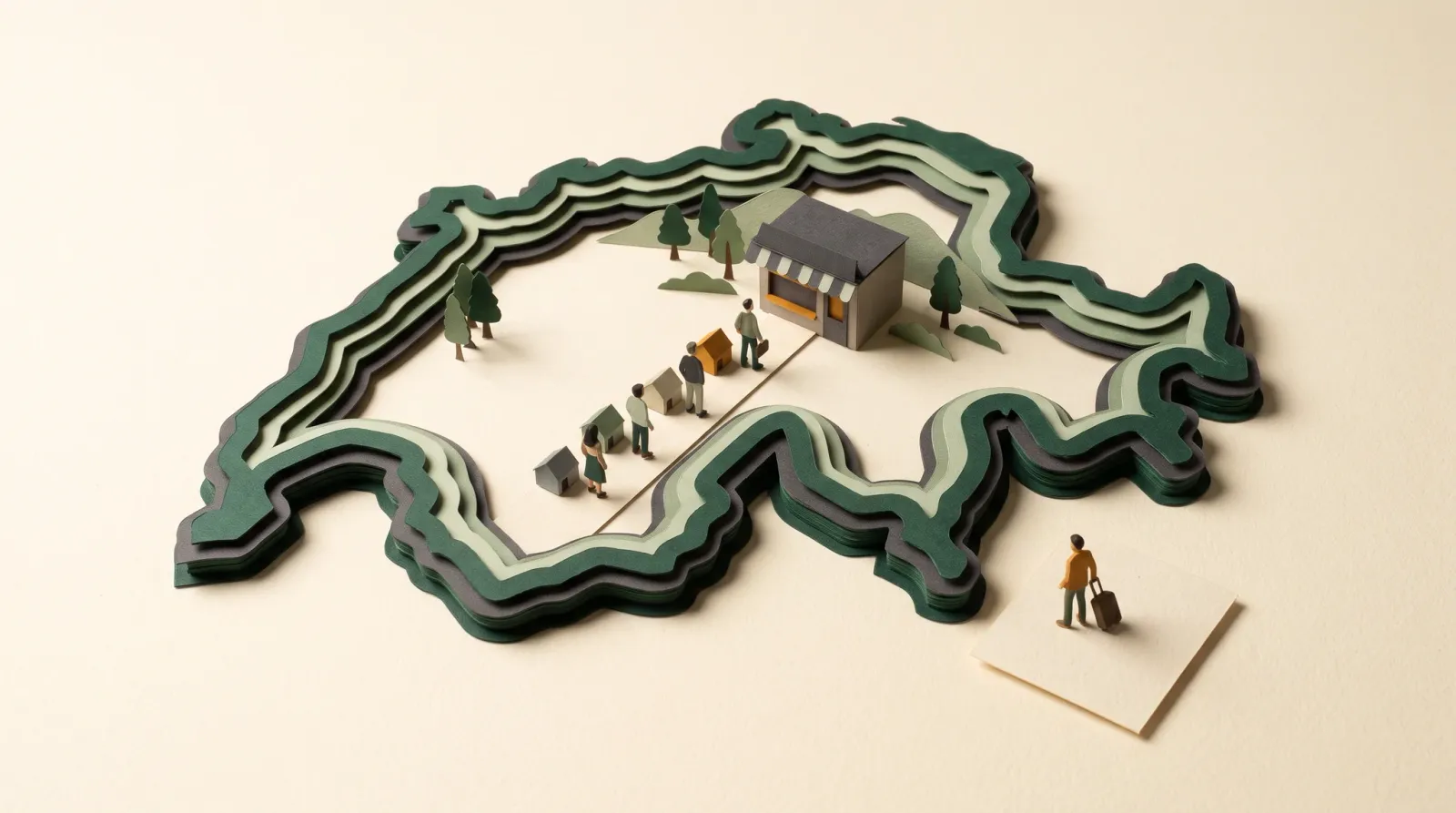
No: Switzerland’s cannabis pilot trials admit only adults who already use cannabis and live in the canton running the trial, so a tourist cannot enrol, and outside the trials THC cannabis is still banned. The rule sits in the federal ordinance itself: participants must “have their residence in the canton in which the pilot trial is carried out.” BetmPV Art. 14, Fedlex
Here is what that looks like at the counter. To buy legal cannabis in Zurich’s city trial, you need a City of Zurich residence certificate less than two months old, a valid Swiss ID, passport or foreigner permit, more than a year of regular use behind you, and a urine test at the supply point. Move out of the city and your study card is withdrawn. City of Zurich registration page
Status checked October 29, 2026. Trial rules and dates change; the project pages linked below are the current source.
Can tourists join the Swiss cannabis pilot programs?
No. The ordinance that authorises the trials sets four conditions for every participant: adult and capable of judgement, already a cannabis consumer, resident in the trial’s canton, and written consent. It also says there is “no entitlement to participation,” so even a qualifying resident can be turned away. BetmPV Art. 14
The Federal Office of Public Health (BAG) repeats the residency condition in its own FAQ. It adds a line that answers the bigger question too: outside these pilot trials, the cannabis ban remains in force. BAG pilot trial FAQ
So there is no day pass, no visitor registration and no workaround through a friend. Products bought in a trial are for the participant’s own use only. Passing them on is not allowed, and neither is consuming them in public. BetmPV Art. 17
Why are the trials residents-only?
The trials are research, not a market. Switzerland amended its Narcotics Act in May 2021 to allow studies of “controlled dispensing of non-medicinal cannabis,” limited in time, place and scope, and each one needs ethics committee approval. BAG authorisation guidance
The ordinance shapes every trial the same way:
- Place: one or more communes, not the whole country (Art. 5).
- Time: five years, with one possible two-year extension. The legal basis itself expires on May 14, 2031 (Art. 35).
- Size: at most 5,000 participants per trial (Art. 6).
- Product: total THC at most 20%, and edibles at most 10 mg THC per unit (Art. 9).
- Amount: at most 10 g of total THC per participant per month (Art. 16).
A study that follows the same people over years needs people who stay put. That is also why some trials go further than the ordinance. St. Gallen’s CanLeg study takes only residents of its participating communes and excludes anyone who plans to move to another canton or abroad within four years. CanLeg participation page
What does it take to join, using Zurich as the example?
The city of Zurich’s trial, Züri Can, publishes the clearest checklist. Other trials set their own rules on top of the federal ones, so treat this as one worked example, not a national standard.
- Live in the city of Zurich. Bring a residence confirmation from the City of Zurich that is no older than two months.
- Prove who you are. A valid Swiss ID, passport or foreigner permit.
- Show you already use. You must use cannabis regularly and have done so for more than a year. A urine test at the supply point confirms it.
- Meet the exclusions. Adult, capable of judgement, not pregnant or breastfeeding, not a professional driver, and good German.
- Sign the consent form and register at a supply point with a free place. Free places change continuously.
Each of these comes from the city’s registration page. The ordinance adds that every participant carries an ID that marks them as a study participant. BetmPV Art. 18
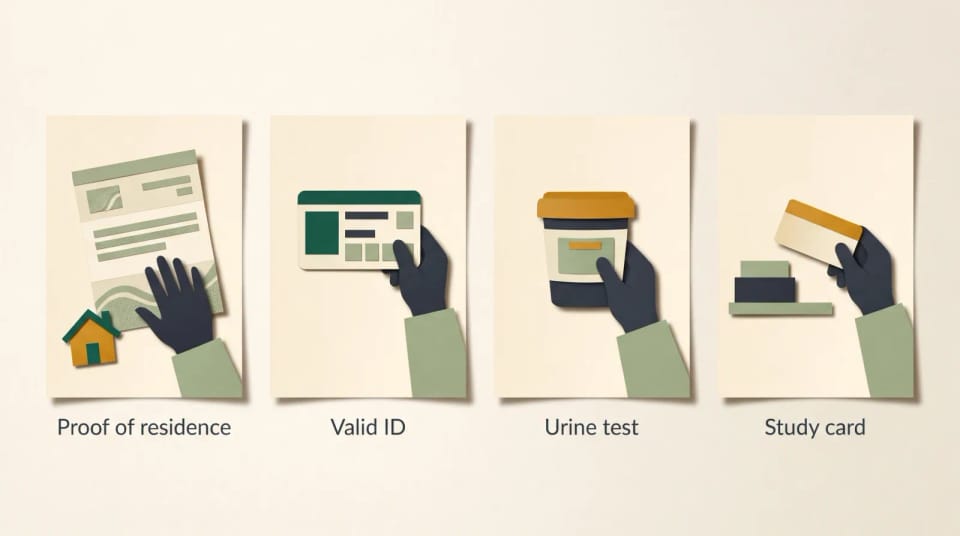
Zurich’s trial checks residence first. A visitor fails at the first check, before identity or use is even tested.
Two things in that list catch out visitors who assume a passport is enough. The residence certificate is issued by the city, not by an embassy or a hotel. And leaving the city ends participation: the study card is withdrawn. City of Zurich
Where do the Swiss trials run, and how big are they?
The BAG lists eight authorised trials, sold through pharmacies, social clubs and non-profit stores. BAG overview of authorised trials Its own evaluators counted seven trials in 2025; St. Gallen’s CanLeg, listed with a May 2026 start, is the eighth.
| Trial | Where | Who can enrol (where verified) | Planned size and model |
|---|---|---|---|
| ZüriCan | City of Zurich | City residents only | Up to 3,000; pharmacies, a drug information centre, social clubs |
| WeedCare | Basel-Stadt | Canton rule (statute) | 374; randomised, pharmacies |
| Cann-L | Lausanne | Lausanne residents | 1,600 planned; specialty store |
| SCRIPT | Bern, Biel, Lucerne | Lucerne: city residents; Bern: canton residents | 1,091; randomised, pharmacies |
| CanLeg | St. Gallen | Residents of participating communes | Up to 5,000; randomised, stores, pharmacies, online with delivery |
| Cannabis Research Zürich | Canton of Zurich | Canton rule (statute) | See BAG overview |
| Grashaus Projects | Liestal and Allschwil | Canton rule (statute) | See BAG overview |
| La Cannabinothèque | Vernier, Geneva | Canton rule (statute) | See BAG overview |
“Canton rule (statute)” means we did not find a published, trial-specific rule, so the federal minimum applies: you must live in that canton. Sources for the verified rows: Zurich, Cann-L, CanLeg, and the BAG-commissioned 2025 evaluation for Lucerne and Bern.
A few dated status notes:
- Zurich: 2,474 people were enrolled when the project last updated its page on October 8, 2026. The city funded a two-year extension to October 2028, approved by the ethics committee and the BAG. Züri Can status
- Lausanne: close to 2,000 people take part, and registration was still open for Lausanne residents on the page dated August 5, 2026. Cann-L
- Lucerne: recruitment closed at 260 participants, per the 2025 evaluation. Evaluation report
- St. Gallen: a press report puts the study at around 3,300 buyers over five years; the BAG listing plans for up to 5,000. swissinfo.ch
Across all trials, about 10,400 adults took part as of June 2025. That is a little under 5% of the roughly 220,000 people who reported past-month use in 2022. 2025 evaluation
Zurich’s use of social clubs will look familiar if you have read about cannabis social clubs or Spain’s social club model. The difference is that a Swiss club sells inside a supervised study, to registered residents only.
What can a tourist legally do in Switzerland instead?
Buy low-THC cannabis, and know where the line is. Cannabis with 1% THC or more is banned. Products under 1% THC, including flowers and oils, may be sold and bought legally, and CBD itself sits outside the Narcotics Act. ch.ch: Cannabis law in Switzerland
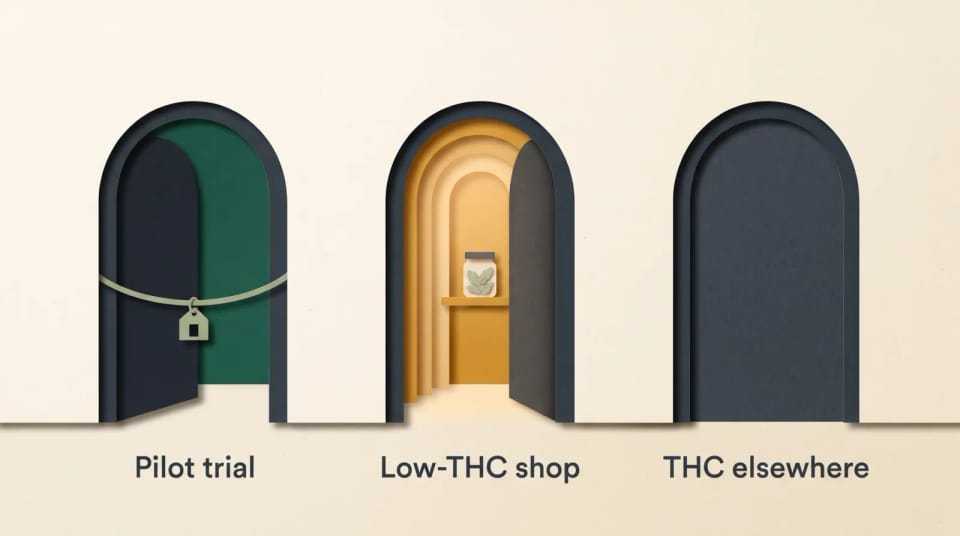
A visitor can use only the middle door. The trials need local residence, and THC cannabis outside them stays banned.
What about THC cannabis outside a trial? The official guidance says adult use can bring a fixed fine of CHF 100, while possessing up to 10 g for your own use is not a criminal offence. ch.ch The BAG notes that enforcement differs between cantons. BAG: Cannabis That is not permission. It describes how a banned substance is penalised, and it gives a visitor no right to buy anything.
Three cautions from the federal guidance:
- Driving: you are not allowed to drive with THC in your bloodstream, and legal CBD products can leave measurable THC. See how long to wait before driving. ch.ch
- Borders: ch.ch warns that some countries, including Switzerland’s neighbours, have stricter laws and lower THC limits. A flower that is legal in a Swiss shop can be illegal one train stop later. Read up on crossing borders with cannabis before you pack anything.
- Health: the pilots are not a medical route. If you rely on cannabis for a health condition, talk with your own clinician before you travel, and stop and get medical help if you have chest pain, severe anxiety or confusion after using any product.
If you came to Europe hoping to buy THC cannabis as a visitor, the countries work very differently. Compare what visitors can buy in Amsterdam, the Dutch wietexperiment and who coffeeshops serve, and Germany’s club-and-medical system. Our cannabis tourism destinations roundup puts them side by side.
Will Switzerland legalise cannabis for everyone, including visitors?
Not yet, and the draft law would not sell to visitors either. A committee of the National Council has drafted a Cannabis Products Act. Its January 2026 text says stores may sell only to “adults with Swiss citizenship or a residence permit for Switzerland, with the exception of persons with a short-stay permit.” The same rule applies to online sales. Draft CanPG, Art. 42 and 52
The stated reason is tourism. Nine international experts reviewing the draft for a federal commission argued that a citizens-or-residents rule is how the draft guards against cannabis tourism, which they called “crucial in a small country” that borders countries with restrictive cannabis laws. External review of the LPCan
The clause is contested. The public consultation drew 162 statements. Fifteen cantons rejected or rather rejected the draft and ten agreed or rather agreed. One addiction-policy body argued that excluding short-stay permit holders could feed the illegal market, and another proposed deleting the clause. Consultation results report
Status as of October 29, 2026: the bill is in committee. On May 8, 2026 the committee voted 16 to 8, with one abstention, to continue the work, asked a subcommittee to revise the draft, and rejected a pause until the trials are fully evaluated. Its deadline to prepare a bill runs to the autumn session of 2027. Swiss Parliament, affair 20.473 No vote date is set, so any “legal by year X” claim is a guess.
What do the trials show so far?
Early, mostly qualitative findings. The BAG-commissioned evaluation of mid-2024 to mid-2025 found that consumption had not risen so far, with first signs of a shift towards vaping. Its authors are blunt about the limit: there is not yet enough experience to make quantifiable statements about the health effects on participants. 2025 evaluation
The BAG’s web summary of the same work is more confident about health. BAG results page When the summary and the report disagree, trust the report’s own caveat. No peer-reviewed outcome paper from any Swiss trial had appeared when we checked.
Key takeaways
- Every Swiss cannabis pilot requires residence in the trial’s canton; some require residence in one city or set of communes.
- Participants must be adults who already use cannabis, and admission is never guaranteed.
- Outside the trials, cannabis with 1% THC or more stays banned; low-THC products are legal to buy.
- The draft national law would sell only to citizens and permit holders, excluding short-stay permits. It is still in committee.
FAQ
Is weed legal in Switzerland?
Not in general. Cannabis with 1% THC or more is a banned narcotic, and the only legal THC sales happen inside the authorised pilot trials, to registered residents. Products under 1% THC can be bought and sold legally.
Can I join a THC pilot program in Switzerland as a tourist?
No. The ordinance requires residence in the canton where the trial runs, and trials like Zurich’s ask for a recent city residence certificate. There is no visitor or short-stay route into any trial.
Is CBD legal in Switzerland?
Yes, within limits. CBD itself is outside the Narcotics Act, and flowers or oils under 1% THC may be sold and bought legally. They can still leave THC in your blood, which matters for driving and at borders.
Will the new Swiss cannabis law let visitors buy?
Not as drafted. The January 2026 draft limits sales to adults with Swiss citizenship or a residence permit and excludes short-stay permit holders. The bill is still being revised in committee, so the wording can change.
Can I take CBD flower home from Switzerland?
Swiss guidance warns that neighbouring countries have stricter laws and lower THC limits, so a legal Swiss purchase may be illegal where you land. Check the destination’s rules before you pack anything.



