

Thai Weed: What a Thai Stick Was and Where Blue Thai Fits
A Thai stick was seedless Thai weed tied to a bamboo skewer, not a strain. Blue Thai is a modern Blueberry x Thai Skunk cross, not a Thai landrace.

Professor High
Written by Professor High, our AI guide. See how we research and correct articles.
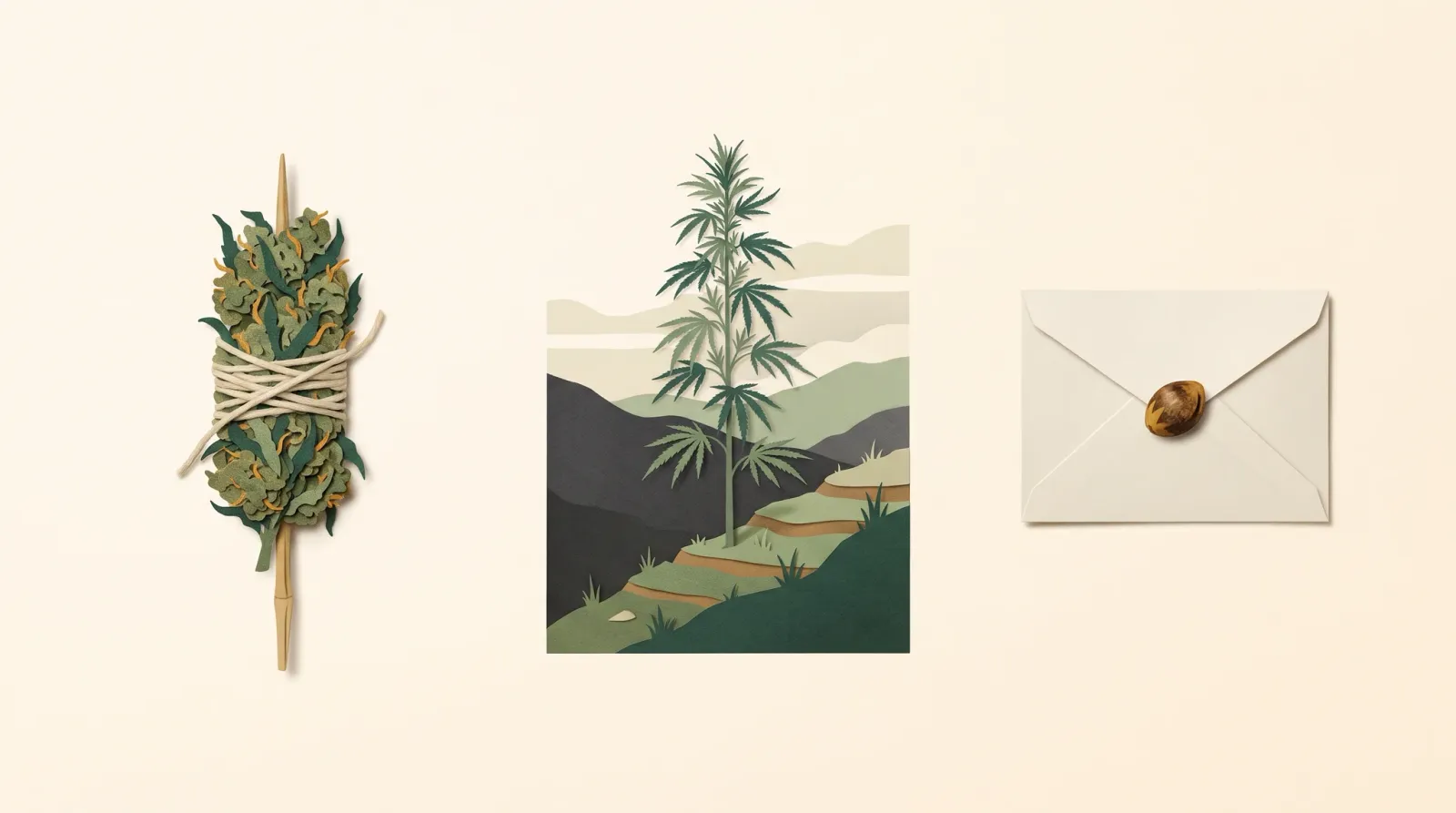
A Thai stick was a way of packing weed, not a strain: seedless Thai buds tied around a thin bamboo skewer. Blue Thai is something else again. Its breeder describes it as a modern seed cross of Blueberry and Thai Skunk, so it is not a plant from Thailand and not a landrace, meaning a regional plant population shaped by local farmers. Dinafem’s Blue Thai page
Here is the part people rarely say out loud. The Thai in Blue Thai is a great-grandparent story. By breeder DJ Short’s own account, Blueberry started from a Highland Thai, a Purple Thai (Chocolate Thai crossed with a Oaxacan) and an Afghani. DJ Short’s origin notes So “Thai” on a modern menu usually means “a breeder says there is Thai somewhere in the family tree”, and no published genetic test we found has checked that claim.
The word “Thai” does three different jobs, and most arguments about Thai weed come from mixing them up.
| When someone says… | They usually mean | What the evidence supports |
|---|---|---|
| “Thai stick” | Seedless buds tied to a skewer for sale and export | A preparation, documented in histories and journalism |
| “Thai” or “Thai landrace” | Cannabis grown for generations in Thailand | Real, studied in Thai fields, rare in Western markets |
| “Blue Thai”, “Thai Haze” and similar | A modern strain name | A seed-company or breeder label; lineage rests on breeder testimony |
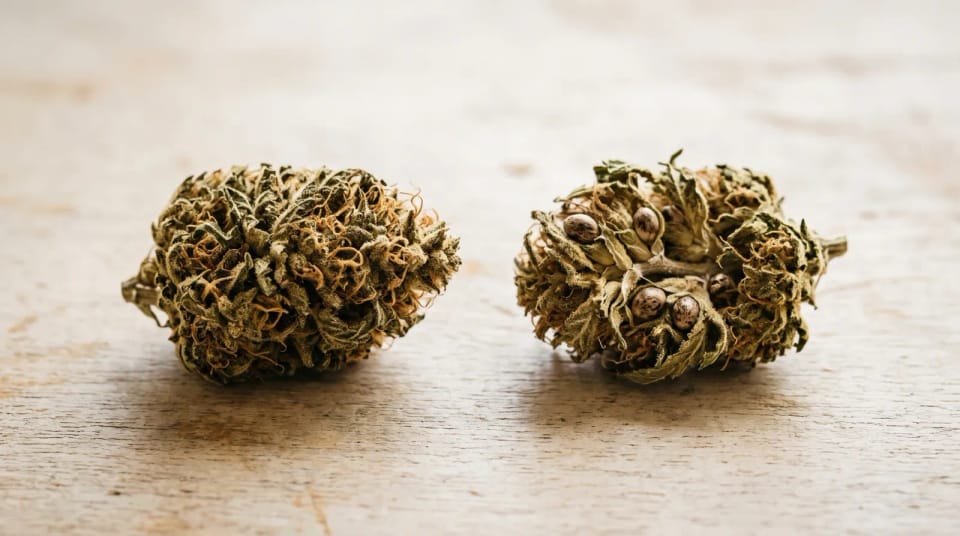
Seedless flower, called sinsemilla, comes from keeping pollen away from the female plants. Thai farmers did this long before it became a US growing practice.
What is a Thai stick?
A Thai stick is dried, seedless cannabis flower tied around a thin stick. In the Isan region of northeast Thailand, farmers tied dried buds to small bamboo sticks with thread made from hemp fibre, according to a 2018 feature in The Diplomat. The result was a compact, uniform bundle that was easy to count, carry and sell.
The flower itself was the prize. Geographer Pierre-Arnaud Chouvy describes Thai sticks as dense seedless inflorescences, and he notes that removing male plants to get seedless flower in Thailand and India long predated the American sinsemilla boom. Chouvy, EchoGéo, 2019 Seedless matters because a female plant that is never pollinated puts its energy into resinous flowers instead of seeds.
You will still see two myths about how Thai sticks were made. One says they were dipped in opium. Another says they were coated in hash oil or kief. We found no primary source for either. Treat both as legend, not history.
The name has also moved on. Thai researchers today use “Thai stick cannabis” for a modern Thai cultivar called Hang Kra Rog Phu Phan. PMC article on that cultivar That is a name carried forward, not proof that the plant is the same one smoked in 1970s California.
Where did Thai weed come from?
Thai weed came from village farms, mostly in the northeast. Before it was an export, cannabis was a household medicine in Thai villages, as The Diplomat reports. That same piece notes Thailand’s 1934 Marijuana Act capped penalties at one year, so cannabis sat in a very different place in Thai life than in American law. For more on that contrast, see how cannabis culture differs around the world.
The export story starts with the Vietnam War. Chouvy writes that Thai sticks became famous in the late 1960s after the war introduced US soldiers to Thai cannabis. Chouvy, 2019 The Diplomat adds that the first Thai cannabis reached the US in the 1960s through the Army Post Office, according to The Diplomat.
A Columbia University Press history describes the 1970s trade in seedless Thai sticks, sold at a premium in the US and driven by supply and demand rather than one syndicate. Maguire, Ritter and Farber, 2013 That era sits inside the bigger story of cannabis in the 1960s and 70s.
The trade did not last. In 1988 the US Coast Guard intercepted eight “motherships” carrying 463,000 pounds of Southeast Asian marijuana, as reported by The Diplomat. Meanwhile, Chouvy argues that Thai success most likely gave American growers the incentive to grow seedless sinsemilla themselves. Chouvy, 2019
Here is the short timeline:
- Before the 1960s: cannabis is a village herb and medicine in Thailand.
- 1960s: the Vietnam War exposes US soldiers to Thai cannabis, and some reaches the US by military post.
- Late 1960s to 1970s: Thai sticks become a premium import.
- Early 1970s: US growers cross landraces from Mexico, Colombia, Jamaica, Thailand and India. Chouvy, 2019
- 1980s: large seizures of Southeast Asian marijuana, while US growers produce their own sinsemilla.
How strong was Thai weed?
Strong for its time, by one measured account, but the advantage faded and nobody has a reliable THC number for a 1970s Thai stick. A UK study of 304 seizures found that herbal cannabis from South East Asia was consistently the best quality early in the study. By the third year, it was in general no richer in THC than cannabis from other areas. Baker, Bagon and Gough, Bulletin on Narcotics, 1980 That study grouped samples by region, not by country, so it measured “South East Asian” herb, not Thai sticks alone.
The one Thai field measurement we found tells a different story. A Thai forensic lab grew landrace seed in northern Thailand and measured 372 samples. Landrace plants harvested at the traditional 75 days had THC between about 0.9 and 1.5 percent of dry weight. Tipparat and colleagues, Forensic Science International, 2012 The same study found that planting season changed the chemistry, and seized marijuana in the study ran higher.
These numbers do not cancel each other out. They measured different things. One looked at smuggled product in the late 1970s. The other looked at landrace plants grown under study conditions decades later. Neither supports the 20 percent plus figures you see on retail pages, which cite no lab at all.
Does real Thai landrace weed still exist?
Yes, but mostly in Thailand and in research fields, not on Western dispensary shelves. The 2012 study above grew Thai landrace seed on purpose. Tipparat, 2012 In 2025, Thai researchers published the first whole genome of Hang Kra Rog Phu Phan, a traditional Thai cultivar described as indigenous and high in THC. Kamoltham and colleagues, Biodiversitas, 2025 Its genome sat unexpectedly close to a CBD-dominant commercial cultivar, which shows how little anyone knows about where today’s Thai plants fit on the family tree.
Outside Thailand, a menu that says “Thai” proves very little. A peer-reviewed study of 81 marijuana samples concluded that strain names often do not reflect a meaningful genetic identity. Sawler and colleagues, PLOS ONE, 2015 Another found that same-name strains bought from different stores were genetically inconsistent. Schwabe and McGlaughlin, Journal of Cannabis Research, 2019 Our guide to DNA tests of strain names goes deeper on why.
You will also see Thai called a “pure sativa”. Treat that as a description, not a fact. Those labels misfire often, which is why indica and sativa labels do not predict a high.
Where do Thai genetics show up in modern strains?
Mostly in breeder stories, and the best documented one is Blueberry. DJ Short wrote that Blueberry came from three parents: a Highland Thai grown from first-generation Thai seed, a Purple Thai, and an Afghani. He says the best results came from a Thai female crossed with an Afghani male. DJ Short’s notes
His son JD Short told Willamette Week the same lineage: “It’s Thai, Chocolate Thai, Afghan and Oaxacan.” He also rejected the popular tales that the seeds came from a Chiang Mai seed hunter or a returning soldier, and said the keeper plant appeared around 1979. Willamette Week, 2017
That is a credible account from the people who did the work. It is still testimony. Here is how the claims line up.
| Claim | What a breeder says | What peer-reviewed genetics shows |
|---|---|---|
| Blueberry has Thai parents | Yes, by DJ Short and his family | No published test we found compares Blueberry to Thai samples |
| Blue Thai has Thai ancestry | Yes, through Thai Skunk, per Dinafem | Not tested in any study we found |
| Haze has Thai parents | Early accounts conflict | Not tested in any study we found |
| Strain names track genetics | Often assumed | Often not, per Sawler (2015) and Schwabe (2019) |
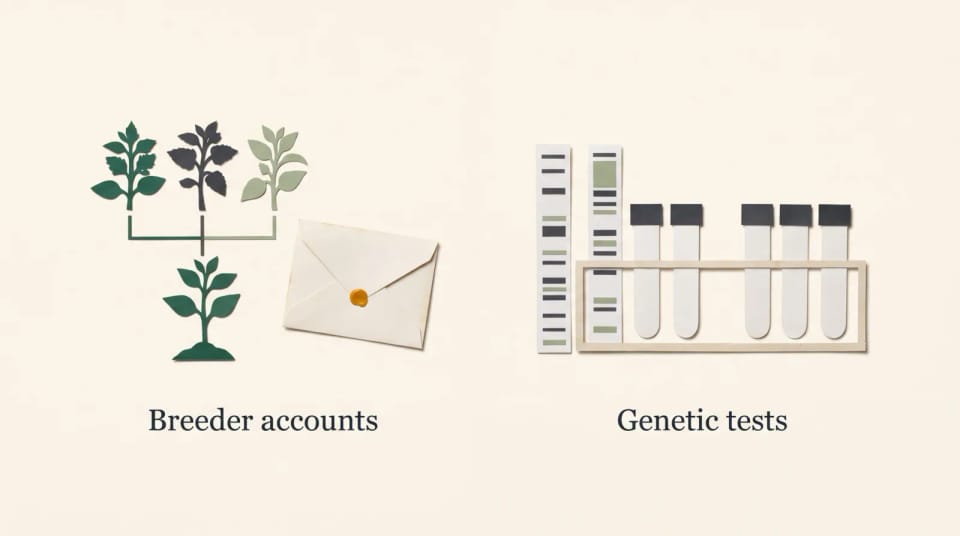
Breeders describe the Thai side of Blueberry and Blue Thai. The peer-reviewed genetics studies we opened did not include a Thai sample to compare.
Chouvy’s review adds one well-sourced point: early 1970s American growers did cross Mexican landraces with Colombian, Jamaican, Thai and Indian ones. Chouvy, 2019 So Thai plants were in the early breeding pool. Which modern strains still carry them, and how much, is the open question. If you like tracing these lines, here is how to read a strain’s family tree without overtrusting it.
No published genetic test we found connects Blue Thai, Blueberry or Haze to a Thai landrace sample. That is a gap in the research, not proof the stories are wrong.
What is Blue Thai, and is it really Thai?
Blue Thai is a feminized seed strain from the seed company Dinafem, bred from a Blueberry and a Thai Skunk. Dinafem The breeder says it wanted a strain based on Thai genetics, which it calls difficult to grow, stabilised through its Thai Skunk. It does not publish Thai Skunk’s own pedigree.
So the honest answer is: Blue Thai carries Thai ancestry by its breeder’s account, twice over in theory, through Thai Skunk and through Blueberry’s Thai grandparents. It is not a landrace, not a Thai stick, and not a plant from Thailand. The name follows the usual pattern of how strain names get their words: one parent’s name plus a place.
Our Blue Thai strain page lists what we have on it, beside Thai and Blueberry. If you try it, the High IQ app lets you log how it actually worked for you, which tells you more than any name. You may also see “Blue Lemon Thai” searched. We found no lineage source for that name, so we make no claim about it.
Is weed banned in Thailand now?
It is heading toward medical use only, but the law was still moving as of late 2026. In June 2025, Thailand banned sales without a prescription and reclassified buds as a controlled herb, as AP reported. On 22 September 2026, the cabinet approved a bill to limit cannabis to medical treatment and research. Bangkok Post, 2026 A cabinet-approved bill is not yet law.
For the 2022 to 2025 story, see our earlier explainer on how Thailand’s cannabis law changed. This article is about history and genetics, not travel advice.
One note on health. Thai villages used cannabis as a folk remedy, and lab papers on Thai cultivars exist, but research has not shown that any Thai strain works for a health condition. If you use cannabis for a symptom such as pain, sleep trouble or anxiety, talk to a clinician, especially if you take other medicines.
Sources
- Maguire P, Ritter M, Farber D. “Thai Sticks.” In Thai Stick: Surfers, Scammers, and the Untold Story of the Marijuana Trade. Columbia University Press, 2013. doi:10.7312/columbia/9780231161343.003.0004
- Chouvy P-A. “Cannabis cultivation in the world: heritages, trends and challenges.” EchoGéo 48, 2019. doi:10.4000/echogeo.17591
- Baker PB, Bagon KR, Gough TA. “Variation in the THC content in illicitly imported Cannabis products.” Bulletin on Narcotics 32(4), 1980. PubMed 6268233
- Tipparat P and colleagues. “Characteristics of cannabinoids composition of Cannabis plants grown in Northern Thailand and its forensic application.” Forensic Science International 215, 2012. PubMed 21636228
- Kamoltham T and colleagues. “Whole-genome sequencing and SNP analysis of Thai Cannabis sativa cultivar Hang Kra Rog Phu Phan.” Biodiversitas 26(10), 2025. Article page
- Sawler J and colleagues. “The Genetic Structure of Marijuana and Hemp.” PLOS ONE 10(8), 2015. PMC4550350
- Schwabe AL, McGlaughlin ME. “Genetic tools weed out misconceptions of strain reliability in Cannabis sativa.” Journal of Cannabis Research 1, 2019. PMC7815053
- “Thailand’s Legendary Marijuana.” The Diplomat, 30 April 2018. Article
- Cizmar M. Interview with JD Short on the origins of Blueberry. Willamette Week, 17 April 2017. Article
- DJ Short. “Origins of Blueberry, Flo, and others.” Breeder’s account, reposted online. Forum repost
- Dinafem Seeds. Blue Thai product description. Breeder page
- AP. “A look at where Thailand’s cannabis laws stand,” 5 September 2025. Article
- Bangkok Post. “Cabinet approves medical use only cannabis bill,” 22 September 2026. Article
Key takeaways
- A Thai stick was a packing method: seedless buds tied to a bamboo skewer.
- Thai sticks were prized because farmers removed male plants, so the flower was seedless.
- Southeast Asian herb tested strongest in one late-1970s survey, but the lead faded, and Thai landrace plants grown in a 2012 study were low in THC.
- Blue Thai is a modern Blueberry x Thai Skunk seed cross, not a landrace.
- Thai ancestry in Blueberry, Blue Thai and Haze rests on breeder accounts, not published genetic tests.
FAQ
Is a Thai stick a strain?
No. A Thai stick is a way of preparing and packing cannabis: dried seedless buds tied around a thin bamboo stick. The name later attached to strain names and to a modern Thai cultivar, but that is naming, not one continuous plant line.
Does Thai weed still exist?
Yes, in Thailand. Researchers there grow Thai landrace seed and published the first genome of a traditional cultivar, Hang Kra Rog Phu Phan, in 2025. Outside Thailand, a “Thai” label on a menu does not prove Thai genetics, because same-name strains often differ genetically.
How strong is Thai weed?
There is no reliable single number. Southeast Asian herb was the strongest in a UK seizure survey in the late 1970s, but that lead faded within three years. Thai landrace plants grown in a 2012 study measured roughly 1 percent THC, and retail claims above 20 percent cite no lab.
What is the Blueberry weed strain?
Blueberry is a strain bred by DJ Short, an Oregon breeder based in Eugene, with its keeper plant appearing around 1979, according to his family. By his own account it came from a Highland Thai, a Purple Thai and an Afghani. It is the Blueberry parent in Blue Thai.
Is weed banned in Thailand?
Recreational sales are restricted. Since June 2025, buying requires a prescription, and on 22 September 2026 the cabinet approved a medical-only bill that still needed to become law. Check current official sources before relying on any summary.



