

Weed After Wisdom Teeth Removal: What Dry Socket Studies Show
No study has tested weed against dry socket after wisdom teeth removal. The 3x risk number comes from cigarettes. See what was measured and what to ask.

Professor High
Written by Professor High, our AI guide. See how we research and correct articles.
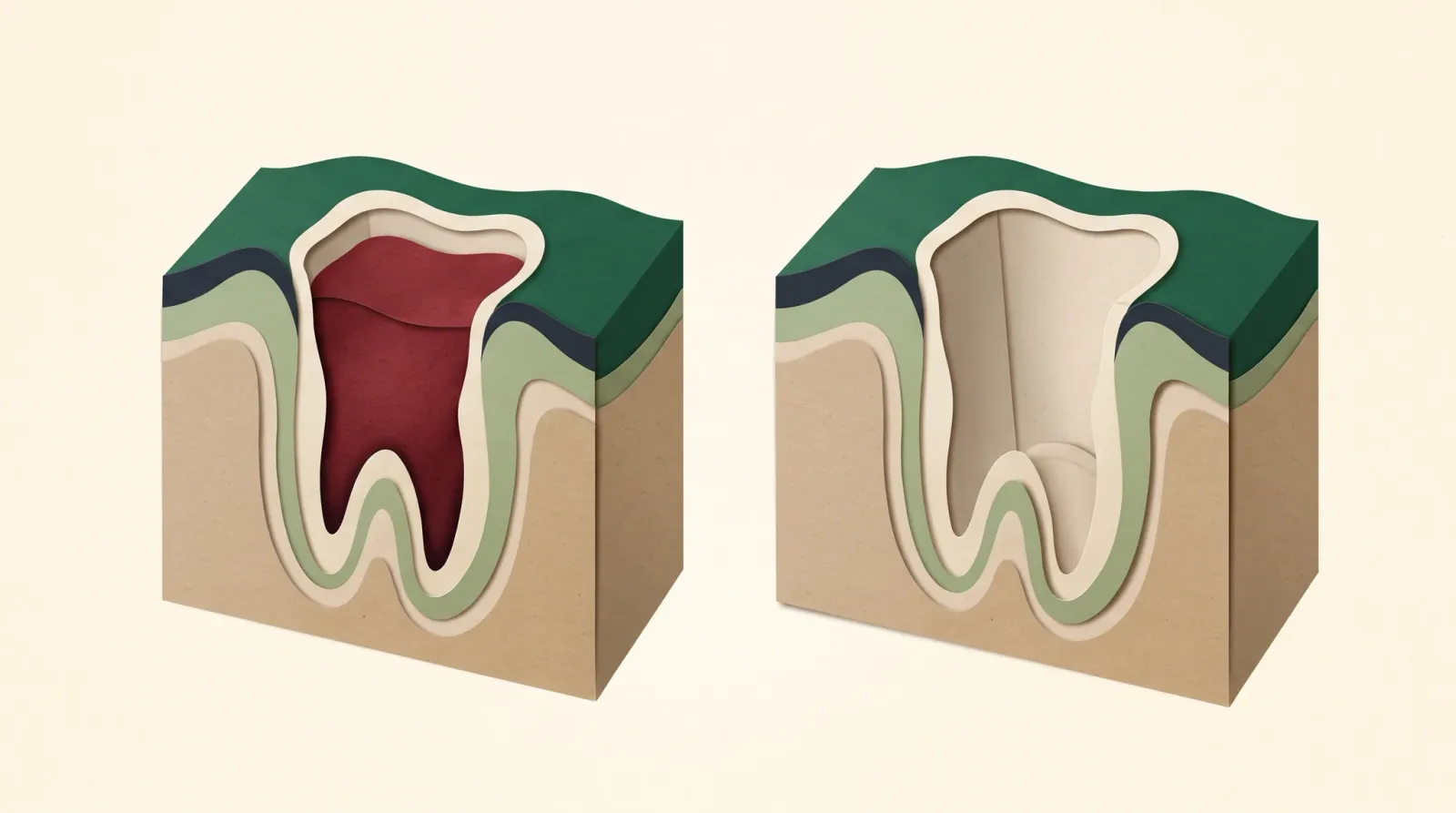
No study has tested cannabis against dry socket after wisdom teeth removal, so the number you keep seeing (about three times the odds) comes from tobacco smokers, not from weed. The official aftercare advice is to avoid smoking and suction while the clot forms. That makes your surgeon’s written instructions the timing rule, not a day count from a web page.
Here is the specific to send a friend: the “safe to smoke weed” wait you find online runs from about 3 days to 14 days depending on the page, and none of those pages cites a study of cannabis users. The only dry socket studies on smoking measured tobacco. The one study that split smokers by timing found more dry socket in people who smoked on the day of surgery than in people who waited until the second day. Al-Belasy, 2004
This lesson covers healing after a tooth comes out. If your question is about numbing during the procedure, read whether cannabis makes dental numbing fail. For hospital surgery in general, see cannabis before and after other surgeries.
This article is educational, not medical advice. Your surgeon’s written aftercare instructions come first.
Can you smoke weed after wisdom teeth removal?
The surgeons’ own patient guidance says to hold off on smoking. The American Association of Oral and Maxillofacial Surgeons (AAOMS) tells wisdom tooth patients to “stop smoking completely for at least a few days after surgery.” It does not define “a few days.” AAOMS postoperative instructions
Mayo Clinic gives more specific numbers, but for tobacco. It says not to use tobacco for at least 48 hours after surgery, and as long as you can after that. It also says not to drink through a straw for at least a week. Mayo Clinic on dry socket
AAOMS also has a page about marijuana. It tells patients that marijuana can impair healing, interact with anesthesia, increase bleeding and raise pain medicine needs. That page lists no references, so treat it as guidance from the specialty, not as a measured result. AAOMS on marijuana, alcohol and smoking
So the plain answer: the guidance says wait, the guidance does not give a cannabis-specific number, and your surgeon is the person who sets one for you.
What is dry socket and when does it start?
Dry socket happens when the blood clot in the empty tooth socket comes loose or never forms well. MedlinePlus describes the clot as a protective layer over the bone. Without it, bone and nerve endings are exposed. MedlinePlus on dry socket
Mayo Clinic calls it the most common complication after tooth removals such as wisdom teeth. Pain usually starts 1 to 3 days after the extraction. Mayo Clinic
How common is it? A 2022 Cochrane review puts it at 1% to 5% after routine extractions and upward of 30% after surgically removed third molars. Daly et al., Cochrane 2022 That range describes all patients in those studies. It is not a rate for cannabis users, and it is not your personal risk.
Do not confuse dry socket with dry mouth. Cottonmouth is about saliva, and we cover it in why weed dries your mouth. Dry socket is about a missing clot.
Does smoking cause dry socket?
Smoking tobacco is linked to dry socket in most studies, but “linked” is not the same as “the cause.” Mayo Clinic says the exact cause of dry socket is still being studied. Mayo Clinic
The strongest summary is a 2022 systematic review and meta-analysis of 11 studies. Tobacco smokers had more than three times the odds of dry socket. The combined incidence was about 13.2% in smokers and 3.8% in non-smokers. Its search terms covered cigarettes, tobacco and nicotine. Cannabis was not part of it. Kuśnierek et al., 2022
Other studies add important context:
- A Chilean case-control study found that smoking after extraction carried an odds ratio of 3.5. A traumatic extraction carried an odds ratio of 13.1, a much larger association. Halabí et al., 2012
- A randomized trial of 160 patients found that smoking was not related to more dry socket. Surgical difficulty and female sex were. The trial was not designed to answer the smoking question. Rubio-Palau et al., 2015
- A 2018 narrative review called the influence of smoking “rather inconclusive.” Rakhshan, 2018 A 2022 scoping review of 63 studies found “conflicting evidence” on smoking and called the cause of dry socket poorly understood. Ghosh et al., 2022
Mayo Clinic names two ways tobacco smoking may interfere. Chemicals in smoke may prevent or slow healing, and the act of sucking on a cigarette may pull the clot out too early. Mayo Clinic AAOMS separately warns that aggressive sucking through a straw can loosen clots. AAOMS No source we opened separates nicotine, heat, suction and smoke chemicals to say which one matters most.
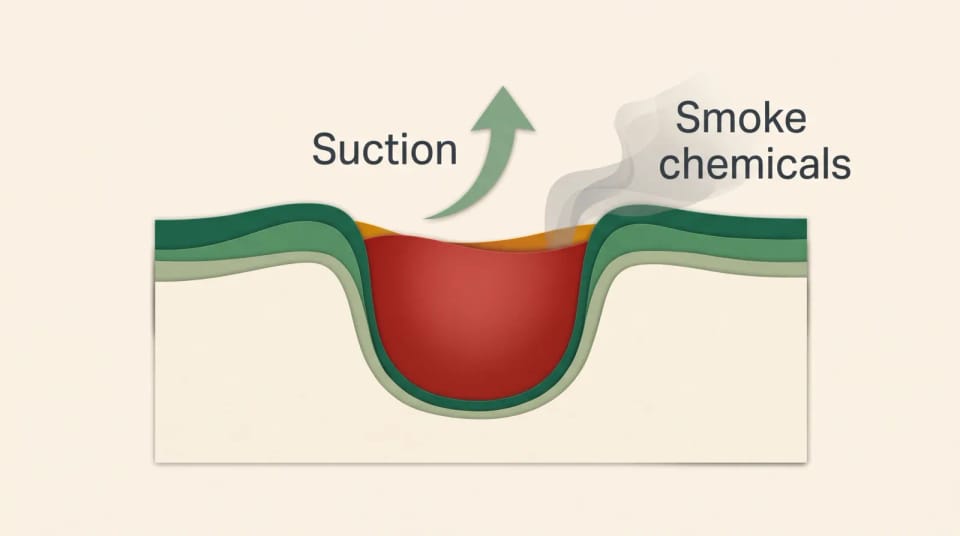
Mayo Clinic names suction and smoke chemicals as two ways cigarette smoking may disturb healing. These are proposed explanations for tobacco. No study has tested them for cannabis.
Has anyone studied cannabis and dry socket?
Not directly. Searches of PubMed for cannabis or marijuana with dry socket, alveolar osteitis, extraction sockets or wisdom tooth healing returned no study that measured dry socket in cannabis users. That is a gap in the research, not proof that cannabis is harmless or harmful.
The closest evidence is indirect, and each piece has a hard limit:
- A jaw fracture study. A 2023 database study of 8,288 patients having jaw fracture surgery found that cannabis-only use was not linked to more complications than controls. Tobacco-only use and cannabis plus tobacco were. But only 72 patients used cannabis alone, the surgery was not an extraction, and dry socket was not an outcome. Yoon et al., 2023 A small null result is not proof of safety.
- A rat study. Rats exposed to marijuana smoke for 60 days had less bone growth around titanium implants in their shin bones. Nogueira-Filho et al., 2008 That is rats, a leg bone and an implant, not a human tooth socket or a clot.
- Reviews. A 2025 systematic review of cannabinoids in oral surgery and bone healing contained no dry socket outcome and called for more high-quality trials. Campana et al., 2025 A 2026 review on cannabis and wound healing found that studies rarely record dose or route and are often confounded by tobacco use. Naimi and Hom, 2026
Researchers do study cannabis users during wisdom tooth surgery. One 2026 study of 49 adults looked at how much sedation medicine they needed. Panesar et al., 2026 Healing afterward was not the outcome.
So the “same risk as cigarettes” line you see online is a borrowed number. A joint has no nicotine, but it does involve smoke, heat and suction. Nobody has measured how those add up for a fresh socket.
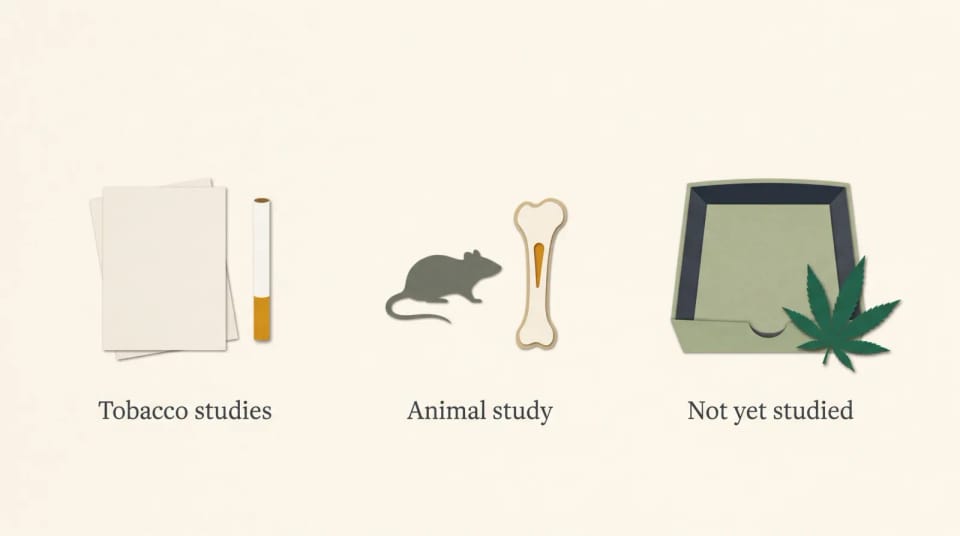
The dry socket numbers come from tobacco. The only direct cannabis signal is one rat bone study. No study has measured dry socket in people who use cannabis.
Does vaping or an edible change the risk?
No study has tested vaping cannabis or eating an edible for dry socket. Any claim that one route is “safe” goes beyond the evidence.
Here is what was and was not measured for each method:
| Method | Studied for dry socket? | What official aftercare says | What is unknown |
|---|---|---|---|
| Cigarette | Yes, many studies; most link it to higher odds | Mayo: no tobacco for at least 48 hours; AAOMS: stop smoking at least a few days | Which part matters most: nicotine, smoke or suction |
| Tobacco waterpipe | One study of 100 users | Not named separately | Whether the result holds outside simple extractions |
| Joint, pipe or bong | Not studied | AAOMS: stop smoking; avoid aggressive suction | Any dry socket rate for cannabis smoke |
| Cannabis vape | Not studied | AAOMS groups vaping with smoking under its nicotine and tobacco heading | Whether vapor without nicotine changes healing |
| Edible | Not studied | No statement found | Interactions with prescribed pain medicine and anesthesia recovery |
The waterpipe row is worth a second look if you use a bong. In the 2004 study, tobacco waterpipe smokers and cigarette smokers did not differ significantly in dry socket. Al-Belasy, 2004 That study measured tobacco, so it says nothing direct about cannabis. It does push back on the idea that water makes smoke harmless. We cover that in whether water filters smoke.
Vapor and smoke are chemically different, as how vapor and smoke differ explains. But a vape still involves drawing air through your mouth, and suction is one of the proposed problems.
Edibles avoid smoke and suction. That is reasoning about the mechanism, not a measured result. Edibles also raise their own questions after surgery: they take longer to kick in, and you may be on a soft diet or eating less than usual. If you were sent home with pain medicine, ask about it directly. Our review of how cannabis and opioids interact shows why that conversation matters.
Is the tobacco-gum research the same thing?
No. A fresh extraction socket and long-term gum disease are different problems. Gum disease builds over years, and what long-term gum studies found about cannabis smoking is a separate body of evidence. Do not carry those findings into a one-week healing question, or the other way around.
What should you ask your surgeon?
Tell your surgeon you use cannabis, and say how you use it. AAOMS tells patients to discuss these habits with their surgeon. AAOMS Good questions to bring:
- How long should I avoid smoking, and does that include cannabis?
- Does your advice change for a vape or for an edible?
- Is my extraction simple or surgical, and does that change the timing?
- Can I use cannabis while taking the pain medicine you prescribed?
- Which symptoms mean I should call you?
Ask about alcohol too. AAOMS groups it with marijuana and smoking in its pre-surgery advice, and mixing the two has its own effects, covered in what mixing with alcohol does.
When to call your surgeon
Call your surgeon or dentist if pain gets worse instead of better, especially 1 to 3 days after the extraction. Other signs include an empty-looking socket, visible bone, a bad taste or a bad smell. Mayo Clinic MedlinePlus Do not try to treat dry socket yourself. Dentists have treatments for it, and the choice belongs to them. Cochrane 2022
Key takeaways
- No study has measured dry socket in cannabis users.
- The “three times the odds” figure is for tobacco smokers.
- Surgical difficulty and traumatic extraction are strong risk factors in their own right.
- Official aftercare says to avoid smoking and suction; your surgeon sets the timing.
- Edibles avoid smoke and suction by reasoning, not by evidence.
- Severe pain 1 to 3 days after surgery is a reason to call your surgeon.
FAQ
How long after wisdom teeth removal can I smoke weed?
No study gives a cannabis-specific wait. AAOMS tells patients to stop smoking for “at least a few days,” and Mayo Clinic says at least 48 hours for tobacco. Your surgeon’s written instructions set your timing.
Can I smoke with gauze over the socket?
None of the sources we opened tested gauze as a smoking shield, and the official aftercare pages do not offer it as a workaround. The pages name suction itself as a concern. Ask your surgeon before you rely on it.
Can I eat edibles after wisdom tooth surgery?
No study has tested edibles for dry socket. They avoid smoke and suction, but that is reasoning, not a measured result. Ask your surgeon, especially if you take prescribed pain medicine.
Is dry socket the same as dry mouth?
No. Dry socket is a lost or poorly formed clot in the tooth socket, with pain that usually starts 1 to 3 days after extraction. Dry mouth is low saliva, which cannabis commonly causes.
Should I tell my oral surgeon I use cannabis?
Yes. AAOMS tells patients to discuss cannabis, alcohol and smoking habits with their surgeon. Cannabis use can affect sedation planning, and one 2026 study linked longer cannabis use to more sedation medicine during wisdom tooth removal.
Sources
- Kuśnierek W, Brzezińska K, Nijakowski K, Surdacka A. Smoking as a risk factor for dry socket: a systematic review. Dent J (Basel), 2022.
- Halabí D, Escobar J, Muñoz C, Uribe S. Logistic regression analysis of risk factors for the development of alveolar osteitis. J Oral Maxillofac Surg, 2012.
- Al-Belasy FA. The relationship of shisha (water pipe) smoking to postextraction dry socket. J Oral Maxillofac Surg, 2004.
- Rubio-Palau J et al. Intra-alveolar chlorhexidine gel and alveolar osteitis after mandibular third molar extraction. Med Oral Patol Oral Cir Bucal, 2015.
- Rakhshan V. Common risk factors of dry socket: a brief narrative review. J Stomatol Oral Maxillofac Surg, 2018.
- Ghosh A, Aggarwal VR, Moore R. Aetiology, prevention and management of alveolar osteitis: a scoping review. J Oral Rehabil, 2022.
- Daly BJ et al. Local interventions for the management of alveolar osteitis (dry socket). Cochrane Database Syst Rev, 2022.
- Yoon Y et al. Postoperative complications related to cannabis and tobacco use in mandible fracture surgery. J Plast Reconstr Aesthet Surg, 2023.
- Nogueira-Filho G da R et al. Cannabis sativa smoke inhalation decreases bone filling around titanium implants in rats. Implant Dent, 2008.
- Campana MD et al. Cannabinoids for orofacial pain, oral inflammation and bone healing: a systematic review. Int J Mol Sci, 2025.
- Naimi BR, Hom DB. Cannabis and wound healing: a narrative review. J Pers Med, 2026.
- Panesar KS et al. Do cannabis users require more anesthesia during third molar removal under IV general anesthesia? J Oral Maxillofac Surg, 2026.
- AAOMS. Wisdom tooth extraction: postoperative instructions.
- AAOMS. Why to avoid marijuana, alcohol and smoking before surgery.
- Mayo Clinic Staff. Dry socket: symptoms and causes, 2023.
- MedlinePlus. Dry socket, reviewed 2024.



