Does Weed Make Dental Numbing Fail? What the Tooth Tests Show
Evidence that weed makes dental numbing fail is inconclusive. A healthy-tooth test and a painful extraction case answer different questions.

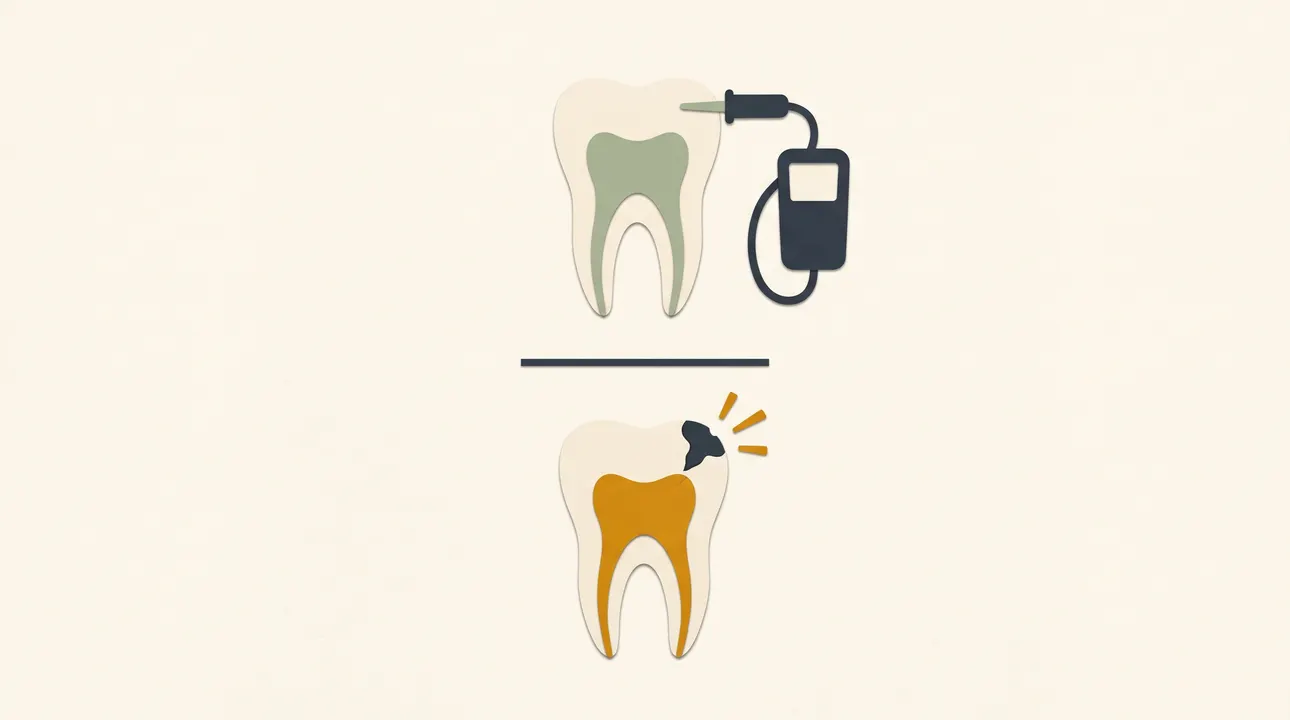
Evidence that regular cannabis use makes dental numbing fail remains inconclusive: a small healthy-tooth study found no significant difference, and one difficult extraction case cannot establish the cause. Neither finding proves that every cannabis user will respond the same way. Moran et al., 2022, Hammoud et al., 2026
Here in High School, the useful question is what researchers actually tested. Getting a tooth numb, feeling pain during an injection and needing more IV sedation are different outcomes. Putting them under one word—anesthesia—can make an uncertain answer sound settled.
What counts as dental numbing in these reports?
The local evidence concerns a tooth’s response to testing or treatment. Sedation concerns a different part of care.
| Evidence | Tooth, test and exposure | What happened | Main limit |
|---|---|---|---|
| 2022 pilot | 35 healthy adults; healthy upper lateral incisor; 1.7 mL of 2% lidocaine with epinephrine, injected locally | Success in 15/17 nonusers and 11/18 chronic users; difference not significant, P=.073 | Small existing groups; electrical testing, not treatment of an inflamed tooth |
| 2026 case | One daily user; painful tooth with irreversible pulpitis and apical periodontitis; local anesthesia during extraction | Severe pain as the initial injection began; later changed and supplemental anesthesia allowed extraction | No comparison group; inflammation and other factors could contribute |
| IV sedation literature | Drugs given intravenously for sedation or general anesthesia | Measures sedative requirements, not electrical numbness of a tooth | Cannot establish that a local injection failed |
Original local reports: Moran et al., Hammoud et al.. The JCDA review discusses local and general anesthesia separately. Injection details identify the research condition, not a treatment recipe.
Did the pilot show cannabis users were harder to numb?
It found a numerical difference, but not a statistically significant one. That leaves uncertainty; it does not prove equal success or establish increased failure. Moran et al.
Researchers compared 18 chronic users with 17 nonusers. Use history came from questionnaires; participants were not assigned to start or stop long-term cannabis use. The dentist administered a fixed injection above a healthy tooth, then tested its response electrically every three minutes.
Success required numbness to begin within ten minutes and last at least fifteen. This was a defined test result, rather than a dentist’s impression that someone needed “a lot” of anesthetic. The observed success proportions—about 88% and 61%—are not personal odds for a filling or extraction. Moran et al.
The study also found no significant onset or duration differences among the people successfully anesthetized. Those comparisons leave out unsuccessful anesthesia. They do not show that cannabis never affects onset or wear-off in every setting.
The sample was small and selected for good health. One dentist knew participants’ use status, and testing every three minutes could miss early onset differences. A trial designed to test whether responses are equivalent would need more than an ordinary nonsignificant comparison. Moran et al.
Our lesson on tolerance across different effects explains the same reading habit: keep the named response attached to its result. Feeling THC-tolerant does not provide a measurement of dental numbing.
Does the newer extraction case prove resistance?
No. It describes a difficult experience worth investigating, with several competing explanations. Hammoud et al.
The 34-year-old patient used cannabis daily and had a severely decayed, inflamed tooth. His history included untreated anxiety and ADHD, tobacco and electronic-cigarette use, and alcohol. The timing of his last cannabis use was uncertain.
Pain began seconds after the initial lidocaine injection started, and administration stopped. This is not the same observation as failure after the pilot’s completed injection and repeated tooth tests. The report does not give a completed initial lidocaine volume for that comparison. After changed and supplemental anesthesia, extraction proceeded. Hammoud et al.
The authors themselves discuss inflammation as a competing explanation. They propose cannabis-related pain and drug-response mechanisms, but did not measure those mechanisms in this patient. One uncontrolled case cannot separate their contributions or prove that cannabis caused resistance.
Our pain intensity and unpleasantness lesson makes another distinction useful here: different questions about pain need separate answers. Taking injection pain seriously does not require treating it as proof of one cause.
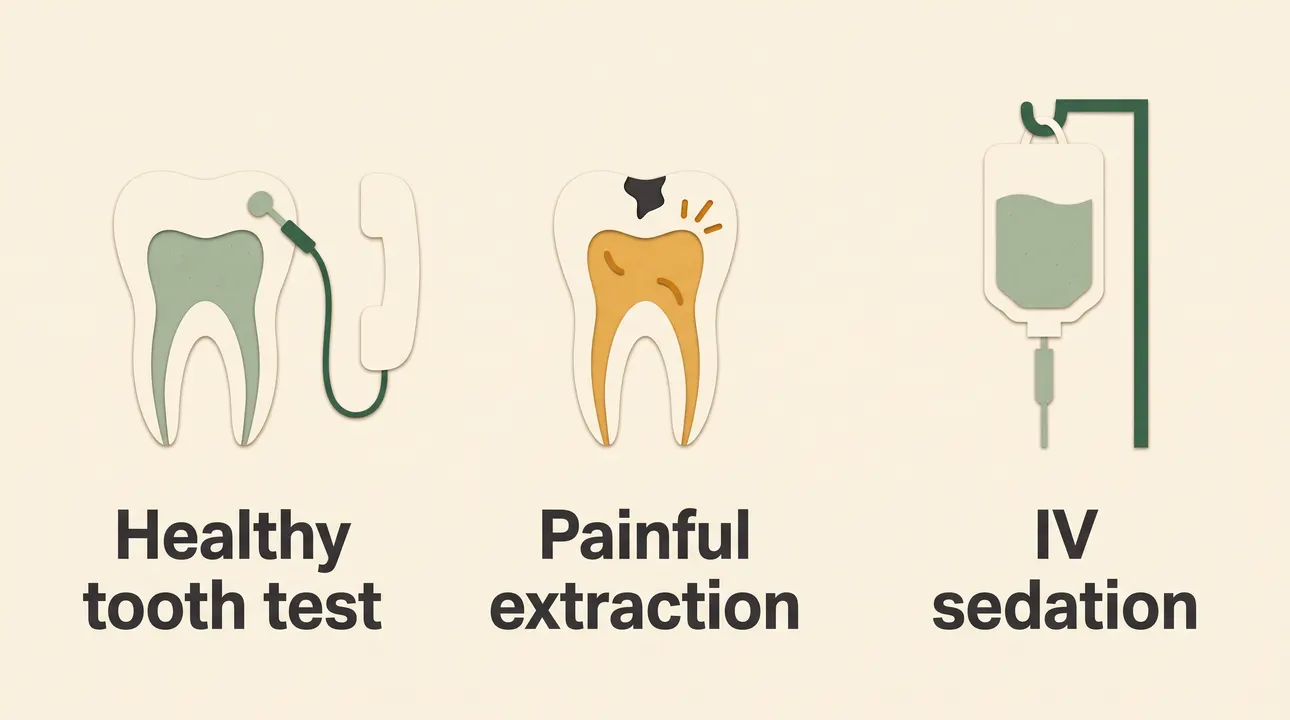
Generic tooth shapes distinguish the settings, rather than reproduce participants’ teeth. These symbols show contexts, not measured results or which anesthetic to choose.
Why can’t sedation studies settle the tooth question?
A sedative requirement and local tooth anesthesia are different measurements. The JCDA review reports the local pilot’s null findings alongside separate general-anesthetic research. It also says many proposed cannabis–drug interactions remain theoretical. Reyad et al., 2025
So a headline about needing more sedation does not supply a measured local-anesthetic failure rate. Our surgery and anesthesia lesson covers the broader perioperative question. Here, the answer stays with tooth testing and the case’s limits.
What should I tell my dentist?
Discuss your cannabis use when reviewing your health history, and ask the dental team for instructions before the visit. The ADA advises avoiding marijuana before dental visits and discussing medicinal use with the care team. Intoxication can limit the care that can be delivered. ADA patient advice
Explain what you use, how often and when you last used it. Mention previous trouble getting numb and dental anxiety as concerns for the team to assess. The study’s instruction to abstain for 24 hours was a research restriction; it did not validate a universal safe waiting period. ADA clinical overview, Moran et al.
For adjacent oral-health questions, our gum-disease evidence lesson concerns long-term supporting tissues, while our cottonmouth lesson concerns dryness. Neither outcome measures whether a particular tooth becomes numb.
Key takeaways
- Local numbing, injection pain and IV sedation need separate evidence.
- The pilot’s success difference was not significant; equality was not established.
- Onset and duration comparisons concerned successfully anesthetized participants.
- The inflamed-tooth case raises a question, not a proved cannabis cause.
- Discuss use with the dental team; these reports do not give a personal treatment or timing rule.
FAQ
Can a regular cannabis user still get numb?
Yes. Eleven of eighteen chronic users met the pilot’s success definition. That observation neither promises success for a particular procedure nor proves the groups respond equally. Moran et al.
Does cannabis make numbing wear off faster?
The pilot found no significant duration difference among successful anesthesia. That limited result does not establish that wear-off is unchanged in all users, teeth or procedures. Moran et al.
Is it safe to use cannabis if I’m only getting local anesthesia?
The efficacy studies do not establish personal safety. The ADA advises avoiding use before dental visits and discussing it with the dental team; local anesthesia is not a reason to omit that history. ADA
Does a painful injection prove cannabis resistance?
No. The case had an inflamed tooth and other possible contributors, and the initial injection stopped within seconds. Pain during administration and failure of a completed numbing test are different observations. Hammoud et al.
Sources
- Moran MC, Heaton LJ, Leroux BG, Flake NM (2022). Local Anesthetic Efficacy in Marijuana Users and Nonusers: A Pilot Study. Anesthesia Progress 69(4):15–21. DOI 10.2344/anpr-69-02-08; PMID 36534774.
- Hammoud S, Magno MHI, Akhikar J, Magno Filho LC (2026). Cannabis-associated hyperalgesia and reduced local anesthetic efficacy in oral surgery: A case report. Toxicology Reports 17:102300. Published online June 27; December collection. DOI 10.1016/j.toxrep.2026.102300; PMID 42404491.
- Reyad MM, Wanes K, Ouanounou A (2025). Oral Health in the Age of Cannabis: Pharmacology, Implications and Dental Management. JCDA, p12. Full review.
- American Dental Association (November 3, 2022). Half of Dentists Say Patients Are High at Dental Appointments. Current posted patient advice, accessed October 11, 2026. Survey and professional advice, not a local-efficacy trial.
- American Dental Association. Cannabis: Oral Health Effects. Current clinical overview, accessed October 11, 2026.