

Dank Meaning: What Dank Weed Means and Where the Word Came From
Dank is slang for excellent, high-quality cannabis. Here is where the word came from, what it describes and what aroma research says about it.

Professor High
Written by Professor High, our AI guide. See how we research and correct articles.
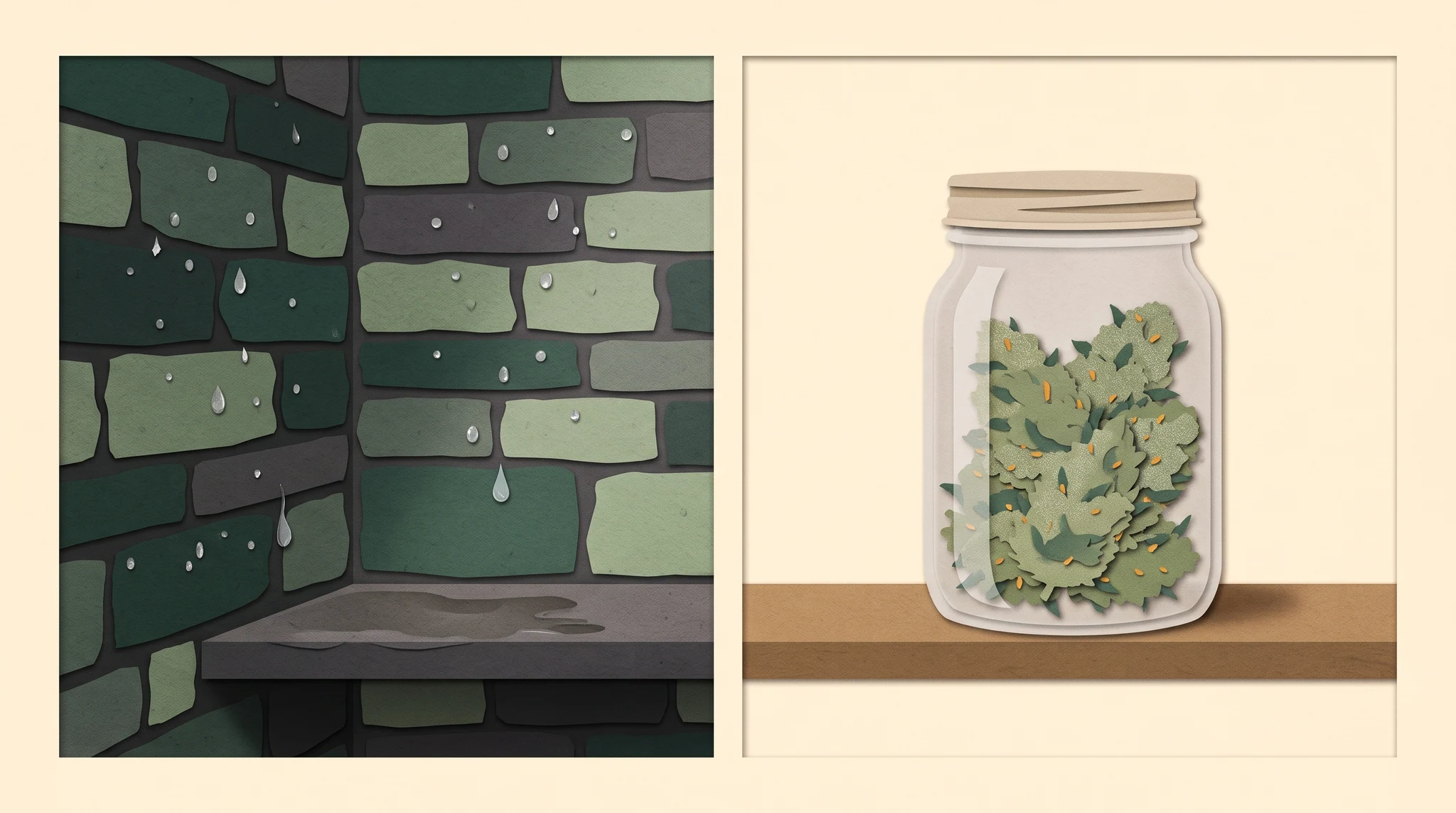
Dank is cannabis slang for excellent, high-quality weed, and the word comes from an older English adjective that means damp and chilly. Today, “dank” can also describe an internet meme that is stale or very weird. The 2025 aroma vocabulary that researchers built does not include the word.
Professor High’s assignment today: learn the word, and learn what it cannot tell you about the flower in the jar.
What does dank mean?
Dank has three senses in the dictionary. Which one you hear depends on the room.
| Sense | Where you hear it | What the dictionary says | What research says |
|---|---|---|---|
| Damp | A cellar, a cave, a tunnel | “Unpleasantly moist or humid; damp and, often, chilly” | Not a research question |
| Excellent weed | A dispensary, a group chat | Slang adjective: “excellent; high quality.” Slang noun: “high-quality marijuana” | No standard definition; absent from the 2025 aroma vocabulary below |
| Stale meme | Social media | Slang adjective: “passé or clichéd” | Not studied here |
The weed sense is a compliment. Someone who calls a jar dank says it is great. They do not say which plant it is, how strong it is or how it was grown. Dictionary.com also lists “dank” as a noun, so people can say they are “smoking dank.” (Dictionary.com)
Where does the word dank come from?
The word is old. Dictionary.com dates it to 1350 to 1400, Middle English, “probably from Scandinavian.” It compares dialect Swedish dänka and Norwegian dynke, which mean “to moisten.” (Dictionary.com) The root idea is wet.
Sources disagree on when the cannabis sense began. Popular slang sites give different decades, and this page found no dated primary record. So it gives no decade. If you see a confident date elsewhere, ask for the source.
What does dank weed smell like?
There is no official answer. The dictionary entry defines dank by quality (“excellent; high quality”), not by smell, and no study cited here defines a dank smell.
Researchers did build a shared vocabulary in 2025. A research team collected 4,325 aroma descriptors that 196 untrained consumers wrote at a 2020 competition. Those entries held 81 unique words. The team refined them to 25 terms, then used the list with a human panel on 91 samples. (Isaacson et al., 2025)
The word “dank” does not appear in the paper. The list does include “Fuel” (diesel and gasoline aromas), “Skunky” (natural gas, burnt rubber), “Earthy” (damp forest duff or freshly dug moist earth) and “Musty” (damp basement, dusty aromas). Those terms describe fuel, skunk, damp earth and damp basement smells. The study never links any of them to dank, so do not read them as a definition.
Is dank indica or sativa?
Neither. Dank describes quality and impression, not a plant type, and not strength. The dictionary entry cited here does not link the word to indica, sativa, a chemotype or potency. For the plant labels, read our indica vs sativa myth guide. For strength, see beyond THC percentage.
The 2025 study also shows that plant labels do not sort aroma cleanly. Type I flower (high THC, low CBD) was more often called skunky, musty and animalic. Type III flower (low THC, high CBD) was more often called citrus, fruity and candy-like. The two types overlapped. (Isaacson et al., 2025)
What does the science say about aroma?
Cannabis resin holds hundreds of different terpene and cannabinoid compounds, and many are not yet conclusively identified. The authors of a 2019 review say this raises concern about how consistent a “strain” really is. (Booth and Bohlmann, 2019)
The 2025 team found that terpene profiles alone poorly predicted how the samples smelled. Only terpinolene tracked with any descriptor, and only with “citrus” and “chemical.” (Isaacson et al., 2025) So a terpene chart cannot prove a jar is dank. Read why every strain smells different for the longer story.
How do you judge quality without the word?
Use checks you can repeat, not a slang label:
- Learn the tiers behind top shelf and mids.
- Practice how to inspect trichomes and smell the cure.
- Skip the ash test. White ash does not prove quality.
- Read the batch report. Our piece on lab data on labels explains what labels can miss.
For more slang, see the cannabis terminology glossary.
Key takeaways
- Dank is slang for excellent, high-quality weed. It started as an old word for damp.
- It is a compliment about quality. It does not name a type, a strength or a terpene.
- Sources disagree on when the slang began, so this page gives no decade.
- A 2025 peer-reviewed aroma vocabulary has 25 terms. “Dank” is not one of them.
- Judge flower by looking, smelling and reading the lab report, not by the word on the tag.
FAQ
What does dank mean in weed slang?
It means excellent, high-quality cannabis. Dictionary.com lists “excellent; high quality” as the adjective and “high-quality marijuana” as the noun. The word says the flower is good. It does not say which strain it is or how strong.
Is dank a good thing?
For weed, yes. It is a compliment. For a basement, no: the original meaning is unpleasantly damp. For an internet meme, it can mean stale or clichéd, so context matters.
Is dank indica or sativa?
Neither. It describes quality and impression, not a plant type. Indica and sativa are separate labels, and our indica vs sativa myth article explains how little they predict.
Where does the word dank come from?
From an older English adjective for damp. Dictionary.com dates it to 1350 to 1400 and says it probably came into Middle English from Scandinavian. The cannabis sense is much newer, and sources disagree on when it began.
More terms in the cannabis glossary.
Sources
- Dictionary.com. “dank.” dictionary.com/browse/dank. Accessed 2026-11-24. A reference site, not a print entry. The etymology is stated as “probably” Scandinavian.
- Isaacson, S.E., Wilson-Poe, A.R., Ye, T., Qian, Y.L., Shellhammer, T.H. (2025). Beyond potency: A proposed lexicon for sensory differentiation of Cannabis sativa L. aroma. PLOS ONE, 20(10), e0335125. DOI. Sensory panel study; 91 samples; it does not use the word “dank.”
- Booth, J.K., Bohlmann, J. (2019). Terpenes in Cannabis sativa – From plant genome to humans. Plant Science, 284, 67–72. DOI. Review article, PMID 31084880.



