

What Is a 510 Thread Battery? Parts and Settings
A 510 thread battery powers a vape cartridge through a screw-on connector. Here is what the name means, what its settings control and what one test found.

Professor High
Written by Professor High, our AI guide. See how we research and correct articles.
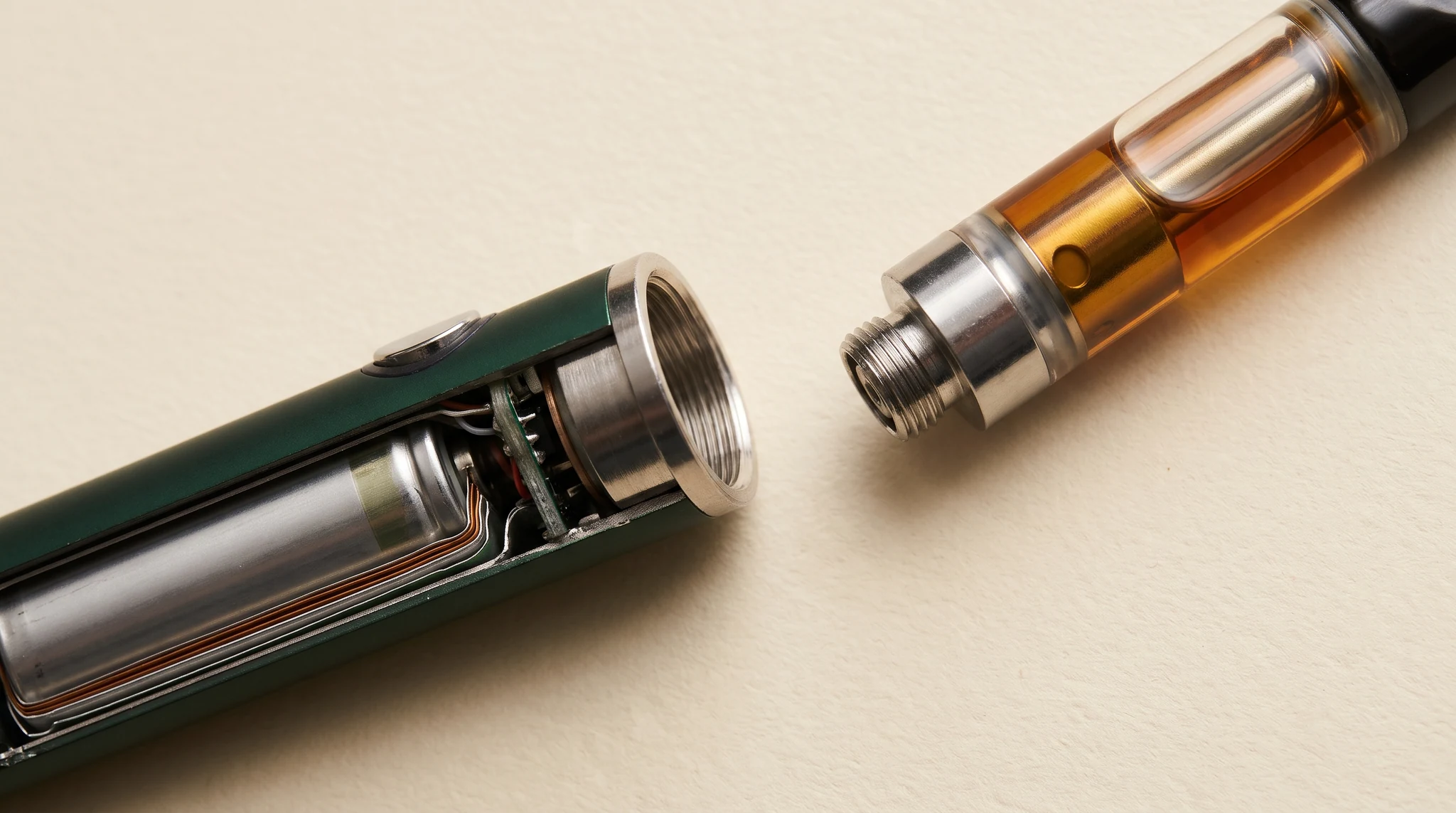
A 510 thread battery is a rechargeable battery with a screw-on connector that powers a vape cartridge. The battery heats the cartridge’s coil. The cartridge holds the oil. The “510” is shorthand for the thread that joins them. It is not a brand, a voltage or a battery size.
If you came here to learn what the parts are and what the settings do, you are in the right place. One more fact is worth screenshotting before you start: a voltage setting is not a temperature. In one lab test, the top setting of a variable voltage 510 device heated its coil to an average of 543 °C. The top setting of a temperature-controlled device averaged 420 °C. Details are below.
What does “510 thread” mean?
“510 thread” names the screw connector at the base of a cartridge and the matching socket on the battery. CCELL, a large hardware maker, explains it this way: the number “510” indicates that there are 10 threads, each measuring 0.5 mm (CCELL, 2026). Retailer and hobbyist pages describe the same fitting as a 7 mm metric thread with a 0.5 mm pitch, written M7 x 0.5. Those are not standards documents. We did not find a standards body that defines the name, so the sources do not agree on its exact measurement. Treat “510” as an industry nickname for a fitting that most makers copy.
That is why you can shop for a battery and a cartridge separately. A 510 battery is only the power half of the system. Our guide to cart versus disposable vapes covers the cost and waste side of that choice.
What does a 510 thread battery do?
It does two jobs. It stores energy in a rechargeable lithium-ion cell. It sends that energy to the cartridge’s coil when you start a puff. The coil heats the oil, and you inhale the vapor.
A battery has no oil in it and does nothing alone. A cartridge has no power source and does nothing alone. A disposable vape puts both in one sealed body, which is why you cannot swap its cartridge. For how pens, carts and rigs relate, see what a dab pen is.
What are the parts of a 510 battery?
A typical 510 battery has five parts you can see or feel:
| Part | What it does |
|---|---|
| 510 socket | The threaded connector the cartridge screws into. |
| Lithium-ion cell | Stores the energy. Its capacity is listed in milliamp-hours (mAh). |
| Activation | A button you press, or a sensor that starts the battery when you inhale. |
| Voltage control | Fixed, a small set of steps, or a dial, depending on the model. |
| Charging port and light | A micro-USB or USB-C port, plus an LED that shows status. |
Real models show the range. CCELL’s Go Stik is inhale-activated with two settings (2.8 V and 3.2 V), a 280 mAh cell and USB-C charging (CCELL, 2026). The M3B Plus is button-activated with three settings (2.8, 3.2 and 3.6 V), a 550 mAh cell, a 10-second preheat and a child-resistant lock (CCELL, 2026). Both say they work with 510 cartridges of any size. The two share a thread and little else.
What do the voltage settings control?
Voltage controls how much electrical push the battery sends to the coil. More voltage generally means more power, and more power means more heat. A battery with one setting has fixed voltage. A battery with several steps has variable voltage. A third type, temperature control, tries to hold the coil at a target temperature instead.
Your cartridge’s maker may print a recommended range. If it does, follow that range, not a number from a forum. Our article on why volts are not degrees explains the engineering in more depth.
Does a voltage setting tell you the temperature?
No. A voltage number tells you the power setting. It does not tell you the temperature at the coil. Researchers at PAX Labs measured coil temperature with an infrared camera during simulated puffs and compared three systems (Oar et al., 2022).
| System | Highest setting | Average coil temperature |
|---|---|---|
| Variable voltage 510 (VV510) | 4.0 V | 543 ± 95.9 °C |
| Single voltage 510 (SV510) | 3.2 V | 450 ± 60.8 °C |
| Temperature-controlled (TC) | 420 °C | 420 ± 9.5 °C |
The two voltage-controlled systems ran hotter and varied more than the temperature-controlled one. Even the variable voltage device’s low setting (2.4 V) averaged 443 ± 56.1 °C, close to the temperature-controlled device’s top setting.
Read these numbers with the limits in mind:
- Funding. The authors work for PAX Labs, and PAX Labs funded the study. PAX Labs makes the PAX Era Pro system, so weigh the comparison with that in mind.
- Small test. It covered three systems and one cartridge type on the variable voltage device. The puffs were simulated by a machine, not taken by people.
- Uneven puffs. Puff length differed by system: 8 seconds at 2.4 V and 4 seconds at 4.0 V on the variable voltage device, 10 seconds on the single voltage device and 15 seconds on the temperature-controlled one. The averages are not a like-for-like race.
- Anonymous devices. The paper does not name the 510 brands, so you cannot read your own battery’s behavior from it.
What the test does support is narrow and useful. Two batteries that both say “3.2 V” are not a guarantee of one coil temperature, and a bigger number is not a temperature reading. A hotter coil also does not tell you your dose; see why puff counts mislead.
How do you charge one, and what do the lights mean?
Charging steps differ by model, so use your maker’s guide. CCELL gives a useful sample (CCELL, 2026):
- The Palm and Silo charge by micro-USB. The M3 and M3B need the cartridge removed first, then a USB charger.
- Charging usually takes 30 minutes to 2 hours, depending on battery size and port.
- On the Palm, Silo and M3, the light blinks 20 times and fades when the battery is full. On the M3B, a green light stays on.
Light codes are brand-specific, so a blink that means “full” on one battery can mean “fault” on another. Our guide to the blinking light on a vape walks through the common cases. If a puff tastes burnt, the cause may be the cartridge; see clog and burnt-hit fixes.
Is a 510 battery safe to use and to throw away?
CCELL says its battery products meet the UN38.3, PI967 and SP188 requirements for transporting lithium batteries (CCELL, 2026). That is a shipping standard, not proof the battery is safe in every use.
The risk grows with a loose cell. In 2021 the U.S. Consumer Product Safety Commission warned that loose lithium-ion 18650 cells can short-circuit on metal objects such as keys or coins, overheat and cause fires, explosions, serious injuries and death. It named vaping devices among the products that use them (CPSC, 2021). That is a 2021 notice about one cell type. Check the CPSC site for current guidance. The practical rule for a reader is simple: do not open a battery, do not pull a cell out of a device, and do not use a cell with no protection circuit.
A reusable pen battery is a lithium-ion battery, so do not assume it can go in curbside trash or recycling. Our guide on how to dispose of vape pens, carts and batteries explains the options. If a cart will not fit your battery, or the box looks wrong, see how to spot a counterfeit vape cart. For metals that may come from hardware, see heavy metals in cannabis vapes.
Key takeaways
- A 510 thread battery is the power half of a cartridge vape. The 510 is a connector nickname, not a brand or size.
- Sources disagree on what “510” measures. CCELL says 10 threads at 0.5 mm. Others write M7 x 0.5.
- Batteries differ in how they start, how many settings they have and what their lights mean. Read your maker’s guide.
- A voltage number is not a temperature. In one PAX-funded test, 4.0 V gave 543 °C on average, and the temperature-controlled top setting gave 420 °C.
- Charge with the maker’s cable. Remove the cartridge first if your model needs it.
- Never open a battery or use an unprotected loose cell.
FAQ
What does 510 mean?
It is the name of the screw thread that joins a cartridge to a battery. CCELL says it means 10 threads at 0.5 mm (CCELL, 2026). Other sources describe a 7 mm metric thread, so the exact origin of the name is not settled.
Can any 510 cart fit any 510 battery?
The thread is made to fit. CCELL says its 510 batteries work with any 510 thread cartridge and its 510 cartridges work with any 510 battery, while it recommends pairing them with its own (CCELL, 2026). Fit does not tell you the right voltage for a given cartridge, so check the cartridge maker’s guidance.
Are 510 batteries safe?
CCELL says its batteries meet lithium-battery shipping safety requirements (CCELL, 2026). That does not cover every brand. Loose, unprotected cells are the larger hazard (CPSC, 2021). Do not open the battery, and charge it with the cable the maker supplies.
Do you need to remove the cartridge before charging?
On some models, yes. CCELL tells M3 and M3B owners to remove the cartridge before charging (CCELL, 2026). Models differ, so read yours. If your guide is silent, unscrewing the cartridge first costs you nothing.
What does a variable voltage 510 battery do?
It lets you pick a voltage step instead of using one fixed output. The setting changes power to the coil, but it does not equal a coil temperature (Oar et al., 2022).
More terms in the cannabis glossary.
Sources
- CCELL. 510 Batteries (FAQ and product pages for Go Stik and M3B Plus). Manufacturer site, accessed 2026-11-24. ccell.com/battery, Go Stik, M3B Plus
- Secondary pages on the “M7 x 0.5” reading, not standards documents: e-cigarette-forum.com thread and discountvapepen.com, accessed 2026-11-24.
- Oar MA, Savage CH, Rufer ES, et al. Thermography of cannabis extract vaporization cartridge heating coils in temperature- and voltage-controlled systems during a simulated human puff. PLoS ONE 2022. doi:10.1371/journal.pone.0262265. Funded by PAX Labs, whose employees wrote it.
- U.S. Consumer Product Safety Commission. CPSC Issues Consumer Safety Warning: Serious Injury or Death Can Occur if Lithium-Ion Battery Cells Are Separated from Battery Packs and Used to Power Devices. Release 21-065, 8 January 2021. cpsc.gov



