How Much THC Is in One Vape Puff? Why Counts Mislead
THC per vape puff has no universal milligram value. Learn why cartridge totals, oil use, aerosol measurements, and absorption are different.

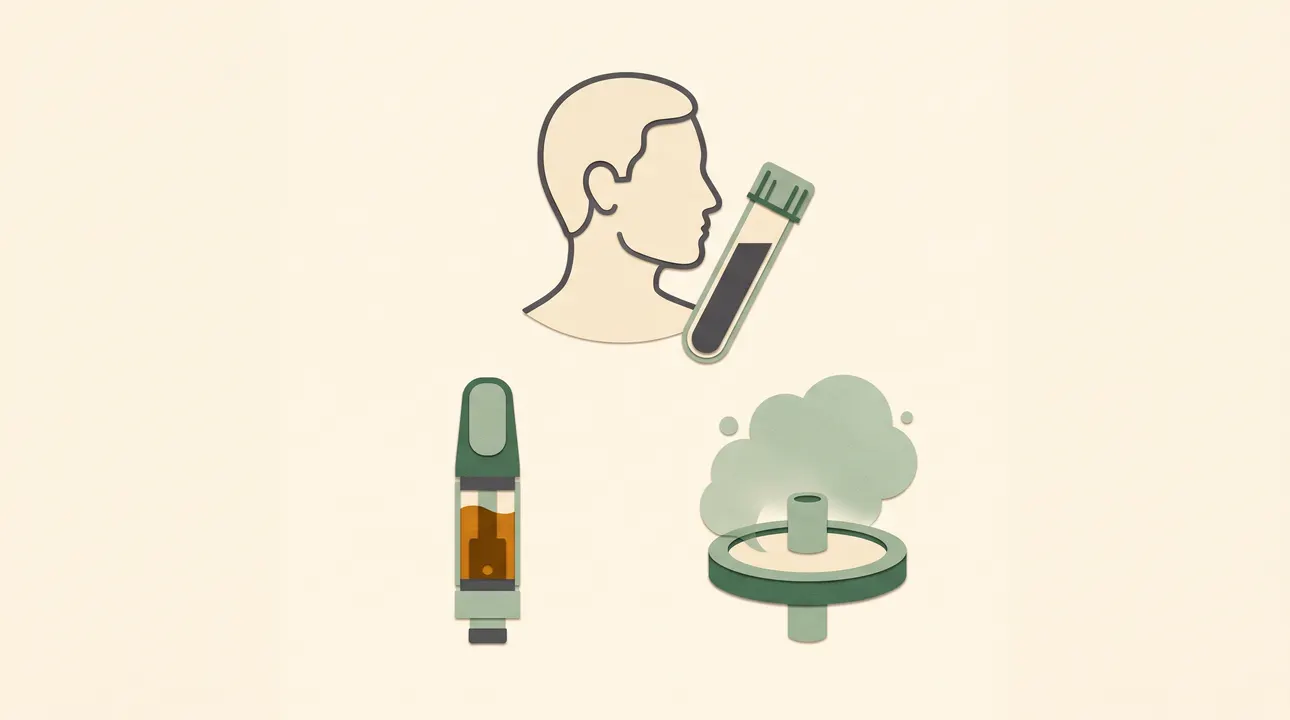
There is no universal milligram dose of THC in one vape puff: a cartridge’s THC total and its puff count do not tell you how much your body absorbs. “One hit” counts an action. It does not specify the amount of oil used, the THC in the aerosol, or the THC that enters circulation.
Here in High School, the useful lesson is to keep those measurements separate. This article concerns oil cartridges, rather than flower vaporizers or metered medical inhalers.
Can I divide the cart’s THC by its puff count?
You can do the division. The result is an inventory average, not a measured dose. Consider this hypothetical example, with every assumption stated:
- The cartridge contains 1 gram of oil, or 1,000 mg.
- An accurate label reports 80% delta-9 THC by mass.
- A seller advertises 200 puffs; that count is an assumption here, not a tested result.
The starting THC inventory would be:
1,000 mg oil × 0.80 = 800 mg THC in the tank.
Dividing 800 by 200 gives 4 mg of starting THC inventory per assumed puff. It does not establish that each puff carries 4 mg, or that a person absorbs 4 mg. Changing the guessed denominator changes the answer without measuring anything new.
To treat that average as a dose, you would have to establish how much oil was actually used, what left the device, and what reached the person. Equal sharing across every puff is another assumption. The calculation supplies none of those observations.
Also keep grams and milliliters separate. A gram measures mass; a milliliter measures volume. A “1 mL” label cannot be inserted as “1 g” without knowing the oil’s density. This example also assumes delta-9 THC, rather than resolving every possible THCA label.
The same inventory-versus-delivery issue appears in our joint THC calculation lesson. A joint adds combustion and sidestream losses; an oil cart needs evidence for its own delivery system.
What are the four different amounts people call a dose?
They are different measurements, even when someone reports all of them in milligrams:
| Amount | What would establish it? | What it cannot tell you alone |
|---|---|---|
| THC in the full tank | Oil mass and measured concentration | THC in a particular puff |
| Oil consumed during a puff | Cartridge mass before and after use | How much of that loss was THC collected in aerosol |
| THC transferred into a collected aerosol sample | Controlled collection and chemical analysis | How much a person absorbed |
| THC absorbed by a person | Human exposure research, with its own methods | A universal result for every user and device |
A filter pad and a bloodstream answer different questions. Even a blood concentration is not the same unit as the total mass absorbed. To understand that last distinction, continue with our bioavailability lesson.
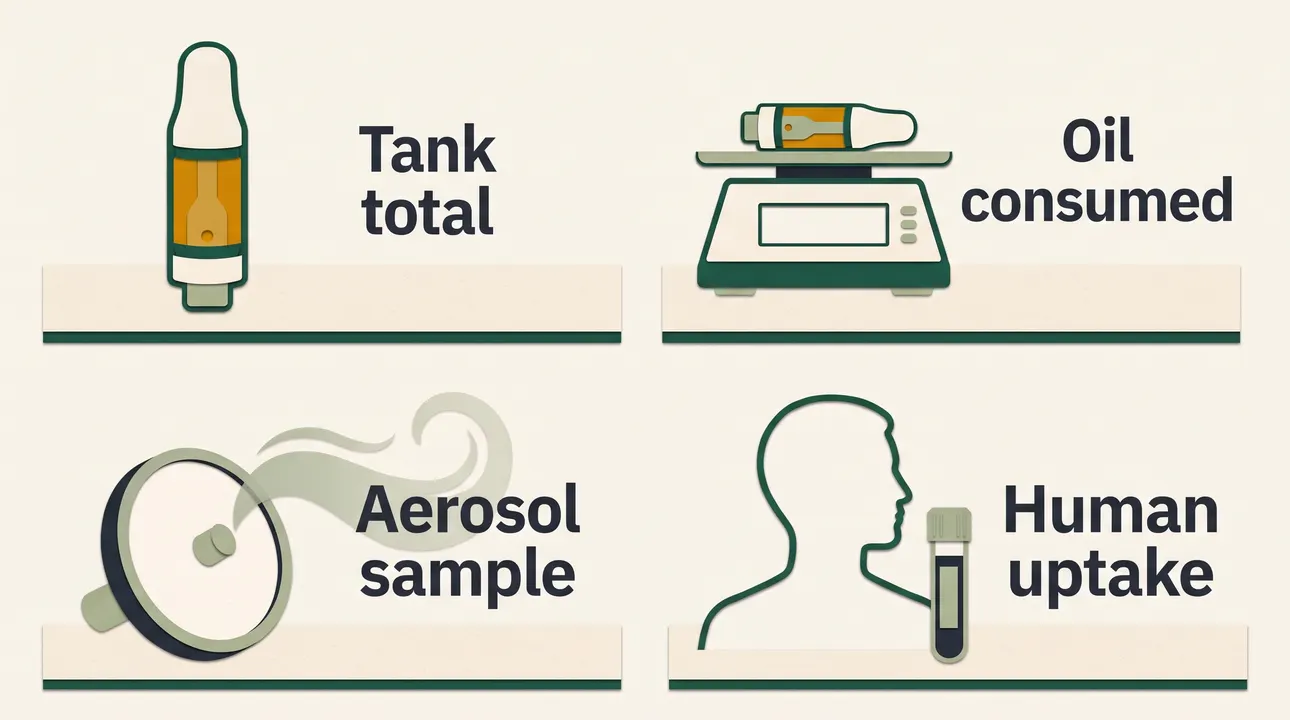
Tank inventory, oil consumption, collected aerosol, and human uptake require different measurements. The diagram supplies no conversion percentage.
What did a cartridge experiment actually measure per puff?
A 2021 laboratory study weighed a cartridge before and after machine puffs, then analyzed THC caught on filter pads. It tested synthetic THC/myrcene mixtures using a TH2 CCELL cartridge design. The puff target was 50 mL over three seconds; measured volumes averaged 44 ± 3 mL. Meehan-Atrash et al., 2021
In its power experiment, with 14% myrcene in the mixture:
| Tested power | Oil consumed per machine puff | THC collected per machine puff |
|---|---|---|
| 8 W | 4 ± 1 mg | 2.9 ± 0.2 mg |
| 10 W | 7 ± 3 mg | 5 ± 1 mg |
| 12 W | 7 ± 2 mg | 5 ± 1 mg |
These are means with 95% confidence intervals, from three to five replicates per condition. They are laboratory results, not dosing instructions. THC transfer rose from 8 to 10 W but did not significantly increase from 10 to 12 W. Composition also changed transfer. Study methods and Table 1
No person inhaled these samples. Manual activation introduced unrecorded puff-duration variation. One setup and model mixtures cannot calibrate every commercial cart. One author disclosed a hemp-company role; the work received partial NIH/FDA funding.
Why doesn’t counting hits measure what reaches a person?
Puff count leaves out the size of each inhalation. In two small 1995 smoking experiments, seven regular users per experiment took ten controlled puffs. Changing puff volume changed blood THC and reported high despite the same count. Longer breath-holds increased blood THC without increasing reported high. These were smoke experiments, not oil-cart calibration. Azorlosa et al., 1995
The point is about measurement, not a technique to copy. More detail on those limits belongs in our breath-hold evidence lesson.
Researchers still work on better estimates. A 2025 survey of 1,824 adults compared models using reported hit sizes. For flower, the revised model increased estimates for large hits, but not significantly for medium or small hits. Concentrate estimates needed further validation. These were self-reported quantities and modeled estimates, not measured absorbed doses. Habib et al., 2025
What information is more useful than a puff-counter number?
Ask what a per-puff claim actually measures: oil loss, THC collected at the mouthpiece, or exposure in people? Look for the tested cartridge, formulation, setting, puff duration and volume, number of trials, and variation between results. “Lab tested” without those details does not answer the dose question.
For device measurement versus session tracking, use our cannabis dosing-device guide. A counter can help record a session without becoming a milligram meter. Keep the product, setting, approximate draw pattern, time and unwanted effects in a cannabis journal. Leave an unknown absorbed dose unknown.
Key takeaways
- Tank THC divided by a guessed puff count is an inventory average.
- Oil consumed and THC collected from aerosol are different measurements.
- Machine results do not measure a person’s absorption.
- Puff size matters; a counter does not record every relevant condition.
- A universal per-puff number cannot supply an edible-equivalent dose.
FAQ
How many vape puffs equal a 10 mg edible?
There is no defensible universal conversion. The tank calculation does not establish an inhaled or absorbed dose, so it cannot establish a matched edible amount. Treat a change of route as a separate dosing question.
Does an 80% cart deliver more THC than a 70% cart?
It contains more THC per equal mass of oil, assuming accurate percentages on the same basis. Delivery per puff also needs the amount consumed and the aerosol measurements. Potency alone does not resolve those details.
Does a puff counter tell me my daily THC intake?
It tells you the number of recorded events. Turning that count into milligrams requires a supported estimate for those specific conditions, with its uncertainty. The display alone does not measure absorption.
Can I calculate a blinker’s THC dose?
A device cutoff gives no universal milligram value. It does not establish the oil used or the aerosol collected, much less human uptake. A long activation is not a standard dose unit.
Sources
- Meehan-Atrash, J., et al. (2021). The influence of terpenes on the release of volatile organic compounds and active ingredients to cannabis vaping aerosols. RSC Advances, 11(19), 11714–11723. DOI.
- Azorlosa, J. L., Greenwald, M. K., & Stitzer, M. L. (1995). Marijuana smoking: effects of varying puff volume and breathhold duration. Journal of Pharmacology and Experimental Therapeutics, 272(2), 560–569. PubMed.
- Habib, M. I., et al. (2025). Estimating Cannabis Consumption in Milligrams of THC From Self-Reported Hit Size. Cannabis, 8(2). DOI.





