

What "White" Means in a Strain Name: Frost, Family or Just a Label?
White strains are not one family. The word can mean frosty buds, a White Widow parent, a separate cut called The White, or only a name. Here is how to tell.

Professor High
Written by Professor High, our AI guide. See how we research and correct articles.
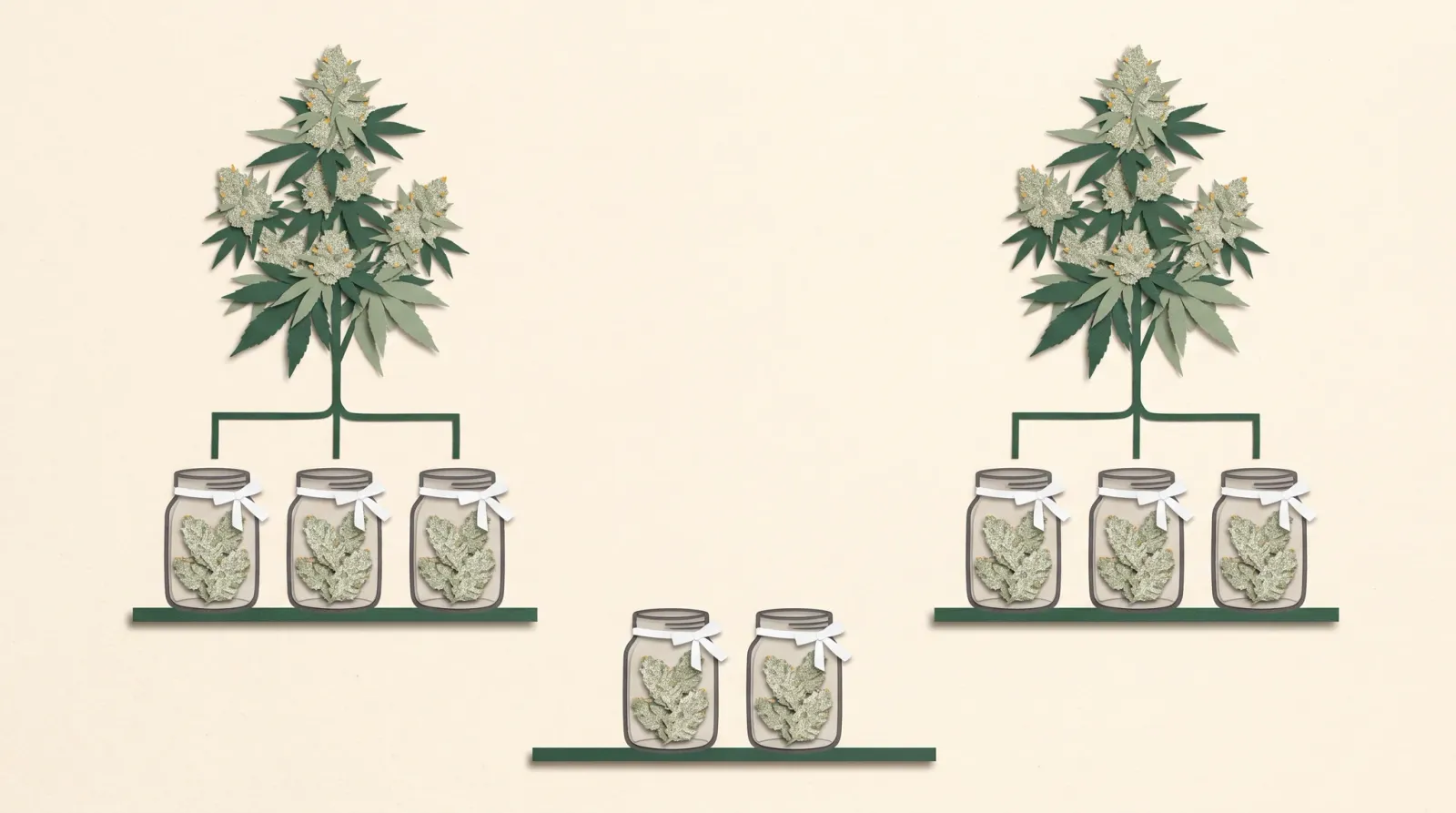
“White” in a strain name can mean four different things: frosty-looking buds, a White Widow parent, a parent called The White that has no known link to White Widow, or nothing more than a name, so the word alone does not tell you two strains are related or that they act alike. White Widow, White OG, White Wedding and White Cherry share a first word. They do not share one family tree.
The clearest proof comes from a breeder. The person behind The White said it “has no relation to white widow to the best of my knowledge” and was “called the white for one reason only. The color of the buds,” according to a strain database page that reproduces the breeder’s words. So White OG, which comes from The White, and White Rhino, which its breeder ties to White Widow, sit in two different families that happen to share a color word.
This High School lesson covers the four meanings, the frost behind the name, four White strains compared by published parents, and a quick check for what you are buying. For the bigger picture of how cannabis names get made, start with our guide to what strain names actually mean.
Breeder pages and studies checked October 29, 2026.
What does “white” mean in a strain name?
It depends on the strain, and the name does not tell you which meaning applies. Here are the four meanings you will run into.
- Frost. The buds look white because they are covered in resin glands. This is a description of appearance, not a parent.
- A White Widow parent. Green House Seed Company describes its own “white” family, including Great White Shark, White Rhino and El Nino, as sharing “a common genetic origin” with White Widow on its Cannabis Cup awards page. That “White Family” is a breeder’s term for its own plants, not a scientific grouping.
- A parent called The White. This is a separate clone, also called Triangle, whose breeder says it is a three-way cross with no relation to White Widow. Its parents have not been published.
- A name only. Some strains carry “white” from another white-named parent, or from no traceable source. Meraki Genetics’ White Cherry takes its “white” from a plant called White Nightmare, per its breeder page. We found no source that explains the “white” in White Wedding.
The practical answer: when you see “white”, ask which white.
Why do some strains look white?
Frost is made of trichomes, tiny resin glands on the flower. A microscopy study in The Plant Journal found that the stalked glandular trichomes on cannabis flowers carry cannabinoids and are strongly dominated by monoterpenes, and that floral trichomes strongly express the genes that make cannabinoids and terpenes. Light catches these glassy heads, and the bud reads as white or silver.
How much frost a plant shows is not fixed. A 2023 study in the Journal of Cannabis Research followed two genotypes through three to eight weeks of flowering. Trichome numbers and stalk length differed significantly by genotype and by week, the glands matured at different times on the same flower, and drying changed their shape. So “white” is partly a genetics trait and partly a result of harvest timing and handling.
Breeders have also pushed frost on purpose. A 2025 comparison in Plant and Cell Physiology found that two modern cultivars had larger trichomes with more secretory cells than two landrace ancestors. That is four varieties, so read it as a direction, not a law. For trichome types and what their color says about ripeness, see our complete guide to cannabis trichomes.
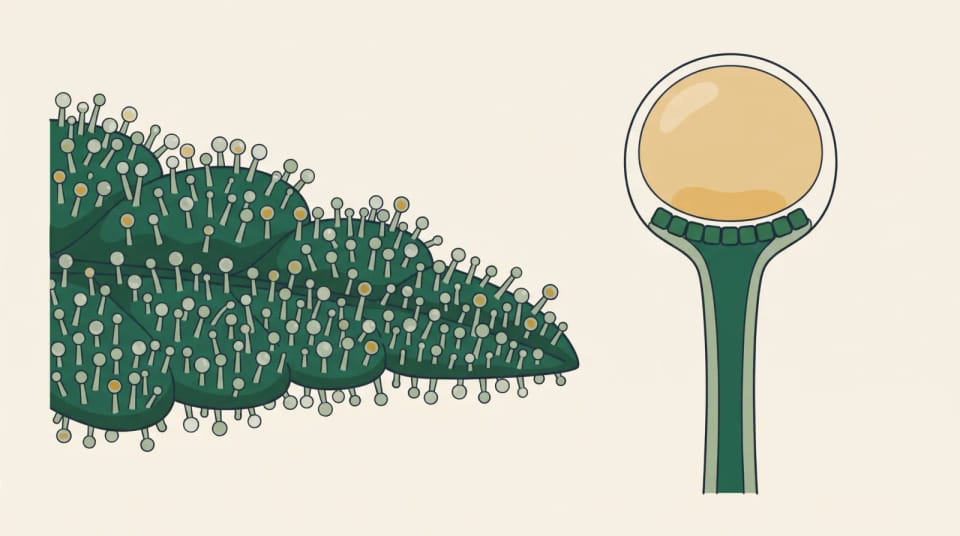
Frost is resin glands. Each stalked gland makes and stores resin in its head. How many a plant shows depends on its genetics, its age at harvest and how it was dried.
One caution before you judge frost by eye. At arm’s length, powdery mildew can look like frost. Our guide on how to tell mold from trichomes shows the difference: trichomes are distinct stalked heads under magnification, and mold looks like a flat or fuzzy film. If you have used flower you now suspect was moldy and you notice coughing, wheezing, chest tightness or fever that does not settle, talk to a clinician and mention the exposure.
Does more frost mean stronger weed?
Not reliably. Frost and cannabinoids are linked inside one plant, but frost is a poor test when you compare different strains.
Both sides of the evidence matter here:
- Inside a plant, they rise together. A 1981 study of three clones found a positive correlation between gland count per bract and the bract’s cannabinoid content as the flowers developed.
- Across strains, frost is a weak signal. A 2025 review in Plants concluded that trichome density alone is unlikely to be directly correlated with cannabinoid content, because gland shape, size, maturity and stress-related surface changes also matter. The authors also found no standard method for counting trichomes.
So a frostier jar is not proof of a stronger jar. The lab label is the better tool, and even THC percent has limits, as our piece on why THC percentage is a poor way to choose cannabis explains. To inspect frost, smell and cure together, use our cannabis quality guide.
Are all white strains related to White Widow?
No. White Widow is one white ancestor, and The White is another, unrelated by its own breeder’s account.
Green House Seed Company lists White Widow’s genetics as “Brazilian x South Indian” on its White Widow product page, and describes “the frosty layer of trichomes” as the flowers’ main characteristic. The page does not say why the strain got its name. The frost explanation is a reasonable guess, but we did not find a breeder source that confirms it.
Who created White Widow is disputed. One account credits Scott Blakey (Shantibaba) while he worked at Green House, per the White Widow encyclopedia entry. A breeder statement reproduced on a strain database page credits an earlier Dutch cut called “Arnhem’s Wonder”. We found no independent record that settles it.
The White is the second root. Its breeder says it was named for bud color, that its real name is Triangle after a three-way cross, and that it has no relation to White Widow. Its parents are unpublished, so nobody can place it on a family tree yet. Sources also disagree on where it came from, so treat any location claim with care.
What are White OG, White Wedding and White Cherry made of?
Each one points to a different “white”, and two of them have more than one published parentage under the same name. The table shows who states each lineage and how much weight it carries.
| Strain | Published parents | Who states it | What “white” points to | Confidence |
|---|---|---|---|---|
| White Widow | Brazilian x South Indian | Green House Seed Company, breeder page | Frost; the breeder does not explain the name | Breeder-stated |
| White OG | The White (female) x SFV OG Kush BX2 (male) | Karma Genetics, text reproduced on a database page | The White | Breeder-stated, indirect copy |
| White Wedding, Ethos version | Wedding Cake x Mandarin Cookies x Crescendo | Ethos Genetics, breeder page | Not explained | Breeder-stated |
| White Wedding, MSIKU version | Wedding Cake x Girl Scout Cookies | Trade magazine feature, “reportedly” | Not explained | Reported |
| White Cherry, Meraki version | Mother of All Cherries x White Nightmare BX1 | Meraki Genetics, breeder page | White Nightmare | Breeder-stated |
| White Cherry, retail version | Cherry OG x The White | Licensed producer product page | The White | Producer-stated |
A third White Wedding parentage also circulates in retail listings, with Wedding Cake, Breathworks and Killer Malawi, and the listings disagree with each other about Breathworks. We did not find a breeder page for it.
The OG half of White OG comes from the line explained in our OG Kush genetics guide, and every White Wedding version starts from the plant in our Wedding Cake profile. Beyond that shared starting point, the versions split.
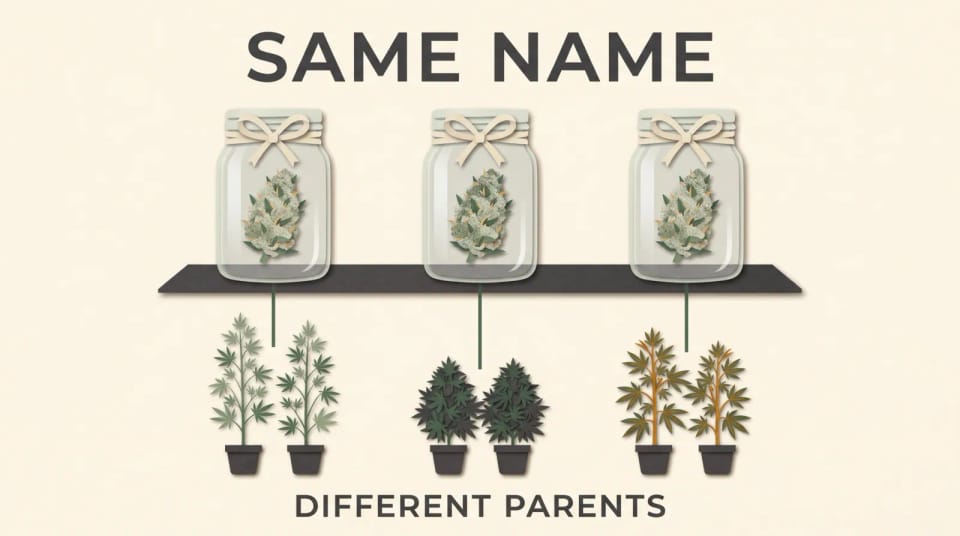
White Wedding and White Cherry each have more than one published parentage. Same label, different plants: ask which version you are holding.
Do white-named strains act alike?
There is no evidence that they do. We searched for a study that tests White Widow, The White or White-named strains as a group, and found none. That is not proof that no study exists, but nobody has shown a shared “white” effect.
The indirect evidence points the other way. A name, first word included, is a weak guide to the plant inside:
- A 2015 genetic study of 81 marijuana and 43 hemp samples concluded that marijuana strain names often do not reflect a meaningful genetic identity.
- A 2019 study of 30 named strains from dispensaries in three states found significant genetic differences within samples sold under the same name. Most strains had at least one genetic outlier, though many looked stable once outliers were removed.
- A 2020 survey of 2,662 Nevada flower samples found that 396 breeder-reported names fell into three terpene-based chemical groups, and the genotypes did not line up with the chemistry. That is one state and one lab from 2016 to 2017.
- A 2021 study of over 100 samples tested at over 100,000 genetic markers found that sativa and indica labels tracked a few terpenes rather than whole-genome differences. The work was funded by Bedrocan, which the paper declares.
A shared first word is a thin reason to expect a shared experience. Our explainer on whether strain names match their DNA goes deeper on these studies, and batch variance explains why even two jars of one strain can test differently.
If you want a grouping built on chemistry instead of names, our High Families classification sorts products by terpene profile. It is a product classification to help you compare, not a prediction of how any strain will feel for you.
How do you check what a white strain really is?
Treat the name as a question, not an answer.
- Ask for the breeder and the parents. A name with no breeder attached carries no lineage claim.
- Match the answer to a breeder record. If two sources give different parents for one name, treat them as different plants.
- Find which white the name points to. White Widow, The White, another white-named parent, or nothing traceable.
- Read the lab label instead of the frost. Cannabinoid and terpene results tell you more about chemistry than how white the bud looks.
- Inspect the frost up close. A loupe or phone macro lens confirms that the coating is trichome heads, not mold.
Then notice how the strain actually worked for you. The High IQ app lets you log a session and compare strains side by side, so over time your own notes tell you more than any color word. The broader version of this habit is in our guide to finding your ideal high by chemistry, not strain name.
One more note: “white” ash after burning is a separate question with its own myth, covered in our white ash vs. black ash guide.
Sources
- Livingston SJ, Quilichini TD, Booth JK, Wong DCJ, et al. “Cannabis glandular trichomes alter morphology and metabolite content during flower maturation.” The Plant Journal, 2020. PubMed 31469934
- Turner JC, Hemphill JK, Mahlberg PG. “Interrelationships of glandular trichomes and cannabinoid content. I.” Bulletin on Narcotics, 1981. PubMed 6914206
- Alberti T, Didaran F, Sharma S, et al. “Bracts, Buds, and Biases: Uncovering Gaps in Trichome Density Quantification and Cannabinoid Concentration in Cannabis sativa L.” Plants, 2025. PMC12300688
- Punja ZK, Sutton DB, Kim T. “Glandular trichome development, morphology, and maturation are influenced by plant age and genotype in high THC-containing cannabis inflorescences.” Journal of Cannabis Research, 2023. PMC10071647
- Nolan M, Guo Q, Garcia-de Heer L, Liu L, et al. “Bigger is better: modern Cannabis trichomes are larger and more productive than their landrace ancestors.” Plant and Cell Physiology, 2025. PubMed 40891499
- Sawler J, Stout JM, Gardner KM, Hudson D, et al. “The Genetic Structure of Marijuana and Hemp.” PLoS One, 2015. PubMed 26308334
- Schwabe AL, McGlaughlin ME. “Genetic tools weed out misconceptions of strain reliability in Cannabis sativa.” Journal of Cannabis Research, 2019. PMC7815053
- Reimann-Philipp U, Speck M, Orser C, Johnson S, et al. “Cannabis Chemovar Nomenclature Misrepresents Chemical and Genetic Diversity.” Cannabis and Cannabinoid Research, 2020. PMC7480732
- Watts S, McElroy M, Migicovsky Z, Maassen H, van Velzen R, Myles S. “Cannabis labelling is associated with genetic variation in terpene synthase genes.” Nature Plants, 2021. PubMed 34650264
- Green House Seed Company. White Widow product page and Cannabis Cup awards page. Breeder pages.
- Breeder descriptions reproduced on strain database pages: The White, White OG, White Widow.
- Ethos Genetics. White Wedding RBX. Breeder page.
- McEwen W. White Wedding by Msiku. Trade magazine feature, 2021.
- Meraki Genetics. White Cherry (Mother of All Cherries x White Nightmare BX1). Breeder page.
- White Cherry product page. Licensed producer page.
- White Widow (cannabis). Encyclopedia entry, used for origin credit context only.
Key takeaways
- “White” can mean frost, a White Widow parent, a parent called The White, or only a name.
- The White’s breeder says it has no relation to White Widow and was named for bud color.
- White Wedding and White Cherry each have more than one published parentage.
- Frost is resin glands; its amount depends on genetics, harvest timing and drying, and it is not a reliable potency test across strains.
- No study shows that white-named strains act alike. Judge a jar by its lab label and your own notes.
FAQ
Is The White the same as White Widow?
No. The White’s breeder says it has no relation to White Widow to the best of their knowledge, and that it was named only for the color of its buds. Its real name is Triangle, and its parents are unpublished. White OG descends from The White, not from White Widow.
Why is White Widow called White Widow?
Its breeder, Green House Seed Company, describes a frosty layer of trichomes as the flowers’ main characteristic, which fits the “white” in the name. The breeder page does not explain the name, though, and we found no breeder source that confirms the frost story. Who created the strain is also disputed.
What is the whitest strain of weed?
No study ranks strains by whiteness, and frost changes with genotype, flowering week and drying, so the same strain can look frostier in one harvest than another. A very white bud is also worth a closer look, because powdery mildew can resemble frost from a distance. Frost level is not a reliable sign of potency.
Is White Rhino related to White Widow?
Its breeder says so. Green House Seed Company groups White Rhino, Great White Shark, El Nino and White Widow as a “white” family with a common genetic origin. That is the breeder’s own description of its plants, not an independent DNA test.



