

Why Does Weed Give Me a Headache? Four Causes, Graded
No study has shown why weed gives some people a headache. Here is how dehydration, smoke, dose and rebound rank on the evidence, plus the red flags.

Professor High
Written by Professor High, our AI guide. See how we research and correct articles.
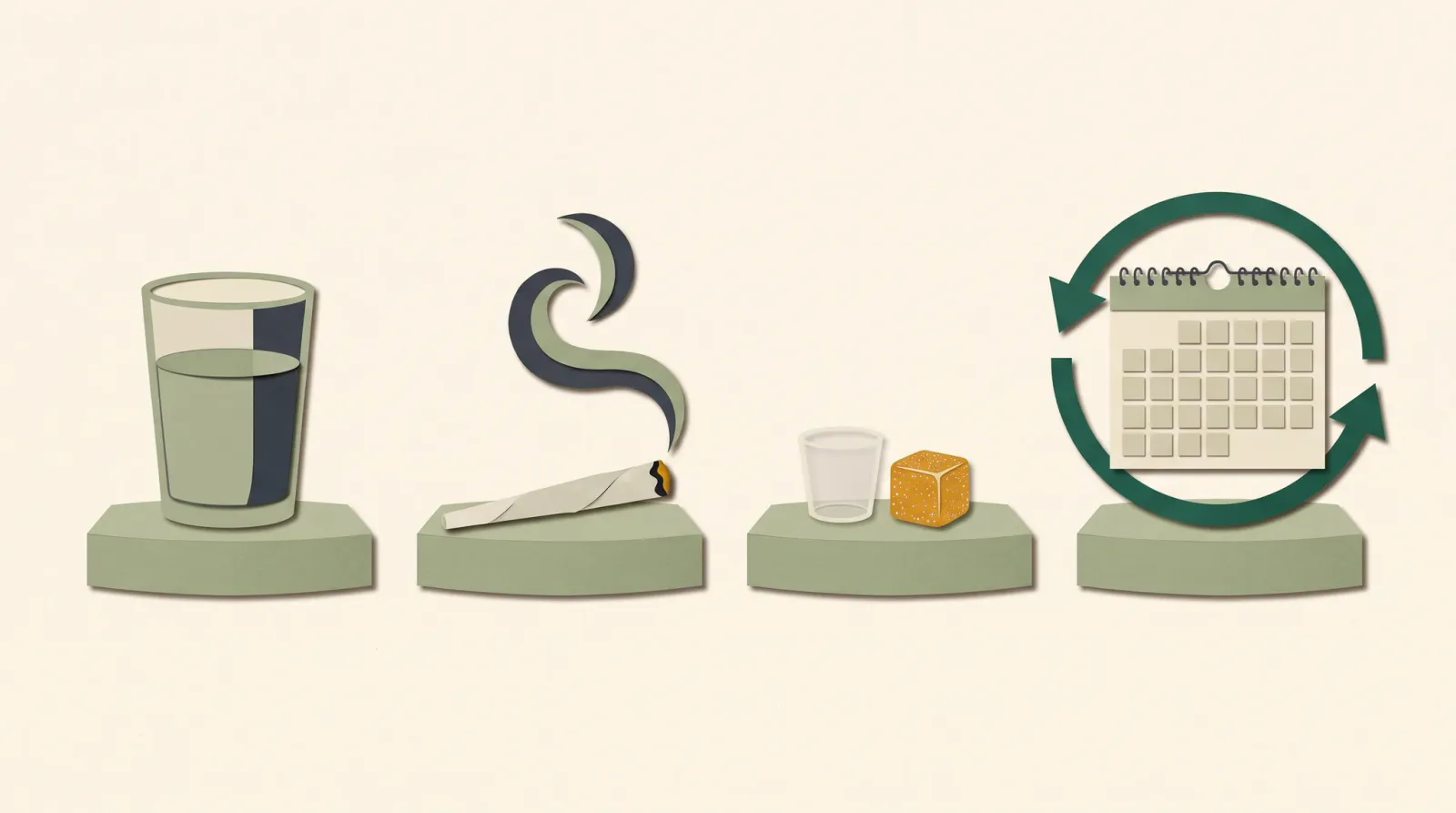
No study has shown why weed gives some people a headache, and the usual explanations (dehydration, too much THC, the strain) are weaker than most pages admit. Smoke, a high dose, and heavy use in people who already have chronic migraine are the better-supported suspects. A sudden, explosive headache is different: it needs emergency care.
Most pages that rank for this question hand you a confident list: drink water, use less, switch strains. None of them grade the list. So here in High School, we sorted the four usual suspects by the evidence we could actually find.
Sources checked October 29, 2026.
| Suspect | What the evidence shows | Grade |
|---|---|---|
| Dehydration | Cannabis dries your mouth by slowing saliva. No study we found links cannabis to body-water loss or to headache. | No cannabis evidence found |
| Smoke | Smoking cannabis delivers carbon monoxide, and carbon monoxide causes headache. No study measured headache from cannabis smoke. | Plausible, untested |
| Dose | Headache shows up in controlled trials, but it does not climb neatly with THC, and placebo got headaches too. | Low, not dose-graded |
| Rebound | Linked to cannabis in one chart review of people with chronic migraine. Supported by a rat model. | Association, chronic migraine only |
The line worth screenshotting: in the one controlled trial that counted headaches at each THC strength, placebo got headaches too: 3 reports at 0% THC, 4 at 9.4%. (Ware 2010)
Why does weed give me a headache?
The honest answer is that nobody has pinned it down. Medicine does not even have a named diagnosis for it. The International Classification of Headache Disorders lists headaches caused by carbon monoxide, alcohol and cocaine by name, but its substance chapter has no cannabis-specific entry. Cannabis falls under the generic “other substance” codes.
So “weed headache” and “THC headache” are everyday phrases, not medical conditions. That matters, because a name makes a cause sound settled when it is not. What we have instead is a short list of suspects, each with a different amount of evidence. Let’s take them one at a time.
Is it dehydration?
Probably not, at least not in the way most pages claim. The dehydration story rests on cottonmouth: your mouth feels dry, so your body must be low on water. But dry mouth is a local effect. In a placebo-controlled study of 57 adults, saliva flow fell as blood levels of THC rose. Lab work in rat salivary glands shows that cannabinoid receptors there directly suppress saliva output. That is a gland slowing down, not your body drying out. Our guide to why cannabis causes dry mouth walks through that mechanism.
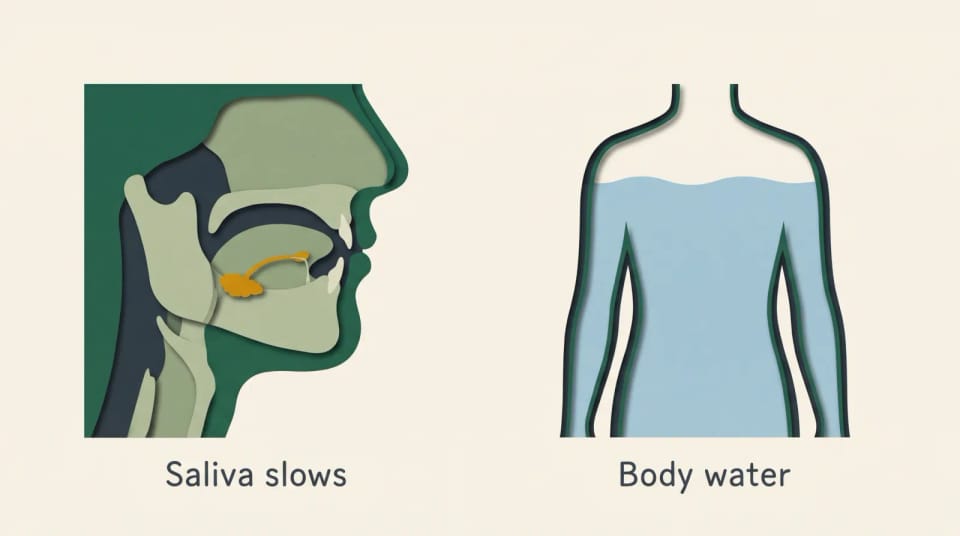
Cannabis slows the salivary glands, so your mouth feels dry. That alone does not show your body is short on water.
Dehydration headache is real in general. A narrative review notes that dehydration alone may cause headache, though it more often worsens an existing headache disorder. The same review notes that IV fluids for acute migraine in emergency rooms have not been shown to improve pain. A small, informal survey found that some people get a headache when deprived of fluids, and the authors called it preliminary.
What is missing is the link. We searched for a human study that connects cannabis to body-water loss and then to headache, and found none. Drinking water is a fine habit. It is just not a tested fix for a headache after weed.
Is it the smoke?
It is a reasonable suspect, but nobody has tested it directly. Here is the chain.
First, smoking cannabis delivers carbon monoxide. In a 1988 lab study of 15 men who smoked both, a marijuana cigarette produced a nearly fivefold greater rise in blood carboxyhemoglobin than a tobacco cigarette. Bigger puffs and longer breath-holding were part of the reason.
Second, carbon monoxide causes headache. The CDC lists headache first among the most common symptoms of carbon monoxide poisoning.
Third, the missing step: no study we found measured carbon monoxide levels and headache together in people who smoke or vape cannabis. So smoke is plausible, not proven. It also cannot be the whole story, because people report headaches from edibles too, and edibles involve no smoke at all. If you want the bigger picture on combustion, our comparison of vaping and smoking cannabis covers it.
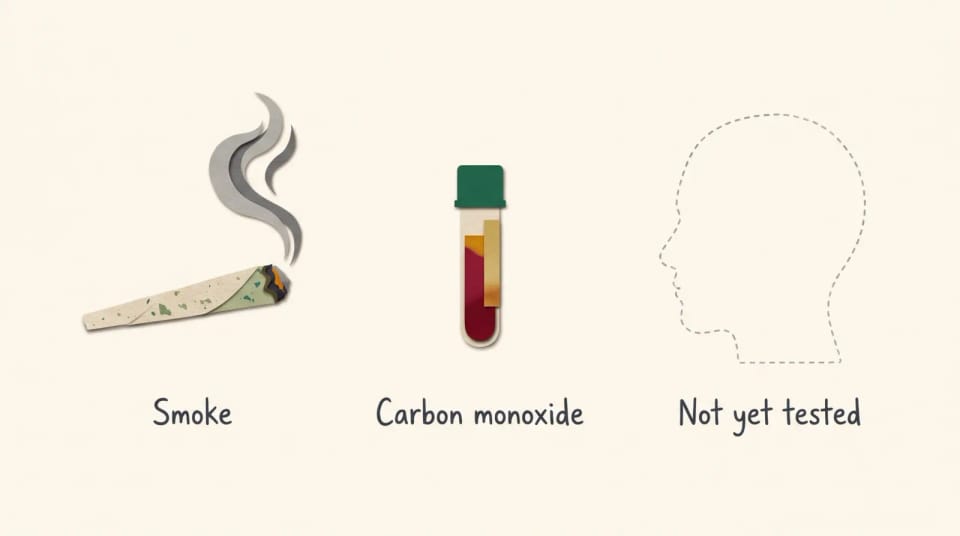
Smoking delivers carbon monoxide, and carbon monoxide can cause headache. No study has yet measured that last step in cannabis users.
Is it the dose?
Maybe, but the data do not show a clean “more THC, more headache” line. In a double-blind crossover trial of people with chronic nerve pain, participants smoked cannabis at four strengths for five days each. The authors listed headache among the most common side effects at the highest strength. But the headache counts in Table 4 look like this:
| THC strength | Headache reports | People in that arm |
|---|---|---|
| 0% (placebo) | 3 | 21 |
| 2.5% | 3 | 22 |
| 6% | 7 | 21 |
| 9.4% | 4 | 22 |
The peak was in the middle, and placebo matched the low dose. It is a small trial in one pain condition, and by the end many participants could guess which strength they had, so blinding weakened. A tiny crossover study in 8 healthy volunteers also listed headache among side effects of inhaled THC, without counts.
The best recent migraine trial is useful context. In the first randomized trial of vaporized cannabis for acute migraine, side effects rose with THC: any reported side effect hit 31% in the THC arm versus 5% on placebo. Headache was not listed as a side effect in the text we read. That trial was not built to test whether cannabis causes headache, so it cannot settle the question either way.
A high dose can clearly make people feel unwell in other ways. If your headache comes with nausea, sweating or a racing heart, read about when too much THC makes you sick. We will not give you a “safe” number here, because no study gives one for headache.
Can overuse cause rebound headaches?
In people with chronic migraine, there is a real association. Outside that group, there is no data. A chart review at a headache clinic looked at 368 adults with chronic migraine. Medication overuse headache showed up in 81% of current cannabis users versus 41% of non-users, an adjusted odds ratio of 6.3 (95% CI 3.56 to 11.1). That is a strong signal, with big caveats: it is one clinic, it shows association rather than cause, and cannabis users in the study also used more opioids.
Animal work suggests a possible mechanism. In female rats, a week of twice-daily cannabinoid dosing left them long-lasting pain sensitivity after a later stress trigger, and the authors say overuse “may increase the risk” in vulnerable people. Rats are not people, but the finding fits the clinic data.
Tolerance is part of the picture too. In an app-based study of thousands of self-tracked sessions, headache relief faded over time and users reached for larger doses. Our guide on how tolerance builds and how breaks work explains that pattern. A 2025 review sums up the field: concerns about overuse headache remain, and most studies are retrospective.
If you came for migraine relief rather than a cause, our migraine and headache guide covers that side.
Can a headache come from stopping weed?
Yes, but it is a separate cause, and it is not one of the main symptoms. A clinical review of cannabis withdrawal lists headaches among the “less common” physical symptoms, alongside chills, sweating and stomach pain. Withdrawal symptoms in general start 24 to 48 hours after stopping and often peak around days 2 to 6. That timeline describes withdrawal as a whole, not headache specifically. If your head hurts a few days into a break, our guide to cannabis withdrawal is the place to start.
What about the strain or the terpenes?
We found no study that links a terpene, or an indica or sativa label, to headache. The one study that tracked strain labels and primary terpenes in real-world use did not measure headache at all. So a page that blames limonene or sativas for your headache is guessing.
You can still notice your own patterns. Writing down the product, the method, and how you felt is the only way to see whether one product keeps lining up with a headache. The High IQ app lets you log how each strain worked for you, which makes that pattern easier to spot. A personal pattern is a clue to bring to a clinician, not a diagnosis.
When is a headache after weed an emergency?
Rarely, a headache after cannabis is a sign of something serious. Reversible cerebral vasoconstriction syndrome (RCVS) is a sudden narrowing of brain arteries. In a French series of 67 patients, most cases were secondary to another cause, and exposure to vasoactive substances, mainly cannabis, SSRIs and nasal decongestants, were among them. Almost all patients had repeated sudden, severe “thunderclap” headaches. Some had bleeding or stroke. Neither that series nor a published case report tells us how often this happens in cannabis users, so do not read it as a risk rate.
The NHS (England) says to call 999 or go to A&E (in other countries, call your local emergency number) if a headache:
- started suddenly and is extremely painful
- follows a head injury in the last 3 months
- comes with a seizure
- comes with numbness or weakness in your body or face, or difficulty speaking, balancing, walking or remembering
- comes with drowsiness or confusion, or loss of vision
- comes with a rash that does not fade under a glass, a very high temperature, a stiff neck, or sensitivity to bright light
If your headache comes with dizziness or faintness rather than these signs, see why weed makes you dizzy.
When to talk to a clinician: if headaches after cannabis keep coming back, are getting more frequent, or come with other symptoms, talk to a doctor or pharmacist. Mention your cannabis use, how often, and any other medicines you take, including over-the-counter pain relievers. That full picture is what lets them check for medication overuse headache.
Key takeaways
- No study has shown why cannabis gives some people a headache, and medicine has no named “cannabis headache” diagnosis.
- Dehydration has no cannabis evidence behind it; dry mouth is a saliva effect.
- Smoke is plausible because it delivers carbon monoxide, but the link is untested, and edibles get blamed too.
- Headache shows up in trials but does not rise neatly with THC, and placebo got headaches too.
- Rebound headache is linked to cannabis in people with chronic migraine, not shown in occasional users.
- A sudden, explosive headache is an emergency.
FAQ
Why do edibles give me a headache?
No study we found counted headaches from edibles specifically. Edibles involve no smoke, so carbon monoxide cannot explain those reports. Dose and individual sensitivity remain possible suspects, but neither has been tested for edible headaches. Our guide to edible dose tiers explains why edibles are harder to dose.
Does weed trigger migraines?
The evidence does not show that cannabis triggers migraine attacks in general. What it does show is an association between cannabis use and medication overuse headache in people who already have chronic migraine. That finding comes from one clinic’s charts and cannot prove cause.
Does drinking water stop a weed headache?
No study has tested it. Dehydration can cause headache in general, but cannabis dries your mouth by slowing saliva, not by draining your body of water. Drinking water is harmless, but it is not a proven fix for a headache after cannabis.
Why do I get a headache the next day after smoking weed?
We found no study that measured next-morning headache after cannabis. Our article on the morning-after fog covers what is known about next-day effects. If you use heavily and the headache starts a day or two after you stop, withdrawal is one possible explanation.
Is a headache after weed dangerous?
Usually not, but a rare exception exists. A sudden, extremely painful headache, or one with weakness, confusion, vision loss or a stiff neck, needs emergency care. For other questions about serious reactions, see what the ER data show about cannabis overdose.
Sources
- Zhang N, Woldeamanuel YW. (2021). Medication overuse headache in patients with chronic migraine using cannabis: a case-referent study. Headache, 61(8). PubMed
- Kopruszinski CM, et al. (2020). Cannabinoids induce latent sensitization in a preclinical model of medication overuse headache. Cephalalgia, 40(1), 68-78. PubMed
- Cuttler C, Spradlin A, Cleveland MJ, Craft RM. (2020). Short- and long-term effects of cannabis on headache and migraine. The Journal of Pain, 21(5-6), 722-730. PubMed
- Schuster NM, et al. (2026). Vaporized cannabis versus placebo for acute migraine: a randomized, double-blind, placebo-controlled crossover trial. Headache, 66(2), 365-376. PMC
- Ware MA, et al. (2010). Smoked cannabis for chronic neuropathic pain: a randomized controlled trial. CMAJ, 182(14), E694-E701. DOI
- Wu TC, Tashkin DP, Djahed B, Rose JE. (1988). Pulmonary hazards of smoking marijuana as compared with tobacco. New England Journal of Medicine, 318(6). PubMed
- US Centers for Disease Control and Prevention. Carbon monoxide (CO) poisoning basics. CDC
- Headache Classification Committee of the International Headache Society. ICHD-3, chapter 8: Headache attributed to a substance or its withdrawal. ICHD-3
- Arca KN, Halker Singh RB. (2021). Dehydration and headache. Current Pain and Headache Reports, 25(8), 56. DOI
- Blau JN, Kell CA, Sperling JM. (2004). Water-deprivation headache: a new headache with two variants. Headache, 44(1), 79-83. PubMed
- Mattes RD, Shaw LM, Engelman K. (1994). Effects of cannabinoids (marijuana) on taste intensity and hedonic ratings and salivary flow of adults. Chemical Senses, 19(2), 125-140. PubMed
- Kopach O, et al. (2012). Cannabinoid receptors in submandibular acinar cells. Journal of Cell Science, 125(8), 1884-1895. PubMed
- Okey SA, et al. (2023). An ecological examination of indica versus sativa and primary terpenes on the subjective effects of smoked cannabis. Cannabis and Cannabinoid Research, 8(5), 857-866. PubMed
- Connor JP, Stjepanović D, Budney AJ, Le Foll B, Hall WD. (2022). Clinical management of cannabis withdrawal. Addiction, 117(7), 2075-2095. PMC
- Ducros A, et al. (2007). The clinical and radiological spectrum of reversible cerebral vasoconstriction syndrome. Brain, 130(12), 3091-3101. PubMed
- Mikami T, et al. (2021). Marijuana-related reversible cerebral vasoconstriction syndrome. Internal Medicine. PMC
- Kuruvilla DE. (2025). Cannabinoids in headache: helpful or harmful? Current Opinion in Neurology, 38(3), 277-280. PubMed
- Naef M, et al. (2004). Development and pharmacokinetic characterization of pulmonal and intravenous delta-9-tetrahydrocannabinol (THC) in humans. Journal of Pharmaceutical Sciences, 93(5), 1176-1184. PubMed
- National Health Service (England). Headaches. NHS



