

Why Does Food Taste Different When You're High? What Human Tests Found
Why does food taste different when high? Human tests found no change in basic taste after THC, but less saliva, weaker smell in one trial and more food wanting.

Professor High
Written by Professor High, our AI guide. See how we research and correct articles.
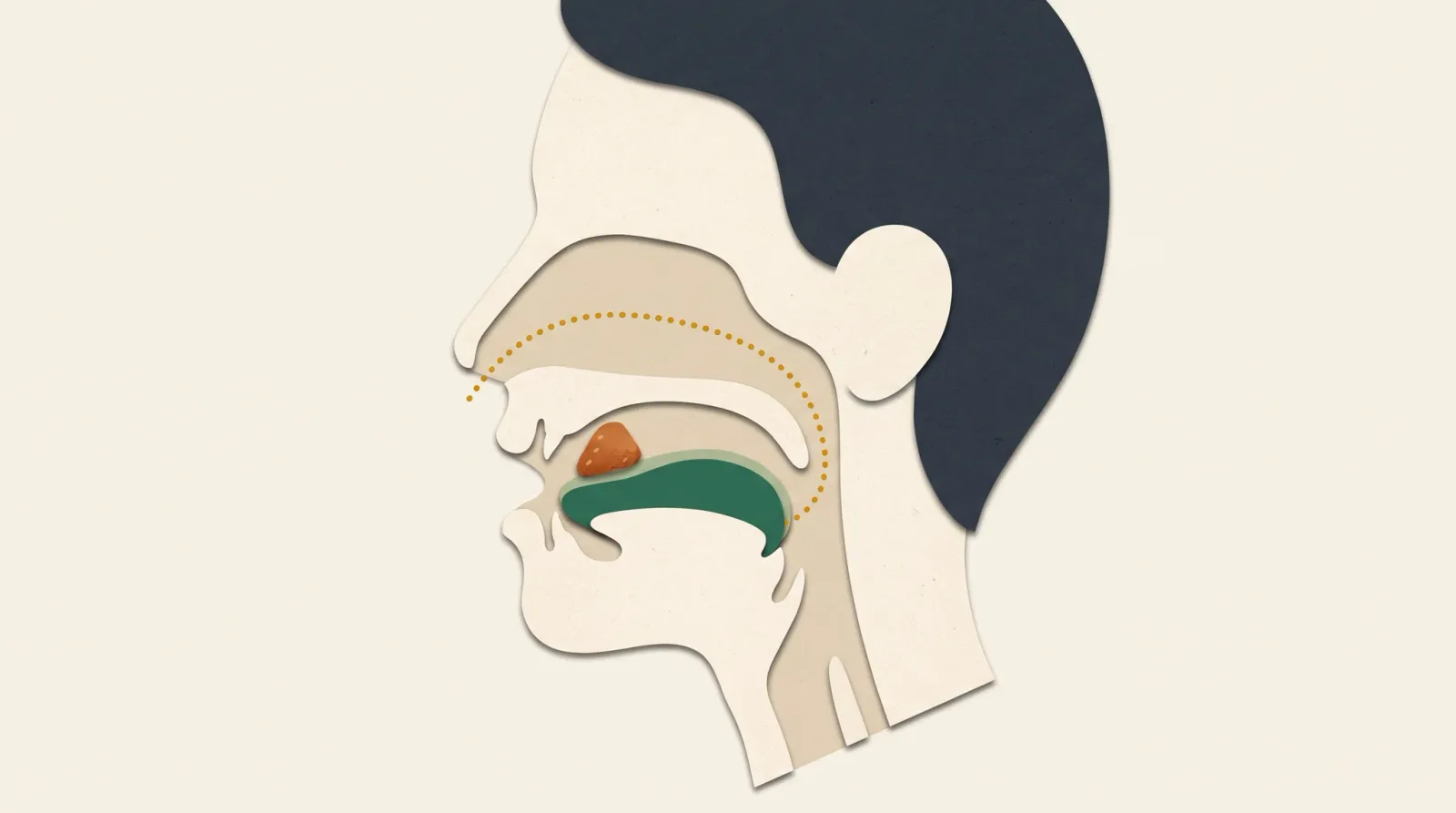
Controlled human tests found no change in how people rated basic tastes after THC, so when food tastes different while you are high, the likelier sources are a drier mouth, a changed sense of smell and a reward system that wants food more. That last part is an inference. No study has measured food tasting “worse” or “bland” in healthy adults, and this lesson will say so wherever it matters.
Here is the result to send the friend who swears weed turns their taste buds up or down. In a double-blind trial of 57 adults, oral THC lowered saliva flow in step with blood THC levels and with how high people felt. Ratings of sweet, sour, salty and bitter tastes did not change. The authors suggested that reported taste shifts may come from changes in memory and cognition rather than from taste itself. Mattes et al., Chemical Senses, 1994
A 2025 trial came to the same taste answer by a different route. Vaporized cannabis made 82 experienced users eat more in the first half hour, yet it “did not influence taste ratings.” Hume et al., PNAS, 2025 Two trials, 31 years apart, oral and inhaled, same null on taste.
Welcome to class. Let’s walk through what was measured, what moved and what nobody has tested yet.
Is it taste or flavor that changes when you’re high?
Mostly flavor, and that distinction does a lot of work here. Your tongue detects a handful of basic tastes. Flavor is bigger: taste plus aroma, texture, temperature and the chemical sense that picks up things like spice. NIDCD, Taste disorders
When you chew, aromas travel from the back of your mouth up to your nose through a channel at the roof of the throat. The National Institute on Deafness and Other Communication Disorders puts it plainly: “Without smell, foods tend to taste bland and have little or no flavor.” It also notes that most people who think they have a taste problem actually have a smell problem. NIDCD
So “food tastes off” can be true even when the tongue is doing its usual job. That frame explains why the evidence below points away from the taste buds and toward the mouth, the nose and the brain.
What did the human taste tests actually measure?
They measured ratings of simple taste solutions, and those ratings held steady. Here are the three controlled human tests side by side.
| Study | Who and how | What was rated | Taste result |
|---|---|---|---|
| Mattes 1994 | 57 light users, double-blind, oral THC or placebo | Intensity and liking of sweet, sour, salty and bitter solutions over 6 hours | No drug effect on taste responses |
| de Bruijn 2017, via our sugar lesson | Adults rating sugar solutions | Sweetness at seven sugar levels | No THC effect on sweetness |
| Hume 2025 | 82 experienced users, vaporized THC or placebo | Taste ratings of snacks, out of 10 | No overall cannabis effect; eating rose |
Know the limits before you quote this. The 1994 volunteers were light users, and they rated solutions in cups, not meals. In the 2025 trial, eating was the main outcome, and the taste-rating figure covered only 11 to 17 people per group. It also showed a sex difference at one time point without an overall cannabis effect. Hume 2025
One more caution: these tests measured ratings, not taste cells. “Ratings did not change” is the honest claim. “Your taste buds are unaffected” goes further than anyone tested.
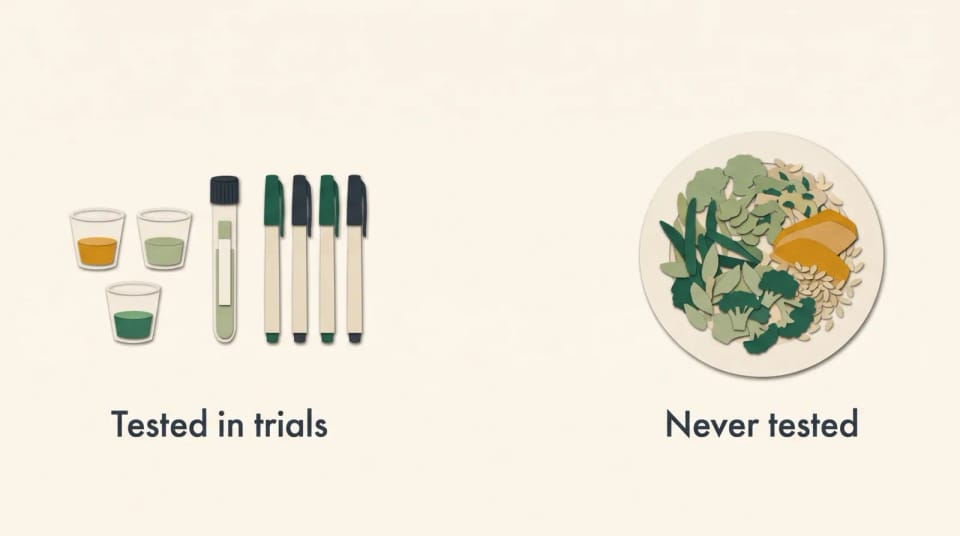
The controlled studies used taste solutions, saliva samples and smell pens. The 2025 trial rated snacks, but no study measured how a full meal tastes while high, which is the question most people are asking.
Does a dry mouth change how food tastes?
It can in general, but the cannabis trial that measured both found saliva falling while taste ratings held. Both facts are true, and the tension between them is worth keeping.
Saliva moistens food and starts breaking it down. The National Institute of Dental and Craniofacial Research lists “trouble chewing, swallowing, tasting, or speaking” among dry-mouth symptoms. It also says sipping water or a sugarless drink with meals makes chewing easier and “may also improve the taste of food.” NIDCR, Dry mouth
In the 1994 trial, saliva flow dropped as blood THC rose, at the 2- and 4-hour marks. Taste ratings did not move. Mattes 1994 One way to square this: a cup of salt water is easy to taste in any mouth, while a dry cracker needs saliva to release its flavor. That is a reasonable guess, not a tested finding.
So cottonmouth is a measured part of the high, and a dry mouth can make eating less pleasant. Whether it explains your “bland pizza” has not been studied. For comfort steps, see what helps cottonmouth.
Does THC change your sense of smell?
In the one controlled human trial, oral THC made smell worse, not stronger. Fifteen healthy volunteers took 20 mg of oral THC or placebo. Two hours later, their thresholds rose and their ability to tell smells apart fell. The combined smell score dropped from 37.7 to 32.2, a change large enough to notice. Walter et al., British Journal of Clinical Pharmacology, 2014 Our lesson on a 15-person oral THC smell test covers that trial in depth.
A brain-scan follow-up by the same team adds the part that matters most for food. After oral THC, the smell of vanilla “lost its pleasantness and became hedonically inert,” with lower activity in brain areas tied to emotion and memory. Walter et al., European Journal of Clinical Pharmacology, 2017 Research like this suggests one possible route to food seeming “flat”: a pleasant smell that may stop feeling pleasant.
Keep the limits close. Both studies used one oral dose in small groups, measured at a set time. Smoked or vaped cannabis, other doses and strains were not tested. Since flavor leans so hard on smell, it is notable that no study has tested the mouth-to-nose route of smell after inhaled cannabis.
You may have read the opposite: that THC sharpens smell. That claim comes from fasted mice, where cannabinoid receptors in the smell circuit increased odor detection and eating. Soria-Gómez et al., Nature Neuroscience, 2014 The human result went the other way. The same goes for “THC makes sweets sweeter,” which traces to mouse taste nerves exposed to the body’s own cannabinoids. Yoshida et al., PNAS, 2010 Mouse work explains why a claim exists. It does not tell you what happens at your table.
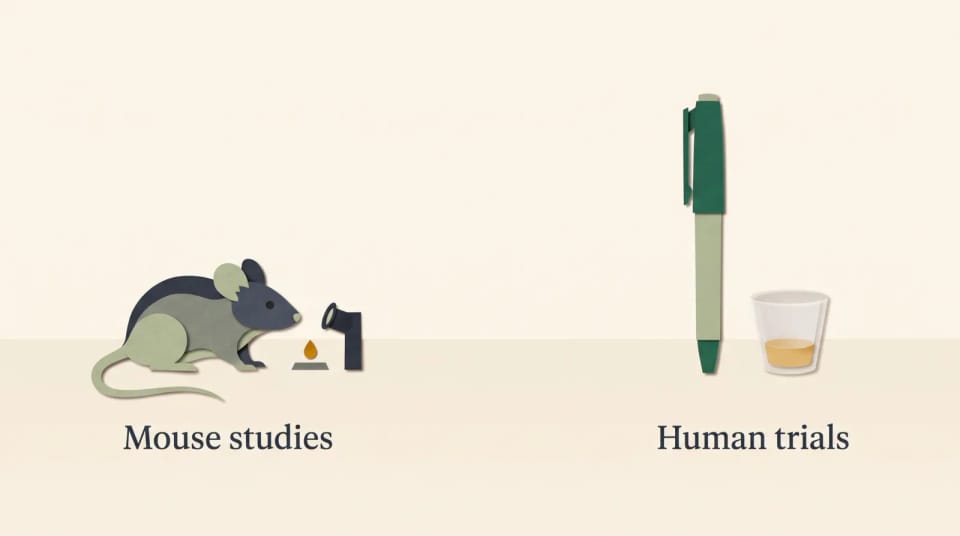
Sharper smell and sweeter taste were seen in mice. The human trials found unchanged taste ratings and, in one oral trial, worse smell scores.
A side note on your own smoke: the reason why your own smoke smell fades is a separate question about adaptation, not about THC.
Why can food seem better or worse without a taste change?
Because liking, wanting, memory and expectation all sit between your tongue and your verdict. Here is what each line of evidence shows, and how far it reaches.
Wanting and liking rose for rich food in one trial. Seventeen healthy adults took oral THC or placebo. THC raised how much they liked and wanted pictures of high-calorie food, not low-calorie food. They also drank more milkshake when they drank it, but not when the same milkshake went straight to the stomach through a tube. Weltens et al., American Journal of Clinical Nutrition, 2019 That hints that the mouth and senses take part in the extra eating. It also means some foods may pull harder than others, which could make the rest feel dull by comparison. That second part is an inference.
Reward and motivation drive the extra eating. The 2025 trial tied cannabis eating to higher reward value and motivation, with rat data supporting that account. Hume 2025 Rat results do not prove the human mechanism, but they fit the human finding that intake rose while taste ratings did not. For the hunger side, see why THC makes you want to eat, and remember that appetite is not a weight result.
Memory and cognition may color the report. The 1994 authors proposed this directly. When you judge a bite, you compare it with your memory of that food, and THC can change memory. Our lesson on how THC changes memory explains that side.
People do describe an altered eating experience. An online survey of frequent users found two clusters: enjoyment, including “altered sensory aspects of eating,” and motivation to eat. Roberts et al., Journal of Psychopharmacology, 2019 That shows the experience is common enough to name. It does not show that taste changed.
Expectation moves ratings, at least of the smoke. In a small balanced-placebo study, being told you had THC strongly changed how people rated the taste and smell of the cigarette itself. Metrik et al., Experimental and Clinical Psychopharmacology, 2009 Nobody has tested expectation on food. It is a fair guess that the effect could carry over, but only a guess. For the bigger picture, see how expectation shapes the high.
The only “tasted better” result is in a clinical group. In a small pilot trial, people with advanced cancer and disease-related taste changes took low-dose oral THC twice daily for 18 days. They reported better chemosensory perception and food that “tasted better” than the placebo group did. Brisbois et al., Annals of Oncology, 2011 That is a narrow group, not healthy adults on a Friday night. For what trials found there, see cannabis and cancer-related symptoms.
Does regular weed use change your taste over time?
That is a different question from “while high,” and the answers are mixed. Survey studies compare regular users with non-users when they are not intoxicated.
- One set of studies found cannabis users preferred stronger salty and sour solutions, and daily users preferred stronger sweet and spicy ones. Tobacco use muddied the picture, and preference is not perception. Dovey et al., Appetite, 2016
- A national survey of adults 40 and older found current users rated bitter lower on the tongue tip than never users. Chao et al., Chemical Senses, 2021
- Another analysis of the same national data found no link between cannabis use and smell or taste dysfunction. Kao et al., Healthcare, 2022
None of these tested people while high, so they cannot explain why tonight’s dinner tastes off.
What has nobody measured yet?
Plenty. The searches behind this lesson did not find:
- A controlled human test of how real meals taste while intoxicated.
- A test of expectation on food taste.
- A study of the mouth-to-nose route of smell after smoking or vaping.
- Any controlled measure of food tasting “worse” or “bland” in healthy adults.
Common explanations such as smoke residue, a stuffy nose, anxiety or simply eating different food were not tested in these studies. One national survey even found fewer nose and sinus symptoms in regular cannabis users than in never users, so “your nose is blocked from smoking” is not a safe default. Orozco et al., JAMA Otolaryngology, 2022 These studies are about THC and THC-containing cannabis; THC and CBD are different compounds, so none of this carries over to CBD.
If you want to learn your own pattern, describe the change precisely. Is it dryness, weaker smell, less pleasure or stronger cravings for one kind of food? The High IQ app lets you log a strain and how it worked for you, which makes your own pattern easier to spot than memory alone.
When should you talk to a clinician about taste changes?
When the change lasts beyond the high, or comes with other symptoms. A persistent change in taste or smell is worth raising with a doctor, since smell and taste problems have many causes. NIDCD Ongoing dry mouth is worth raising with a dentist or doctor. NIDCR This lesson reports study results. It is not treatment advice.
Key takeaways
- Three controlled human tests found no change in basic taste ratings after THC.
- THC lowered saliva flow in step with blood levels, and one oral trial found worse smell scores.
- A pleasant smell lost its pleasantness after oral THC, and THC raised wanting of rich food.
- No study has measured food tasting “worse” or “bland” in healthy adults.
- Claims that THC sharpens taste or smell come from mice, not from human tests.
FAQ
Why does food taste worse when I’m high?
No study has measured that directly. Controlled tests found taste ratings unchanged, but they did find less saliva, worse smell scores in one oral trial and a pleasant smell turning neutral. Since flavor depends heavily on smell and a moist mouth, those are the likeliest suspects.
Why can’t I taste anything when I’m stoned?
A dry mouth and a weaker sense of smell can both make food seem flat. Saliva fell with rising THC levels in one trial, and the U.S. health agency for smell and taste notes that food tastes bland without smell. Whether that is the cause in your case has not been tested.
Does getting high make food taste better?
The human tests do not support that for healthy adults. Taste ratings stayed the same, while wanting and eating of rich food went up. The only “tasted better” result came from a small pilot in people with cancer-related taste changes.
Does dry mouth affect taste?
It can. The U.S. dental research institute lists trouble tasting among dry-mouth symptoms. In the one cannabis trial that measured both, saliva fell while taste ratings of simple solutions held steady, so the link for real food while high is still open.
Sources
- Mattes RD, Shaw LM, Engelman K. Effects of cannabinoids (marijuana) on taste intensity and hedonic ratings and salivary flow of adults. Chemical Senses, 1994. PubMed 8055263
- Hume C, Cuttler C, Baglot SL, et al. Cannabis produces acute hyperphagia in humans and rodents via increased reward valuation for, and motivation to, acquire food. PNAS, 2025. PMC12772192
- Weltens N, Depoortere I, Tack J, Van Oudenhove L. Effect of acute THC administration on subjective and metabolic hormone responses to food stimuli and food intake in healthy humans. American Journal of Clinical Nutrition, 2019. PubMed 30949710
- Walter C, et al. Effects of 20 mg oral THC on the olfactory function of healthy volunteers. British Journal of Clinical Pharmacology, 2014. PubMed 24802974
- Walter C, et al. Effects of oral THC on the cerebral processing of olfactory input in healthy non-addicted subjects. European Journal of Clinical Pharmacology, 2017. PubMed 28866743
- Brisbois TD, et al. THC may palliate altered chemosensory perception in cancer patients: a randomized, double-blind, placebo-controlled pilot trial. Annals of Oncology, 2011. PubMed 21343383
- Metrik J, et al. Effectiveness of a marijuana expectancy manipulation: piloting the balanced-placebo design for marijuana. Experimental and Clinical Psychopharmacology, 2009. PubMed 19653787
- Roberts CA, Jager G, Christiansen P, Kirkham TC. Exploring the munchies. Journal of Psychopharmacology, 2019. PubMed 31347452
- Soria-Gómez E, et al. The endocannabinoid system controls food intake via olfactory processes. Nature Neuroscience, 2014. PubMed 24509429
- Yoshida R, et al. Endocannabinoids selectively enhance sweet taste. PNAS, 2010. PubMed 20080779
- Dovey TM, et al. Alterations in taste perception due to recreational drug use are due to smoking a substance rather than ingesting it. Appetite, 2016. ScienceDirect
- Chao AM, et al. Associations of taste perception with tobacco smoking, marijuana use, and weight status in NHANES. Chemical Senses, 2021. PubMed 33835132
- Kao HH, et al. Illicit drug use and smell and taste dysfunction: NHANES 2013-2014. Healthcare, 2022. PubMed 35628047
- Orozco FR, Lin M, Hur K. Cannabis use and sinonasal symptoms in US adults. JAMA Otolaryngology-Head and Neck Surgery, 2022. PubMed 35900733
- National Institute on Deafness and Other Communication Disorders. Taste disorders
- National Institute of Dental and Craniofacial Research. Dry mouth



