Can Cannabis Create False Memories? Forgetting Is Only Half the Story
Cannabis can increase false memories in controlled tests. Learn how added details differ from forgetting, why timing matters, and what studies cannot tell you.


Yes. THC can increase false recognition and false recollection in controlled memory tests. That means accepting a detail that was never presented, not just forgetting something that was. These findings concern specific tasks and conditions; they cannot determine whether one of your personal memories is true. Doss and colleagues, 2018
The useful distinction is simple: forgetting leaves a gap; a false memory adds an error. Neither requires someone to be deliberately dishonest.
Is a false memory the same as forgetting?
Imagine a fictional dinner reservation. The confirmation says 7 p.m. Forgetting means you cannot remember the time. A false recollection would mean remembering a different time as though that was the original arrangement. This example illustrates the distinction; it is not a cannabis experiment.
| Type of error | What the person reports | What needs checking |
|---|---|---|
| Forgetting | “I don’t remember the time.” | The missing information |
| False recognition | “Yes, that time was in the message.” | Whether the detail appeared at all |
| False recollection | “I remember reading that time.” | Whether the remembered detail matches the record |
This lesson focuses on added details. For the broader picture, see our class on short-term and long-term cannabis memory effects.
Forgetting to carry out a plan raises a separate question. Our cannabis and prospective memory lesson explains intentions and the cues that should bring them back.
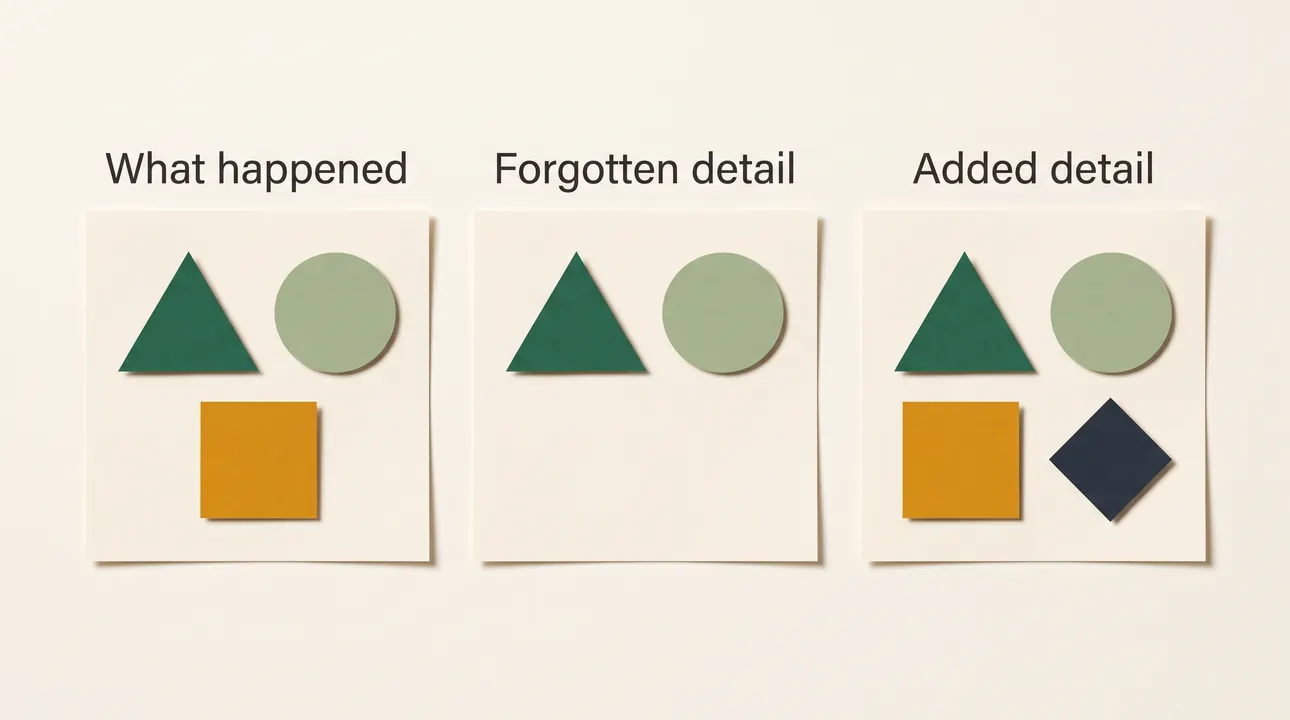
A conceptual example: forgetting removes a detail from the report; a false memory introduces one.
What did the cannabis false-memory experiment find?
A 2020 randomized, blinded, placebo-controlled study tested 64 occasional cannabis users after vaporized THC at 300 micrograms per kilogram of body weight. Immediate word-list tests showed more false recognition of related and unrelated unpresented words. Recognition of actual words and strongly associated missing theme words did not change significantly. In virtual-reality scenarios, results depended on the detail category; the suggested-detail result was not significant in one scenario. Kloft and colleagues, 2020
One week later, sober participants still made more false recognitions of unrelated words. Scenario differences were no longer significant, partly because placebo performance worsened. Delayed recognition of actual words and missing theme words was lower after THC; the authors flagged those latter effects as less robust. This was not a uniform increase in every kind of memory error. Study results and Table 1
That makes the headline useful, but incomplete without the task details. “More errors in this comparison” does not mean every remembered event became an invented story.
Can THC affect something you learned while sober?
Yes, in a separate retrieval experiment. Twenty-three healthy volunteers viewed pictures and studied words before taking THC. Forty-eight hours later, they received either 15 mg oral THC or placebo and answered memory questions.
THC increased false recollection of both neutral and emotional material. Correct responses to studied items did not decrease. The experiment therefore separates accurate answers from added errors: both can appear in the same test. Doss and colleagues, 2018
“I was sober when that happened” does not address whether THC was present during later recall. Learning and remembering are different stages. Our endocannabinoid system lesson explains the wider biology; this experiment measured performance, not a complete mechanism for one person’s memory.
Why don’t all studies find more false memories?
A 2012 study used a different schedule: volunteers studied word lists after oral THC, then took a recognition test two days later while sober. THC reduced correct recognition but did not significantly increase false memory versus placebo. Ballard, Gallo and de Wit, 2012
A newer randomized trial, published in 2026, tested 120 participants after vaporized cannabis containing 0, 20 or 40 mg THC. Its abstract reports increased susceptibility to false memories. The two active-dose groups did not differ significantly. That is not evidence of a universal dose cutoff or a reliable safe threshold. Cuttler and McLaughlin, 2026
These experiments ask related questions, with different routes, timing and tasks. Reading their results together is more useful than selecting whichever headline supports an argument. A test about recognizing a word also cannot measure every detail of a years-old personal event.
Does feeling sober prove a memory is accurate?
No feeling can compare a remembered detail with what actually happened. For that comparison, you need another record or source of information. The studies above offer no home test that certifies a particular memory.
Separate two questions: “Am I still feeling this dose?” and “Does this detail match the evidence?” Our guide to how long a cannabis high lasts addresses the first. It does not establish the second.
Likewise, a tolerance break is not a fact-check of a past event. And a product’s High Family classification describes its experience category; it does not certify recall accuracy.
What can you check when a detail matters?
Treat uncertainty as a reason to check the detail, rather than a reason to accuse yourself or someone else of lying. For ordinary questions about plans or purchases, the relevant evidence may be a message, receipt, calendar entry or original confirmation.
Be specific about what is uncertain. “Was the booking at seven?” is a narrower question than “Is my entire memory unreliable?” Keep the original record separate from your interpretation of it. If the record does not settle the question, leaving the answer unresolved is more honest than filling the gap.
Those are practical checking suggestions, not a tested treatment for cannabis-related memory errors. None of the cited experiments establishes a way to erase a false memory or guarantees that a check will resolve an important disagreement.
Key takeaways
- A missing detail and an added detail are different errors.
- The evidence depends on when THC was taken and what the test measured.
- A study result cannot tell you whether a particular personal memory is true.
FAQ
Can weed make you remember something that did not happen?
Controlled studies show increased acceptance or recollection of unpresented details under some THC conditions. They do not show that every person invents whole life events after using cannabis. Doss and colleagues
Can you have false memories after the high wears off?
The 2020 study detected a delayed difference for one word category at sober testing. Its scenario results differed. A one-week measurement does not establish permanent damage. Kloft and colleagues
Does cannabis always increase false memories?
No. The 2012 word-list study did not detect a significant increase versus placebo, although correct recognition declined. Ballard and colleagues
How can you tell whether one memory is false?
These studies provide no personal diagnostic test. Check the specific detail against independent information where available. Cannabis use alone does not prove that someone’s account is wrong.
Sources
- Kloft, L., Otgaar, H., Blokland, A., Monds, L. A., Toennes, S. W., Loftus, E. F., and Ramaekers, J. G. (2020). Cannabis increases susceptibility to false memory. PNAS, 117(9), 4585–4589. DOI: 10.1073/pnas.1920162117.
- Doss, M. K., Weafer, J., Gallo, D. A., and de Wit, H. (2018). Δ9-Tetrahydrocannabinol at Retrieval Drives False Recollection of Neutral and Emotional Memories. Biological Psychiatry, 84(10), 743–750. DOI: 10.1016/j.biopsych.2018.04.020.
- Ballard, M. E., Gallo, D. A., and de Wit, H. (2012). Psychoactive drugs and false memory: comparison of dextroamphetamine and δ-9-tetrahydrocannabinol on false recognition. Psychopharmacology, 219(1), 15–24. DOI: 10.1007/s00213-011-2374-5.
- Cuttler, C., and McLaughlin, R. J. (2026). Mapping the acute effects of cannabis on multiple memory domains: A randomized, double-blind, placebo-controlled study. Journal of Psychopharmacology, 40(3), 410–421. DOI: 10.1177/02698811261416079.





