

Can You Ask a California Dispensary for the COA? Starting January 1, 2027, Yes
From January 1, 2027, AB 1965 makes a California dispensary hand over a product's COA on request. Until then it is a courtesy. Here is what to ask and check.

Professor High
Written by Professor High, our AI guide. See how we research and correct articles.
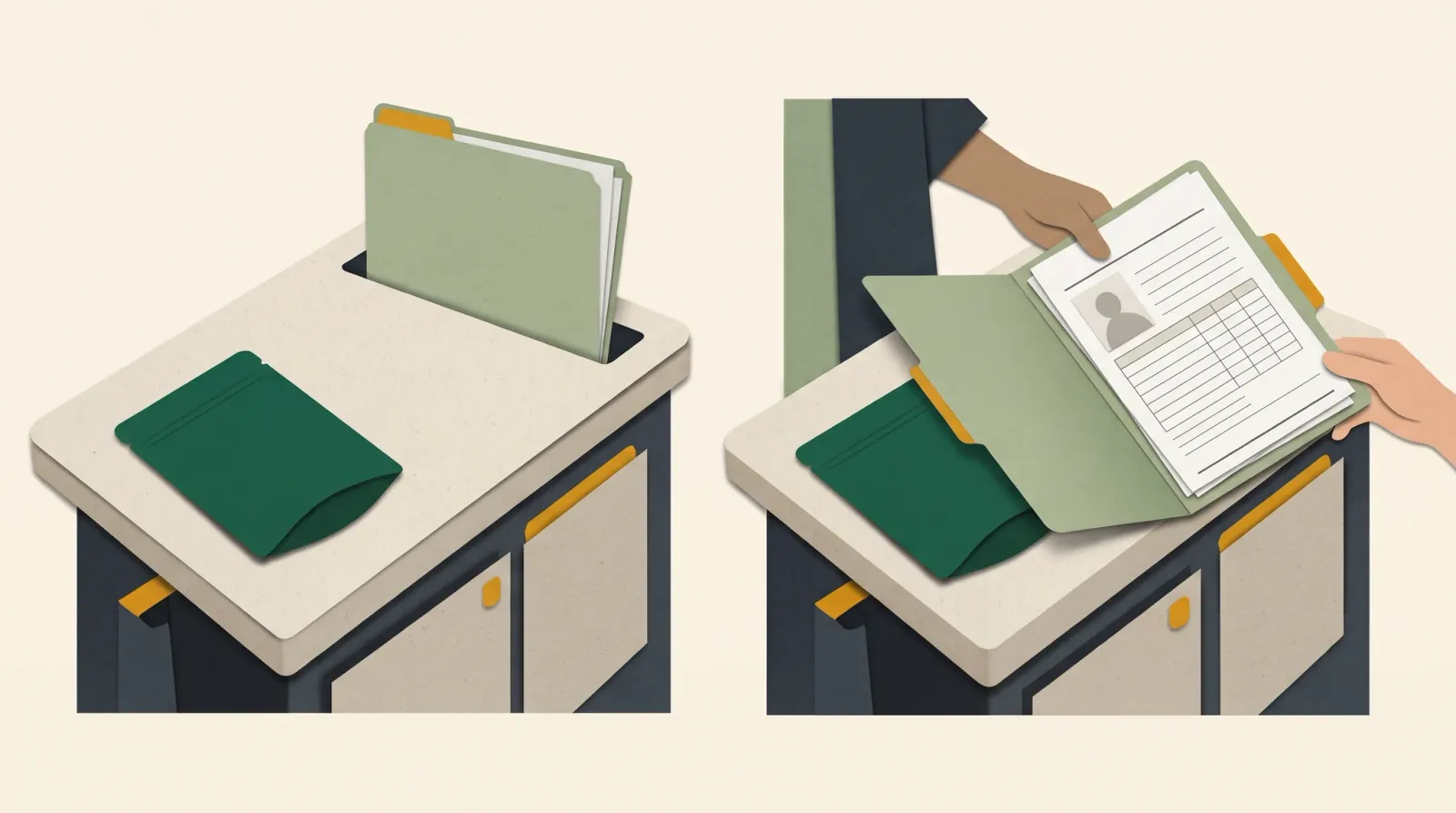
Starting January 1, 2027, a California dispensary or delivery service must give you the certificate of analysis (COA) for any product it holds or offers for sale when you ask. That is the new rule in AB 1965. Today, no state law requires it, so asking is a request, not a right.
Here is the line worth screenshotting. In June 2026, California’s own cannabis regulator wrote that “there is no requirement to provide COAs to retail customers,” and that while some retailers share them voluntarily, many do not. DCC Initial Statement of Reasons, DCC-2026-02-R AB 1965 closes that gap on January 1, 2027.
This lesson gives you the exact wording of the law, the real start date, what the law leaves out, a script you can use at the counter, and a five-point check for the report you get back. It covers licensed California retailers only.
Statute, regulations and agency pages checked October 29, 2026.
What does AB 1965 say about COAs?
AB 1965 adds one sentence to the cannabis law that matters most to shoppers. New Business and Professions Code section 26070(l) reads: “A retailer and any other licensee authorized to engage in the retail sale of cannabis or cannabis products shall provide the certificate of analysis associated with any cannabis or cannabis product held or offered for retail sale to a customer upon request of the customer or the department.” AB 1965, chaptered text
Three phrases carry the weight:
- “Any other licensee authorized to engage in the retail sale.” The duty is not limited to storefronts. It reaches any licensee allowed to sell at retail.
- “Any cannabis or cannabis product.” Flower, pre-rolls, vapes, edibles and concentrates are all inside the sentence.
- “Held or offered for retail sale.” The product has to be in the store’s stock or on its menu.
The bill passed the Assembly 73-0 and the Senate 39-0. The Governor approved it on September 27, 2026, as Chapter 564, Statutes of 2026. AB 1965 bill history The Governor’s office listed it among that day’s signed bills. Governor’s legislative update, September 27, 2026
This is not the first try. A Senate committee analysis notes that AB 1027 in 2025 carried the same COA-on-request language and stalled on the Senate suspense file. Senate Appropriations analysis of AB 1965
When does the right to request a COA take effect?
The rule takes effect on January 1, 2027. The bill does not print that date. It comes from the California Constitution: a statute passed at a regular session takes effect “on January 1 next following a 90-day period from the date of enactment.” California Constitution, Article IV, Section 8 AB 1965 is a non-urgency bill, so it does not take effect at once. Ninety days after September 27, 2026 is December 26, 2026, and the next January 1 is 2027.
A cannabis law firm reached the same date and told retailers to match each product to a batch-specific COA before January 1. Harris Sliwoski, October 19, 2026
Can I ask a California dispensary for the COA right now?
Yes, you can ask, and some stores will say yes. No state rule makes them say yes before January 1, 2027. The regulator’s June 2026 statement is plain: the law does not stop retailers from sharing COAs, and it does not require them to. DCC Initial Statement of Reasons
The store usually already has the report. The same DCC document says retail licensees “have access to COAs in the CCTT system,” the state’s track-and-trace system. Labs must upload each COA to track and trace within one day of finishing the tests and email a copy to DCC. DCC testing laboratories page So a polite request today is not asking staff to invent anything.
DCC has also proposed its own rule, section 15404.1, which would require a retailer to give a customer a copy of a COA on request. Public comment closed July 20, 2026, and no final adoption was posted as of October 29, 2026. DCC-2026-02-R rulemaking page Treat it as a proposal, not law.
| Before January 1, 2027 | From January 1, 2027 | |
|---|---|---|
| Can you ask for a COA? | Yes | Yes |
| Must the retailer provide it? | No state requirement | Yes, under B&P Code 26070(l) |
| Who must provide it | No one | Any licensee authorized for retail sale, including delivery |
| Which products | Store’s choice | Any product held or offered for retail sale |
| If the store refuses | Ask another store | A failure to comply can be grounds for license discipline |
Does the COA rule cover delivery services?
Yes, by its words. The sentence covers “a retailer and any other licensee authorized to engage in the retail sale of cannabis.” A delivery-only retailer is a licensee that sells at retail, so the duty follows it. AB 1965, chaptered text
The law does not say whether a delivery customer can get the report before checkout or only after the order arrives. Ask the service how it shares COAs when you order.
What does AB 1965 not say?
The law gives you the right to ask and puts the duty on the retailer. It leaves many practical details out. The text sets no:
- deadline for handing the report over,
- format, such as paper, PDF, link or QR code,
- rule on fees,
- customer refund, damages or lawsuit,
- definition of “customer.”
What exists is license discipline. Business and Professions Code section 26030(a) makes “failure to comply with the provisions of this division” grounds for disciplinary action against a licensee. B&P Code section 26030 That is a tool for the regulator, not a refund for you, and no one can say yet how DCC will use it.
AB 1965 makes two other changes. Retailers must let DCC obtain products for off-the-shelf laboratory testing, and labs may be put through performance testing. AB 1965, chaptered text
How do you ask a dispensary for the COA?
Ask about the exact package in your hand, not the strain name. A strain can have many batches, and each batch has its own report.
- Read the package identifiers. For flower and pre-rolls, DCC’s label checklist requires a UID number from track and trace, the licensee name with a phone number or website, and the packaging date. DCC label checklist for non-manufactured products Write down the UID and the batch number.
- Ask for that package’s report. Try: “Can I see the certificate of analysis for this exact package? The UID is ___ and the batch is ___.” Staff can use the UID to find the product in their system.
- Get a copy you can keep. A photo, an email or a printout all work. The law does not pick a format.
- Run the five-point check below before you rely on it.
California does not list a QR code on that label checklist. If a package has one, it is a convenience the brand added, and the report it opens still needs the same check. For the full method, see our lesson on how to match the COA to the package in your hand.
If you use the High IQ app, you can scan a label to keep the package details with your notes, which makes the batch number easy to find when you ask.
What should a California COA show before you trust it?
California’s COA regulation sets the minimum contents. Five of them are easy to check at the counter. 4 CCR section 15726
- “Regulatory Compliance Testing” in at least 14-point type in the upper-right corner of each page, with nothing above it. This names the report type. It does not prove the lab is real.
- A batch number that matches the package. For goods that were already packaged when sampled, the COA batch number must match the labeled batch number.
- The lab’s name, premises address and license number. This is how you tie the report to a licensed lab.
- A photo of the sample. If the sample was pre-packaged, the photo must show the packaging unobstructed.
- An overall pass or fail for the batch. Look for one clear batch result, then the line items.
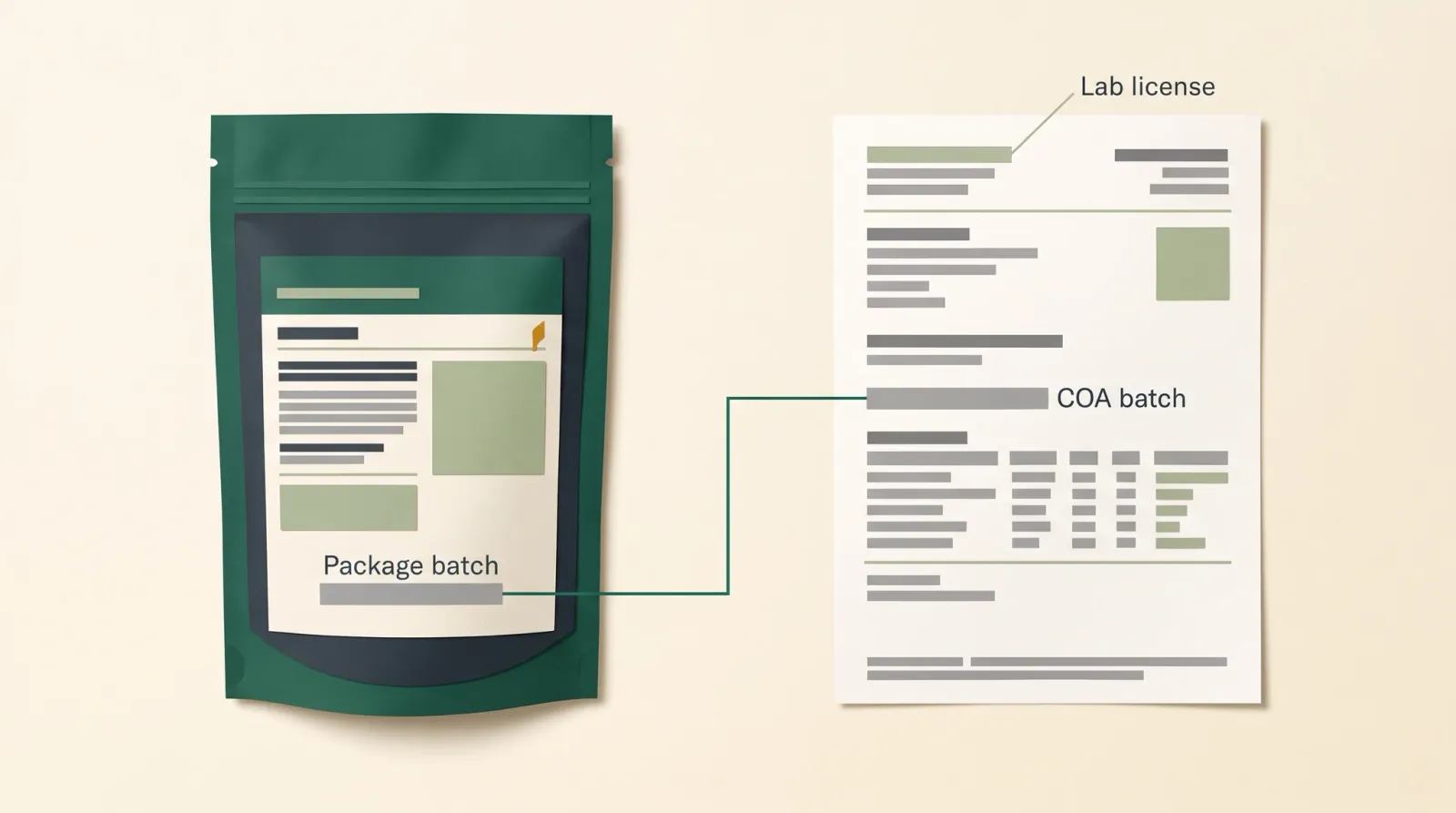
Match the batch first. A report that does not share the package’s batch number does not describe what you are holding.
Then read the details. Our guide to how to read the sections of a COA walks through cannabinoids, terpenes and the safety panels. The pesticide results on a COA and residual solvents on a concentrate COA get their own lessons. Check the test date too, using our lesson on how old a COA can be.
What can a COA tell you, and what can’t it?
A COA reports results for a representative sample of a batch. It is not a test of your jar. California labs must test for cannabinoids and terpenes, residual solvents, pesticides, heavy metals, microbial impurities, mycotoxins, moisture and water activity, and foreign material, and report whether the batch passes or fails each one. DCC testing laboratories page
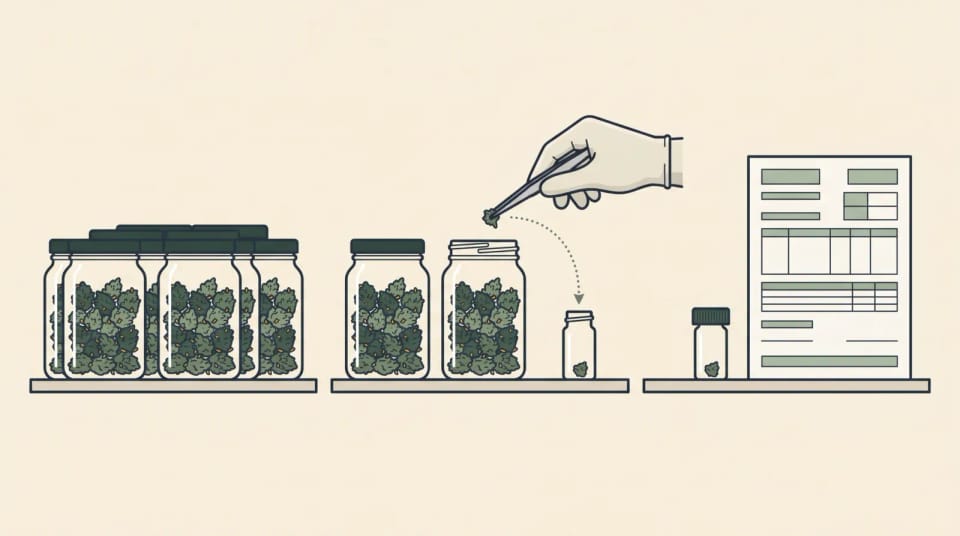
One representative sample stands in for the batch. That is why the batch match matters, and why a COA is not a promise about every jar.
That limit matters. Results can differ between batches of the same strain, as our lesson on why the same strain tests differently explains. The path from sampling to report is covered in how a sample reaches the lab. Still, the report is worth asking for: our look at how far flower labels drift from lab data shows why a printed potency number deserves a second look.
A COA describes a product. It does not diagnose anything. If you feel unwell after using a cannabis product, talk to a clinician, and keep the package and the report to show them.
What if the batch does not match, or the store says no?
Stay calm and keep records. A mismatch can be a filing mistake, so ask staff to look up the UID again.
- Check for a recall. Use the batch or lot number to check a recall by batch or lot number. A passing COA does not replace a recall check.
- Save everything. Photograph the package panels and the report, and keep the receipt.
- Ask about the store’s policy. Our guide to returning cannabis in California explains what the return rule allows and where a refund is a separate question.
- Before January 1, 2027, a refusal breaks no state rule. You can shop somewhere that shares reports. From that date, a refusal can be grounds for license discipline under section 26030(a), and DCC decides what happens next.
For the wider legal picture, see our California cannabis law basics.
Key takeaways
- From January 1, 2027, any California licensee that sells cannabis at retail, including delivery, must give you the COA for a product on request.
- Until then, asking is a courtesy. DCC said in June 2026 that no rule required it.
- The law sets no deadline, format, fee rule or customer remedy.
- Ask for the report for the exact package, by UID and batch.
- Check the header, the batch match, the lab license, the sample photo and the overall pass or fail.
FAQ
Do dispensaries have to give you a COA in California?
Not yet. From January 1, 2027, Business and Professions Code section 26070(l) requires a retailer to provide the COA for any product it holds or offers for sale when a customer asks. Before that date, sharing a COA is voluntary.
Is a QR code required on cannabis packages in California?
DCC’s label checklist for flower and pre-rolls lists a UID number, the licensee name with a phone number or website, and the packaging date, and it does not list a QR code. Some brands add one. A QR code is a shortcut to a report, and that report still needs the batch check.
Does the law cover edibles, vapes and pre-rolls?
Yes. Section 26070(l) applies to “any cannabis or cannabis product held or offered for retail sale,” which includes flower, pre-rolls, vapes, edibles and concentrates.
Can the state test products off the shelf now?
AB 1965 requires retailers to let DCC obtain or access products for off-the-shelf laboratory testing once the law takes effect on January 1, 2027. The law does not say how often DCC will test or which products it will pick.
What if the dispensary cannot find the COA?
Ask staff to search track and trace by the package UID, since DCC says retailers can access COAs there. If they still cannot find it, keep your photos and receipt and check for a recall by batch number. From January 1, 2027, the retailer has a duty to provide it.



