

Cannabis Root Rot: Signs, Causes and What Recovery Looks Like
Cannabis root rot is root decay from Pythium, Fusarium and other microbes in wet, warm, airless roots. Learn the signs, causes and what recovery looks like.

Professor High
Written by Professor High, our AI guide. See how we research and correct articles.
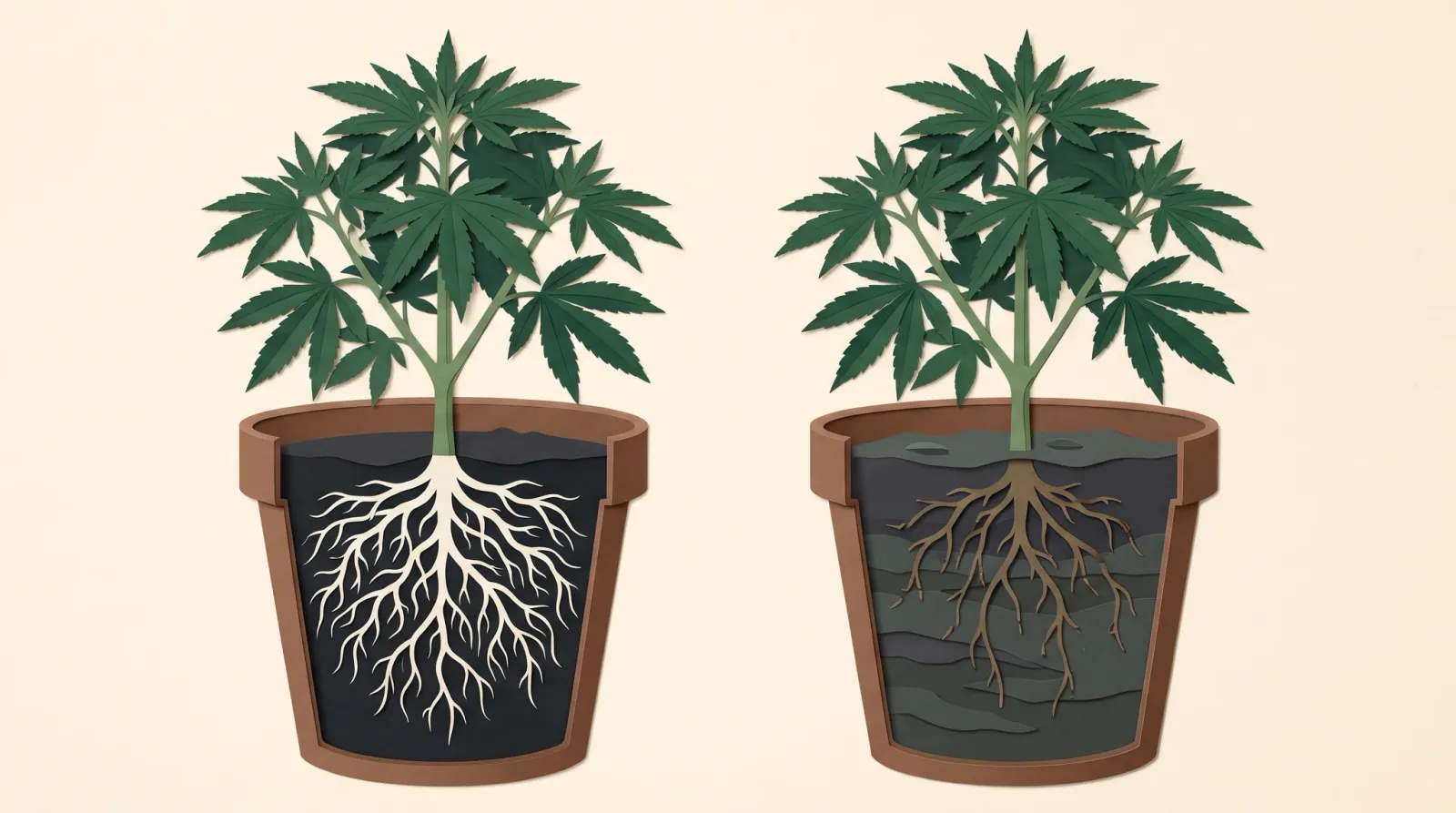
Cannabis root rot is the browning and decay of roots caused by water- and soil-borne microbes, most often Pythium or Fusarium, and it takes hold when roots sit wet, warm and short of oxygen. Fixing those conditions and removing dead tissue is what the evidence supports. Research suggests no product has been shown to cure an established infection: we found no published trial that tests one.
Here is the part most guides skip: your leaves are the last to know. In hydroponic crops with Pythium root rot, the canopy can stay green, even look darker green, while many roots are already brown and falling apart (Sutton et al., 2006). That review covers cucumber, pepper, tomato and other crops, not cannabis, but the lesson transfers as a warning: by the time leaves droop, check the roots.
And “root rot” is not one disease. Brown cannabis roots have been traced to several Pythium and Fusarium species (Punja et al., 2019) and to a black root rot fungus that every commercial pathogen test missed (Dumigan et al., 2023). So you cannot pick a fix from root color alone.
What does cannabis root rot look like?
Above the pot, the early sign is slow growth. Below it, the sign is brown, thinning roots. Researchers who sampled sick cannabis from hydroponic, coco and field grows found brown roots, browning in the crown and inner stem (the pith), stunting, yellow leaves and, in some plants, death (Punja et al., 2019). An extension guide for hemp adds wilting, especially in flower, and lateral roots that are decayed or gone (PNW Handbooks).
The order matters. Pythium attacks root tips first, and a common early pattern in greenhouse crops is wilting at midday that recovers overnight (Penn State Extension). In hydro crops, that wilting starts temporary, often on hot days, then becomes permanent as rot advances (Sutton et al., 2006).
Signs to look for, roughly in the order they show up:
- Growth slows while leaves still look normal.
- Midday wilt that recovers at night.
- Brown, thin or missing root tips, and fewer fine feeder roots.
- Root skin that slides off. Tug a brown root gently. In Pythium rot, the brown outer layer pulls away and leaves a thin inner strand (Penn State Extension).
- A brown crown or brown pith where the stem meets the medium.
- Yellowing and permanent wilting late in the process.
Advanced rot in hydro can turn slimy (Sutton et al., 2006). Smell and sliminess are clues, not tests. No source we opened shows that color or smell alone separates rot from harmless staining, so the root-skin check and the plant’s overall pattern carry more weight.
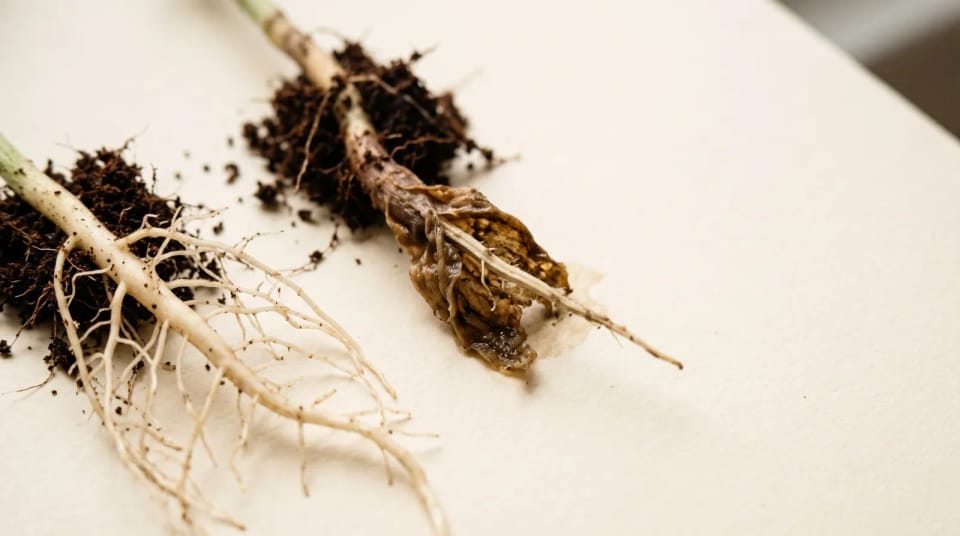
The root-skin check: in Pythium root rot, the brown outer tissue slides off and leaves a thin strand behind. It is a strong clue, not a lab diagnosis.
Is it root rot, overwatering or something else?
Start with the medium, not the leaves. A plant that droops in dry soil is thirsty and perks up after a drink. A plant that droops in wet soil, or in a full reservoir, has roots that cannot do their job. Our guide to telling overwatering from underwatering walks through that first check.
Overwatering and root rot are related but not the same thing. Waterlogged, airless medium is the strongest setup for rot, but the microbes still have to be present (UC IPM). An overwatered plant with clean, white roots usually recovers once the medium dries.
Two look-alikes are worth knowing:
- Slow decline in older plants can come from a low-grade Fusarium or Pythium infection, or from hop latent viroid, which causes stunting without rotting roots (Buirs and Punja, 2024).
- Nutrient and pH problems can yellow leaves on a plant with healthy roots. pH and runoff readings help rule that out before you blame the roots.
One more mix-up: root rot is not bud rot. Bud rot is a different disease, caused by Botrytis, and it attacks flowers, not roots.
What causes root rot in soil and coco?
Wet medium that stays wet. The organisms behind Pythium root rot live in nearly all cultivated soils and attack when conditions are wet from poor drainage or too much irrigation (UC IPM). In cannabis, overwatering, flooding and root damage all make Fusarium and Pythium root rot worse (Buirs and Punja, 2024).
Common setups that keep roots wet and short of air:
- Pots that do not drain, or saucers left full.
- Oversized pots for small plants, so the medium dries slowly. Our guide to pot size and slow-drying soil covers when to size up.
- Watering on a schedule rather than when the medium needs it. Cannabis researchers recommend longer intervals between waterings as part of root rot management (Buirs and Punja, 2024).
- Reused medium. The fungi survive on plant debris as durable spores, so medium from a diseased plant carries them forward (PNW Handbooks).
- Insects. Fungus gnats and shore flies can carry Pythium into potting mix, according to UC IPM’s guide for ornamental crops (UC IPM). A gnat problem is also a sign the top of the medium stays wet. See fungus gnats and wet soil.
Young plants are especially exposed. Infected transplants often look symptom-free at first (Sutton et al., 2006), and flowering-stage symptoms in cannabis can trace back to an infection that began during propagation or vegetative growth (Buirs and Punja, 2024). That makes clean starts with rooting cuttings part of rot prevention.
Why does warm water cause root rot in hydro?
Because warm water squeezes roots from both sides: it holds less oxygen while roots and microbes demand more. Dissolved oxygen falls from about 9 to about 7 milligrams per liter as water warms from 20 to 35°C, while oxygen demand rises faster than that, and a stressed crop needs roughly ten times more oxygen (Sutton et al., 2006). The underlying physics is simple: cold water holds more dissolved oxygen than warm water (USGS).
Low oxygen and Pythium go together. In tomato, a Pythium group colonized roots more at low oxygen levels than at high ones, though the review notes it is not known whether oxygen acts on the plant or the pathogen (Sutton et al., 2006). That review encourages hydroponic growers to keep dissolved oxygen at or above 5 mg/L.
Temperature alone also matters. In a controlled test with tobacco seedlings in float trays, Pythium root damage rose with water temperature from 15 to 30°C and was lowest at 15°C (59°F) (Fortnum et al., 2000). That is tobacco and one Pythium species, not cannabis.
So what is a safe reservoir temperature for cannabis? Nobody has measured it. You will find many different numbers quoted online, and none we found traces back to a cannabis study. The species question makes a single number shaky anyway: one Pythium species is a pathogen mainly above 77°F, while others stay active in cold water (UC IPM). Treat any range you see as a grower convention. The direction is what the evidence supports: cooler water and more oxygen work in the roots’ favor.
Room heat sets reservoir heat, which is why grow room temperature belongs in the same conversation. Recirculating systems add one more risk: Fusarium spores spread through nutrient solution, and untreated recirculated solution killed cuttings in one cannabis propagation room (Punja et al., 2019). For how deep water culture and other hydro systems move water past roots, see our hydro primer.
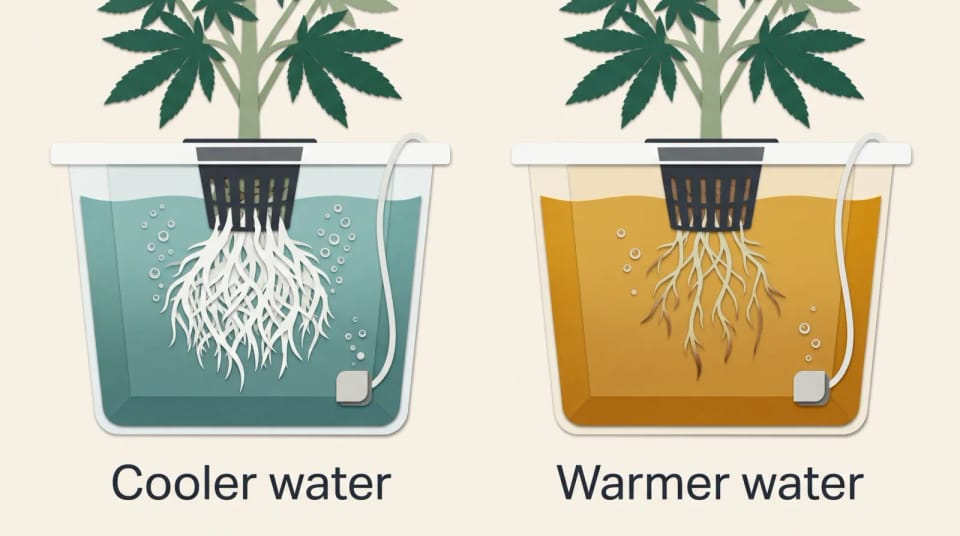
Warm water holds less dissolved oxygen while roots and microbes demand more. The evidence supports the direction, cooler and better aerated, not one magic number for cannabis.
| Soil and coco | Hydro (DWC, NFT, aeroponics) | |
|---|---|---|
| Main trigger | Medium that stays waterlogged | Warm water short on dissolved oxygen |
| How it spreads | Spores in reused medium, debris, insects | Spores carried through shared or recirculated solution |
| What to check first | Drainage, pot size, how fast the medium dries | Reservoir temperature, aeration, slime on roots |
| First fix | Let it dry, fix drainage, water less often | Raise oxygen, keep water from running warm, stop sharing water |
Is it Pythium, Fusarium or black root rot?
You cannot tell by looking, and that is the point. In the cannabis sampling study, researchers identified root pathogens by growing them in culture and sequencing their DNA. They found Fusarium oxysporum, F. solani, F. brachygibbosum, Pythium dissotocum, P. myriotylum and P. aphanidermatum (Punja et al., 2019). The hemp extension guide adds Rhizoctonia solani (PNW Handbooks).
Then there is black root rot. In a licensed aeroponic facility in British Columbia, a fungus called Berkeleyomyces rouxiae caused rapid root discoloration and rot, and the plants tested negative on all commercially available pathogen tests (Dumigan et al., 2023). That is one facility, but it shows why a negative test or a color guess is not the last word.
Why it matters for a home grower: a treatment aimed at one organism may do nothing for another. The conditions that favor all of them, though, are the same. Wet, airless, warm roots and dirty water help every one of these pathogens. That is why fixing conditions comes first.
What can you do once you see root rot?
Change the conditions, cut losses and protect the other plants. Pythium root rot “is difficult to control once the rot has begun,” so prevention is the focus in greenhouse crops (Penn State Extension). What the evidence does support:
- Dry it out. In soil and coco, let the medium dry between waterings and fix drainage. As soil dries, new roots may form and the plant may recover (UC IPM).
- Add oxygen. In hydro, oxygenating the solution is “one of the few practical measures available when root rot is well advanced,” and it limits further root decay (Sutton et al., 2006).
- Monitor the water. Cannabis researchers recommend watching water temperature and oxygen to avoid extremes, and testing recirculated water for Fusarium and Pythium in production settings (Buirs and Punja, 2024).
- Separate the sick plant. Stop it sharing water with healthy plants. Remove and discard plants that are too far gone (UC IPM).
- Do not reuse the medium. Clean pots and tools before the next plant (PNW Handbooks).
Beneficial microbes have a narrower role than their marketing suggests. Biocontrol fungi such as Trichoderma and Gliocladium reduced plant losses in cannabis greenhouse work, but they protect tissue, so they need to be in place before infection (Buirs and Punja, 2024). They are a prevention tool, not a rescue.
Does hydrogen peroxide cure root rot?
No study shows that it does. The only cannabis-specific peroxide data we found is a lab test. Researchers grew Pythium and Fusarium in nutrient broth and found that a hydrogen peroxide and peracetic acid product, and hypochlorous acid, reduced growth at higher concentrations, with Pythium more sensitive (Buirs and Punja, 2024). The same test found these products could harm the beneficial fungus Trichoderma.
That is a petri-dish result. It was never tested on rotting roots or on whole plants. A related caution from hydroponic crops: disinfecting recirculating solution outside the crop often has only a minor effect on an epidemic already underway (Sutton et al., 2006). So peroxide may slow organisms in the water, but nothing shows it brings dead roots back.
Can a cannabis plant recover from root rot?
Sometimes, and usually with a cost. Nobody has published recovery odds for cannabis, so be wary of any percentage you see. What the sources support is this: when the medium dries out, new roots may form and the plant may recover (UC IPM). In hydroponic peppers and some other crops, severely affected plants regrew enough root to keep green foliage for a long time, but growth and yield were normally reduced or poor (Sutton et al., 2006).
A practical way to judge it: look for new white root tips after you fix the conditions. A plant still making new roots has something to work with. A plant with a brown crown and no living roots does not, and keeping it around mainly risks the plants next to it.
How do you prevent cannabis root rot?
Keep roots wet only as long as they need to be, keep water cool and oxygenated, and start clean. The prevention advice from extension services and cannabis researchers lines up:
- Clean starts. Use clean pots, sterile or pasteurized medium, clean tools and clean water (PNW Handbooks; Penn State Extension).
- Drainage and spacing between waterings. Let the medium dry back between waterings (Buirs and Punja, 2024).
- Cool, aerated reservoirs. Watch water temperature and dissolved oxygen, and clean reservoirs between runs.
- No shared sick water. Keep a struggling plant off a shared or recirculating system.
- Protective biology early, if you use it. Biocontrol works before infection, not after.
Root rot is a plant problem. This guide does not cover human health. If you have symptoms after handling or using any cannabis, talk to a clinician rather than relying on a grow guide.
Sources
- Punja ZK, Collyer D, Scott C, et al. “Pathogens and Molds Affecting Production and Quality of Cannabis sativa L.” Frontiers in Plant Science, 2019. DOI 10.3389/fpls.2019.01120
- Buirs L, Punja ZK. “Integrated Management of Pathogens and Microbes in Cannabis sativa L. (Cannabis) under Greenhouse Conditions.” Plants, 2024. PMC10974757
- Sutton JC, Sopher CR, Owen-Going TN, et al. “Etiology and epidemiology of Pythium root rot in hydroponic crops: current knowledge and perspectives.” Summa Phytopathologica, 2006. DOI 10.1590/S0100-54052006000400001
- Fortnum BA, Rideout J, Martin SB, Gooden D. “Nutrient Solution Temperature Affects Pythium Root Rot of Tobacco in Greenhouse Float Systems.” Plant Disease, 2000. PubMed 30841243
- Dumigan CR, Maddock S, Bray-Stone D, Deyholos MK. “Hybrid Genome Assembly of Berkeleyomyces rouxiae, an Emerging Cannabis Fungal Pathogen Causing Black Root Rot in an Aeroponic Facility.” Plant Disease, 2023. PubMed 36774565
- Osterbauer NK, Ocamb CM. “Hemp (Cannabis sativa) - Root and Crown Rot.” Pacific Northwest Pest Management Handbooks
- Moorman GW. “Pythium.” Penn State Extension
- UC IPM. “Pythium Root Rot” (Floriculture and Ornamental Nurseries). University of California Statewide IPM Program
- USGS Water Science School. “Dissolved Oxygen and Water.” U.S. Geological Survey
Sources checked October 29, 2026.
Key takeaways
- Root rot is root decay from several microbes, mainly Pythium and Fusarium, not one disease.
- Leaves are the last to show it; slow growth and midday wilting come first.
- Wet, airless medium and warm, low-oxygen water set the stage.
- No cannabis study sets a safe reservoir temperature or proves any cure, including peroxide.
- Plants that grow new white roots can recover, usually with reduced growth.
FAQ
Can cannabis recover from root rot?
It can if living roots remain and conditions improve. As the medium dries, new roots may form and the plant may recover. In other hydroponic crops, plants that regrew roots stayed green but usually grew and yielded less. No study gives recovery odds for cannabis.
Does hydrogen peroxide kill root rot?
In a lab test, a peroxide product slowed Pythium and Fusarium growing in nutrient broth. Nobody has tested it on rotting cannabis roots, and it can also harm beneficial fungi. Fixing drainage, oxygen and water temperature has stronger support.
Are brown roots always root rot?
No. Brown roots in cannabis have been traced to several different organisms, and no source shows color alone settles the question. Check whether the brown outer skin slides off, whether the crown is brown, and whether the plant is wilting in wet medium.
How warm is too warm for a hydro reservoir?
No cannabis study sets a number. Warm water holds less oxygen while roots need more, and in tobacco, Pythium damage rose with water temperature. Treat any quoted range as a grower convention and aim for cooler, well-aerated water.
Can root rot spread to other plants?
Yes. Fusarium spores travel in nutrient solution, and untreated recirculated solution killed cannabis cuttings in one propagation room. Spores also survive in reused medium and debris, and insects can carry Pythium. Separate sick plants and do not share their water or medium.



