CBE: Cannabielsoin, the CBD Metabolite You Haven't Heard Of
CBE (cannabielsoin) is a CBD oxidation product and minor metabolite with almost no human data. Here's the candid science and why it matters.

Professor High
Your friendly cannabis educator, bringing science-backed knowledge to the community.
If you have ever left a bottle of CBD oil open on a sunny windowsill and noticed it slowly turning from pale gold to a stubborn amber-red, you have watched cannabielsoin being born. Probably. We will get to the hedging in a moment, because cannabielsoin — abbreviated CBE — is one of those cannabinoids where the honest answer to almost every interesting question is “we are not entirely sure.”
CBE is not a household name. It does not appear on certificates of analysis, it is not sold as an isolate, and you will not find a Blue Dream cut bred to be “high in CBE.” What CBE is, instead, is a quiet chemical footnote that keeps turning up in two very different places: in the test tube when CBD oxidizes, and in the livers of certain laboratory animals after they metabolize CBD. That dual identity — degradation product and metabolite — is exactly what makes it worth a careful look.
Not medical advice. This article summarizes early, mostly preclinical chemistry and pharmacology. CBE has essentially no human safety or efficacy data. Nothing here is a recommendation to seek out, dose, or self-experiment with cannabielsoin.
What cannabielsoin actually is
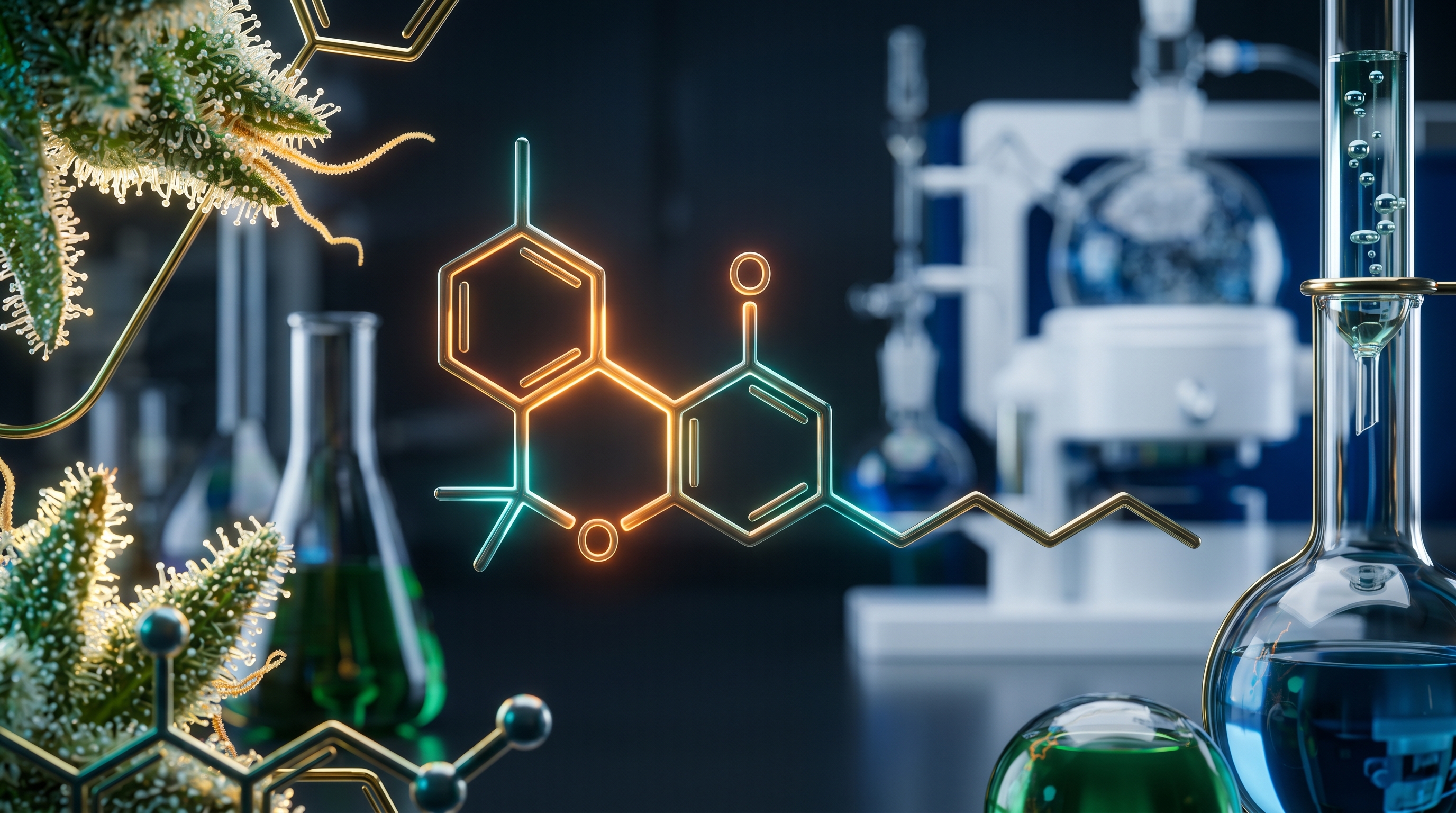
Start with the molecule. CBD — cannabidiol — is an open-ring cannabinoid: two rings joined by a single carbon-carbon bond, with a free terpene-derived ring hanging off the side. That flexible, electron-rich structure is part of why CBD is chemically restless. CBE takes that skeleton and closes part of it into a new cyclic ether, producing a tighter, three-ring (tricyclic) framework that structurally sits somewhere between CBD and the THC-type cannabinoids [Haghdoost et al., 2024]. It is, in the most literal sense, CBD that has rearranged itself around an oxygen atom.
The defining event is oxidation. CBD has an unusually low oxidation potential — around 1.2 volts, which makes it one of the more readily oxidized natural cannabinoids — and that sensitivity is the same property that lets it act as an antioxidant in the first place [Haghdoost et al., 2024]. When CBD reacts with oxygen, or with an oxygen-atom-transferring oxidant, the major product is cannabielsoin. The visible color shift toward red and purple that aging CBD extracts develop comes from a different set of products (quinones such as cannabidiolquinone), but CBE forms along the same oxidative road. If you want the broader picture of how cannabinoids drift over time, our piece on acetylated cannabinoids and vaping covers a related cautionary tale about what degradation can do.
There is a stereochemistry wrinkle worth flagging, because it matters for the pharmacology later. Naturally occurring CBD is the (−) enantiomer, and oxidizing it can in principle give two diastereomers, S-CBE and R-CBE; with four chiral centers, the full theoretical family runs to sixteen optical isomers [Haghdoost et al., 2024]. In practice, oxidizing (−)-CBD with dimethyldioxirane forms essentially only S-CBE, which is why almost every functional study you will read is really a study of one isomer, S-CBE [Haghdoost et al., 2024].
The acid form: CBEA
Like most cannabinoids, CBE has an acidic precursor in the plant world. Cannabielsoinic acid (CBEA) is the carboxylated form, and it ties CBE back to the raw-cannabis chemistry we cover in CBDA and THCA. There appear to be two routes to CBE in a plant or extract: CBDA can decarboxylate to CBD and then oxidize to CBE, or CBDA can oxidize first to CBEA and then decarboxylate to CBE [Haghdoost et al., 2024]. Either way, you end up at the same tricyclic ether. CBEA itself has been studied even less than CBE — which is saying something.
Two ways CBE shows up: degradation and metabolism
Here is the part that makes CBE genuinely interesting rather than just obscure. It arrives by two completely different mechanisms.
Path one is non-enzymatic degradation. This is the windowsill scenario: CBD in a product, exposed to oxygen, light, and time, slowly converting to CBE. Historically, CBE was first made photochemically from CBD in the lab — a 1974 synthesis by Uliss and colleagues described it as a “stereospecific intramolecular epoxide cleavage by phenolate anion” [Uliss et al., 1974]. In plain terms, CBD picks up an oxygen, briefly forms a strained epoxide, and that epoxide gets cracked open by a neighboring phenol group to lock in the new ring. The same logic explains why proper storage matters for any CBD product — a theme we hit hard in full-spectrum vs broad-spectrum vs isolate.
Path two is biological metabolism. This is the more surprising one. In the late 1980s and early 1990s, Yamamoto and colleagues identified CBE as a genuine metabolite of CBD — something an animal’s own liver enzymes produce after CBD is absorbed [Yamamoto et al., 1988; Yamamoto et al., 1991]. The reaction runs through cytochrome P450 enzymes, requires NADPH and molecular oxygen, and peaks around physiological pH (~7.3). When researchers blocked P450 with classic inhibitors — SKF 525-A, alpha-naphthoflavone, metyrapone, carbon monoxide — CBE formation dropped, confirming the enzyme’s role [Yamamoto et al., 1989].
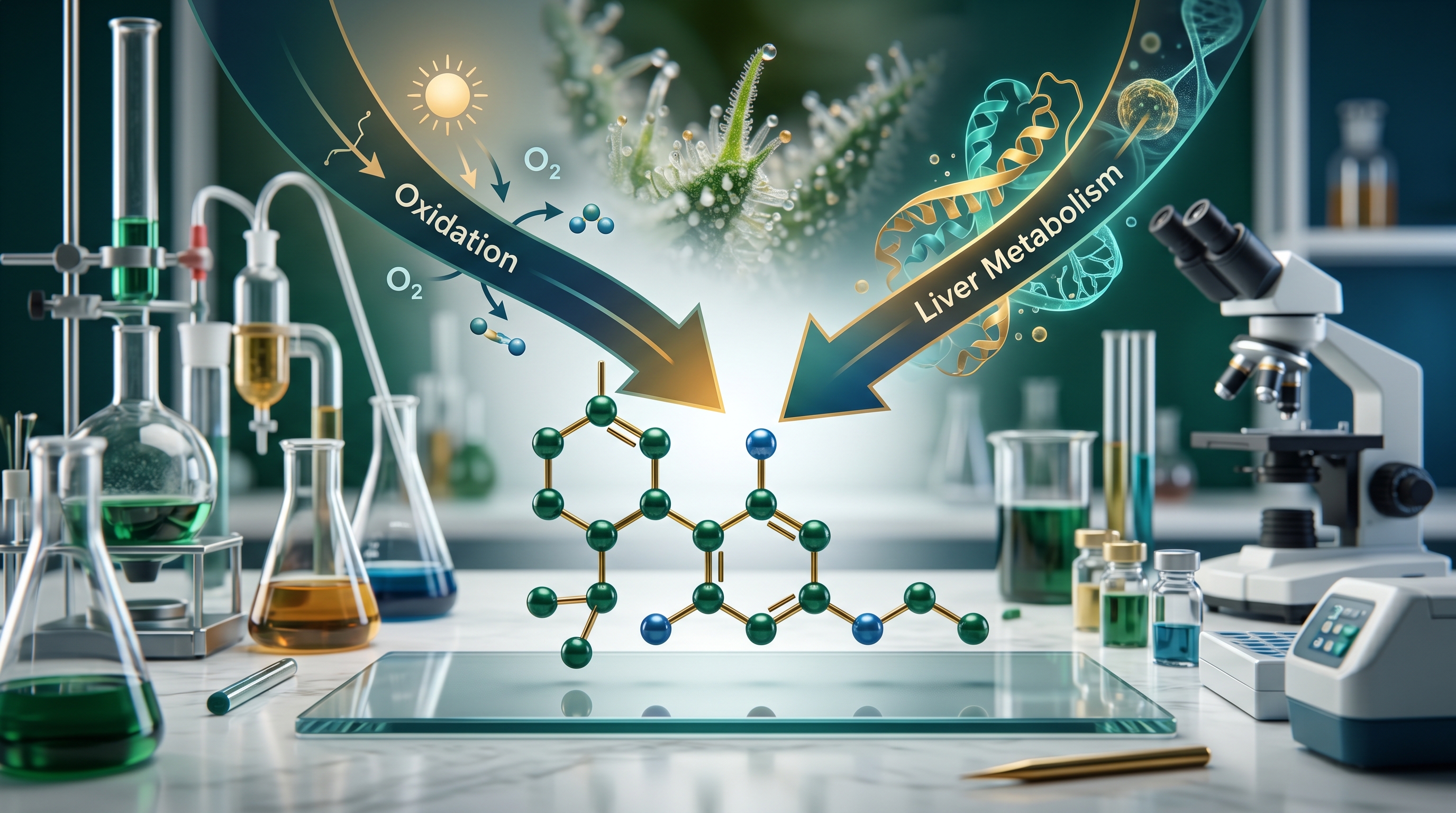
And both roads pass through the same chemical checkpoint: an epoxide intermediate. Yamamoto’s team showed that a synthetic 1S,2R-epoxide of CBD readily converted to cannabielsoin, while the mirror-image 1R,2S-epoxide went a different direction entirely [Yamamoto et al., 1989]. That convergence — a lab oxidant and a liver enzyme both funneling CBD through an epoxide to reach CBE — is the kind of tidy mechanistic story chemists love. The catch, as always, is the species it was shown in.
The species problem (and the human research vacuum)
CBE-forming activity is not equal across animals. Ranked by how much CBE their liver microsomes produced, the order was guinea pig > mouse ≥ rabbit ≥ rat, with guinea pigs being far and away the most prolific converters [Yamamoto et al., 1989]. There was even a sex difference in rats, with males forming more CBE than females [Yamamoto et al., 1991]. For scale, in guinea pigs the amount of CBE generated was roughly one-sixth that of the dominant CBD metabolite, 7-hydroxy-CBD [Haghdoost et al., 2024]. So even in the best converters, CBE is a minor metabolite.
Now the uncomfortable part. CBE has not been clearly isolated from humans [Devinsky review context, 2017]. A major review of human CBD metabolites notes that CBE was identified in guinea pigs but has not been demonstrated in people [Ujváry & Hanuš, 2016, as discussed in human-metabolite reviews]. Humans metabolize CBD heavily — hydroxylation, then oxidation to 7-COOH-CBD, plus a long tail of minor pathways — and a 2019 study even reported novel decarbonylated CBD metabolites formed by human liver microsomes and recombinant CYP3A4 [Beers et al., 2020]. Whether the guinea-pig CBE pathway operates meaningfully in humans is, as of this writing, an open question. The honest summary: CBE is a confirmed CBD metabolite in rodents and a confirmed degradation product in any CBD bottle, but its status in the human body is unproven.
This is the research vacuum I promised to be candid about. We are talking about a compound discovered as a metabolite nearly forty years ago that still has no human pharmacokinetic data, no human safety data, and no clinical trials of any kind.
What little we know about how CBE behaves
For decades, the pharmacology readout on CBE was essentially “nothing obvious.” Early rodent work found that CBE produced no clear CNS activity — it did not meaningfully change body temperature or prolong pentobarbital-induced sleep in mice the way some cannabinoids do, and it was negative in the Ames mutagenicity test [Yamamoto et al., 1988]. One intriguing peripheral signal did appear: an intravenous dose in rabbits lowered intraocular pressure where CBD itself did not [human-metabolite review, 2017]. That hinted CBE might act outside the brain rather than inside it — but it was a single, old observation, never followed up in a serious way.
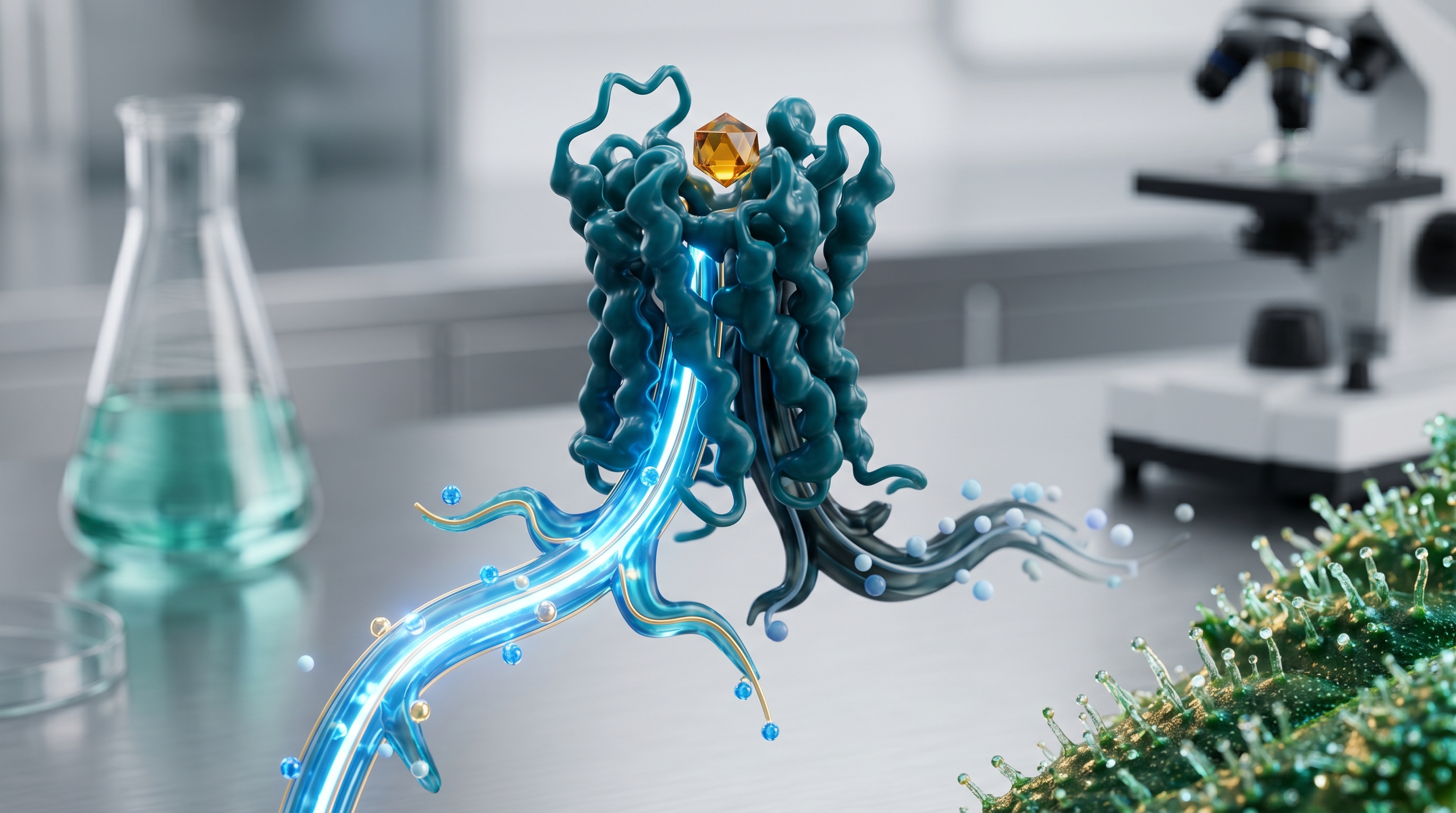
Then, in 2024, the picture got more interesting. A team led by Haghdoost ran S-CBE through modern receptor assays and found it is not inert after all: it acts as a biased CB1 agonist [Haghdoost et al., 2024]. The numbers are worth stating precisely, with the usual caveats:
- In the cAMP assay, S-CBE activated CB1 with an EC50 of about 3.72 µM (1.23 µg/mL), reaching roughly 60% of the efficacy of the reference agonist CP55940 [Haghdoost et al., 2024].
- In the β-arrestin assay, it showed no agonist activity at all, and only weak antagonism at higher concentrations [Haghdoost et al., 2024].
That split — turning on the G-protein/cAMP signaling arm of CB1 while ignoring the β-arrestin arm — is the textbook definition of biased agonism. It is the same conceptual territory that makes researchers excited about designing cannabinoids with cleaner effect profiles. Docking studies suggested why: CBE sits higher in the CB1 pocket than THC, skips a hydrogen bond (to Ser383) that THC relies on, and stays far from the “toggle switch” residue Phe200 [Haghdoost et al., 2024]. Different pose, different signaling.
Before anyone gets carried away: put that 3.72 µM potency next to THC’s CB1 EC50 of around 13 nM in the same kind of assay [Haghdoost et al., 2024]. CBE is roughly hundreds of times weaker at the receptor. Combined with its status as a minor metabolite present at low concentrations, the practical pharmacological relevance of CBE in a real person who took CBD is — at best — uncertain. The 2024 authors said as much, listing their own limitations frankly: engineered overexpressing cell lines rather than native tissue, in vitro concentrations that may never be reached physiologically, only the S isomer tested experimentally, and zero in vivo validation [Haghdoost et al., 2024].
Why CBE is worth caring about anyway
If CBE is weak, minor, and unproven in humans, why spend ten minutes on it? Three reasons, none of them about getting high.
1. It is a stability and quality marker. Because CBE forms when CBD oxidizes, the presence of CBE (and its cousins like CBDQ) in a finished product is essentially a chemical fingerprint of age, heat, light, or oxygen exposure. As analytical labs get better at detecting minor cannabinoids, CBE is exactly the kind of compound that could become a shelf-life indicator. That matters for anyone who cares whether their CBD-only product is fresh — and it is the same degradation logic behind why we tell people to store flower and extracts cool, dark, and sealed.
2. It is a window into CBD metabolism. If the guinea-pig pathway turns out to operate in humans even slightly, CBE could serve as a marker of a specific P450-mediated route of CBD clearance — useful context for understanding CBD’s well-documented drug interactions through enzymes like CYP3A4 and CYP2C19. Metabolites are not just waste; they are clues about how a drug moves through the body.
3. It is a case study in the entourage frontier. The 2024 biased-agonism finding is a reminder that “minor” and “degradation” do not mean “inert.” Aged full-spectrum products are chemically different from fresh ones, and that difference is part of why the entourage effect is so hard to pin down — the mixture literally changes as it sits. CBE joins a growing list of barely-studied cannabinoids, alongside CBL (cannabicyclol) and CBT (cannabitriol), where the science is decades behind the marketing.
How CBE fits with its better-known cousins
It helps to place CBE on the family tree. CBN is what THC becomes when it oxidizes — so CBN is to THC roughly what CBE is to CBD: a child of oxidation, formed in old, air-exposed material. CBL is a light-driven rearrangement of CBC, another “the molecule reshuffled itself” story. CBC and CBG sit upstream as biosynthetic players. CBE is the odd one out only in that it is so rarely measured — but mechanistically it belongs right in that oxidation-and-rearrangement neighborhood. And if you want the deeper dive on how CBD behaves before it ever oxidizes, our piece on CBD being stimulating, not sedating, at low doses is a good companion.
None of this maps neatly onto our High Family framework, by the way, and that is the point. The High Families are built from terpene profiles — myrcene, limonene, linalool, caryophyllene — and the effects people actually report, not from trace oxidation products nobody can feel. CBE is a chemistry-and-metabolism story, not an experience you will ever chase down at a dispensary.
Key takeaways: the honest bottom line
Cannabielsoin is real, well-characterized chemically, and almost entirely mysterious biologically. It forms two ways — CBD oxidizing in the bottle and CBD being metabolized in the liver — and both routes pass through the same epoxide intermediate to reach the same tricyclic ether. In rodents it is a confirmed minor metabolite; in humans it has never been clearly demonstrated. Its one modern pharmacological claim to fame, biased CB1 agonism, comes from a single 2024 in-vitro study using one isomer at concentrations far above what a CBD user would plausibly produce.
So when you read a product page or a forum post hyping CBE as the next breakthrough cannabinoid, reach for skepticism. The data simply are not there yet. What CBE can honestly offer today is a more sophisticated way to think about freshness, metabolism, and the fact that cannabis chemistry keeps moving long after the plant is harvested. The best way to make sense of any of it — minor cannabinoids included — is to stop guessing and start tracking how specific products and profiles actually affect you. That is the entire premise behind logging your sessions in the High IQ app: your own data beats a trace-metabolite headline every time.
Sources
- Haghdoost, M., Young, S., Roberts, M., Krebs, C., & Bonn-Miller, M. O. (2024). Cannabielsoin (CBE), a CBD Oxidation Product, Is a Biased CB1 Agonist. Biomedicines, 12(7), 1551. DOI: 10.3390/biomedicines12071551 (PMID: 39062125)
- Yamamoto, I., Gohda, H., Narimatsu, S., & Yoshimura, H. (1988). Identification of cannabielsoin, a new metabolite of cannabidiol formed by guinea-pig hepatic microsomal enzymes, and its pharmacological activity in mice. Journal of Pharmacobio-Dynamics, 11(12), 833–838. PMID: 3254981
- Yamamoto, I., Gohda, H., Narimatsu, S., & Yoshimura, H. (1989). Mechanism of biological formation of cannabielsoin from cannabidiol in the guinea-pig, mouse, rat and rabbit. Journal of Pharmacobio-Dynamics, 12(8), 488–494. DOI: 10.1248/bpb1978.12.488 (PMID: 2614640)
- Yamamoto, I., Gohda, H., Narimatsu, S., Watanabe, K., & Yoshimura, H. (1991). Cannabielsoin as a new metabolite of cannabidiol in mammals. Pharmacology Biochemistry and Behavior, 40(3), 541–544. DOI: 10.1016/0091-3057(91)90360-e (PMID: 1806944)
- Yamamoto, I., et al. (1990). In vivo and in vitro metabolism of cannabidiol monomethyl ether and cannabidiol dimethyl ether in the guinea pig: on the formation mechanism of cannabielsoin-type metabolite from cannabidiol. Chemical & Pharmaceutical Bulletin / J Pharmacobiodyn. PMID: 2208386
- Uliss, D. B., Razdan, R. K., & Dalzell, H. C. (1974). Stereospecific intramolecular epoxide cleavage by phenolate anion. Synthesis of novel and biologically active cannabinoids. Journal of the American Chemical Society, 96(23), 7372–7374. DOI: 10.1021/ja00830a035
- Ujváry, I., & Hanuš, L. (2016). Human Metabolites of Cannabidiol: A Review on Their Formation, Biological Activity, and Relevance in Therapy. Cannabis and Cannabinoid Research, 1(1), 90–101. DOI: 10.1089/can.2015.0012 (PMC5576600)
- Beers, J. L., et al. (2020). Cannabidiol metabolism revisited: tentative identification of novel decarbonylated metabolites of cannabidiol formed by human liver microsomes and recombinant cytochrome P450 3A4. Forensic Toxicology, 38, 449–457. DOI: 10.1007/s11419-019-00467-0


