

Does Weed Have Calories? What Flower, Gummies and THC Drinks Add
Does weed have calories? At real doses THC adds almost none. The calories sit in the gummy, the brownie or the drink, and in the snacks that follow.

Professor High
Written by Professor High, our AI guide. See how we research and correct articles.
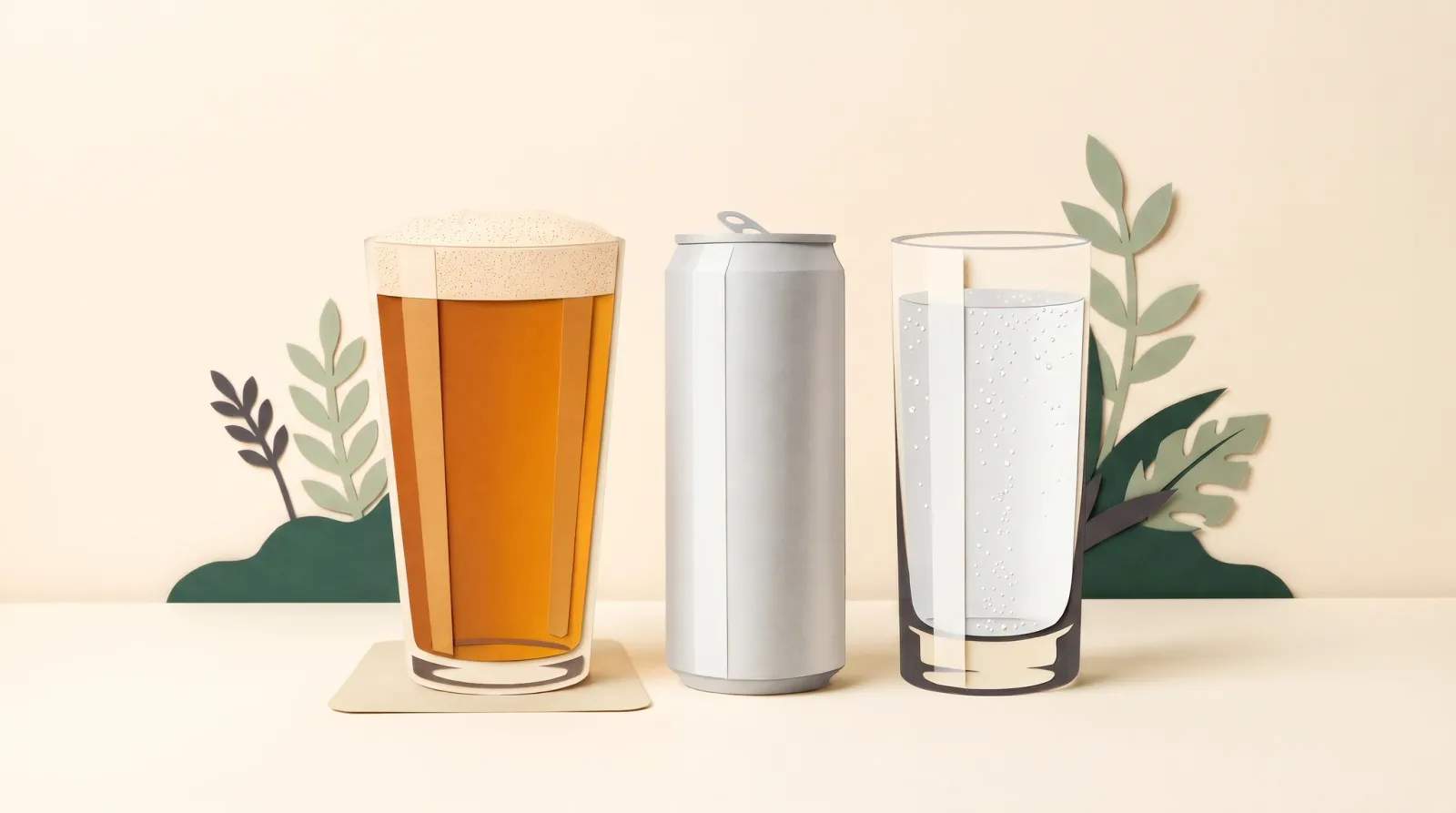
At real doses, weed itself adds almost no calories: the calories in a cannabis product come from the food or drink carrying the THC, and the bigger calorie effect in lab studies was people eating more afterward. A gummy carries its sugar, a brownie its butter and flour, and a THC seltzer whatever sweetener went into the can. Smoked or vaped flower is not eaten at all.
Here is the number worth sending to a friend. A 12 fl oz regular beer carries about 153 calories (MedlinePlus), and roughly 98 of those come from the alcohol alone. Now treat a full 10 mg dose of THC as if it were pure fat, the most energy-dense nutrient. The most it could add is under one tenth of a calorie. The calories that move are printed on the label, and on the plate you reach for later.
Does weed have calories?
Not in any amount that matters at the doses people use. Every organic molecule holds chemical energy, THC included, so “zero” is not quite the right word. The honest answer is that a dose is too small to count, and nobody has measured THC as a fuel in people.
The arithmetic makes this clear. Food energy is calculated with standard conversion factors: about 9 calories per gram of fat, 4 per gram of carbohydrate or protein, and 7 per gram of alcohol (FAO energy conversion factors). A 10 mg THC dose weighs 0.010 g. Even at the fat factor, that is 0.010 g x 9 = 0.09 calories. This is a ceiling built on an assumption, not a measurement.
You may see figures online claiming a gram of flower has 1, 9 or 200 calories. Those numbers disagree with each other by about a hundredfold, and none of the pages shows a measurement. Our research found no peer-reviewed value for the usable energy in cannabis flower or smoke in humans. That is a gap in the literature, not proof that a number can never exist. Until someone measures it, no calorie figure belongs on a gram of weed.
One related trap: hemp seeds are a real food with real calories. Flower is a different part of the plant, so a hemp seed calorie count tells you nothing about a joint.
Calories by format: where they come from
The table below is the short version. It shows where the energy lives in each format and how to find the real number for the product in your hand.
| Format | Where the calories come from | The number you can check |
|---|---|---|
| Smoked or vaped flower | Nothing is eaten; the plant is burned or heated | No measured value; no figure belongs on it |
| Eaten raw flower (rare) | Plant fibre, some fat and protein | No human value found; the plant material is largely fibre and minerals |
| Gummy | Sugar and the gelling agent | The label; sugar carries about 4 calories per gram |
| Brownie, cannabutter, infused oil | Flour, sugar, butter or oil; the infusion fat is part of the recipe | The label or your recipe; fat carries about 9 calories per gram |
| THC seltzer or soda | Any added sugar, juice or sweetener | The label, if the product has one |
| Regular beer, 12 fl oz | Alcohol plus carbohydrate | About 153 calories; light beer about 103 |
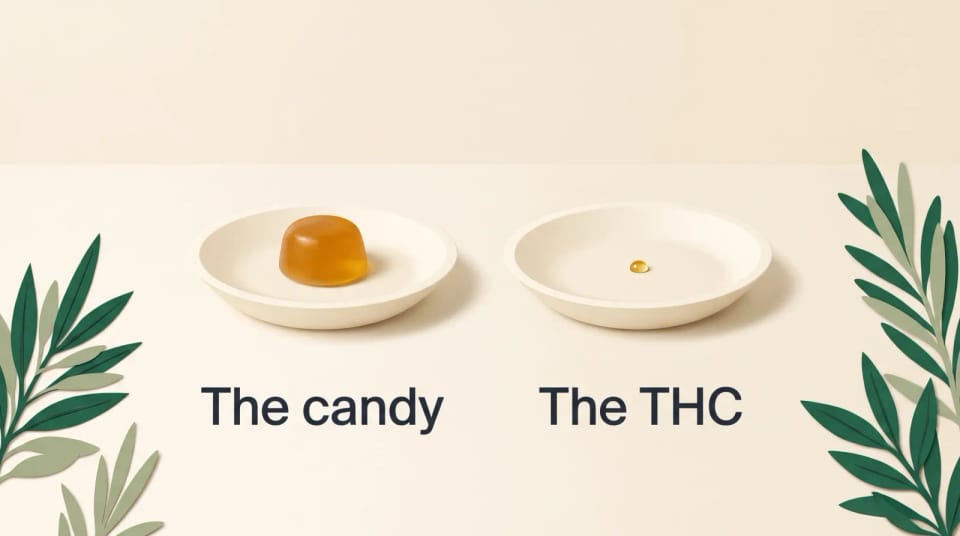
A gummy is grams of sugar and gelling agent. The THC inside weighs milligrams, so it contributes almost nothing to the calorie count.
Do edibles have calories?
Yes, because an edible is food. The THC rides along in a carrier that has its own energy. A gummy is mostly sugar, which carries about 4 calories per gram (FAO), so a small gummy that is mostly sugar lands in the range of a regular piece of candy. The label on the package is always a better number than any estimate.
Baked goods are where calories add up. THC is usually infused into butter or oil, and fat carries more than twice the calories of sugar per gram. Swapping in a low-carb recipe does not change that: fat is calorie-dense, even in keto edibles. The choice of which oil carries the infusion affects flavour and texture more than the calorie total, since cooking oils all sit near the same fat factor.
If you are comparing formats for sugar, our gummies versus capsules comparison covers what each carrier adds. And remember that the THC milligrams on a package have their own accuracy problems, which we cover in why edible milligrams can miss.
Does smoking or vaping weed add calories?
No. You do not eat or digest smoke or vapour, so there is nothing for your gut to turn into energy. The weight involved is small anyway. A typical joint holds well under a gram of flower, as our guide to the weight and label math for a joint explains, and most of that is burned or exhaled.
The plant material itself is not a rich fuel. In a 2021 analysis of hemp flower trimmings, neutral detergent fibre made up 31 to 37 percent of the dry matter and ash about 23 percent. In a rumen fermentation test, well under half of the organic matter broke down (Vastolo et al., 2021). That study tested hemp co-products in an animal model, not smokable flower in people, and it reported no calorie value. It supports one narrow point: flower is largely fibre and minerals, not food.
Does smoking weed burn calories?
There is no evidence that it does. Our research found no human study that measured energy expenditure after smoking or vaping cannabis. A fitness tracker may show a higher “calories burned” figure after a session, but trackers often estimate burn from heart rate, so anything that raises your pulse raises the estimate. A faster pulse on a watch is not a measurement of your metabolism.
So do not count a session as exercise, and do not treat cannabis as a weight-loss tool. Our article on cannabis and weight explains why appetite is not a weight-loss result, and why population studies on body weight are hard to read.
How do THC drinks compare with beer?
Beer has a fixed calorie floor that THC drinks do not: the alcohol. A US standard drink holds about 14 grams of pure alcohol, the amount in 12 fl oz of regular beer at about 5 percent alcohol (NIAAA). At 7 calories per gram, that is about 98 calories before you count any carbohydrate. Federal dietary advisers put it the same way: one standard drink is about 100 calories from ethanol, and the rest of the drink adds more (2020 Dietary Guidelines Advisory Committee report).
A THC seltzer has no alcohol, so its calories depend entirely on what else is in the can. One with no added sugar or juice can sit close to zero. One sweetened with sugar carries about 4 calories per gram of that sugar, like any soda. We found no independent dataset of THC drink calories, so we will not quote a typical range. Read the label.
Here is the detail most labels never explain. Under FDA rules for food labels, calories are rounded in 5-calorie steps up to 50, and a serving with fewer than 5 calories may be listed as zero (21 CFR 101.9(c)(1)). So “0 calories” means “under 5”, not “none”. Not every cannabis drink carries an FDA-style Nutrition Facts panel, either. State cannabis programs set their own label rules, so check the label if it has one.
This is a calorie comparison only. It does not make a THC drink a healthier choice than beer, and it is not a reason to swap one for the other. For how these drinks deliver THC and why their timing differs from edibles, see how THC drinks work.
Do the munchies matter more than the weed?
For most people, yes: in controlled studies the calorie change came from eating more, not from the cannabis. The mechanism behind that hunger is a separate lesson here in High School, covered in why cannabis makes you hungry. This section sticks to what the studies measured.
- A 2025 randomized trial. Eighty-two adults vaporized cannabis flower with 20 mg or 40 mg of THC, or a placebo plant, then had access to snacks and drinks. Cannabis raised energy intake within the first 30 minutes of food access, regardless of dose or gender. It did not change the mix of fats, carbohydrates and protein people chose (Hume et al., PNAS 2025). This was one session over a few hours. In the same paper, rats showed no change in 24-hour intake or body weight.
- A residential lab study from 1988. Six men lived in a lab for 13 days. Smoked marijuana raised their total daily calorie intake by 40 percent, mostly through extra snacks such as candy bars rather than bigger meals (Foltin et al., 1988). The cigarettes held 2.3 percent THC, far below many modern products, and no women took part.
- The same lab, 1986. A single cigarette before a work period did not change intake. Two or three during social time raised daily calories, again through snacks (Foltin et al., 1986).
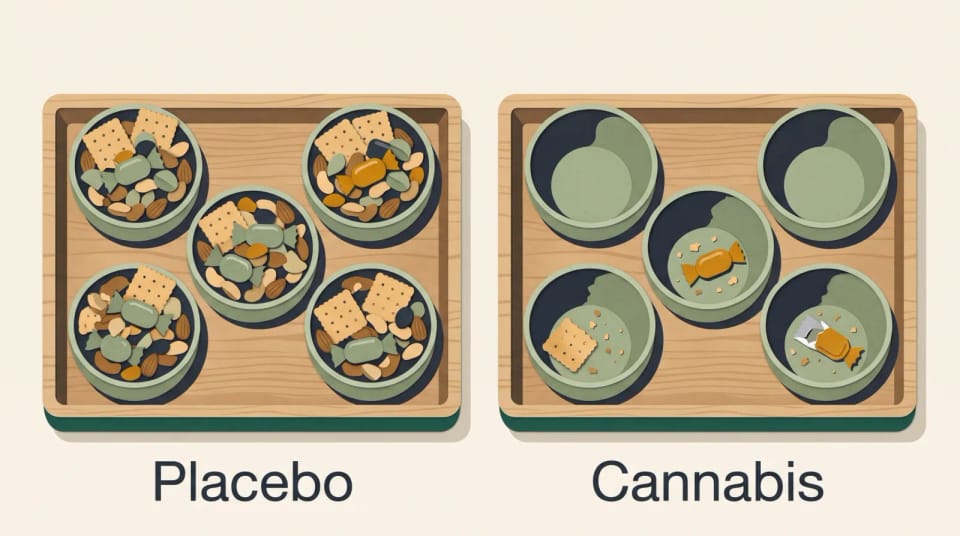
In controlled studies, cannabis raised short-term snacking compared with placebo. That shows a change in eating over hours, not weight gain over months.
The response is not the same for everyone. In a 2025 trial in adults aged 65 and over with poor appetite, a THC and CBD spray did not change test-meal intake on the main outcome; the average difference was 10 calories, with a range that included zero (Nielsen et al., 2025). In a 2005 study of people living with HIV, cannabis raised calorie intake in those with low muscle mass but not in those with normal muscle mass (Haney et al., 2005). Those are clinical groups, and none of these studies is treatment advice.
At the population level, one economics study found that sales of high-calorie foods rose about 3 percent in counties after their states legalized recreational cannabis (Baggio and Chong, 2020). That is store sales data. It cannot tell us who ate the food or whether cannabis users ate it.
The practical takeaway is simple. If you care about calories, the snacks within reach matter far more than the THC. If you wonder whether sweets hit differently, see what human tests found on cannabis and sweetness. If you log sessions in the High IQ app, a quick note on what you ate afterward can show you your own pattern over time.
When to talk to a clinician
Talk to a doctor or a registered dietitian if your appetite or weight changes without explanation, if you are using cannabis to manage eating, or if you take medication that affects appetite or blood sugar. That includes the newer weight-loss drugs; our article on cannabis edibles and weight-loss drugs covers what is and is not known. If eating feels out of your control, reach out for support rather than adjusting cannabis on your own.
Sources
- Hume C, Cuttler C, Baglot SL, et al. “Cannabis produces acute hyperphagia in humans and rodents via increased reward valuation for, and motivation to, acquire food.” PNAS, 2025. DOI 10.1073/pnas.2518863122. PubMed
- Foltin RW, Fischman MW, Byrne MF. “Effects of smoked marijuana on food intake and body weight of humans living in a residential laboratory.” Appetite, 1988. DOI 10.1016/s0195-6663(88)80017-5. PubMed
- Foltin RW, Brady JV, Fischman MW. “Behavioral analysis of marijuana effects on food intake in humans.” Pharmacology Biochemistry and Behavior, 1986. PMID 3774823. PubMed
- Haney M, Rabkin J, Gunderson E, Foltin RW. “Dronabinol and marijuana in HIV(+) marijuana smokers: acute effects on caloric intake and mood.” Psychopharmacology, 2005. DOI 10.1007/s00213-005-2242-2. PubMed
- Nielsen RL, Bornaes O, Christensen LWS, et al. “The appetite stimulating effect and safety of THC and CBD in older patients with poor appetite: a triple-blinded, randomized, placebo-controlled, cross-over trial.” Clinical Nutrition, 2025. DOI 10.1016/j.clnu.2025.02.024. PubMed
- Baggio M, Chong A. “Recreational marijuana laws and junk food consumption.” Economics and Human Biology, 2020. DOI 10.1016/j.ehb.2020.100922. PubMed
- Vastolo A, Calabro S, Pacifico S, et al. “Chemical and nutritional characteristics of Cannabis sativa L. co-products.” Journal of Animal Physiology and Animal Nutrition, 2021. DOI 10.1111/jpn.13557. PubMed
- FAO. “Food energy: methods of analysis and conversion factors,” Chapter 3. FAO Food and Nutrition Paper 77, 2003. fao.org
- National Library of Medicine. “Lower-calorie choices for alcoholic drinks.” MedlinePlus, reviewed 2026. medlineplus.gov
- National Institute on Alcohol Abuse and Alcoholism. “What Is A Standard Drink?” niaaa.nih.gov
- Dietary Guidelines Advisory Committee. “Scientific Report of the 2020 Dietary Guidelines Advisory Committee,” Part D, Chapter 11: Alcoholic Beverages. 2020. dietaryguidelines.gov
- US Food and Drug Administration. 21 CFR 101.9(c)(1), Nutrition labeling of food. ecfr.gov
Key takeaways
- At real doses, THC adds a fraction of a calorie, too little to count, and no one has measured it as a fuel in people.
- No calorie figure belongs on a gram of flower; the numbers online conflict and show no measurement.
- Edibles and drinks carry the calories of their sugar, flour, fat or sweetener. Read the label.
- A 12 fl oz regular beer is about 153 calories, about 98 of them from alcohol.
- “0 calories” on a food label can mean anything under 5.
- In lab studies, the calorie change came from eating more after cannabis, and the response varies by person.
FAQ
How many calories are in a joint?
There is no measured figure, and you do not digest smoke, so a joint adds no meaningful calories. The flower in a joint weighs well under a gram, and plant material is largely fibre and minerals. Any number you see online for a joint is an estimate without a measurement behind it.
Do edibles have calories?
Yes. An edible carries the calories of the food it is made from, such as the sugar in a gummy or the butter and flour in a brownie. The THC itself adds almost nothing. The package label is the best source for the real number.
Does smoking weed burn calories?
No study we found shows that it does. A fitness tracker may report more “calories burned” after cannabis because heart rate rises, but that is an estimate, not a measurement of metabolism. Cannabis is not exercise or a weight-loss method.
Do THC drinks have fewer calories than beer?
Often, because they contain no alcohol, and the alcohol in a 12 fl oz regular beer alone supplies about 98 calories. A THC drink’s calories depend on its sugar or sweetener, so a sweetened one can approach a soda. Check the label, and remember that “0” can mean under 5.
Does weed make you gain weight?
Cannabis can raise how much people eat in the short term, as lab studies show. That is not the same as proven weight gain, and studies on body weight are mixed. Our article on cannabis and metabolism covers that evidence in detail.



