

How Much Does Cannabis Stretch in Flower? What the Studies Show
Cannabis stretch in flower usually ends 2 to 4 weeks after the 12/12 flip, and no study backs the double-or-triple rule. Here is how to plan tent height.

Professor High
Written by Professor High, our AI guide. See how we research and correct articles.
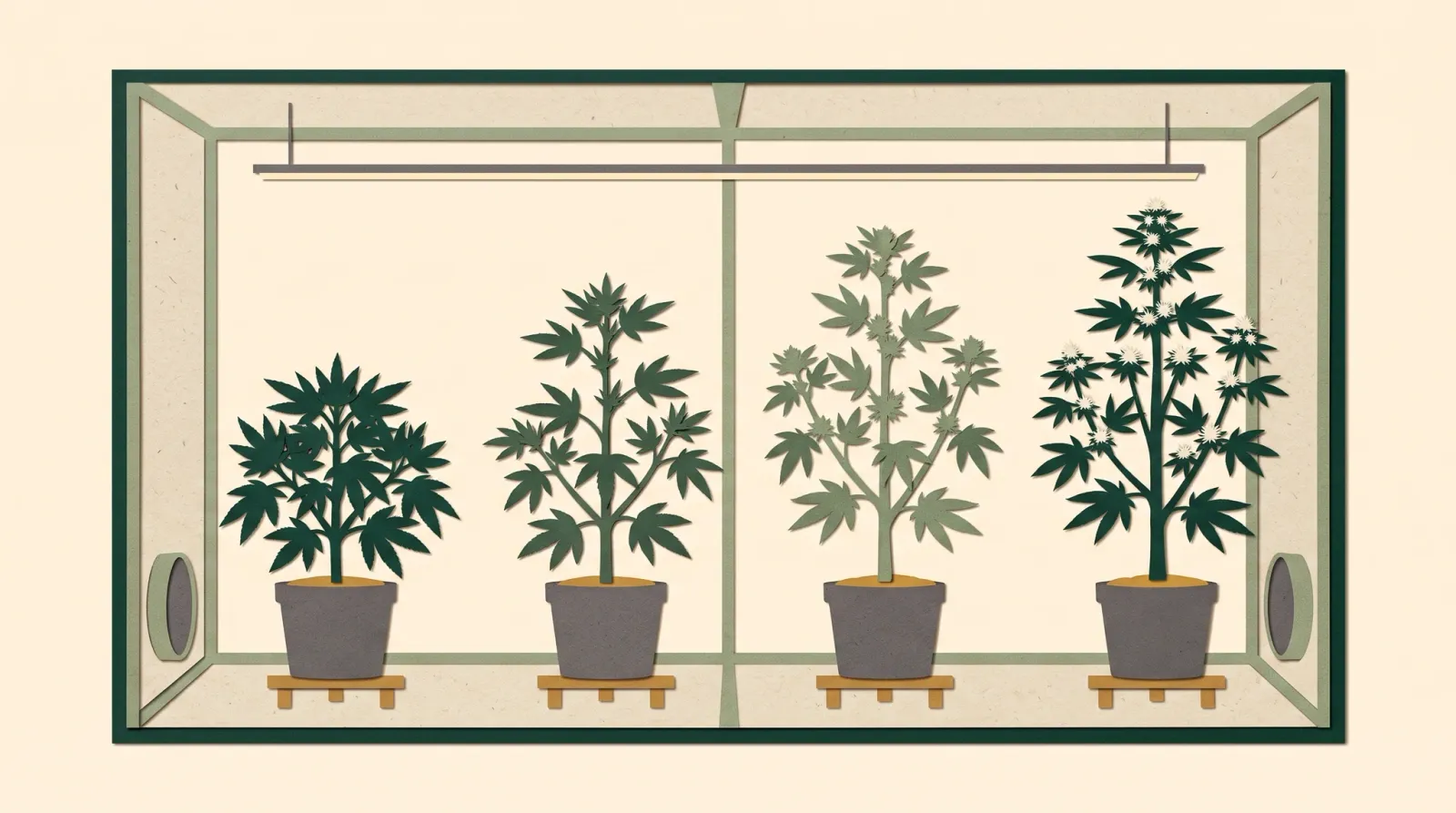
Most cannabis plants stop gaining height two to four weeks after the switch to 12/12, but no study we found backs the popular “double for indica, triple for sativa” rule. So the honest answer to “how much will it stretch?” is: measure your own plant in the first two weeks, and plan tent height with arithmetic, not a strain label.
Here is the number worth sending to the friend who swears every sativa triples. In a trial of 121 medical cannabis genotypes, the average height growth rate fell 64% after the switch to short days, and most plants stopped growing taller at about week 3. The same team found that strain-group names did not predict plant shape. Naim-Feil et al., BMC Plant Biology, 2021
That 64% is a drop in how fast plants grew, not how much they stretched. It is not a multiplier, and no other study reviewed here gives one either.
What happens to a cannabis plant after the 12/12 flip?
In the studies that measured it, plants put on a short burst of height after the flip, then stopped. The best timing data come from a 2024 study of one medical cultivar grown from cuttings. Under 12/12, the plants grew faster than plants kept on long days for the first 14 days. After that, their height “stabilized,” while the long-day plants kept growing and were taller by day 30. Alter et al., Horticulture Research, 2024
The same study pinned down the busiest window. The main stem and its internodes, the stretches of stem between leaf nodes, lengthened fastest from day 5 to day 10 of short days. Flower clusters were visible by day 7. Internodes that formed after that point stopped lengthening.
The plant also needed at least three short days before it registered the change. So nothing much happens on day one, and the real action is in week two.
The 121-genotype trial gives the wider view. Before the switch, height growth ran 11 to 21 cm per week across genotypes. After it, 2 to 11 cm per week. Slowing began within two weeks of the switch. Most genotypes stopped gaining height at about three weeks, with individual genotypes stopping at two, three or four weeks. Naim-Feil et al., 2021
If you want the full stage-by-stage picture, our guide to the 12/12 flip and the flowering stages walks through it.
Why do cannabis plants stretch when they start flowering?
The best-supported mechanism involves gibberellin, a plant hormone that drives stem lengthening. In the 2024 study, gibberellin levels fell under short days. When the researchers applied extra gibberellin (GA3) to short-day plants, the stems and internodes grew longer. When they moved plants back to long days, the stems started lengthening again. Alter et al., 2024
In plain words: day length sets hormone levels, and hormone levels set how much the stem lengthens. That is mechanism from one cultivar, not a rule for every plant, but it explains one grower headache. If the long nights stop, for example after a timer fault, the plant can resume vertical growth. That restart is a different thing from the normal early-flower stretch.
Does cannabis really double or triple in height in flower?
Nobody has shown that it does. Grow guides and forum threads mostly say plants “double,” and many say sativa-leaning plants “triple.” None of the seven studies we reviewed reports a harvest-height to flip-height ratio in its text. Doubling may be a fair rough guess for some plants, but it is grower lore, not a measured figure.
The evidence that does exist disagrees on whether a distinct stretch exists at all:
| Study | What the plants did after the switch | Main limitation |
|---|---|---|
| Alter et al., 2024 | Grew faster than long-day plants for 14 days, then stopped | One cultivar, cuttings |
| Naim-Feil et al., 2021 | Growth rate fell 64% on average; most stopped by about week 3 | One facility, one lamp type |
| Danziger and Bernstein, 2021 | No distinct stretch; growth simply continued at the pre-flip rate | One high-CBD cultivar, greenhouse |
The third study is the surprise. Its authors write that they saw “a continuation of the pre-short-day growth rate,” and that their results “debunk the concept of an endogenous ‘stretching period.’” They suggest the folk idea may come from growers who switch from metal halide to high-pressure sodium lamps at the flip, since sodium light is low in blue and rich in far-red, and both promote stem lengthening. They did not test that idea. It is a hypothesis. Danziger and Bernstein, Plants, 2021
The fair reading of all three: growth ends within weeks of the switch in the two trials that measured timing. Whether there is a burst on top of normal growth depends on the plant and the light.
Do indicas stretch less than sativas?
The labels do not predict it. In the 121-genotype trial, the researchers found “no physiological association across genotypes attributed to the same vernacular classification.” Plants grouped under the same strain-type name did not cluster together on traits like height and growth pattern. The authors called the names “inconsistent for validating morphological characteristics.” Naim-Feil et al., 2021
Strains do differ, a lot. In a German greenhouse trial, three strains grown side by side reached estimated maximum heights of 136 cm, 95 cm and 66 cm, roughly a twofold spread. Reichel et al., Plants, 2021 Those are whole-cycle heights from three strains, not stretch figures and not strain types. The point is that genetics matter, but the indica or sativa sticker is a poor proxy for those genetics. This is the same problem covered in why indica and sativa labels do not predict effects, applied to plant shape.
Autoflowers are a separate case. They do not wait for a light change, so there is no flip to plan around. See autoflowers vs photoperiod plants for how their height planning differs.
What makes a plant stretch more or less after the flip?
Light spectrum has the strongest evidence. In the German trial, the same three strains grew to an estimated 114 cm under a ceramic metal halide lamp and 88 cm under one LED lamp, a 30% gap from light alone. Every strain responded the same way. The authors linked the extra height to the lamp with the lowest red to far-red ratio, a classic shade-avoidance signal. Reichel et al., 2021
A second trial found the same direction: plants under high-pressure sodium were taller than plants under two LED fixtures. Magagnini et al., Medical Cannabis and Cannabinoids, 2018 Both studies include a co-author who works for an LED maker. Neither shows that a lamp “causes” stretch. They show that the lamp you grow under moves final height. Our LED grow lights guide covers fixture choice.
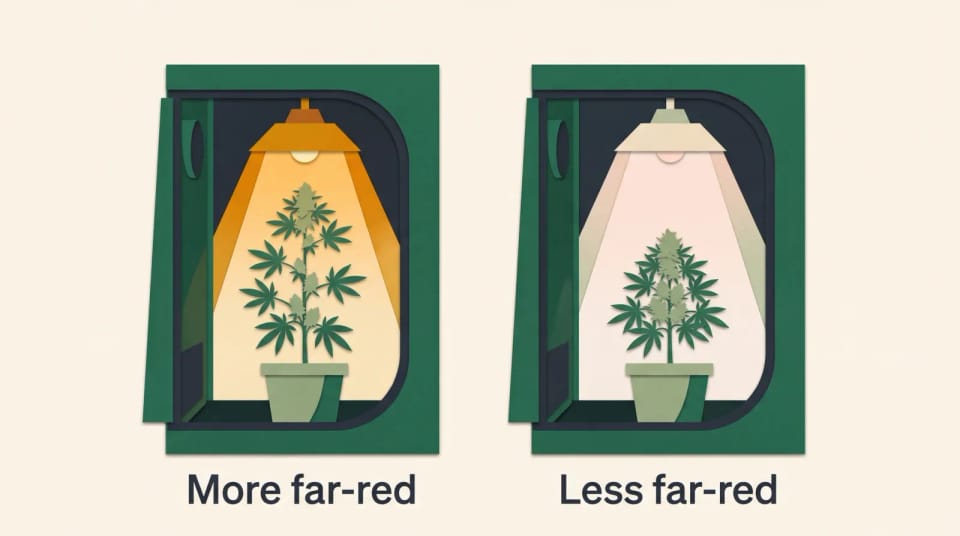
In one trial, the same three strains finished about 30% taller under the lamp with the lowest red to far-red ratio. Spectrum moved final height; it did not decide whether plants flowered. The drawing is an illustration, not measured data.
Day length can matter if the nights shrink. In a hemp study, nine of 15 essential-oil cultivars grew 47% to 102% more under 14-hour days than under 12-hour days, while the other six were unaffected. Zhang et al., Frontiers in Plant Science, 2021 That is hemp, and longer days also delayed flowering, so it is not a drug-type stretch result. It does suggest that a weak dark period gives some plants more time to grow tall.
Pruning delays height but does not cap it. In the greenhouse study, plants pruned once caught up to the height of unpruned plants about seven days after the switch. Danziger and Bernstein, 2021 No trial we found tested low-stress training against stretch. Training changes where the height goes. Our guides to topping, LST and SCROG and topping vs FIMming cover the techniques.
Shrinking plants usually costs flower. A small 2025 study raised nutrient-solution salinity and cut height by 15% in two cultivars, but flower yield fell about 20% in some treatments. Its authors: “It is difficult to reduce plant size without reducing yield.” Allred et al., Journal of Cannabis Research, 2025
And taller does not reliably mean more bud. The German trial’s tallest strain gave the lowest yield, and its authors “cannot confirm the theory of higher productivity of tall plants.” Reichel et al., 2021 The 121-genotype trial, by contrast, found harvest-day height correlated with bud weight across genotypes. Both results stand.
How do I plan tent height before I flip to 12/12?
Work backward from the ceiling. The plan below is arithmetic, not a finding about plants. The one number that has to come from you is the stretch fraction, which you get from your own past runs.
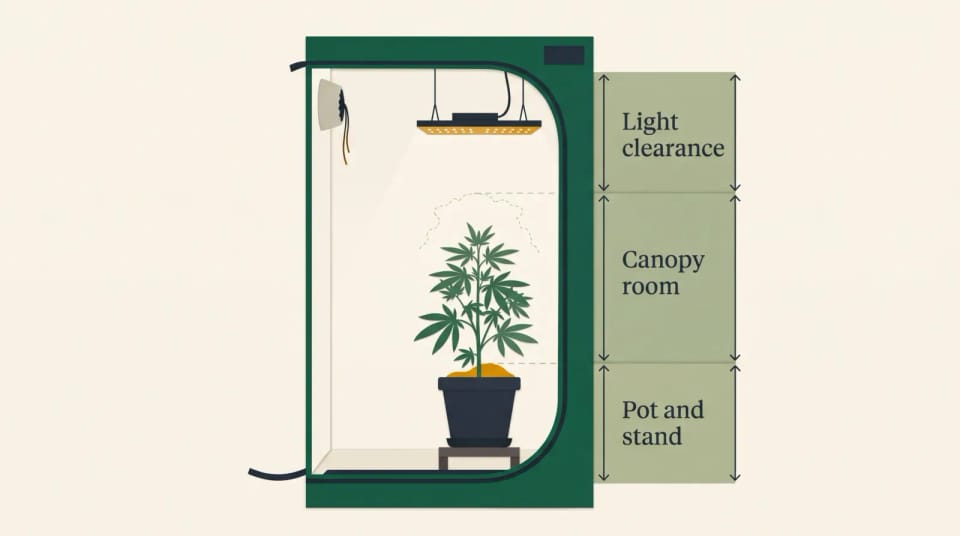
The tent budget: canopy room is what is left after the pot, the stand and the fixture’s minimum distance. Your past stretch tells you how much of that room to leave empty at the flip. Band sizes are not to scale.
- Measure the canopy room. Measure from the tent floor to the bottom of the light at its highest hanging point. Subtract the pot and stand height. Then subtract the minimum light-to-canopy distance from your fixture’s manual. That clearance number belongs to the fixture, not to any study. Our grow tent setup guide covers hanging hardware and ceiling height.
- Pick your stretch fraction. Use the height gain you recorded on past runs of the same plant. A plant that went from 50 cm to 100 cm gained 100%, a fraction of 1.0. With no record, write down a cautious placeholder and treat it as a guess you will correct.
- Divide to find your maximum flip height. Max flip height = canopy room ÷ (1 + stretch fraction). Flip at or below that height.
- Measure again at day 7 and day 14. Measure from the soil line to the top. The fastest stem growth in the 2024 study came from day 5 to day 10, and the 121-genotype trial saw slowing within two weeks, so these two checks catch most of the move while you can still react. Alter et al., 2024
- Adjust before the room runs out. If the gain is outrunning the headroom, bend tall tops sideways with low-stress training, raise the light within the range the manual allows, and write down the result. Next run, your stretch fraction is a measurement instead of a guess.
A worked example, for illustration only. Say your tent gives 200 cm to the bottom of the light, the pot and stand take 25 cm, and the manual asks for 30 cm of clearance. That leaves 145 cm of canopy room. If your plant gained 100% last time, flip at or under 72 cm (145 ÷ 2). If it gained 150%, flip at or under 58 cm (145 ÷ 2.5). Swap in your own numbers; these are not typical values.
If you use a screen, the same logic sets your fill target. Our screen of green guide explains when to flip relative to screen fill. For the tightest spaces, see micro-growing in small spaces.
Why is my plant not stretching after the flip?
A plant that barely grows taller after the flip is not necessarily in trouble. One of the three studies above saw no distinct stretch at all, only steady growth. Danziger and Bernstein, 2021 Genetics and a light spectrum with little far-red can both mean a small height gain. Check that the dark period is truly dark and the timer works. Then watch for flower clusters, which appeared by day 7 in the 2024 study. Flowers forming on schedule mean the flip worked.
Key takeaways
- Most plants stop gaining height two to four weeks after the 12/12 switch; the fastest stem growth in one study ran from day 5 to day 10.
- The “double or triple” rule is grower lore. No study we reviewed reports a stretch multiplier.
- Indica and sativa labels did not predict plant shape across 121 genotypes. Strains still differ a lot.
- Lamp spectrum moved final height by 30% in one trial. Pruning delays height by about a week; it does not cap it.
- Plan tent height with arithmetic: canopy room ÷ (1 + your measured stretch fraction), then check at day 7 and day 14.
FAQ
How long does the stretch last in flower?
In the two studies that measured timing, height gain ended within a few weeks. One cultivar outgrew long-day plants for 14 days and then stabilized. Across 121 genotypes, most stopped by about week 3, with a range of two to four weeks.
How much taller will my plant get after I switch to 12/12?
No study gives a reliable multiplier, so the best predictor is your own record for the same plant. Grow guides commonly say “double,” but that is lore, not a measurement. Measure at day 7 and day 14 after the flip to see where your plant is heading.
When should I flip to 12/12 if my tent is short?
Flip earlier, at a height you calculate from your canopy room. Divide the room left after the pot, stand and light clearance by one plus your expected stretch fraction. Training and a screen can then spread the canopy sideways instead of up.
Is it normal for a flowering plant to look thin and stretchy?
Some lengthening of the stem early in flower is normal, especially between days 5 and 10. Light with a lot of far-red produced taller plants in two trials. If a plant keeps stretching well past week 4, check that the dark period is fully dark and the timer works.
Does the light schedule affect how much a plant stretches?
It can. In a hemp study, some cultivars grew 47% to 102% more under 14-hour days than 12-hour days, and others did not change. That was hemp, not drug-type flower, but it is a good reason to keep the dark period long and truly dark.
Sources
- Naim-Feil E, Pembleton LW, Spooner LE, et al. The characterization of key physiological traits of medicinal cannabis (Cannabis sativa L.) as a tool for precision breeding. BMC Plant Biology, 2021. doi:10.1186/s12870-021-03079-2
- Alter H, Sade Y, Sood A, et al. Inflorescence development in female cannabis plants is mediated by photoperiod and gibberellin. Horticulture Research, 2024. doi:10.1093/hr/uhae245
- Danziger N, Bernstein N. Shape Matters: Plant Architecture Affects Chemical Uniformity in Large-Size Medical Cannabis Plants. Plants, 2021. doi:10.3390/plants10091834
- Reichel P, Munz S, Hartung J, et al. Impact of Three Different Light Spectra on the Yield, Morphology and Growth Trajectory of Three Different Cannabis sativa L. Strains. Plants, 2021. doi:10.3390/plants10091866
- Magagnini G, Grassi G, Kotiranta S. The Effect of Light Spectrum on the Morphology and Cannabinoid Content of Cannabis sativa L. Medical Cannabis and Cannabinoids, 2018. doi:10.1159/000489030
- Zhang M, Anderson S, Brym Z, Pearson B. Photoperiodic Flowering Response of Essential Oil, Grain, and Fiber Hemp (Cannabis sativa L.) Cultivars. Frontiers in Plant Science, 2021. doi:10.3389/fpls.2021.694153
- Allred J, Fatzinger B, Bugbee B. Crop steering through osmotic stress can reduce height but reduced yield in medical Cannabis. Journal of Cannabis Research, 2025. doi:10.1186/s42238-025-00351-2



