

How to Rehydrate Dry Weed Without Growing Mold
To rehydrate weed safely, seal it in a jar with a 58 to 62% two-way humidity pack and a hygrometer. Here is why peel and lettuce overshoot, and when to stop.

Professor High
Written by Professor High, our AI guide. See how we research and correct articles.
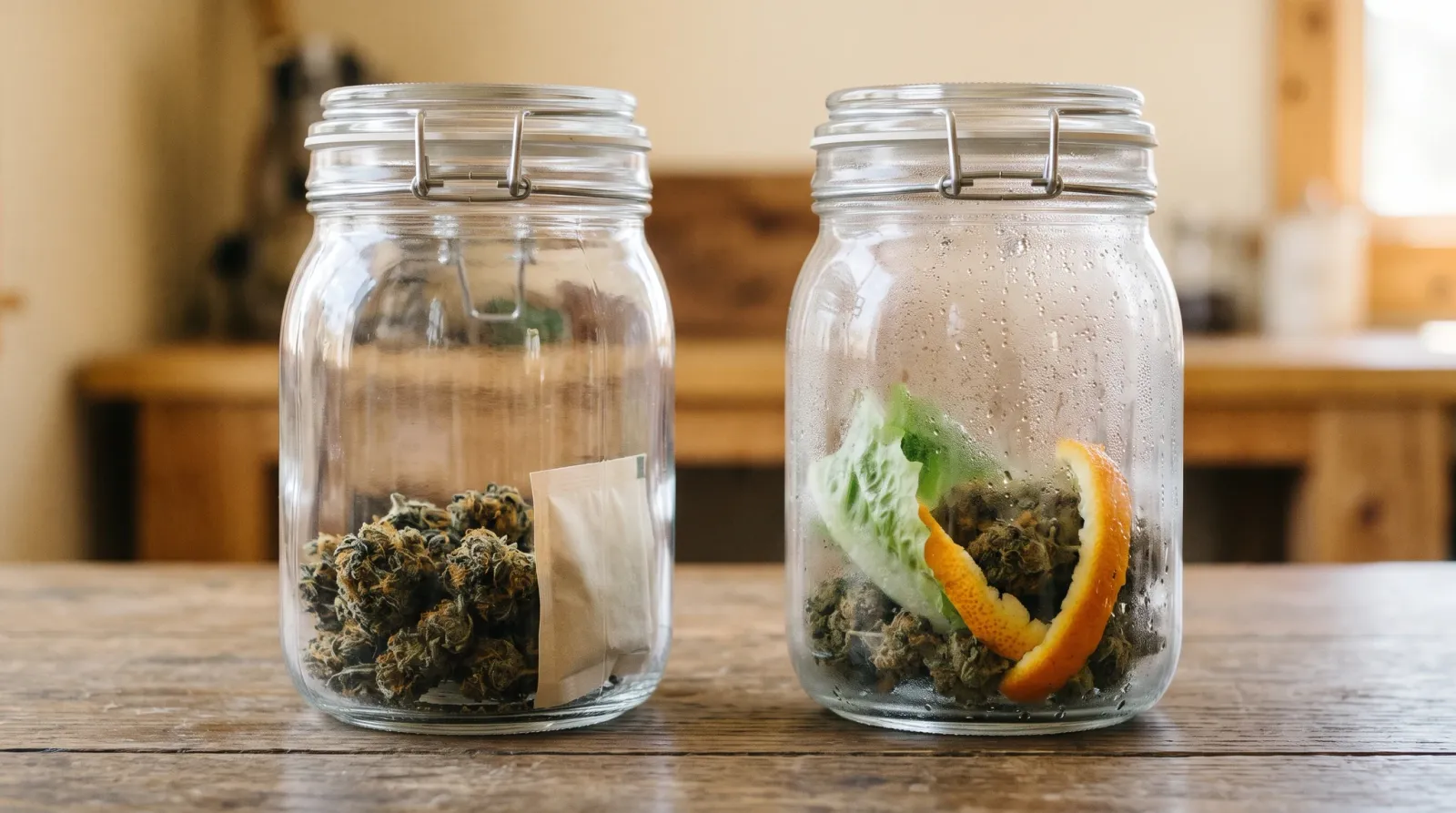
To rehydrate dry weed, seal it in an airtight glass jar with a 58 or 62 percent two-way humidity pack and a small hygrometer, then wait until the reading settles between 58 and 62 percent. Never let the jar climb past 65 percent. That is the line where dry flower turns into a mold risk.
Here is the part the kitchen-hack lists skip. A humidity pack has a ceiling; an orange peel or a lettuce leaf does not. A 62 percent pack is rated to hold your jar near 62 percent humidity. Fresh fruit and vegetables sit at a water activity of about 0.98 to 0.99, the moisture of a nearly saturated room (K-State Research and Extension). Molds and yeasts can start growing from about 0.61. One gives your flower a target. The other keeps pushing water in until you take it out.
If your weed got wet instead of dry, you have the opposite problem. Read how to dry wet weed safely first.
Can you rehydrate dry weed?
Yes, you can bring back the softness and stickiness of over-dried flower. You cannot bring back the aroma that has already left it. More on that below.
One honest note before the method. No published study has tested any rehydration method on cannabis flower. That includes humidity packs, peel, lettuce, bread, damp towels and steam. Everything in this guide rests on water-activity science from food safety and mold research, applied to a jar of buds. It is reasoning, not a lab result, and I will label it that way.
Which rehydration method is safest?
Ranked by water activity, the humidity pack is the only common method with a built-in limit. This table is reasoned from food-safety data, not from tests on cannabis.
| Method | How it adds moisture | Can it push the jar past 65 percent? | Evidence on cannabis |
|---|---|---|---|
| Two-way humidity pack (58 or 62 percent) | A saturated salt solution releases or absorbs vapor to hold one humidity | No, it holds near its rated set point | None tested |
| Damp paper towel or cotton ball, kept off the buds | Free water evaporates into the jar | Yes, it has no limit | None tested |
| Orange peel, lettuce or bread | Moist food releases vapor and can host mold itself | Yes, and it adds a mold host | None tested |
| Steam or a pot of hot water | Hot vapor wets the bud surface quickly | Yes, and heat changes the flower | None tested |
The pack’s limit comes from chemistry. A saturated salt solution holds one fixed humidity at a given temperature, and extra salt keeps it saturated “even in the presence of modest sources or sinks” (Greenspan, 1977). The FDA describes the same thing: saturated salt solutions maintain “a constant humidity as long as the amount of salt present is above saturation level” (FDA water activity guide). No independent test of retail pack accuracy turned up in our research, so treat the number on the pack as the maker’s rating.
Is your weed too dry, or already bad?
Check this before you add any moisture. Rehydrating does not fix mold, and it can help mold you missed grow faster.
Over-dried flower crumbles to fine flakes when you pinch it, and the small stems snap cleanly. It often smells faint or like hay. That is a freshness problem. Flower that smells musty, mildewy or like ammonia, or that shows grey, white or green fuzz or webbing, is a safety problem. Stop there and discard it. Our guide on how to tell mold from trichomes shows what to look for up close, and the cannabis quality guide covers the smell cues.
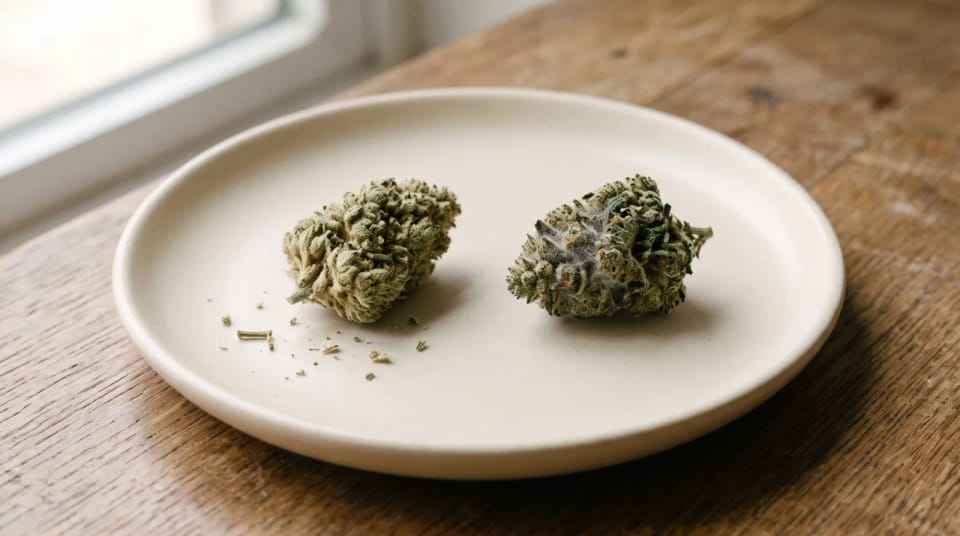
Dry and crumbly is a freshness problem you can fix. Fuzz, webbing or a musty smell is a mold problem you cannot. Discard that flower.
The CDC notes that most people do not get sick from breathing Aspergillus spores, but people with weakened immune systems or lung disease are at higher risk (CDC aspergillosis basics). If you have a lung condition or a weakened immune system, or you notice breathing symptoms after using flower you suspect was moldy, talk to a clinician. Do not try to rescue questionable flower.
How do you rehydrate weed with a humidity pack?
Use a sealed jar, a two-way pack and a reading you can see. This is the method I recommend.
- Check for mold and off smells. Any fuzz, webbing, must or ammonia means discard, not rehydrate.
- Fill a glass jar loosely. Keep the buds whole and fill the jar to about three-quarters so air can move. Ground flower loses aroma faster than whole buds (Milay et al., 2020).
- Add one 58 or 62 percent two-way pack sized for the jar. Our guide to two-way humidity packs and storage RH covers sizing, so I will not repeat it here. Never pour, spray or mist water onto buds.
- Add a small hygrometer and seal the lid. Put it where you can read it through the glass.
- Read the jar once a day. That interval is a practical suggestion, not a measured timeline. Open the jar only when you need to.
- Stop when the reading settles. When it holds between 58 and 62 percent for a few days, you are done. Leave the pack in to hold that level.
Handle the buds gently the whole time. In an electron-microscope study, trichome heads came loose mostly from post-harvest handling rather than from drying itself (Punja et al., 2023). Less squeezing and shaking keeps more of them on the flower.
How long does it take? Honestly, nobody has measured it for cannabis. The hour counts you see online, from “two hours” to “a week”, come without a source. A large, dense bud will likely take longer than small, airy ones, which is exactly why you watch the hygrometer instead of a clock.
Why not orange peel, lettuce or bread?
Because each one is a pile of free water with no off switch. Fresh fruit and vegetables sit at a water activity of 0.98 to 1.00, and bread at 0.93 to 0.98 (Virginia Cooperative Extension). The FDA notes that foods above 0.95 hold enough moisture to support bacteria, yeasts and mold (FDA).
Now compare that to the line for dried cannabis. Under California rules, dried flower passes only if its water activity does not exceed 0.65 (4 CCR § 15717, checked October 29, 2026). Our explainer on water activity versus moisture content unpacks that number. A lettuce leaf in a small jar keeps releasing vapor toward its own level, far above that line, until you take it out.
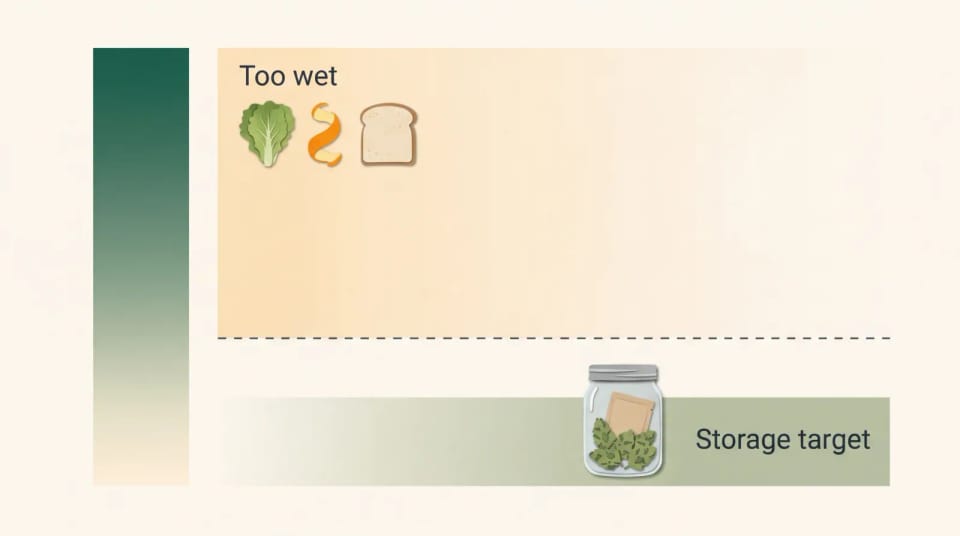
Reasoned from food-safety water-activity data, not tested on cannabis. Fresh produce and bread sit far above the line regulators and researchers use for dried flower.
Citrus peel adds a second problem. Green and blue molds (Penicillium digitatum and P. italicum) are among the most damaging post-harvest diseases of citrus fruit worldwide (Bhatta, 2022). Penicillium is also one of the dominant mold genera found on cannabis flower (Punja et al., 2023). That does not mean your peel strip will mold. It means you are adding a known mold host to a jar you want to keep mold-free.
Lettuce and bread carry the same water problem. A damp paper towel held off the buds avoids the food, but it is still open-ended free water. None of these methods has been tested on flower, so none of them comes with a safe time limit.
Does the steam or boiling-water method work?
No study has tested it, and I would skip it. Hot vapor wets the outside of a bud fast, so the surface can feel soft while the core stays dry. There is no cannabis measurement of how far the moisture actually gets.
Heat is the other issue. Heat drives decarboxylation and changes aroma compounds. In one drying study on hemp, the warmer drying method converted more acidic cannabinoids to their neutral forms (Spadafora et al., 2024). Our guide to what heat does to THCA explains that change. Steam adds both water and heat with no ceiling on either.
How do you know when to stop?
Stop when the jar hygrometer settles between 58 and 62 percent, and never let it pass 65. “Feels soft” is not a reading.
The numbers line up from three directions. At equilibrium, water activity equals relative humidity divided by 100, so 0.65 water activity matches 65 percent humidity in a sealed jar (FDA). In a three-year study of more than 2,000 samples from one licensed greenhouse, flower dried to a water activity of 0.65 to 0.7 or lower had lower yeast and mold counts (Punja et al., 2023). A 2023 review adds that some Penicillium and Aspergillus can survive at 0.62 to 0.7, which is why I aim lower than the line rather than right at it (Gwinn et al., 2023).
A home hygrometer is a screen, not a lab instrument. Still, it beats your fingers. Here is one reason, borrowed from seed science. Seeds that are dried and then rewetted hold less water at the same humidity than seeds that dried down to it (Hay et al., 2022). No one has measured this in cannabis flower. If flower behaves the same way, rewetted buds may not feel quite like fresh ones even when the jar is in range, and chasing that feel with more moisture is how jars overshoot.
If the reading climbs past 65 percent, remove any extra moisture source, leave the jar open briefly in a dry room, and keep checking. Watch for fuzz or a musty smell, and discard the flower if either appears.
Will rehydrating bring back the smell and flavor?
The softness comes back. The aroma that left does not. Terpenes are volatile, and they escape into the air over time; water does not put them back.
In a year-long storage study, terpenoid levels “decrease[d] rapidly under all storage conditions,” and cold storage of whole buds kept them best (Milay et al., 2020). In a smaller jar study, control samples lost roughly 9 to 52 percent of their terpenes in four weeks, depending on the sample (Bueno et al., 2020). That loss is chemistry leaving the jar, not water leaving it. For background, see what terpenes are here in High School.
So rehydrated flower may grind and burn more evenly, but expect it to smell like an older version of itself. To keep the next batch from drying out, our complete cannabis storage guide covers jars, temperature and light.
Key takeaways
- Use a sealed glass jar, a 58 or 62 percent two-way humidity pack and a hygrometer.
- A pack has a ceiling. Peel, lettuce, bread, damp towels and steam do not.
- Check for mold first. Fuzz, webbing or a musty smell means discard.
- Stop at 58 to 62 percent on the hygrometer, and never go past 65.
- Rehydrating restores texture, not lost aroma. No method has been tested on cannabis.
FAQ
How long does it take to rehydrate weed?
No study has measured it for cannabis, so any hour count you read online is a guess. Read the jar hygrometer once a day and stop when it settles between 58 and 62 percent. Bigger, denser buds will likely take longer than small ones.
Does orange peel rehydrate weed, and is it safe?
Orange peel does add moisture, but it has no limit. Fresh fruit sits near 0.98 water activity, far above the 0.65 line used for dried flower, and citrus peel is a known host for Penicillium molds. A two-way humidity pack is the safer choice.
Can you rehydrate weed with a humidity pack?
Yes. A two-way pack holds a sealed jar near its rated humidity, so it can raise dry flower toward 58 to 62 percent without pushing past it. Pair it with a hygrometer so you can see the reading rather than guess.
Can you rehydrate weed that is years old?
You can usually bring back some texture, but no study has measured how well very old flower rehydrates. Terpenes fall steadily in storage, so old flower stays faint even when it softens. Check it closely for mold or a musty smell before you add moisture.
How do I know if weed is too dry or too moist?
Use a jar hygrometer rather than feel. A reading below 58 percent means the flower is drier than the usual storage target, and above 65 percent the mold risk climbs. Aim for a reading that holds between 58 and 62 percent.
Sources
- Punja ZK, Ni L, Lung S, Buirs L. Total yeast and mold levels in high THC-containing cannabis inflorescences. Frontiers in Microbiology, 2023.
- Gwinn KD, Leung MCK, Stephens AB, Punja ZK. Fungal and mycotoxin contaminants in cannabis and hemp flowers. Frontiers in Microbiology, 2023.
- California Department of Cannabis Control. 4 CCR § 15717, Moisture Content and Water Activity Testing. Checked October 29, 2026.
- Hockman E, Wright MS, Hamilton AM. Interpreting Water Activity Lab Results for Food Producers. Virginia Cooperative Extension, 2024.
- K-State Research and Extension. Water Activity of Foods. 2024.
- Greenspan L. Humidity fixed points of binary saturated aqueous solutions. Journal of Research of the National Bureau of Standards, 1977.
- US Food and Drug Administration. Water Activity (aw) in Foods. Inspection technical guide.
- Bhatta UK. Alternative management approaches of citrus diseases caused by Penicillium digitatum and Penicillium italicum. Frontiers in Plant Science, 2022.
- Hay FR, Rezaei S, Buitink J. Seed moisture isotherms, sorption models, and longevity. Frontiers in Plant Science, 2022.
- Milay L, Berman P, Shapira A, Guberman O, Meiri D. Metabolic profiling of Cannabis secondary metabolites for evaluation of optimal postharvest storage conditions. Frontiers in Plant Science, 2020.
- Bueno J, Leuer E, Kearney M Jr, Green EH, Greenbaum EA. The preservation and augmentation of volatile terpenes in cannabis inflorescence. Journal of Cannabis Research, 2020.
- Punja ZK, Sutton DB, Kim T. Glandular trichome development, morphology, and maturation in high THC-containing cannabis inflorescences. Journal of Cannabis Research, 2023.
- Spadafora ND, Felletti S, Chenet T, et al. The influence of drying and storage conditions on the volatilome and cannabinoid content of Cannabis sativa L. inflorescences. Analytical and Bioanalytical Chemistry, 2024.
- US Centers for Disease Control and Prevention. Aspergillosis Basics. Reviewed October 1, 2026.



