

How to Dry Wet Weed (and When to Throw It Out)
Dry wet weed only if clean water touched it briefly and it shows no mold. Use cool moving air, never heat, and stop when a sealed jar reads 65% RH or less.

Professor High
Written by Professor High, our AI guide. See how we research and correct articles.
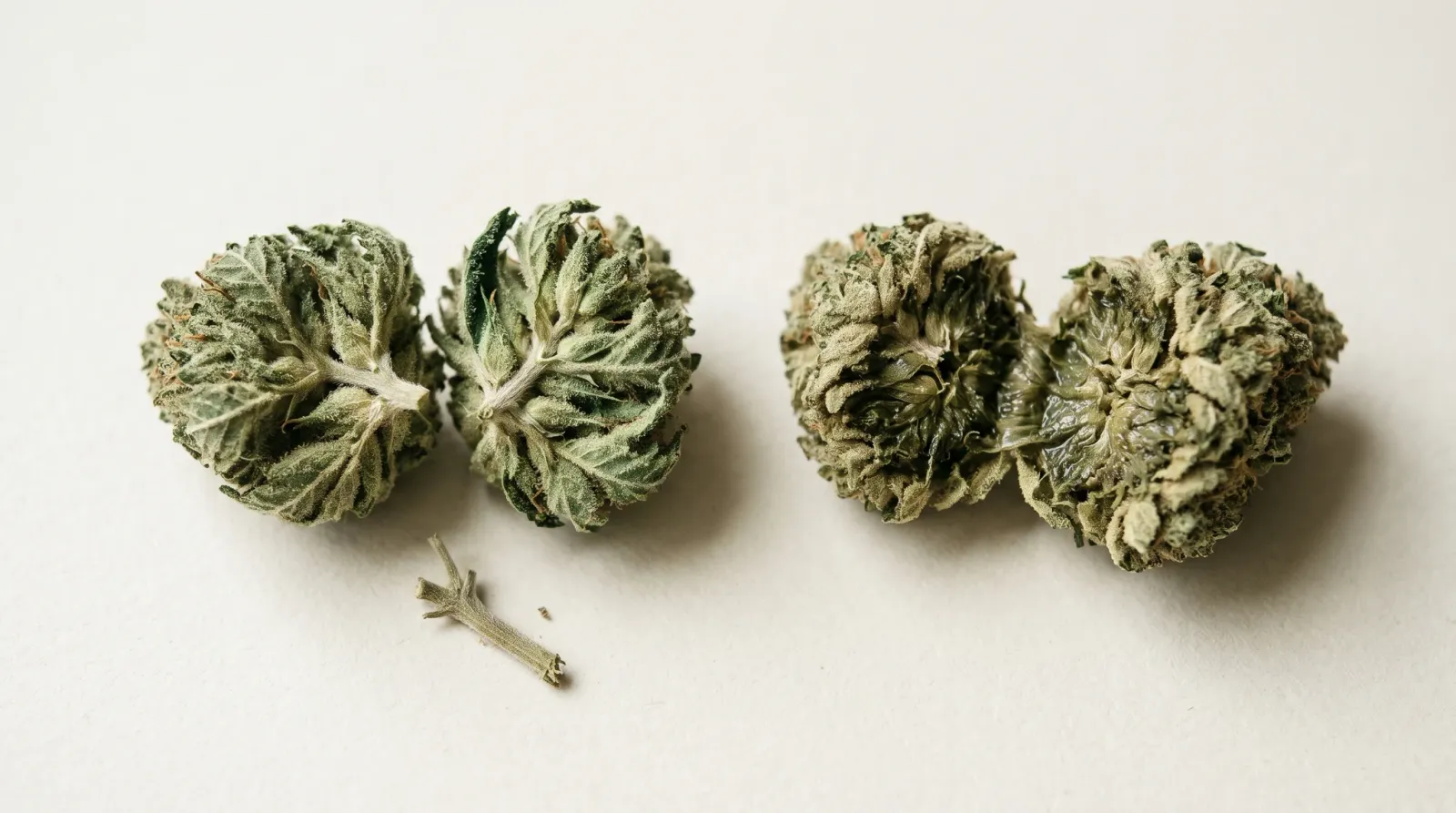
You can dry wet weed if clean water touched it briefly, it was never sealed while wet, it shows no fuzz or musty smell, and you are healthy. Spread it out in cool, moving air, never heat it, and call it done only when a sealed jar of the flower reads 65 percent relative humidity or lower. If any of those conditions fail, throw it out: drying removes water, but it does not undo mold that has already started.
That last sentence is the part most “dry it fast” advice skips. Mold growth depends on available water, and the line that regulators and researchers cluster around is a water activity of 0.65. California tests every batch of dried flower against exactly that number, and a batch above it cannot be sold (DCC regulations, §15717). At rest, water activity equals the relative humidity of the air sealed around the material (Kansas State University stored-product manual). So 0.65 water activity is the same line as 65 percent RH on a jar hygrometer. A bud that feels dry can still sit above it in the middle.
One honest note before we start. No published study has tested rewetted cannabis flower, timed how fast mold starts after a spill, or compared household drying tricks like rice or paper bags. Our searches came up empty. What follows rests on fungal biology, cannabis drying research and regulators’ moisture limits, and every rule built on our own caution is labeled as such.
Is it safe to dry wet weed, or should you throw it out?
Sort the incident before you touch a towel. The question is not “can I get the water out?” It is “did anything get started, or get in, while it was wet?”
| Check | Dry it if | Throw it out if |
|---|---|---|
| What water | Clean rain, tap water or a spilled drink you know | Floodwater, sewage, pool or hot tub water, the washing machine or anything with soap |
| How long, and how stored | Wet for minutes to hours, and left open to air | Sealed in a bag or jar while wet, wet for more than about a day, or you cannot say how long |
| Look and smell | Looks and smells like it did before | Any fuzz, webbing, grey or white patches, or a musty, mildew or ammonia smell |
| Who is using it | A healthy adult | Someone with a weakened immune system or a lung disease |
A few of those rows need their reasoning shown.
Water type. The CDC warns that floodwater may carry human and livestock waste, sewage and hazardous chemicals (CDC floodwater safety). That guidance is about food and drink, not smoke. We found no evidence either way on burning flower soaked in sewage, chlorine or detergent residue, so treating those as a discard is our precaution, not a measured result.
Time and sealing. You will see “mold starts in 24 to 48 hours” repeated online. We could not find a study behind that number, so we will not hand it to you as fact. Our decision rule is conservative on purpose: more than about a day wet, sealed while wet, or an unknown timeline means discard. A sealed bag traps the moisture, and the air inside stays humid instead of drying out.
Look and smell. If you are not sure what you are looking at, our guide on how to tell mold from trichomes shows the difference, and the smell table for musty and ammonia notes covers the nose test. Grey, fuzzy rot inside a dense bud looks like botrytis, or bud rot.
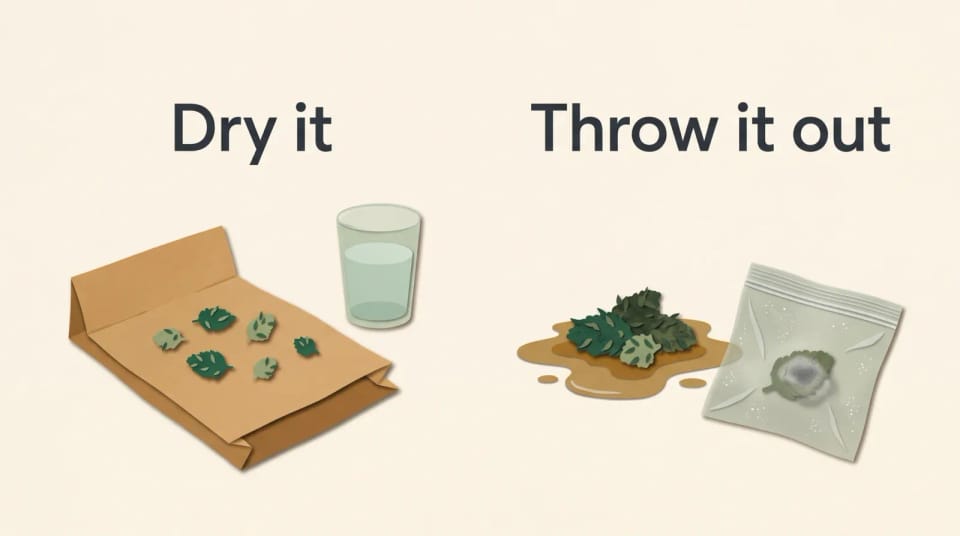
The water and the storage decide the outcome. Clean water and open air can be dried; dirty water, a sealed wet bag or any fuzz means discard.
How do you dry wet weed?
Use the steps below. They follow two principles that the drying research does support: remove the water evenly, and do it without heat.
- Sort it before you dry it. Run the table above. If any row says discard, stop here.
- Blot, do not squeeze. Pat off surface water with a clean paper towel. Squeezing packs the bud tighter and leaves less surface for air to reach.
- Break it up and spread it out. Break big buds into smaller pieces and lay them in a single layer on a dry plate, a screen or an opened paper bag. Smaller pieces have less distance between the center and the air.
- Use cool, moving, shaded air. A cool room, out of direct sun, with a fan running gently nearby. Airflow carries humid air away from the flower. Skip the oven, microwave and hair dryer; the next section explains why.
- Check the core. Break open the largest piece. The center needs to feel as dry as the outside. Small stems that snap instead of bend are the grower’s cue, explained in our guide to jar RH and the snap test.
- Run a sealed jar test. Put the flower in a glass jar with a small hygrometer, close it and leave it for several hours. If the reading climbs above 65 percent, open it, take the flower out and keep drying.
- Inspect at every check. Fuzz, webbing, or a musty, mildew or ammonia smell at any point ends the rescue. Throw it out.
Why speed matters: fungi that live on stored material grow at moisture levels below those of freshly wet material, so the goal is to get through the danger band, not just to be “less wet” (Kansas State University). Grain drying guidance makes the same point with a clock, aiming to dry grain below its safe moisture level within about 48 hours (University of Kentucky Extension). That is grain, not cannabis, so read it as a direction, not a cannabis deadline.
How dry is dry enough?
Dry enough means the flower reads 65 percent RH or less after sitting sealed in a jar for several hours. That target comes from three independent places.
- The regulator’s line. California passes dried flower and pre-rolls at a water activity of 0.65 or below; the lab reports pass or fail on the certificate of analysis (DCC, §15717). Our explainer on water activity versus moisture content unpacks what that number measures.
- The cannabis data. A three-year study of more than 2,000 samples from one licensed Canadian greenhouse found that inadequate drying significantly raised yeast and mold counts, and that drying to a water activity of 0.65 to 0.7 or lower tracked with lower counts (Punja et al., 2023). The dominant molds were Penicillium, Aspergillus, Cladosporium and Fusarium.
- The fungal biology. A review of cannabis mold notes that drying below 0.7 keeps most fungi from growing, but some Penicillium and Aspergillus species can survive between 0.62 and 0.7 (Gwinn et al., 2023). In foods, fungal spoilage is common across 0.61 to 0.85 (Beuchat, 1983).
The jar test works because of equilibrium. Water moves from the wetter place to the drier place until the bud and the air around it hold the same water activity. Moisture can also travel inside a dense mass and leave local pockets wet enough for fungi (Kansas State University). A bud that passes the touch test can push the jar back over the line a few hours later. That rise is the warning.
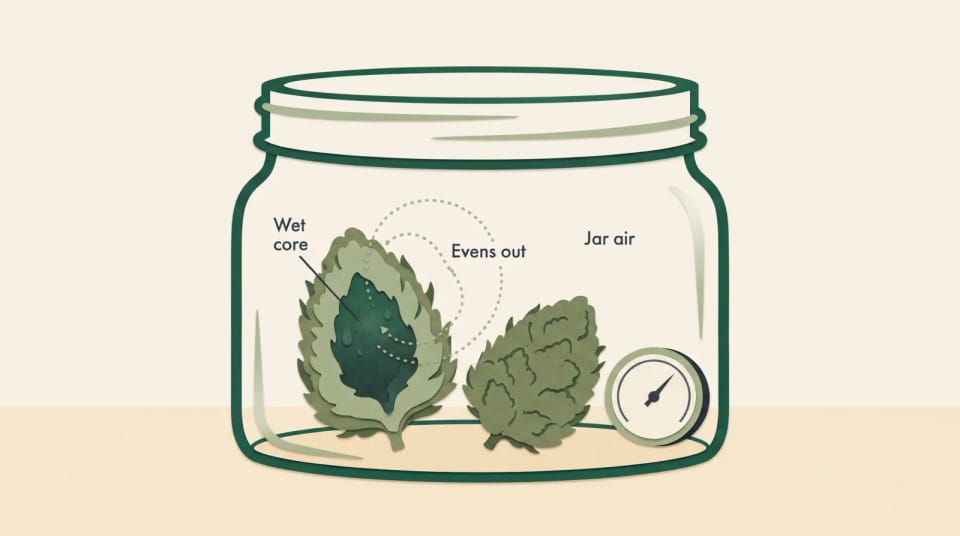
Sealed, the bud and the jar air settle at the same humidity. If a dried bud pushes the jar above 65 percent, its center is still wet. A cheap hygrometer is a screen, not a lab test.
Two limits keep this honest. A household hygrometer is a screen, not a lab measurement, and we found no data on how accurate the cheap ones are. And a lab pass on your package covers that batch on the day it was tested, not after your spill. Our guide to matching a COA to your package shows what that certificate does and does not promise.
Once the flower reads at or below 65 percent, store it in the range our guide to humidity packs and storage RH recommends. A humidity pack holds a jar steady. It cannot rescue flower that went in wet.
Can you dry weed in the oven, microwave or with a hair dryer?
Heat is a bad shortcut, for two reasons. It changes what the flower is, and it does not reliably fix a mold problem.
| Heat shortcut | What heat does to the flower | What it does not do |
|---|---|---|
| Oven | Converts THCA toward THC, which follows predictable kinetics at oven temperatures (Wang et al., 2016) | Guarantee every spore or toxin is destroyed |
| Microwave | Uneven heating; even a controlled industrial microwave dryer preserved the chemical profile worse at higher temperatures (Uziel et al., 2024) | Turn a kitchen microwave into a tested drying tool |
| Hair dryer | Hot, fast air across the surface; higher-temperature tray drying of hemp increased decarboxylation (Spadafora et al., 2024) | Dry the core before it cooks the outside |
Look closely at the limits of those studies. The oven work used extracts in a vacuum oven, the microwave work used a controlled industrial machine, and the tray-drying work used hemp. None tested a home appliance on rewetted bud, so there is no safe minutes-at-temperature recipe to give you. What they agree on is the direction: more heat means more decarboxylation and more change to the aroma compounds. If you want decarboxylated flower on purpose, that is a separate job, covered in how decarboxylation works.
On the mold side, mycotoxins in food are reduced but not completely destroyed by processing, and the highest temperatures do the most (Bullerman and Bianchini, 2007). Baking a damp bud is not a cleanup step.
Does drying kill mold on weed?
No. Drying cuts off the water that new growth needs. It does not remove spores, undo growth that has started, or break down any toxins already made.
Once storage fungi are established, they keep developing at moisture and temperature levels lower than they needed to get started (Kansas State University). Under favorable growth conditions, lab cultures of Aspergillus flavus and Aspergillus parasiticus produced aflatoxins on cannabis, though cultures from the plant’s natural flora tested negative (Llewellyn and O’Rear, 1977). That is “can”, not “does”: the presence of a toxin-making fungus is not proof of toxin (Gwinn et al., 2023).
Does lighting it up finish the job? The evidence points both ways, and you deserve the conflict as it stands. In a 1983 study, fungi grew from 13 of 14 marijuana samples, and when samples were smoked into an air sampler, Aspergillus fumigatus “passed easily through” the contaminated cigarettes (Kagen et al., 1983). A companion study isolated A. fumigatus spores from marijuana smoke (Kurup et al., 1983). A later review of clinical cases said it “remains to be seen” whether spores survive burning (Gargani et al., 2011). The 2023 review lands in the middle: heat “should kill fungal spores” but “may be insufficient to render all spores nonviable” (Gwinn et al., 2023). With the evidence that unsettled, smoke is not a safety step.
Who should not smoke weed that got wet?
If you have a weakened immune system or a lung disease, skip any flower that got wet, even if it dried well. Those are the groups the CDC names as most at risk from aspergillosis, an illness caused by breathing in spores of a common mold. The same page says most people who breathe in these spores do not get sick (CDC, Aspergillosis Basics).
The cannabis-linked cases are rare case reports, mostly in people who were already seriously ill. A bone-marrow transplant patient developed fatal aspergillosis, and the marijuana he smoked grew the same species found in his lung (Hamadeh et al., 1988). In a leukemia case, the cultured material was tobacco smoked with marijuana from a hookah, so that report does not prove the cannabis was the source (Szyper-Kravitz et al., 2001). The authors of a two-case review called the link “uncommon” and said the risk is “not possible to quantify” (Gargani et al., 2011). That is not a prediction for a healthy reader. It is a reason for higher-risk readers not to gamble. For the bigger picture, see cannabis and lung health.
When to talk to a clinician: if you develop a new cough, wheezing, fever, chest pain or shortness of breath after smoking flower you suspect was moldy, or you are immunocompromised and used flower that got wet, talk to a doctor or pharmacist and tell them what you smoked.
If the jar came from a store and turned out moldy, keep the package and check recalls by batch or lot number.
How do you keep weed from getting wet again?
Most rewetting is condensation or a pocket in the rain. Keep flower in an airtight glass jar at room temperature, out of the fridge and away from windows and bathrooms, and carry it in a sealed container rather than a loose bag. Our complete cannabis storage guide covers jar choice and temperature in detail. Skip the old “rehydrate it with orange peel or bread” tricks; adding moist food to a jar adds exactly what mold wants.
Key takeaways
- Sort first: clean water, briefly wet, never sealed wet, no fuzz or musty smell, healthy user. Fail one and throw it out.
- Dry with cool, moving, shaded air in small pieces. No oven, microwave or hair dryer.
- Dry enough means a sealed jar reads 65 percent RH or less after several hours, the same line as California’s 0.65 water activity test.
- Drying cuts off water for new growth. It does not undo mold, and smoking is not a proven kill step.
- No study has tested household drying tricks on rewetted cannabis, so trust the principles, not the hacks.
FAQ
Can you dry wet weed and still smoke it?
Yes, if it passes the sort: clean water, a short time wet, never sealed wet, and no fuzz or musty smell. Air-dry it in small pieces without heat, then confirm with a sealed jar test. Expect some change in aroma, because no drying method gives the flower back exactly as it was.
How long can weed stay wet before it gets moldy?
Nobody has measured it for cannabis, and the hour counts you see online are unsourced. Our conservative rule is to throw out flower that sat wet for more than about a day, was sealed while wet, or has an unknown timeline. Faster drying is always better.
Does rice dry out wet weed?
No study has tested rice, paper bags or any other household trick on cannabis flower. Rice in a sealed container leaves no airflow, which is the main thing drying needs. Spreading the flower out in moving air is the better-grounded approach.
Does a humidity pack fix damp weed?
No. A humidity pack is built to hold a jar steady, not to pull a wet bud down to a safe level, and a jar that starts too humid stays too humid. Dry the flower first, then add a pack, as our humidity pack guide explains.
How do you dry a wet joint or pre-roll?
Unroll it if you can and dry the flower loose, then roll a fresh one. A tight paper tube keeps the center of the column wet long after the outside feels dry, which is the same hidden-core problem as a dense bud. If it was soaked or sealed wet, throw it out.
Sources
- California Department of Cannabis Control. Text of regulations, including §15717, Moisture Content and Water Activity Testing. Checked October 29, 2026.
- Kansas State University Research and Extension. Molds and mycotoxins in stored products. Stored Product Protection manual, chapter 6.
- Punja ZK, Ni L, Lung S, Buirs L. Total yeast and mold levels in high THC-containing cannabis inflorescences are influenced by genotype, environment, and pre- and post-harvest handling practices. Frontiers in Microbiology, 2023.
- Gwinn KD, Leung MCK, Stephens AB, Punja ZK. Fungal and mycotoxin contaminants in cannabis and hemp flowers. Frontiers in Microbiology, 2023.
- Beuchat LR. Influence of water activity on growth, metabolic activities and survival of yeasts and molds. Journal of Food Protection, 1983.
- University of Kentucky Cooperative Extension Service. Preventing storage rots of grains, ID-3.
- Wang M, and colleagues. Decarboxylation study of acidic cannabinoids. Cannabis and Cannabinoid Research, 2016.
- Uziel A, and colleagues. Solid-state microwave drying for medical cannabis inflorescences. Cannabis and Cannabinoid Research, 2024.
- Spadafora ND, and colleagues. The influence of drying and storage conditions on the volatilome and cannabinoid content of Cannabis sativa L. inflorescences. Analytical and Bioanalytical Chemistry, 2024.
- Bullerman LB, Bianchini A. Stability of mycotoxins during food processing. International Journal of Food Microbiology, 2007.
- Llewellyn GC, O’Rear CE. Examination of fungal growth and aflatoxin production on marihuana. Mycopathologia, 1977.
- Kagen SL, Kurup VP, Sohnle PG, Fink JN. Marijuana smoking and fungal sensitization. Journal of Allergy and Clinical Immunology, 1983.
- Kurup VP, and colleagues. Allergenic fungi and actinomycetes in smoking materials and their health implications. Mycopathologia, 1983.
- Gargani Y, Bishop P, Denning DW. Too many mouldy joints: marijuana and chronic pulmonary aspergillosis. Mediterranean Journal of Hematology and Infectious Diseases, 2011.
- Hamadeh R, and colleagues. Fatal aspergillosis associated with smoking contaminated marijuana, in a marrow transplant recipient. Chest, 1988.
- Szyper-Kravitz M, and colleagues. Early invasive pulmonary aspergillosis in a leukemia patient linked to aspergillus contaminated marijuana smoking. Leukemia and Lymphoma, 2001.
- US Centers for Disease Control and Prevention. Aspergillosis basics.
- US Centers for Disease Control and Prevention. Safety guidelines: floodwater.



