Cannabis Laws in Texas 2026: What's Legal (and What's Not)
Texas cannabis laws in 2026: no recreational, a low-THC medical program, a booming hemp-THC market, criminal possession penalties, and the ban fight.

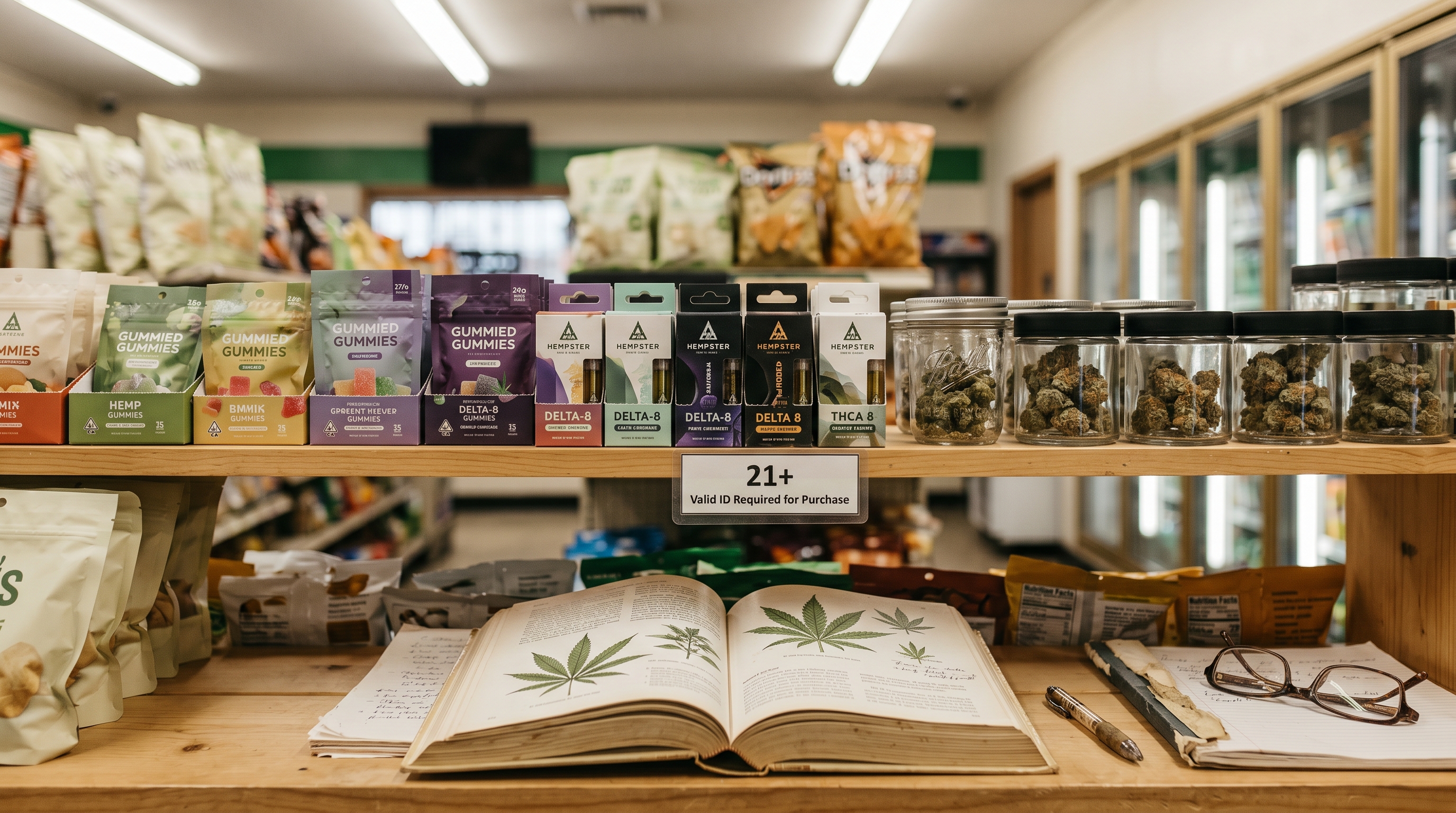
Walk into a Texas gas station in 2026. You might see a cooler full of THC drinks next to the energy shots and think the Lone Star State went legal. It didn’t. Texas is one of the most confusing cannabis states in the country. Recreational marijuana is still illegal. Possession can still land you in jail. Yet you can legally buy hemp-derived THC gummies that get you genuinely high a few aisles over from the beef jerky.
Let me untangle it for you. This is a science-and-policy walkthrough, not legal advice. But by the end you will know exactly what Texas allows, what it punishes, and why the rules feel like they were written by two governments fighting each other. Because, in a sense, they were.
The quick answer: still mostly illegal
Here’s the headline you came for. As of 2026, Texas has not legalized recreational (“adult-use”) marijuana. There is no licensed dispensary where any adult can walk in and buy cannabis flower for fun. Possessing marijuana remains a criminal offense under the Texas Health and Safety Code.
What Texas does have:
- A narrow, doctor-gated medical program (the Compassionate Use Program) for low-THC products.
- A massive, lightly regulated market for hemp-derived THC products (delta-8, delta-9 from hemp, THCA) that exists in a legal gray zone created by the 2018 federal Farm Bill.
- Criminal penalties for “marijuana” the moment a product crosses the hemp line.
- No legal home cultivation for personal use.
So the honest one-liner is: Marijuana is illegal in Texas, but a chemically similar — and often more potent — set of hemp products is sold openly while lawmakers fight over what to do about it. If you want the national picture for comparison, our state-by-state cannabis laws guide and the broader U.S. legalization overview map out where Texas sits relative to its neighbors.
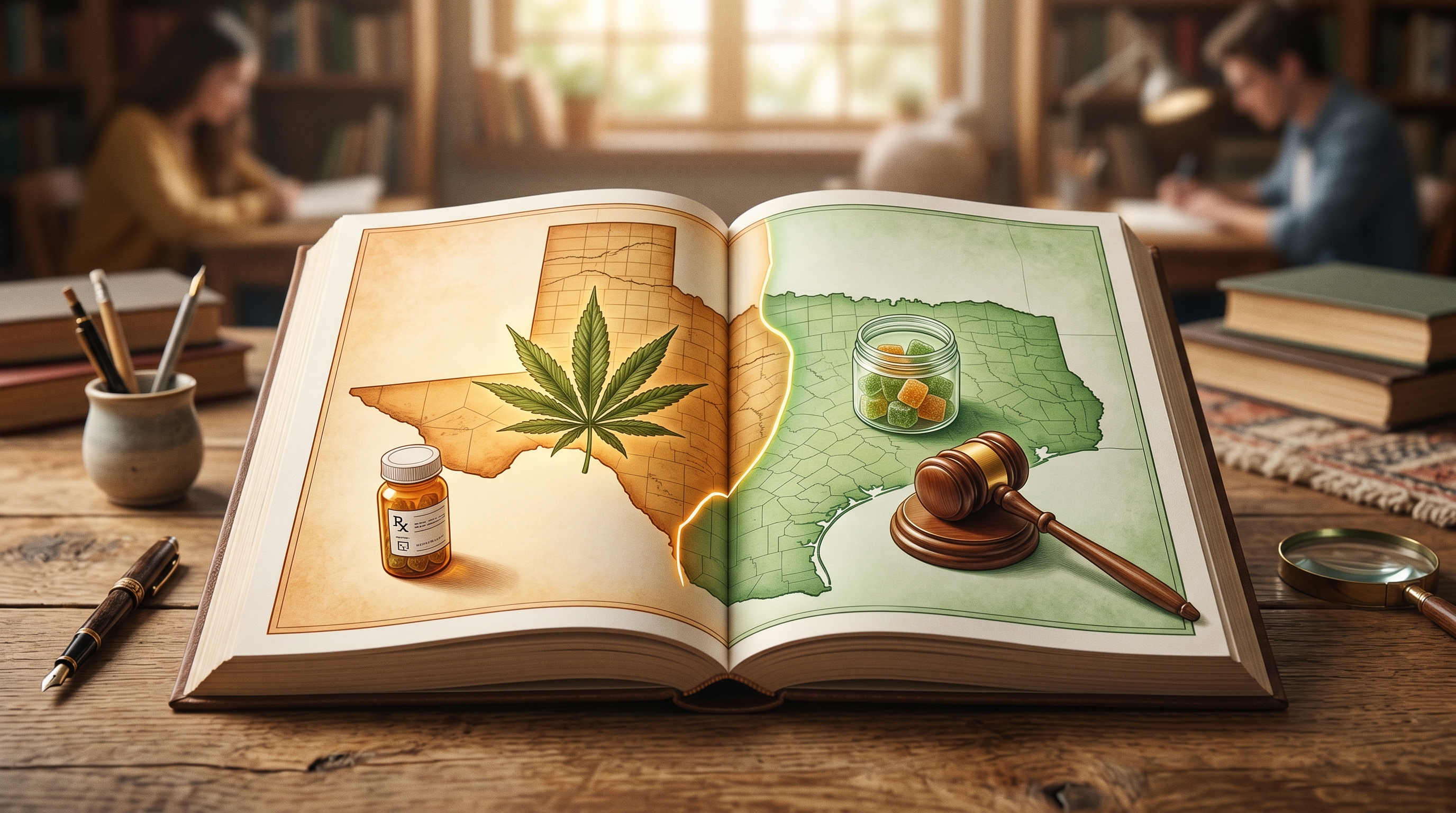
The Compassionate Use Program: Texas’s low-THC medical lane
Texas’s only formally legal medical marijuana pathway is the Compassionate Use Program (CUP), often written TCUP. Governor Greg Abbott signed the original, extremely restrictive version into law in 2015, and lawmakers have widened it incrementally ever since.
For years the program had a hard cap of 1% THC by weight and a short list of qualifying conditions. That changed in 2025. On June 21, 2025, Abbott signed House Bill 46 (HB 46), the biggest expansion in the program’s history. Most of it took effect September 1, 2025. The expansion pushed Texas across the line many advocates use to define a “comprehensive” medical program — though it is still restrictive [Marijuana, 2025].
What HB 46 changed:
- New qualifying conditions including chronic pain (continuous or intermittent severe pain lasting more than 90 days), Crohn’s disease, traumatic brain injury, terminal illness, and hospice care — added to the prior list (epilepsy, multiple sclerosis, PTSD, cancer, autism, and others).
- New delivery methods: lotions, patches, suppositories, and non-smoked pulmonary inhalation. Approved inhalers, nebulizers, and vaporizers are allowed under a doctor’s direction. Raw, smokable flower is still banned.
- A new potency rule: the old 1%-by-weight cap was replaced with a per-dose limit (up to 10 mg THC per dose) and a package cap of 1 gram of total THC.
- More access: recommendations valid for one year with four 90-day refills, and a directive to expand licensed dispensing organizations from three to as many as 15, plus satellite locations.
If you have a qualifying condition, a registered Texas physician can enter you in the Compassionate Use Registry — there’s no plastic “card,” the prescription lives in the registry itself. Want the mechanics across states? See how to get a medical marijuana card state by state. And because Texas medical products are dosed by milligrams, our pieces on finding your ideal THC-to-CBD ratio, the beginner’s dosing chart, and cannabis for chronic pain vs opioids are worth a read.
Professor High note: “Low-THC” does not mean “no effect.” A 10 mg dose is a real dose. If you’re new, our first-time users guide and edible dosing 2-hour rule will save you a rough afternoon.
The hemp gray market: delta-8, delta-9, and THCA
Here is where Texas gets strange. The 2018 federal Farm Bill legalized hemp. It defined hemp as cannabis with no more than 0.3% delta-9 THC by dry weight. Texas adopted that same 0.3% line for its Consumable Hemp Program, run by the Department of State Health Services (DSHS) [Texas, 2026].
Here is the catch. That definition is written around delta-9 THC by weight. Chemists quickly saw a loophole. You can stay under the line and still sell products that get people high:
- Delta-8 THC, a chemical cousin synthesized from hemp-derived CBD, produces a milder but real intoxicating effect. See our delta-8 vs delta-9 breakdown.
- Hemp-derived delta-9 gummies and drinks can pack 10+ mg of actual delta-9 per piece and still pass the 0.3%-by-weight test if the product is heavy enough.
- THCA flower is raw cannabis bud that is chemically below 0.3% delta-9 until you heat it — then it converts to delta-9 THC and behaves like regular weed. We cover the chemistry in THCA flower vs delta-9 flower and what is THCA.
- Novel cannabinoids like HHC muddy the picture further.
The result: thousands of Texas retailers — DSHS has cited figures around 8,000-plus — sell intoxicating hemp products with minimal oversight. Our explainer on the confusing 2026 hemp-vs-cannabis landscape digs into how a single percentage point splits the entire market.
A few 2025-26 guardrails did appear. DSHS adopted emergency rules effective October 2, 2025. They bar sales of consumable hemp products to anyone under 21 without valid government-issued ID. Sales of THC vape pens also became illegal effective September 2025, though possession was not made a crime [Texas, 2026]. Broader new DSHS hemp rules were set to take effect March 31, 2026. Worth knowing if you’re worried about contaminants: read how to read cannabis lab results, why lab testing standards are failing consumers, and the safety reporting in hemp-derived THC sending kids to the ICU and hemp THC sold to minors.
The ban fight: SB 3, the veto, and the special-session saga
The hemp boom triggered one of the most dramatic policy fights in recent Texas history — and it shaped exactly what’s legal in 2026.
In the 2025 regular session, Lt. Gov. Dan Patrick made banning intoxicating hemp THC a top priority. The Legislature passed Senate Bill 3 (SB 3), which would have effectively prohibited consumable hemp products containing any amount of THC.
Then, late on June 22, 2025, Governor Abbott vetoed SB 3. His reasoning was striking. He argued the state should not criminalize what Congress had legalized under the Farm Bill. He warned the ban would likely face court challenges. Instead, he called for regulation — age limits, testing, licensing, and a funded enforcement division. He called a special session to sort it out [Abbott, 2025].
The special sessions did not produce a deal. The Senate again passed ban-style legislation. That bill, Senate Bill 6, targeted products with a “detectable amount of any cannabinoid.” But the House never advanced it. By early September 2025, the second special session ended with no ban and no broad new rules. Abbott, Patrick, and House Speaker Dustin Burrows could not reach a compromise [Tribune, 2025]. Plans for a Texas Hemp Council and a statewide age-21 purchase rule failed at the statehouse. (DSHS later imposed the 21+ rule on its own.)
The practical upshot for 2026: the multibillion-dollar hemp-THC market remains intact, governed mostly by DSHS rules rather than a sweeping statute, while the underlying fight is unresolved.
Possession penalties: still criminal, still serious
This is the part people underestimate. Outside the medical and hemp lanes, “marijuana” is illegal. And Texas penalties are real. Here is the breakdown of the Texas Health and Safety Code [Norml, 2026]:
| Amount (marijuana) | Classification | Maximum penalty |
|---|---|---|
| 2 oz or less | Class B misdemeanor | Up to 180 days jail, $2,000 fine |
| 2-4 oz | Class A misdemeanor | Up to 1 year jail, $4,000 fine |
| 4 oz - 5 lbs | Felony | 180 days - 2 years, up to $10,000 |
| 5-50 lbs | Felony | 2-10 years, up to $10,000 |
| 50-2,000 lbs | Felony | 2-20 years, up to $10,000 |
| Over 2,000 lbs | Felony | 5-99 years, up to $50,000 |
Concentrates and hash are treated as a separate, harsher substance category — possession of even less than 1 gram can be a felony. Paraphernalia possession is a misdemeanor (around a $500 fine). And remember: a product that looks like legal hemp flower but tests over the delta-9 threshold is, legally, marijuana.
A few collateral points worth knowing: cannabis remains federally illegal, which is why a Texan with a state medical recommendation still can’t legally own a firearm under federal law, and why traveling with cannabis — even hemp products that look like weed — can get complicated fast.
Decrim cities vs. state preemption
You may have read that Austin “decriminalized” weed. That’s partly true and increasingly fragile. Several Texas cities — Austin, San Marcos, Denton, Killeen, Elgin, and others — passed local measures directing police to deprioritize low-level marijuana arrests and citations.
But Texas is a strong state-preemption state. Local rules can’t override the Health and Safety Code. The Texas Attorney General even sued several cities, arguing their measures unlawfully blocked enforcement of state drug law [Paxton, 2026]. The result is a patchwork. In some cities, a small amount of marijuana is a low priority in practice. In others — and certainly outside city limits, or during a traffic stop by state troopers — the full state penalties above still apply. Local “decrim” is not legalization, and it is not a guarantee. California’s experience shows how different a fully legal state looks — see California cannabis at 10 — and our Georgia 2026 guide covers another low-THC-only Southern state for comparison.
No home grow
Let’s be blunt: there is no legal home cultivation in Texas for personal use. Growing marijuana plants is prosecuted under the same possession framework, scaled by aggregate plant weight — meaning a few mature plants can quickly push you into felony territory. The Compassionate Use Program supplies patients through licensed dispensing organizations; patients cannot grow their own. If you’re curious how cultivation works where it’s legal, our home grow beginner’s guide is educational only — and not a green light in Texas.
The 2026 outlook
Texas in 2026 is a state in tension. The medical program is finally credible after HB 46. The hemp market is enormous and, for now, intact. And the fight over intoxicating hemp is paused, not settled. Another special session or a 2027 bill could swing toward heavier rules — age limits, testing, licensing — or a fresh ban attempt.
Full adult-use legalization is a longer shot. Texas has no citizen ballot-initiative process for statutes, so any change must run through the statehouse. The most likely near-term path is regulation of hemp THC, which is Abbott’s stated preference. It is not legalization of marijuana, and it is not an outright ban. But “most likely” does a lot of work in Texas politics. Watch DSHS rulemaking and the next legislative session closely.
Frequently asked questions
Is recreational weed legal in Texas in 2026? No. Adult-use marijuana is illegal. There is no recreational dispensary system.
Can I get a medical marijuana card in Texas? Texas uses the Compassionate Use Program, not a traditional card. A registered physician enters qualifying patients into the Compassionate Use Registry. HB 46 (2025) expanded qualifying conditions to include chronic pain, Crohn’s, TBI, terminal illness, and hospice care.
Why can I buy THC gummies at a gas station if weed is illegal? Those are hemp-derived products that stay under 0.3% delta-9 THC by dry weight, making them legal under the federal Farm Bill definition Texas adopted — even when they’re intoxicating. See delta-8 vs delta-9 and hemp vs cannabis regulations.
Is delta-8 legal in Texas? As of 2026, delta-8 and other hemp-derived THC products generally remain available, subject to DSHS rules including a 21+ purchase requirement and a ban on THC vape sales (effective September 2025). The legislature failed to pass a broader ban in its 2025 special sessions.
How much weed is a misdemeanor in Texas? Possession of 2 oz or less of marijuana is a Class B misdemeanor (up to 180 days jail and a $2,000 fine). More than that escalates quickly — see the table above.
Did Austin legalize marijuana? No. Austin and several other cities passed local deprioritization measures, but Texas state preemption means state penalties still apply, and the Attorney General has challenged these ordinances in court.
Can I grow cannabis at home in Texas? No. Home cultivation for personal use is illegal and prosecuted under possession law by plant weight.
Key takeaways
- No recreational weed. Adult-use marijuana is still illegal in Texas in 2026.
- A real medical lane. The Compassionate Use Program now covers more conditions and more product forms after HB 46 [Marijuana, 2025]. No smokable flower, though.
- A huge hemp market. Delta-8, hemp delta-9, and THCA products are sold openly under the 0.3% Farm Bill line. Most are now 21+ only.
- The ban fight stalled. Lawmakers failed to pass a ban or broad rules in 2025 [Tribune, 2025]. The issue is paused, not settled.
- Possession is still a crime. Even 2 ounces or less is a misdemeanor [Norml, 2026]. Concentrates are treated worse.
- Local “decrim” is not a shield. State law and state troopers still apply.
- No home grow. Growing for personal use is illegal, full stop.
Track what actually works for you
Texas law splits cannabis into categories that have little to do with how a product affects your body. A 10 mg hemp delta-9 gummy and a 10 mg medical dose can hit you completely differently depending on the terpene and cannabinoid profile — which is exactly why we built High IQ around how you respond, not the label on the jar. Whatever’s legal where you are, a good cannabis journal beats guessing.
Sources
- [Texas, 2026] — Texas Department of State Health Services, Consumable Hemp Program (0.3% delta-9 definition; October 2, 2025 age-21 emergency rule; March 31, 2026 rules): dshs.texas.gov/consumable-hemp-program
- Texas Department of Public Safety — Compassionate Use Program: dps.texas.gov/section/compassionate-use-program
- [Marijuana, 2025] — Marijuana Policy Project, “HB 46 expands the Compassionate Use Program” (signed June 21, 2025; effective Sept. 1, 2025): mpp.org/states/texas/hb46-expands-compassionate-use-program
- [Abbott, 2025] — NBC DFW / Associated Press, “Abbott vetoes THC ban, calls special session” (June 23, 2025): nbcdfw.com
- [Tribune, 2025] — The Texas Tribune, “Most Texas THC products remain legal after GOP leaders fail to break legislative impasse” (Sept. 3, 2025): texastribune.org
- [Norml, 2026] — NORML, Texas Penalties (possession classifications and fines): norml.org/laws/texas-penalties-2
- [Paxton, 2026] — Texas State Law Library, Cannabis & the Law guide (state vs. federal preemption, decriminalization, AG litigation): guides.sll.texas.gov/cannabis
This article is for educational purposes only and is not legal advice. Cannabis and hemp laws change frequently and are enforced differently across jurisdictions. Consult a licensed Texas attorney and verify current statutes with official state sources before making any decisions.


