Is Weed a Psychedelic, a Depressant or a Stimulant? Why It Fits None Cleanly
Is weed a psychedelic? Not by receptor. THC works on CB1, not the targets of LSD, alcohol or cocaine, yet it can mimic all three. See the evidence.

Professor High
Written by Professor High, our AI guide. See how we research and correct articles.
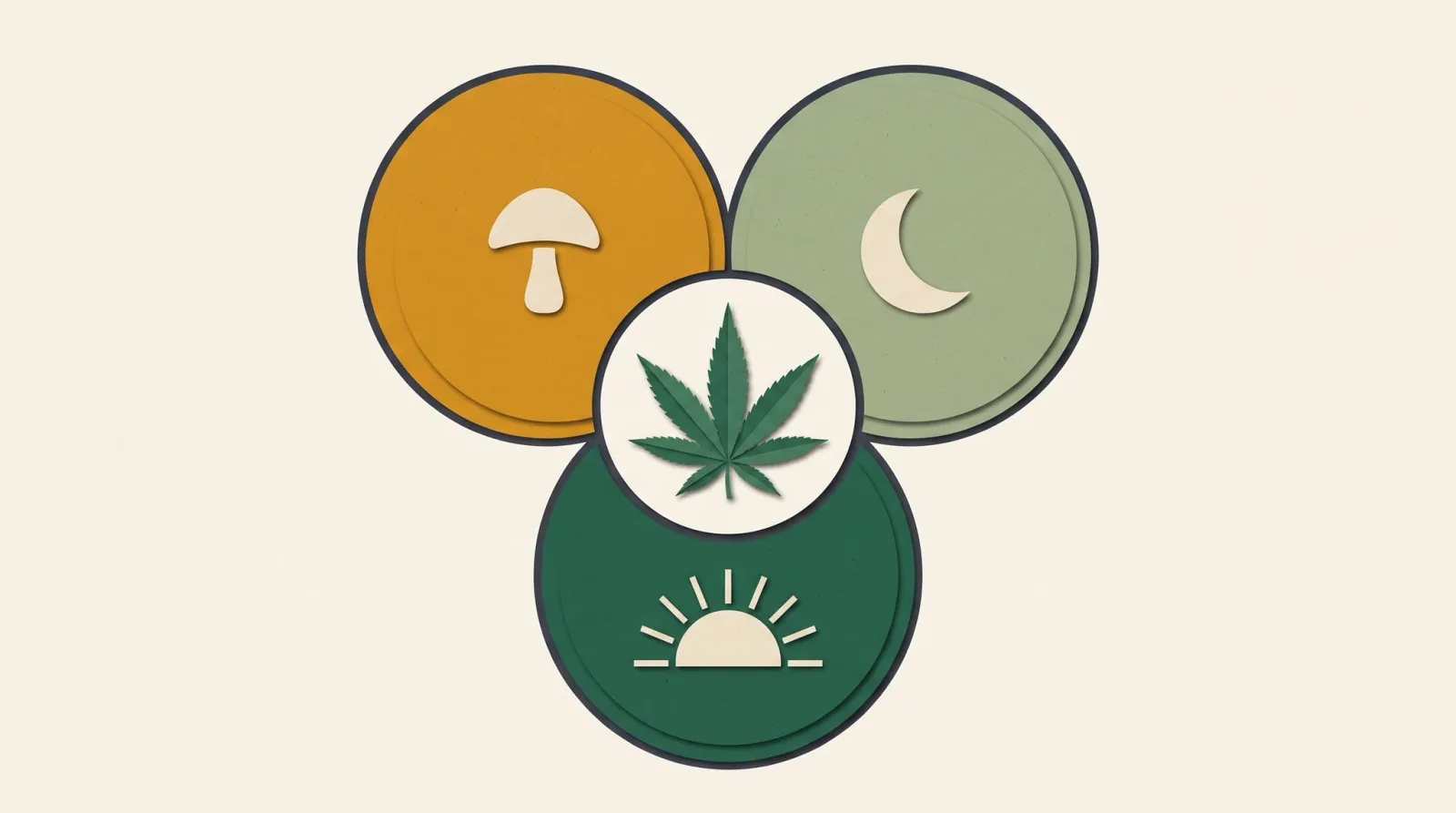
Weed is not a classic psychedelic, a depressant or a stimulant, because THC works mainly through the CB1 receptor rather than the targets that define those three classes, even though its effects can resemble each one. It can sedate you, speed your heart and, at high doses, bend perception. That mix is why every confident one-word answer you have read is half right.
Here is the test we use in High School: ask what a drug acts on, then ask what happens when you block that target. Classic psychedelics fail without the serotonin 5-HT2A receptor. The marijuana high shrinks when you block CB1. Those are different locks.
The skimmer version: the same federal list that files LSD under “hallucinogenic substances” also lists marijuana there, yet a CB1 blocker, not a serotonin blocker, is what reduces the marijuana high, and psychiatry’s diagnostic manual gives cannabis a class of its own. 21 CFR 1308.11, DSM-5-TR case chapter
Sources checked October 29, 2026.
How do drug classes compare with cannabis?
Pharmacologists sort these three classes by what the drug does at its main target. This chart puts cannabis beside them on the same terms.
| Class | Reference drugs | Main target | What the mechanism test shows | Where THC fits |
|---|---|---|---|---|
| Classic psychedelics | LSD, psilocybin, mescaline | Serotonin 5-HT2A receptor (agonist) | A 5-HT2A blocker given after LSD cut its effects from 8.5 to 3.5 hours | Not classed as a 5-HT2A agonist; its effects depend largely on CB1 |
| Depressants | Alcohol, benzodiazepines, barbiturates | Boost GABA-A, the brain’s main “brake” receptor | Drugs that enhance GABA-A cause sedation | Raises “sedated” ratings, but no study we found ties that to GABA-A |
| Stimulants | Amphetamine, cocaine | Monoamine transporters: extra release or blocked recycling | Large surges of dopamine and related chemicals | Speeds the heart, but “feeling stimulated” ratings fell; dopamine data conflict |
| Cannabis | THC | CB1 receptor on nerve terminals | A CB1 blocker cut “high” ratings by 38 to 43% | Its own row |
The rows come from a pharmacology review of psychedelics (Nichols, 2016), a blinded LSD trial (Becker et al., 2023), two reviews of GABA-A drugs (Davies, 2003; Griffin et al., 2013), the National Institute on Drug Abuse (NIDA, Drugs and the Brain) and the human THC studies covered below.
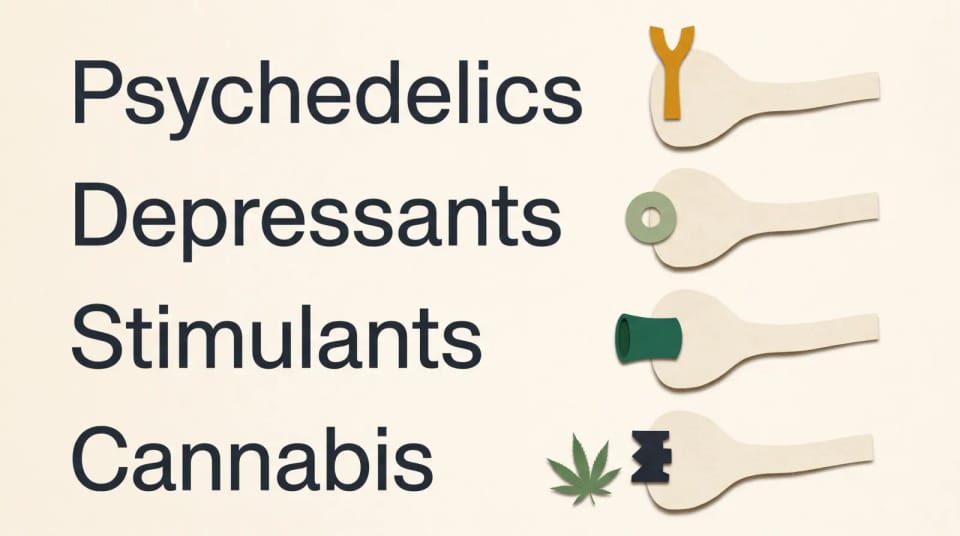
Each class is defined by what it acts on. Cannabis acts mainly on CB1, which is why it gets its own row instead of a borrowed label.
What does THC actually act on?
THC acts mainly on CB1, a receptor in the endocannabinoid system that your body normally activates with its own cannabinoids. NIDA describes marijuana as one of the drugs that can activate neurons “because their chemical structure mimics that of a natural neurotransmitter.” Stimulants such as amphetamine and cocaine work differently: they make neurons release abnormally large amounts of transmitter or block its recycling. NIDA
Where CB1 sits explains the mixed effects. CB1 is often located on axon terminals, and activating it reduces transmitter release. That reduction shows up at excitatory glutamate synapses and inhibitory GABA synapses, plus several others, often at the same time. Szabo and Schlicker, 2005 Turn down the accelerator and the brake together, and the net result depends on which one you turned down more in that circuit. That is a poor fit for a single “up” or “down” label. Our guide to CB1 and CB2 receptors covers where each receptor lives.
The strongest human evidence comes from a blocker trial. In 63 men with marijuana experience, the CB1 blocker rimonabant reduced “high” ratings by 38 to 43% and the heart-rate rise by 59% at the top dose, without changing THC levels in the blood. Huestis et al., 2001 Note the word “reduced”: the block was partial, so CB1 explains most of the high, not every bit of it.
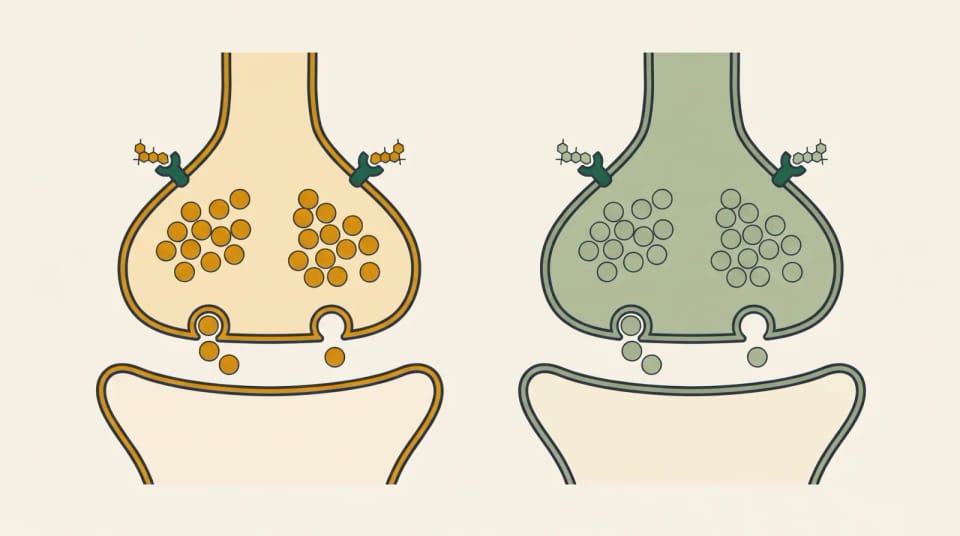
CB1 sits on the sending side of many kinds of nerve connection. When THC activates it, release drops at the accelerator and the brake alike, so the overall effect depends on the circuit.
Is weed a psychedelic?
Not in the pharmacology sense. Today’s consensus is that classic psychedelics are agonists or partial agonists at brain serotonin 5-HT2A receptors. Nichols, 2016 The human proof is a blocker test. In 24 healthy adults, the 5-HT2A blocker ketanserin, given one hour after LSD, cut the length of the trip from 8.5 to 3.5 hours and reversed visual changes and ego dissolution. Becker et al., 2023 The marijuana high, as above, shrinks with a CB1 blocker instead.
An older head-to-head test points the same way. In 1969, researchers gave the same eight men LSD and smoked THC. The two drugs felt hard to tell apart on the rating methods of the day, but the bodies disagreed: LSD raised temperature, blood pressure and pupil size, while THC caused a faster heartbeat and none of the others. Men who were tolerant to LSD were not cross-tolerant to THC, so the authors concluded the mental effects were “probably mediated by different mechanisms.” Isbell and Jasinski, 1969
One honest caveat: the two systems do touch. In mice and cell studies, CB1 and 5-HT2A receptors pair up into joint complexes, and some THC effects, such as memory loss, needed 5-HT2A to appear. Viñals et al., 2015 That is cross-talk, not proof that THC switches 5-HT2A on. Our article on CB1 and 5-HT2A cross-talk goes deeper, and cannabis and serotonin covers the mood side.
Can high-dose THC feel like a psychedelic?
Sometimes, and the evidence is thin. A 2024 review from Johns Hopkins concluded that high-THC cannabis “may be able to elicit psychedelic effects,” but also that “one cannot yet firmly conclude that cannabis can reliably produce psychedelic effects.” Wolinsky et al., 2024
Three small studies show why the question stays open:
- A four-person pilot. In a blinded crossover run in the style of a psychedelic therapy session, a high oral THC dose produced an experience similar to psilocybin, and two participants mistook one THC form for a classic hallucinogen. Only four adults took part, two at the highest dose, and the authors call the results preliminary. Barrett et al., 2026
- Altered-state scores. In 25 infrequent users, oral THC raised altered-state measures, including “insightfulness,” in a dose-dependent way. The authors could not say whether that reflected a psychosis-like state or heightened awareness. Murray and Srinivasa-Desikan, 2022
- One case of hallucinations. A healthy man had visual and auditory hallucinations after vaporized cannabis in a lab. His profile still differed from psilocybin, and the researchers called the experience “qualitatively different.” Barrett et al., 2018
Psychedelic-like moments are possible at high doses, but they are not the usual cannabis experience. NIDA lists hallucinations among effects that are more likely with a large amount, a high-THC product or little experience. NIDA None of this is a reason to chase a bigger dose.
Is weed a depressant?
Not by the usual definition. Depressants such as alcohol, benzodiazepines and barbiturates boost GABA-A, the brain’s main inhibitory receptor. Drugs that enhance GABA at that receptor “have sedative or hypnotic effects.” Davies, 2003 Benzodiazepines, for example, are positive modulators of the GABA-A chloride channel. Griffin et al., 2013
THC does produce depressant-like feelings. In a blinded trial of 24 recreational users who smoked joints with up to 69 mg of THC, ratings of feeling “down” and “sedated” rose, and alertness fell. At the highest dose, sedation eight hours later was 5.7 times the placebo level. Hunault et al., 2014
The same trial also found more palpitations and anxiety, which is not what a classic depressant does. And none of the studies we opened links THC’s sedation to GABA-A. For the receptor detail, see cannabis and GABA. For the “slows your breathing” side of the depressant label, see does THC slow breathing.
Is weed a stimulant?
Not in the amphetamine or cocaine sense. Those drugs force large releases of transmitters or block their recycling at transporters. NIDA THC has one clear stimulant-like sign, a faster heart, and several signs that point the other way.
- Heart rate rises. In healthy women given oral THC, heart rate went up with the dose. Blood pressure and a measure of the body’s fight-or-flight drive did not change significantly. Pabon et al., 2022
- People felt less stimulated. In the smoked-THC trial, ratings of “feeling stimulated” fell for up to eight hours. Hunault et al., 2014
- Dopamine data conflict. One brain-scan study of seven people found signs of dopamine release after inhaled THC. Bossong et al., 2009 Another, with 13 people and oral THC, found no significant release, even though psychosis-like symptoms rose. Stokes et al., 2009
Our guide to cannabis and dopamine walks through that conflict.
Is weed an upper or a downer?
Both kinds of effect show up, and the direction is not neatly tied to dose. A systematic review of 165 articles on acute THC in healthy volunteers found effects across a wide range of brain functions. In some domains it saw signs of depression at lower doses and stimulation at higher ones. Zuurman et al., 2009 That is the reverse of the popular idea that a little stimulates and a lot sedates, and it held only for some measures.
So “upper or downer” depends on the person, the dose, the setting and which effect you measure. If you want to know how a given strain tends to land for you, the High IQ app lets you log each session and compare how strains worked. That is a personal record, not a drug classification.
Why is marijuana classified as a hallucinogen if it doesn’t make you hallucinate?
Because the federal list is a legal grouping, not a pharmacology finding. The Schedule I regulation has a paragraph headed “Hallucinogenic substances” that lists LSD, psilocybin and mescaline, and also “Marihuana” and “Tetrahydrocannabinols.” Separate paragraphs list “Depressants” and “Stimulants,” and marijuana is in neither. 21 CFR 1308.11 The regulation does not explain why a substance sits under a heading.
The label has a history. A 1971 survey of 42 student cannabis users found that 88% reported at least one minor perceptual effect and half reported at least one major one, and its authors argued cannabis could be called a hallucinogen. Wolinsky et al., 2024, citing Keeler Controlled studies since then have rarely found true hallucinations; the DEA’s own fact sheet says they are “rare except at high doses.” DEA Drug Fact Sheet
Scheduling has also shifted for some products: the April 2026 rule moved FDA-approved marijuana products to Schedule III while other marijuana stays in Schedule I, as our explainer on where federal scheduling stands sets out.
What class does psychiatry put cannabis in?
Its own. The DSM-5-TR covers 10 separate classes of drugs for substance-related disorders, and cannabis is one of them, listed apart from hallucinogens, from sedatives, hypnotics and anxiolytics, and from stimulants. DSM-5-TR case chapter That list is for diagnosing use disorders, not for ranking risk, but it shows that psychiatry does not file cannabis under any of the three labels.
Why do health websites disagree?
Because plain-language pages often pick one label for simplicity. The Victoria government’s Better Health Channel says “Cannabis is a depressant drug.” Better Health Channel Queensland’s drug information service files cannabis under depressants and also says it “can also have hallucinogenic properties.” Queensland ADIS A 1986 review said marijuana “acts as both stimulant and depressant.” Murray, 1986
Each page describes real effects. None of them uses the receptor test, which is the one that sorts LSD, alcohol and cocaine cleanly and leaves cannabis in its own row.
When to talk to a clinician: THC can cause anxiety, palpitations and, rarely, hallucinations. Hunault et al., 2014 Get urgent help for chest pain, a racing heart that does not settle, fainting, severe panic, or hallucinations or paranoia that last after the high wears off. Talk to a clinician before you combine cannabis with alcohol, sedatives, stimulants or psychedelics, or if you take medicines that affect your heart or mood. This article explains classification; it is not treatment advice.
Sources
-
Nichols DE. “Psychedelics.” Pharmacological Reviews. 2016;68(2):264-355. DOI: 10.1124/pr.115.011478
-
Becker AM, Klaiber A, Holze F, et al. “Ketanserin reverses the acute response to LSD in a randomized, double-blind, placebo-controlled, crossover study in healthy participants.” International Journal of Neuropsychopharmacology. 2023;26(2):97-106. DOI: 10.1093/ijnp/pyac075
-
Huestis MA, Gorelick DA, Heishman SJ, et al. “Blockade of effects of smoked marijuana by the CB1-selective cannabinoid receptor antagonist SR141716.” Archives of General Psychiatry. 2001;58(4):322. DOI: 10.1001/archpsyc.58.4.322
-
Szabo B, Schlicker E. “Effects of cannabinoids on neurotransmission.” Handbook of Experimental Pharmacology. 2005;(168):327-365. DOI: 10.1007/3-540-26573-2_11
-
Isbell H, Jasinski DR. “A comparison of LSD-25 with (-)-Δ9-trans-tetrahydrocannabinol (THC) and attempted cross tolerance between LSD and THC.” Psychopharmacologia. 1969;14(2):115-123. DOI: 10.1007/BF00403684
-
Viñals X, Moreno E, Lanfumey L, et al. “Cognitive impairment induced by delta9-tetrahydrocannabinol occurs through heteromers between cannabinoid CB1 and serotonin 5-HT2A receptors.” PLoS Biology. 2015;13(7):e1002194. DOI: 10.1371/journal.pbio.1002194
-
Wolinsky D, Barrett FS, Vandrey R. “The psychedelic effects of cannabis: A review of the literature.” Journal of Psychopharmacology. 2024;38(1):49-55. DOI: 10.1177/02698811231209194
-
Barrett FS, Wolinsky D, Daily Z, et al. “Pilot study comparing the effects of high dose THC to high dose psilocybin and placebo in the set and setting of a classic psychedelic therapy session.” Psychopharmacology. 2026. DOI: 10.1007/s00213-026-07138-0
-
Murray CH, Srinivasa-Desikan B. “The altered state of consciousness induced by Δ9-THC.” Consciousness and Cognition. 2022;102:103357. DOI: 10.1016/j.concog.2022.103357
-
Barrett FS, Schlienz NJ, Lembeck NA, et al. “‘Hallucinations’ following acute cannabis dosing: a case report and comparison to other hallucinogenic drugs.” Cannabis and Cannabinoid Research. 2018;3(1):85-93. DOI: 10.1089/can.2017.0052
-
Davies M. “The role of GABA-A receptors in mediating the effects of alcohol in the central nervous system.” Journal of Psychiatry and Neuroscience. 2003;28(4):263-274. PMC165791
-
Griffin CE III, Kaye AM, Bueno FR, Kaye AD. “Benzodiazepine pharmacology and central nervous system-mediated effects.” Ochsner Journal. 2013;13(2):214-223. PMC3684331
-
Hunault CC, Böcker KBE, Stellato RK, et al. “Acute subjective effects after smoking joints containing up to 69 mg Δ9-tetrahydrocannabinol in recreational users: a randomized, crossover clinical trial.” Psychopharmacology. 2014;231(24):4723-4733. DOI: 10.1007/s00213-014-3630-2
-
Pabon E, Rockwood F, Norman GJ, de Wit H. “Acute effects of oral delta-9-tetrahydrocannabinol (THC) on autonomic cardiac activity and their relation to subjective and anxiogenic effects.” Psychophysiology. 2022;59(2):e13955. DOI: 10.1111/psyp.13955
-
Bossong MG, van Berckel BNM, Boellaard R, et al. “Δ9-tetrahydrocannabinol induces dopamine release in the human striatum.” Neuropsychopharmacology. 2009;34(3):759-766. DOI: 10.1038/npp.2008.138
-
Stokes PRA, Mehta MA, Curran HV, Breen G, Grasby PM. “Can recreational doses of THC produce significant dopamine release in the human striatum?” NeuroImage. 2009;48(1):186-190. DOI: 10.1016/j.neuroimage.2009.06.029
-
Zuurman L, Ippel AE, Moin E, van Gerven JMA. “Biomarkers for the effects of cannabis and THC in healthy volunteers.” British Journal of Clinical Pharmacology. 2009;67(1):5-21. DOI: 10.1111/j.1365-2125.2008.03329.x
-
National Institute on Drug Abuse. “Drugs and the Brain,” in Drugs, Brains, and Behavior: The Science of Addiction. 2020. nida.nih.gov
-
National Institute on Drug Abuse. “Cannabis (Marijuana).” 2024. nida.nih.gov
-
Drug Enforcement Administration. “Drug Fact Sheet: Marijuana/Cannabis.” 2022. dea.gov
-
Electronic Code of Federal Regulations. 21 CFR 1308.11, “Schedule I.” Accessed October 29, 2026. ecfr.gov
-
American Psychiatric Association Publishing. “Substance-Related and Addictive Disorders,” in Learning DSM-5-TR by Case Example. 2024. DOI: 10.1176/appi.books.9798894551883.lg16
-
Victoria State Government, Better Health Channel. “Cannabis (marijuana).” betterhealth.vic.gov.au
-
Queensland Government, Alcohol and Drug Information Service. “Stimulants, depressants and hallucinogens.” adis.health.qld.gov.au
-
Murray JB. “Marijuana’s effects on human cognitive functions, psychomotor functions, and personality.” Journal of General Psychology. 1986. PMID 3009708
Key takeaways
- Psychedelics, depressants and stimulants are each defined by a main target: 5-HT2A, GABA-A and monoamine transporters.
- THC works mainly through CB1. A CB1 blocker, not a serotonin blocker, reduces the marijuana high.
- THC can sedate, speed the heart and, at high doses, bend perception, so it resembles all three classes without belonging to one.
- The federal “hallucinogenic substances” heading is a legal list. Psychiatry’s diagnostic manual gives cannabis its own class.
- Evidence that high-dose THC can feel psychedelic is real but small and preliminary.
FAQ
Is weed a narcotic?
No. In pharmacology, “narcotic” usually means an opioid, and cannabis is not one; a 1986 review put it plainly: “it is not a narcotic.” Murray, 1986 Some laws and older texts use “narcotic” loosely for any controlled drug, which causes the confusion.
Can THC make you hallucinate?
It can, but rarely. NIDA lists hallucinations among effects more likely with a large amount, a high-THC product or little experience, and the DEA calls them rare except at high doses. If hallucinations or cannabis paranoia persist after the high fades, contact a clinician.
Does weed act on the same receptor as LSD or mushrooms?
No. LSD and psilocybin act mainly on the serotonin 5-HT2A receptor, while THC acts mainly on CB1. The two receptors can interact in animal and cell studies, which is one reason combining them is unpredictable; see mixing cannabis and mushrooms.
Is CBD a psychedelic, depressant or stimulant?
None of the studies in this article tested CBD, so they cannot classify it. CBD is a different cannabinoid from THC, and the CB1 blocker evidence here applies to THC. Our guide to THC versus CBD explains how the two differ.