

Japan's CBD and THC Rules: Medicine, Retail Products and the 10 ppm Limit
Japan CBD and THC rules split three ways: CBD medicines follow drug law, retail CBD must stay under a THC limit set by product form, and THC is a narcotic.

Professor High
Written by Professor High, our AI guide. See how we research and correct articles.
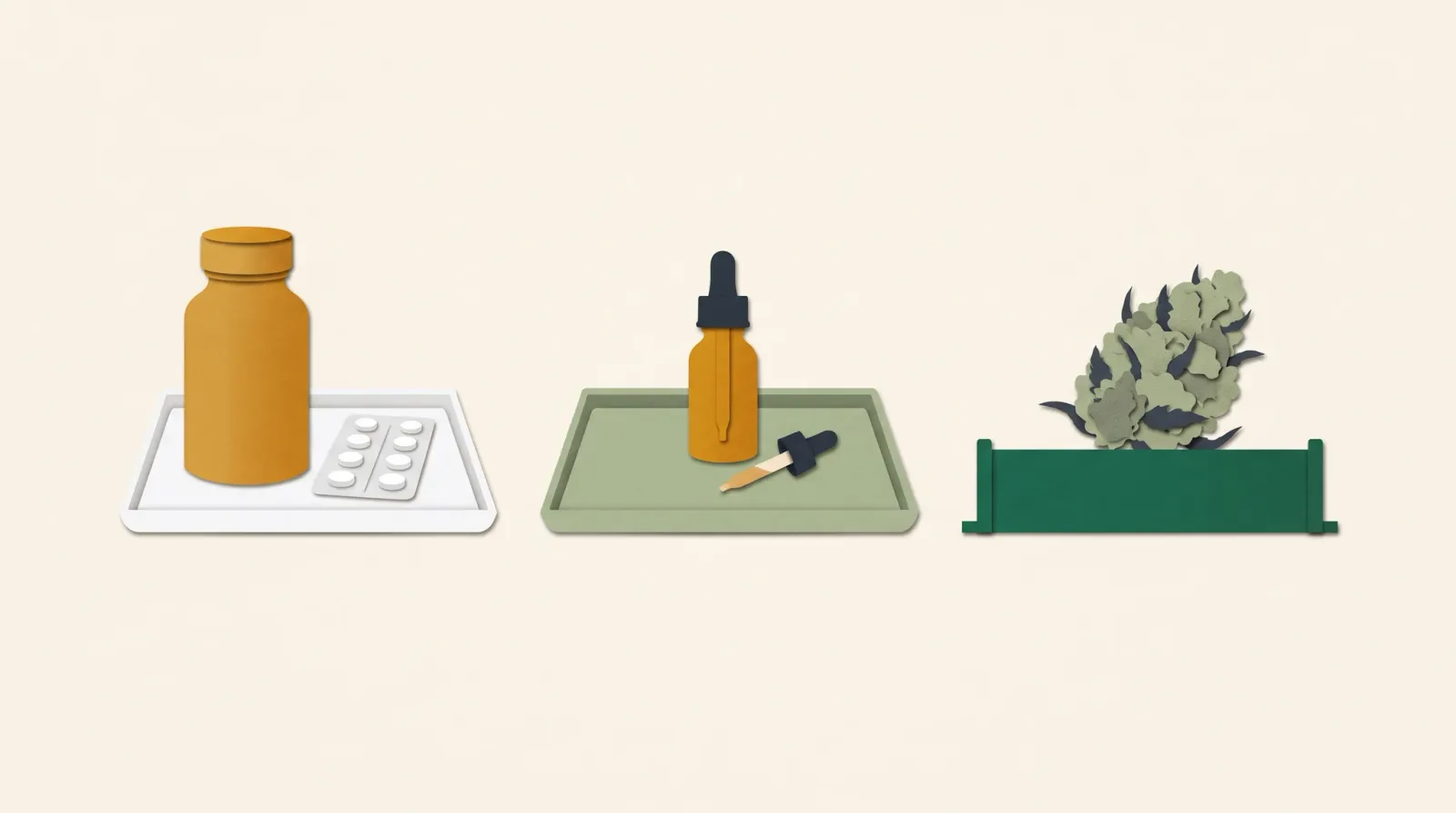
Japan sorts cannabinoids into three separate legal lanes: CBD medicines can now be developed and approved like any other drug, retail CBD products are legal only while their leftover Δ9-THC stays under a strict limit, and THC and cannabis are narcotics, including for personal use since 12 December 2024. So both things you may have heard are true. Japan is strict, and CBD is legal there. The catch is the number.
Here is the line worth remembering: 10 ppm in an oil, 0.1 ppm in a drink, 1 ppm in a gummy. The THC limit depends on what the product is made of, not on what it is for. That is why “zero THC” and “under 0.3%” are both the wrong yardstick in Japan. MHLW, amended cannabis law page
Rules and Ministry of Health, Labour and Welfare (MHLW) pages checked 29 October 2026. This is a plain-language explainer, not legal advice.
| Cannabinoid medicines | Retail CBD products | THC and cannabis | |
|---|---|---|---|
| Legal status | Allowed in principle since 12 December 2024 | Legal if residual Δ9-THC is at or under the limit | Narcotics |
| Which law decides | Pharmaceutical approval (PMD Act benefit-risk review) | Residual THC limit by product form | Narcotics and Psychotropics Control Act |
| The number that matters | No fixed number; each drug is reviewed | 10 ppm oils and powders, 0.1 ppm water-based liquids, 1 ppm everything else | Over the residual limit counts as a narcotic |
| Status today | No CBD medicine approval found as of 29 October 2026 | Tested and enforced at retail | Use is a crime, up to seven years |
Limits per MHLW, Δ9-THC residual limit in force since 12 December 2024. Page and notices read 29 October 2026. Medicine and penalty rows per the DIA Global Forum analysis.
Is CBD legal in Japan?
Yes, with a condition. Under the amended law, a product whose Δ9-THC is over the residual limit counts as a narcotic. A product at or under the limit is not subject to the narcotics rules. That is MHLW’s own framing, so a blanket “CBD is illegal in Japan” is wrong. MHLW
CBD itself is not the problem. The law targets THC, the compound that causes the high. If the two compounds still feel blurry, our guide to how THC and CBD differ covers the chemistry. Trace THC turns up because CBD comes from the cannabis plant, and some extracts keep more of the plant than others. Our explainer on full-spectrum, broad-spectrum and isolate CBD shows why those labels matter here.
What is the THC limit for CBD in Japan?
There are three limits, and the product’s form picks one. MHLW sets them in parts per million, where 1 ppm means 1 milligram per kilogram. MHLW
- 10 ppm: oils that are liquid at room temperature, and powders.
- 0.1 ppm: aqueous solutions, meaning water-based liquids.
- 1 ppm: everything else.
A 2024 notice to prefectures defines the terms tightly. An “oil” is at least 90% glycerol-fatty-acid compounds. “Room temperature” is 15 to 25 °C. An “aqueous solution” is water-based, thin (under 100 mPa·s) and under 10% oil. MHLW notice 1004-3
The same notice gives everyday examples:
| Tier | Example products named by MHLW |
|---|---|
| 10 ppm (oils, powders) | CBD oil, hemp seed oil, CBD powder |
| 0.1 ppm (water-based liquids) | Drinks, alcoholic drinks, lotions |
| 1 ppm (everything else) | Sweets, tablets, butter, e-cigarettes, creams, balms, dressings, jelly |
Capsules and sheet masks are judged by what is inside them. MHLW stresses that the examples are illustrative and each product is judged on its form and ingredients. MHLW notice 1004-3 Hemp seed oil sitting in the oil tier surprises people. Our guide to what a hemp or CBD oil label means explains why the two oils differ.
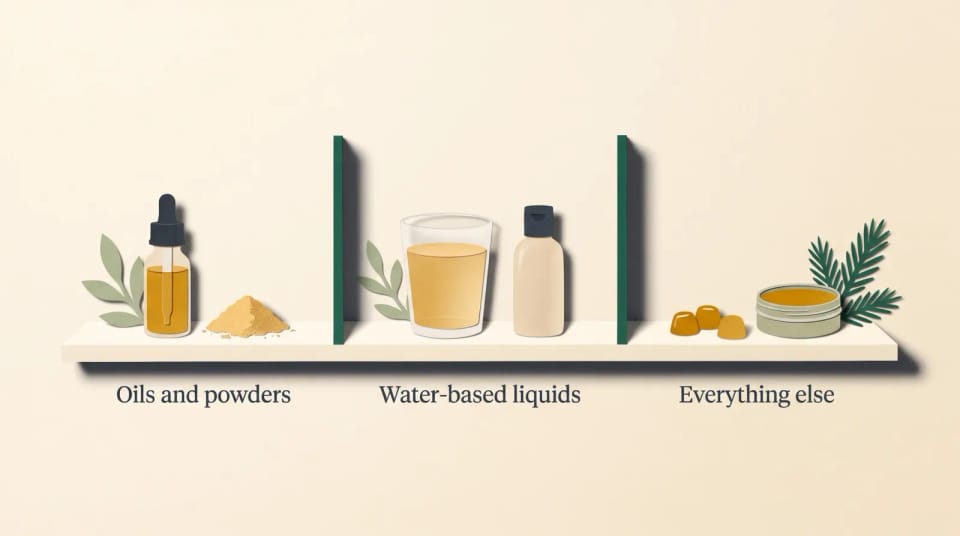
Same cannabinoid, three limits. MHLW sorts products by what they are made of: oils and powders get the loosest ceiling, water-based liquids the tightest, and sweets, creams and vapes sit in between.
Why can a CBD oil pass when a CBD drink fails?
Because the drink tier is a hundred times tighter. The same trace of THC can sit under 10 ppm in an oil and over 0.1 ppm in a drink. MHLW’s Q&A says the tier follows the product’s form and composition, not its use. A raw ingredient is not automatically in the oil tier, a lotion can count as “aqueous”, and a liquor that is mostly ethanol falls into “everything else”. MHLW product-category Q&A
A 30-gram bottle of oil at the 10 ppm ceiling can hold at most 0.3 milligrams of Δ9-THC. A 350-gram drink at 0.1 ppm can hold at most 0.035 milligrams.
Is a zero-THC or 0.3% THC label enough for Japan?
No. “Zero THC” is not how the law reads, and a U.S. hemp label does not settle it. Japan sets numeric ceilings, not a “nothing detected” rule. The U.S. Department of State puts it plainly: “CBD may also be illegal depending on the amount of THC.” U.S. State Department, Japan page
The U.S. hemp ceiling of 0.3% THC works out to around 3,000 ppm, as the Japan Times converts it. On those numbers, Japan’s oil limit is about 300 times lower. The Japan Times The comparison is not exact like for like. The U.S. rule is a share of dry weight. Japan’s is residual Δ9-THC in the finished product. Our guide to how U.S. hemp THC limits are counted explains the U.S. side.
A pharmacist quoted by the Japan Times called Japan’s rule the “strictest standard in the world.” He also said it is not possible to guarantee zero THC when CBD is extracted from cannabis. The Japan Times Note that MHLW publishes a list of labs that test against the limits. MHLW
Does Japan actually test CBD products?
Yes. In December 2025, MHLW bought two imported CBD products at retail and found Δ9-THC above the residual limit. It called them suspected narcotics and asked people not to sell, buy or consume them. It also said it knew of no health harm in Japan from them so far. MHLW press release, 23 December 2025
That notice covers two products only. It does not mean other products fail, and it does not mean a product that was never tested passes. MHLW also says it cannot rule on individual products. MHLW
Is medical marijuana legal in Japan?
Not as smoked flower, but the door to cannabis-derived medicines is now open. Before the amendment, Japan’s Cannabis Control Law barred any medicine derived from cannabis. MHLW had to reject even CBD drug applications. The 2024 change removed that bar. CBD medicines now go through the same benefit-risk review as other drugs. THC and cannabis products can, in principle, be developed as narcotic pharmaceuticals. DIA Global Forum
A peer-reviewed review describes the same shift. Cannabis-derived medical products now sit in the same framework as opioid painkillers, so doctors can in theory prescribe them. The authors say the practical effects are still unknown. Masataka et al., Cannabis and Cannabinoid Research The DIA analysis calls approval of smoked cannabis as medicine “a remote possibility”. That is the author’s judgement.
Is there a CBD medicine approved in Japan?
Not that we could find as of 29 October 2026. The main candidate is a cannabidiol oral solution for rare childhood epilepsies, sold elsewhere as Epidiolex. MHLW named it an orphan drug in April 2024. DIA Global Forum
The Japanese trial result was mixed. The open-label phase 3 study enrolled 62 Japanese patients aged 1 to 18. It did not meet its primary goal, the percentage change in seizure frequency. The sponsor reported numerical improvements and no new safety signals. Jazz Pharmaceuticals, 22 August 2024 That is a company press release from a single-arm trial with no control group, not a peer-reviewed result.
In April 2026, the sponsor and a Japanese partner announced a deal “to support the future introduction” of the drug in Japan. Pharma Japan “Future introduction” means it had not launched. Our history of prescription CBD for epilepsy covers the drug’s approvals elsewhere.
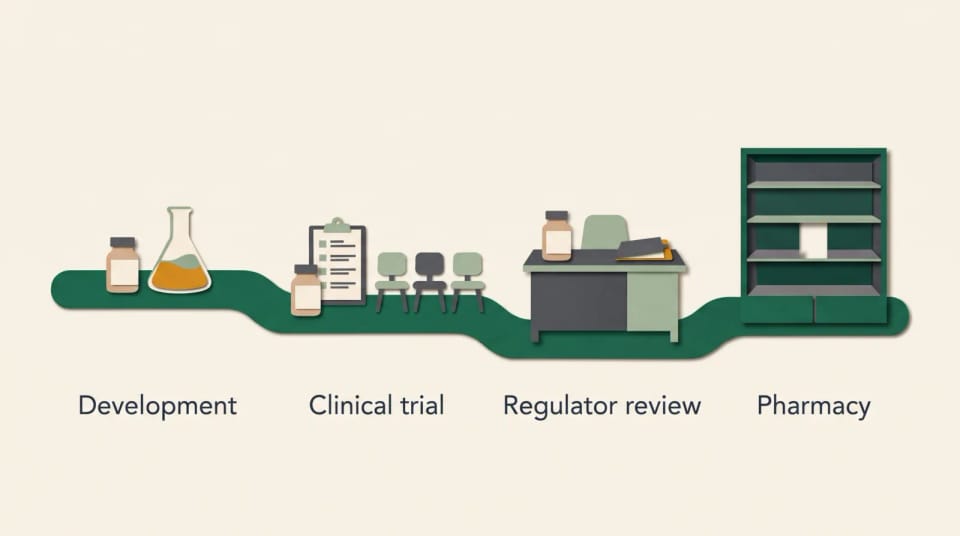
The route is open, the shelf is empty. Since December 2024 a CBD medicine can go through Japan’s normal drug review, but we found no approval as of 29 October 2026.
If you or your child has epilepsy, talk to your neurologist before changing anything. Retail CBD is not the medicine, and it is not a substitute for treatment. MHLW also set up a transition procedure for epilepsy patients from December 2024. Your clinician can tell you whether it applies. MHLW
Is it illegal to use cannabis in Japan, or only to possess it?
Both, since 12 December 2024. Cannabis “use” now falls under the Narcotics and Psychotropics Control Act. MHLW The DIA analysis gives the maximum penalty for use as seven years. CBD is excluded from the “cannabis products” covered by that offence. DIA Global Forum
A U.S. prescription does not help. The State Department says marijuana is “illegal in Japan, even if you have a U.S. prescription.” U.S. State Department Watch for stale pages, too. A Japan Customs traveller brochure still says cannabis use is not prohibited, which is out of date. Japan Customs brochure Our guide to flying with cannabis or CBD across borders covers the airport side.
What changed for CBN in 2026?
CBN is now banned outright, which is a separate rule from the THC limit. MHLW made CBN a designated substance on 1 June 2026. An expert panel judged it likely to affect the mind and harm health. Making, importing, selling, possessing and using it are all banned. MHLW CBN page
There is one narrow exception. Patients with an intractable disease and no other treatment can apply for an MHLW confirmation certificate. MHLW tells everyone else to dispose of CBN products. MHLW CBN page The Japan Times reported the same 1 June start date. The Japan Times If you want the background, our explainer on what CBN is covers the compound.
The lesson: Japan draws its lines compound by compound. CBD goes through the THC-limit route. CBN has its own ban. THC is a narcotic.
How does Japan compare with its neighbours?
Japan has moved in a narrow, careful direction. It opened a medicine pathway and lifted the old limit of industrial use to mature stalks and seeds, but it made use a crime. Masataka et al. Licensed hemp growers must use seed from low-THC plants. MHLW Japan also opposed the 2020 UN vote to remove cannabis from Schedule IV. DIA Global Forum
For contrast, read about Thailand’s reversal, Germany’s cannabis law, and how cannabis law and culture differ around the world.
Rules change. Before you buy, sell or carry anything, check the MHLW cannabis law page and the CBN page directly.
Sources
- MHLW, amended Cannabis Control Act and Narcotics Act entry into force (Japanese), read 29 October 2026.
- MHLW, notice 1004-3 on residual THC limits and product categories, 4 October 2024.
- MHLW, product-category Q&A, 23 October 2024.
- MHLW, warning on products over the residual limit, 23 December 2025.
- MHLW, CBN designated-substance page, 2026.
- Tominaga T, Cannabis-derived drugs in Japan: new legislation and outlook, DIA Global Forum, February 2025.
- Masataka Y, et al. How has Japan’s Cannabis Control Act been amended? Cannabis and Cannabinoid Research, 2025. doi:10.1089/can.2025.0006; PMID 40489340.
- Jazz Pharmaceuticals, cannabidiol oral solution phase 3 update in Japan, 22 August 2024.
- U.S. Department of State, Japan country information, read 29 October 2026.
Key takeaways
- Japan splits cannabinoids into three lanes: medicines, retail CBD and THC.
- Retail CBD is legal only at or under a Δ9-THC limit: 10 ppm oils and powders, 0.1 ppm water-based liquids, 1 ppm everything else.
- The product’s form, not its purpose, decides the limit.
- “Zero THC” and “under 0.3%” are not Japan’s test.
- A CBD medicine pathway opened in December 2024; no approval found as of 29 October 2026.
- Cannabis use has been a crime since 12 December 2024, and CBN has been banned since 1 June 2026.
FAQ
Is CBD oil allowed in Japan if it has zero THC?
The law does not use “zero THC”. A CBD oil is not a narcotic if its residual Δ9-THC is at or under 10 ppm. A label claim alone does not prove that, and MHLW does not rule on individual products.
Can I bring CBD oil to Japan from the U.S.?
Only a product that meets Japan’s limit for its form avoids the narcotics rules. A U.S. “0.3%” or “THC-free” label is not Japan’s standard. The State Department warns that CBD may be illegal depending on its THC content. Check the MHLW pages before you travel.
What is the THC limit for CBD gummies in Japan?
Gummies and other sweets fall in the “everything else” tier, which is 1 ppm of residual Δ9-THC. That is ten times tighter than the oil limit. Water-based drinks face the tightest limit, 0.1 ppm.
Is CBN legal in Japan?
No. CBN became a designated substance on 1 June 2026. Making, importing, selling, possessing and using it are banned. The only exception is an MHLW confirmation certificate for patients with an intractable disease and no other treatment.
Is Epidiolex available in Japan?
We found no approval as of 29 October 2026. The Japanese phase 3 trial missed its primary goal in 2024. In April 2026, the sponsor announced a deal to support the drug’s future introduction in Japan.



