

Medical Card Reciprocity: Which States Accept Your Out-of-State Card?
At least 16 states and DC let visiting patients buy with a home-state card, but five make you apply first. See each route, fee and limit.

Professor High
Written by Professor High, our AI guide. See how we research and correct articles.

At least 16 states and Washington, DC give a visiting patient a route to buy with a home-state medical card, but the route is not the same everywhere. In some places you show your card at the counter. In others you must apply for a temporary visitor card, and pay a fee, before you can shop. And the arrangement only runs one way: a state that accepts your card may have no reason to accept its own patients’ cards elsewhere.
Here is the detail most lists miss. DC accepts registrations from 38 states, Puerto Rico and one tribal program with no extra paperwork. Illinois, by contrast, says plainly that it “does not accept out-of-state medical cards”. Missouri has let visiting patients buy since February 3, 2023, yet some popular lists still call it “possession only.”
This guide is for patients who already hold a card. If you do not, get your home-state card first. It is a map of the rules, not legal advice.
Rules, fees and limits checked against state sources on October 29, 2026. They change; confirm with the host state before you travel.
What does medical card reciprocity actually mean?
Reciprocity means a host state honors your home-state card for some purpose, usually buying from its medical dispensaries. The word suggests a two-way deal. In practice, each host state decides alone which visiting cards it honors and on what terms.
That is why one list per host state matters. Maine’s approved list names 29 jurisdictions. DC’s names 40 entries. Those lists are not interchangeable, and neither tells you what your home state does for visitors.
There are three practical routes:
- Show your card. You present your home-state card and a photo ID at the dispensary. Some states add a form or a store registration at the counter.
- Register at the counter. You complete a short online application in the store, pay, and receive a visitor ID on the spot.
- Apply before you go. You apply to the state for a temporary visitor card, wait for approval, and only then shop.
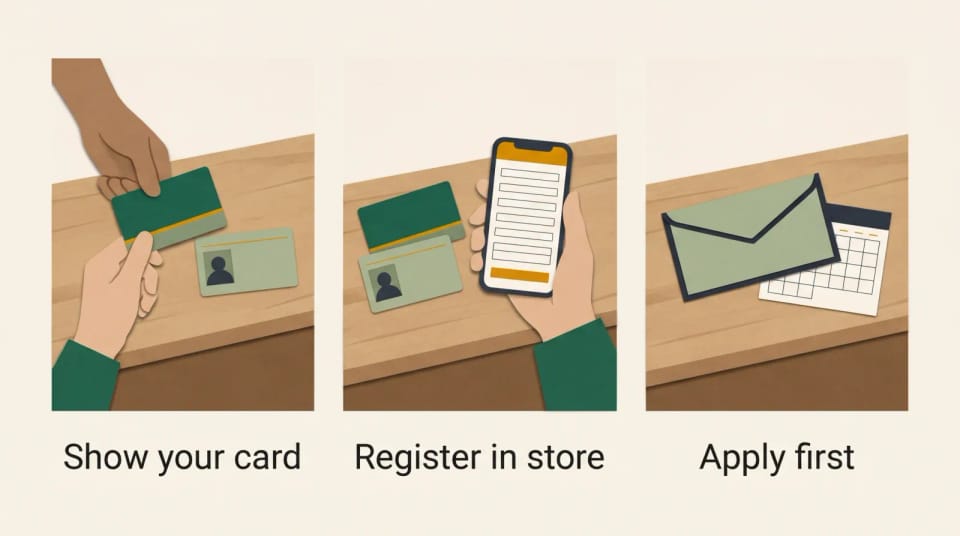
The same home-state card can meet three different routes. Which one applies depends on the host state, not on your card.
Which states accept out-of-state medical cards?
These are the jurisdictions where a state source confirms a visiting-patient buying route. The table is not exhaustive. States not listed may have a route that this guide did not verify, so check the regulator directly.
| Host state | Route | What you bring or do | Key limit or term | Source |
|---|---|---|---|---|
| Maine | Show your card | State-issued card from an approved jurisdiction plus photo ID | 2.5 oz per 15 days; no cultivation | Maine OCP, 22 MRSA §2423-D |
| Michigan | Show your card | Valid, unexpired out-of-state registry card or equivalent | Store purchase limits apply | Michigan CRA |
| Nevada | Show your card | Any document valid at home, which can include a provider’s letter if your state accepts that | Nevada possession limits apply | NRS 678C.470 |
| New York | Show your card | Proof of certification or registration plus government photo ID | Ask the dispensary what it requires | NY OCM FAQ |
| Missouri | Show your card | Active out-of-state card plus government photo ID | Since February 3, 2023 | Missouri DCR guidance |
| Rhode Island | Show your card | Valid card or equivalent plus photo ID; sale logged in tracking | Compassion centers and hybrid retailers | 560-RICR-10-10-2 |
| New Hampshire | Show your card | Valid out-of-state card | 2 oz usable cannabis | RSA 126-X:2 |
| Louisiana | Show your card, plus a form | Card, photo ID and a signed diagnosis certification | Pharmacist checks the tracking system | R.S. 40:1046.1 |
| New Mexico | Show your card, plus store registration | Physical proof of enrollment; register with the retailer | 425 units per three months; provider letters not accepted | 7.34.3 NMAC |
| Kentucky | Show your card, plus diagnosis proof | Out-of-state card and documentation of a qualifying condition | 10-day supply per 8-day period | KRS 218B.025 |
| Washington, DC | Show your card (listed programs) | Registration from a listed program plus photo ID; 21+ | Others buy a temporary registration | DC ABCA |
| Delaware | Register in store | Scan a QR code, upload license and card, pay | Visitor ID issued immediately | Delaware OMC FAQ |
| Arkansas | Apply first | Online visitor application; condition must qualify in Arkansas | $50; up to 14 days to process; 90-day card | ADH FAQ |
| Hawaii | Apply first | Home-state ID and state-issued card; qualifying condition | $47.41; up to 60 days; one renewal a year | Hawaii DOH |
| Oklahoma | Apply first | State-issued card, not a provider letter | $100 plus $4.30 processing; 30 days | OMMA |
| Utah | Apply first | Department registration as a nonresident | Up to 21 days, twice per calendar year | Utah Code 26B-4-213 |
| New Jersey | Apply first | Consult a New Jersey practitioner, then register | Nonrenewable six-month card | NJ CRC |
Several of these states also run adult-use stores that sell to anyone 21 or older without a card. This table covers only the medical route. Which route serves you better depends on the store, the product and the host state’s limits, so ask.
Which states make you apply before you can buy?
Arkansas, Hawaii, Oklahoma, Utah and New Jersey all require a state visitor card or enrollment before a purchase. If you walk in with only your home card, expect to be turned away. Treat the application as part of trip planning, not a step for the day you land.
The details differ:
- Arkansas charges a nonrefundable $50, allows up to 14 days for processing, and issues the card for 90 days. Your home-state condition must also be on Arkansas’s list. Our Arkansas visiting patient card guide walks through the portal.
- Hawaii issues a digital “329 card” valid for up to 60 days, with one 60-day renewal per calendar year. You can apply up to 60 days ahead, and the fee is $47.41. See Hawaii’s 329 out-of-state registration for the steps.
- Oklahoma issues an out-of-state license valid up to 30 days for $100 plus a $4.30 card-processing fee. Oklahoma’s 30-day visitor license covers renewals.
- Utah law allows a nonresident registration for no more than two visits a year, each up to 21 days. Utah’s temporary visitor card explains the application.
- New Jersey offers a nonrenewable six-month card, but only after you consult a New Jersey practitioner who gives you a registry reference.
DC sits partly in this group. If your home program is not on DC’s list, you can buy a temporary non-resident registration online. The DC patients page sets the fee from $10 to $100 by length, requires self-certification, and does not accept a healthcare recommendation for non-residents.
Does a telehealth or doctor’s-letter card count?
Often not. Many host states want a card issued by your home state’s government, not a letter or a card from a private company. Hawaii says it outright: a card from a private telehealth entity does not qualify, and it accepts only cards “issued by another state or territory”. Oklahoma’s out-of-state license also requires a state-issued medical marijuana license. New Mexico’s rule says a practitioner’s permission “shall not in itself be deemed proof of authorization”.
Nevada is the notable exception. Its statute lets a dispensary accept a provider’s written documentation if that document is enough to protect you under your home state’s law (NRS 678C.470). For more on Nevada’s wider cannabis rules, see our Nevada cannabis law guide.
If your state does not issue cards at all, most of the routes in the table are closed to you. Check the host state’s page before assuming otherwise.
Why do some lists say “possession only” for states that allow buying?
Because many lists are copied, undated and slow to change, while the rules move. Three examples show the drift.
- Missouri. The state’s constitution says an equivalent out-of-state card “shall allow for the purchase of medical marijuana” by a non-resident patient. State guidance put that into practice on February 3, 2023. See our Missouri cannabis law guide for the rest of the state’s rules.
- New Hampshire. State law gives an out-of-state card “the same force and effect” as a New Hampshire card and protects treatment centers that supply visiting patients. The health department announced in June 2023 that visitors could buy at its centers.
- Rhode Island. A state regulation lets compassion centers and hybrid retailers sell to out-of-state cardholders who show a valid card and matching photo ID (560-RICR-10-10-2).
Even state agencies lag. The Illinois health department’s reciprocity page, which is undated, still describes Hawaii’s visitor card as lasting 21 days. Hawaii’s own page says up to 60. When two sources disagree, the host state’s regulator wins.
Can I bring my medicine home?
No. A host state’s welcome ends at its border, and federal law still applies on the way home. None of these programs makes it legal to carry cannabis across a state line. Hawaii advises against traveling with cannabis at all, because you pass through federal jurisdiction “which may put you at jeopardy of delay or arrest”. New Mexico makes visitors sign a form acknowledging its border-transport prohibitions.
So the working rule is simple: buy there, use there. Before you leave, read why state rules stop at the border, and if your trip involves an airport, see flying or crossing a border with medicine.
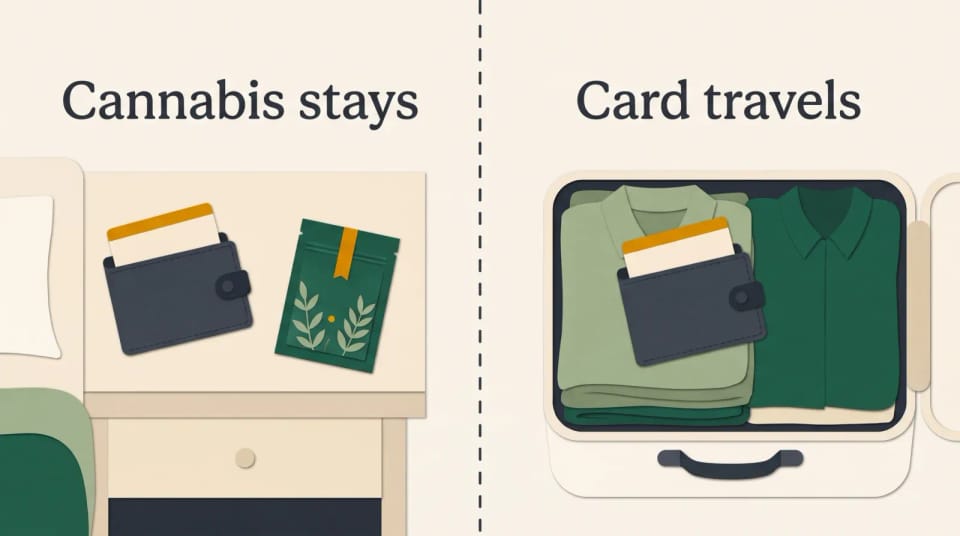
Your card goes home with you. Anything you bought stays in the state where you bought it.
How should a visiting patient plan the trip?
Start with the host state’s regulator page, then work backward from your travel date. This order avoids the most common surprise: arriving at an apply-first state with only a home card.
- Check the host state’s own rule. Confirm that it accepts your home program, and whether you show the card or apply first. Do not rely on another state’s list.
- Confirm your card qualifies. Make sure it is current and state-issued. If it expires during the trip, expect the host state’s permission to end with it; Hawaii says so directly.
- Apply early where required. Arkansas can take up to 14 days. Hawaii lets you apply 60 days ahead. Leave margin for errors.
- Bring the right documents. Carry your home card, a government photo ID, and any visitor card or form the host state requires. Louisiana, for example, asks visitors to sign a diagnosis certification at the store. See what Louisiana asks visitors to bring.
- Stay inside the limits, then leave it behind. Purchase and possession caps differ by state. Use what you buy in that state, under its local rules on where use is allowed.
If you keep notes on how products work for you, the High IQ app can track how a strain worked, so your notes come home even though the product cannot.
A note on health: a trip can disrupt routines, time zones and sleep. If your symptoms change, or you are unsure whether a new product suits your condition or your medicines, talk to a clinician or pharmacist before you change what you use. This guide covers access rules only, not treatment.
For context on why these programs are built so differently, see why medical and adult-use rules differ.
Key takeaways
- At least 16 states and DC have a verified buying route for visiting patients.
- Arkansas, Hawaii, Oklahoma, Utah and New Jersey require a visitor card or enrollment first.
- Reciprocity runs one way: DC accepts 40 programs; Illinois accepts none.
- Many hosts reject private telehealth cards and provider letters; Nevada is an exception.
- Buy there, use there: no state route makes carrying cannabis home legal.
FAQ
Can I use my medical marijuana card anywhere in the U.S.?
No. Each state decides for itself, and many accept no visiting cards at all. Illinois, for example, says it does not accept out-of-state medical cards. Check the host state’s regulator before you travel.
What is the difference between purchase and possession-only reciprocity?
Purchase reciprocity lets you buy at the host state’s medical dispensaries. Possession-only means the state may protect you for carrying a limited amount but gives you no way to buy there. Some lists label states “possession only” that now allow purchases, so confirm with the state’s own page.
Do states with recreational sales accept out-of-state medical cards?
Some do. Several states in the table above also run adult-use stores, and their medical dispensaries still serve visiting patients through the routes shown. The medical route can change which limits apply, so ask the store which rules cover your purchase.
Can you use an out-of-state medical card in Illinois?
No. The Illinois Department of Public Health says Illinois does not accept out-of-state medical cards. Your home card gives you no medical purchase route there. Our Illinois cannabis law guide covers what the state allows for adults.
Does my home-state card work in Pennsylvania or Florida?
This guide did not verify a visiting-patient purchase route in either state. That is not proof that none exists, but do not count on one. Ask the state program directly before you travel, and plan as if your home card will not work there.



