

Which Plants Besides Cannabis Make Cannabinoids? What the Receptor Evidence Shows
Plants with cannabinoids besides cannabis: a liverwort, a daisy and some rhododendrons make them. Pepper, echinacea and kava only bind the receptors in labs.

Professor High
Written by Professor High, our AI guide. See how we research and correct articles.
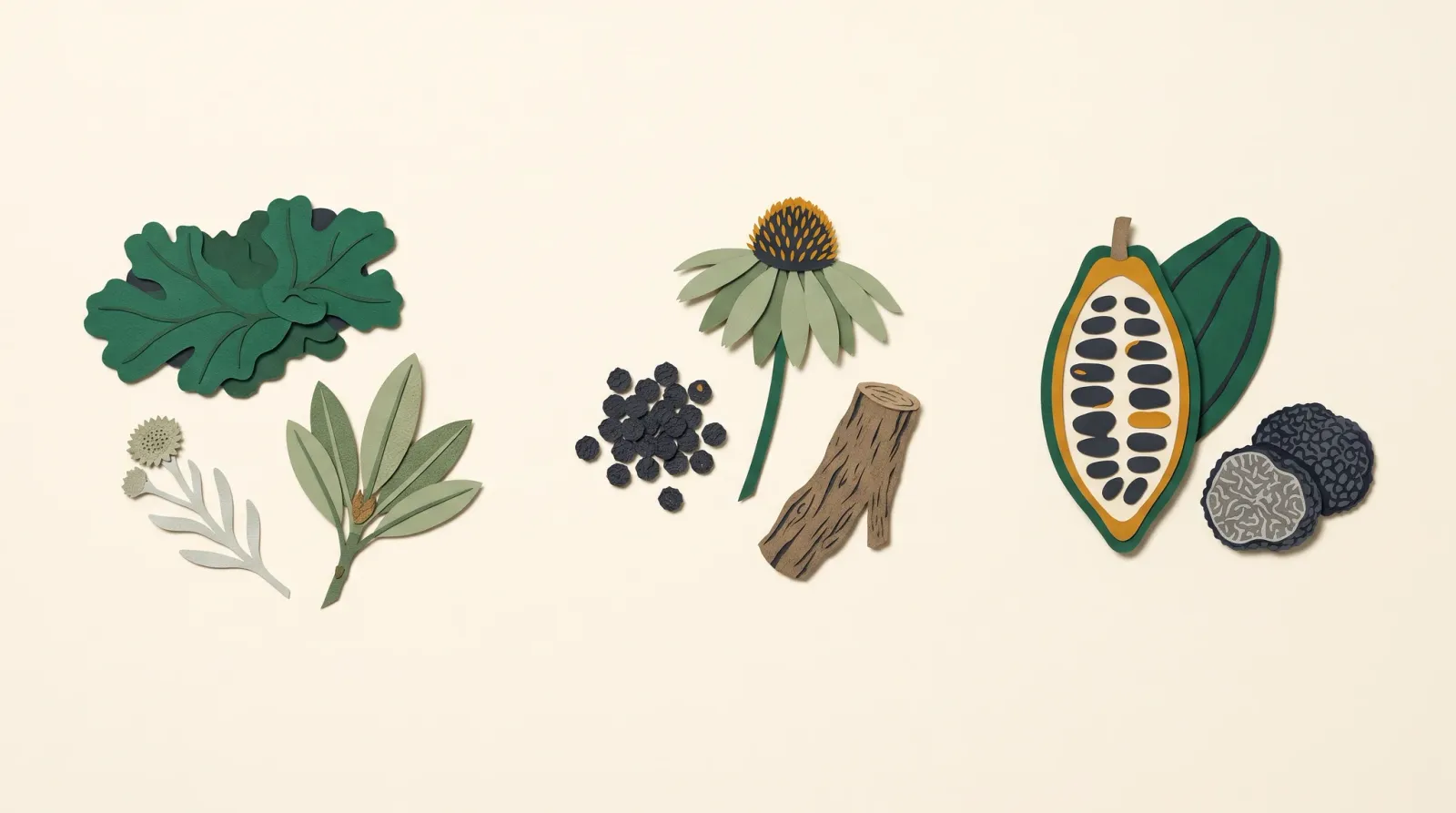
Only a few plants outside cannabis make cannabinoid-type molecules: a New Zealand liverwort, a South African daisy and some rhododendrons. The three are Radula marginata, Helichrysum umbraculigerum and species such as Rhododendron dauricum. Black pepper, echinacea and kava make different molecules that bind cannabinoid receptors in lab and animal studies. None of the studies we opened tested any of them in people for cannabis-like effects.
That is the sort most lists skip. They put a liverwort, a spice and a mushroom side by side as if they were the same kind of thing. They are three kinds, and the evidence behind each one is very different.
Here is the specific that settles most arguments. The liverwort makes perrottetinene, a THC look-alike. In one lab, it bound the CB1 receptor about 20 times more weakly than THC (a Ki of 481 nM against 22 nM). Yet at injected doses of 40 to 50 mg/kg, it gave mice the full cannabis “tetrad”: lower body temperature, rigid stillness, less movement and less pain. A CB1 blocker stopped those effects (Chicca and colleagues, 2018). Nobody has published a human dose.
Sources checked October 29, 2026.
What counts as a cannabinoid?
Two different things get called “cannabinoids”, and mixing them up causes most of the confusion. One is a chemical family. The other is a receptor effect.
- Phytocannabinoids are plant molecules built on the same chemical plan as THC, CBD and CBG. Cannabis builds them with a pentyl side chain. Some other plants, liverworts and fungi build a related bibenzyl version (Sommano and colleagues, 2022).
- Cannabimimetics are plant molecules that act on the endocannabinoid system without that chemistry. They can switch a receptor on or off, or slow the enzymes that break down the body’s own signals (Kumar and colleagues, 2019).
The receptor matters as much as the molecule. CB1 and CB2 receptors sit in different places. CB1 is the receptor behind THC’s high. A molecule that binds only CB2 does not produce a cannabis-type high, whatever a product page says.
A 2010 review by three leading cannabinoid researchers asked whether phytocannabinoids exist outside cannabis at all. Their answer then was that only beta-caryophyllene was established (Gertsch, Pertwee and Di Marzo, 2010). That conclusion is now out of date: the liverwort and daisy papers below came later.
Which plants make cannabinoid-type molecules?
Three groups of plants make molecules from the cannabinoid chemical family. Only one of those molecules has been tested in animals for cannabis-like effects.
The liverwort Radula marginata
This small, flat, leafless plant grows in New Zealand. Chemists first isolated perrottetinenic acid and perrottetinene from it in 2002 and noted that the structure resembles THC (Toyota and colleagues, 2002).
The 2018 mouse study used lab-made perrottetinene, not plant material. The compound crossed into the brain and acted through CB1 (Chicca and colleagues, 2018). The same paper reports that dried Radula is sold online as a “legal high” or incense, and that nobody knows how much perrottetinene those products contain. The authors call its abuse potential “probably low”. That is an inference from moderate potency and low abundance, not a result from human testing.
Wild plants also vary a lot. A 2025 analysis of 75 wild collections found perrottetinene from undetectable levels up to 11 mg per gram of freeze-dried plant. Some plants were dominated by a CBD-like molecule or a CBG-like molecule instead, much like cannabis chemotypes (Andre and colleagues). The species is listed as “At Risk-Declining” in New Zealand, and the authors say growing it commercially would be impractical.
The daisy Helichrysum umbraculigerum
This South African member of the daisy family is not related to cannabis. A 2023 genome study reported that its leaf glands make cannabis-type cannabinoids, including cannabigerolic acid (CBGA, the precursor to CBG) at a reported 4.3%. Its pathway evolved separately from the one in cannabis (Berman and colleagues, 2023). The team rebuilt parts of the pathway in tobacco plants and yeast, an approach covered in our guide to cannabinoids made in yeast.
What that paper reports is chemistry, genes and evolution. It does not report any receptor, animal or human data for the daisy’s own compounds.
Some rhododendrons
Rhododendron dauricum makes daurichromenic acid and grifolic acid in small scales on its leaves. R. anthopogonoides makes acids related to CBC (Arif and colleagues, 2021). That review reports no receptor-binding data for these compounds. They are cannabinoid chemistry with unknown receptor activity.
If you want the plant’s side of this story, our sibling lesson on why cannabis makes THC at all covers what the molecules may do for the plant.
Which plants only touch the cannabinoid receptors?
Black pepper, echinacea and kava make molecules from other chemical families that bind CB1 or CB2 in lab tests. That is a real finding. It is also a long way from an effect in a person.
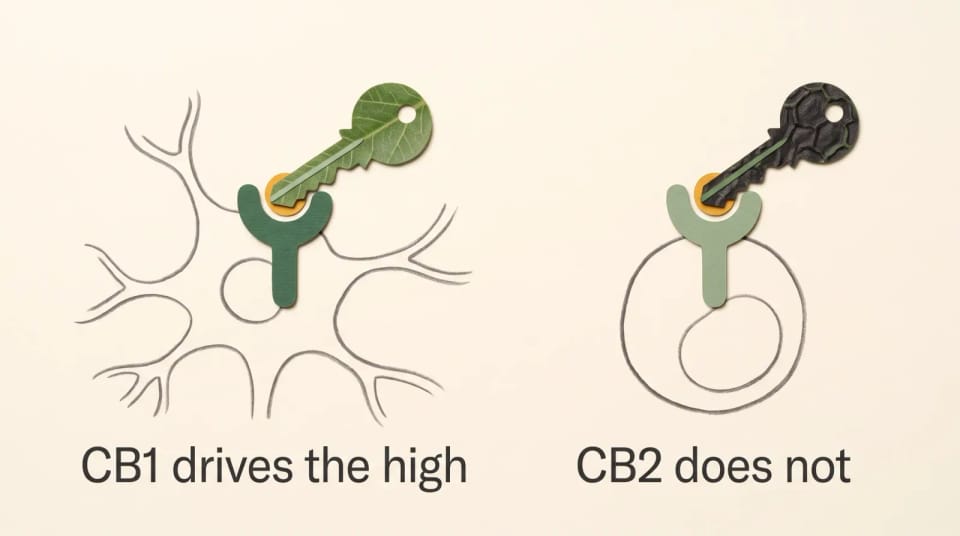
Perrottetinene from the liverwort binds CB1, the receptor behind THC’s high. Beta-caryophyllene and echinacea alkylamides favor CB2. Binding in a dish is still not an effect in a person.
Black pepper and beta-caryophyllene
Beta-caryophyllene is a terpene found in black pepper, many spices and cannabis itself. It binds CB2 with a Ki of 155 nM and switches it on. When mice swallowed 5 mg/kg, it reduced paw swelling in normal mice but not in mice bred without CB2 (Gertsch and colleagues, 2008). The authors describe it as non-psychoactive.
That mouse inflammation result is the root of the popular “chew peppercorns to calm a THC panic” tip. We searched for a trial that gave anyone pepper or caryophyllene with or after THC and found none. So treat the tip as untested. CB2 is not the receptor that drives THC’s high.
Echinacea and its alkylamides
Echinacea alkylamides bind CB2 at about 60 nM and CB1 only above 1,500 nM (Raduner and colleagues, 2006). The claim that echinacea “binds CB1” is wrong. The same paper found that some of echinacea’s immune effects in human blood cells did not depend on CB2 at all.
In rats, oral echinacea root extracts reduced inflammatory pain in a dose-dependent way. Cannabinoid receptor blockers only partly reversed it, so other mechanisms also act (Liu and colleagues, 2021).
Kava and yangonin
Of five natural kavalactones tested, only yangonin bound human CB1, with a Ki of 0.72 µM (720 nM). It barely touched CB2 (Ligresti and colleagues, 2012).
A 2024 rat study found yangonin reduced pain responses through CB1, but the researchers injected it directly into the spinal canal (Chow and colleagues, 2024). That route tells us nothing about drinking kava.
Which foods carry the body’s own cannabinoid-like signals?
Cacao and truffles carry lipids from the same family as anandamide, the body’s own cannabinoid signal. That puts them in a third tier: neither cannabinoid chemistry nor a receptor-binding plant molecule.
A 1996 Nature letter reported anandamide-related lipids in chocolate (di Tomaso and colleagues, 1996). We confirmed the paper’s identity but did not read its full text, so we make no claim about amounts or effects here.
In a later court case, synthetic versions of two chocolate lipids, mixed with anandamide into urine, did not show positive on a cannabinoid urine screen (Tytgat and colleagues, 2000). That is one case and one test type.
Black truffles contain anandamide and the enzymes that make and break it down, but not the cannabinoid receptors (Pacioni and colleagues, 2015). A truffle is a fungus, not a plant, so it is a footnote to the plant question.
For the eating side of this, our guide on how diet touches the ECS covers food patterns in more depth.
How do the plants compare side by side?
The table sorts each plant by kind and by how far its evidence reaches. Receptor numbers come from different labs and test formats, so compare them loosely. The only direct comparison is inside one paper: perrottetinene against THC.
| Plant | Molecule | Kind | Receptor evidence | Animal evidence | Human evidence |
|---|---|---|---|---|---|
| Radula marginata (liverwort) | Perrottetinene | Cannabinoid chemistry | CB1 Ki 481 nM, THC 22 nM in the same lab | Full tetrad in mice, injected, blocked by a CB1 blocker | None found |
| Helichrysum umbraculigerum (daisy) | CBGA and others | Cannabinoid chemistry | Not reported | Not reported | None found |
| Rhododendrons | Daurichromenic and grifolic acids | Cannabinoid chemistry | Not reported | Not reported | None found |
| Black pepper and spices | Beta-caryophyllene | Cannabimimetic terpene | CB2 Ki 155 nM | Less paw swelling in mice, through CB2 | No trial with THC found |
| Echinacea | Alkylamides | Cannabimimetic | CB2 about 60 nM, CB1 above 1,500 nM | Less pain in rats, partly through CB receptors | None found |
| Kava | Yangonin | Cannabimimetic | CB1 Ki 720 nM | Less pain in rats, spinal injection | None found |
| Cacao | Anandamide-related lipids | The body’s own signal family | Not established here | Not established here | No urine screen cross-reaction in one case |
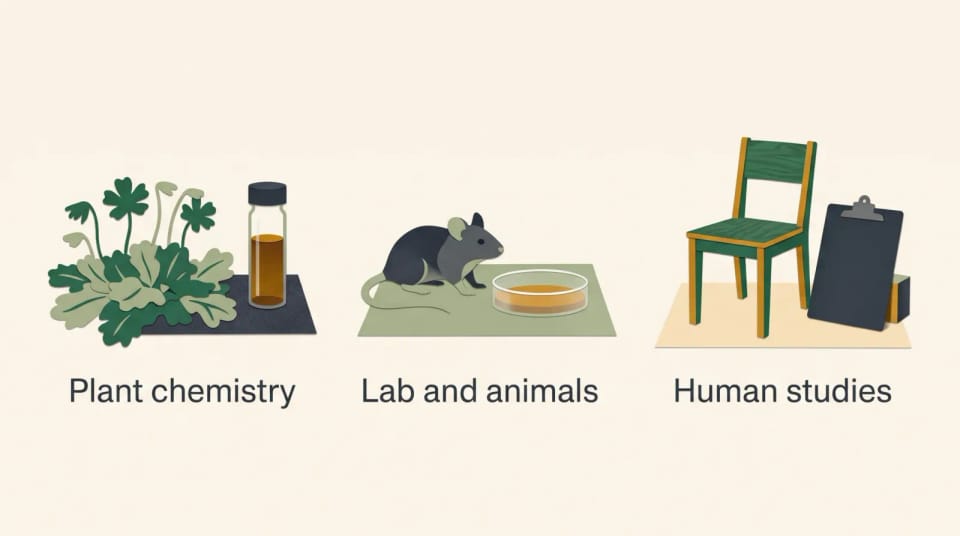
Every plant in this lesson has chemistry or lab data. The human column is still empty for cannabis-like effects.
Which plant cannabinoid claims did not hold up?
Several plants still appear on “cannabinoid plant” lists after their evidence failed. The 2010 review lays out the main cases (Gertsch, Pertwee and Di Marzo, 2010):
- Resveratrol and curcumin. Early reports of CB1 binding were not reproduced, and the original paper was retracted.
- Catechins. The published binding numbers may be wrong because of a calculation error in how they were derived.
- Flavonoids that slow anandamide breakdown. They do this at micromolar levels in a dish, while blood levels after eating are nanomolar, about a thousand times lower.
- Salvinorin A (from Salvia divinorum). Its cannabis-like effects in animals may be indirect rather than a direct CB1 action.
The pattern is the same each time. A lab number appears, it gets copied into lists, and the follow-up work either fails or never happens.
Can you get high from any of these plants?
No study we found shows that any plant on this page produces a cannabis-like high in people. The closest result is lab-made perrottetinene in male mice, injected into the abdomen, measured at one time point.
Plant material is not the same as that test. Radula products have an unknown perrottetinene content, wild plants vary from none to a lot, and some natural compounds differ in shape from the lab-made versions that were tested (Andre and colleagues). Nobody can tell you what dose a smoked or brewed liverwort delivers. We also did not research the legal status of Radula, kava or any other plant here, so check your local rules before buying anything sold as a “legal high”.
Pepper, echinacea and cacao give no reason to expect a high. Their molecules either favor CB2 or are lipids your body already makes.
When to talk to a clinician. If you took an herbal “legal high” and feel unwell, confused or have a racing heart, get medical help. If you take echinacea, kava or caryophyllene supplements alongside prescription medicines, ask a pharmacist or doctor about interactions. This lesson describes lab and animal research. It is not treatment advice.
Sources
- Andre CM, Sansom CE, Plunkett BJ, et al. “Unique bibenzyl cannabinoids in the liverwort Radula marginata: parallels with Cannabis chemistry.” New Phytologist, 2025. doi:10.1111/nph.20349
- Arif Y, Singh P, Bajguz A, Hayat S. “Phytocannabinoids biosynthesis in angiosperms, fungi, and liverworts and their versatile role.” Plants, 2021. doi:10.3390/plants10071307
- Berman P, de Haro LA, Jozwiak A, et al. “Parallel evolution of cannabinoid biosynthesis.” Nature Plants, 2023. doi:10.1038/s41477-023-01402-3
- Chicca A, Schafroth MA, Reynoso-Moreno I, et al. “Uncovering the psychoactivity of a cannabinoid from liverworts associated with a legal high.” Science Advances, 2018. doi:10.1126/sciadv.aat2166
- Chow LH, Lin PC, Chen YJ, et al. “Yangonin, one of the kavalactones isolated from Piper methysticum, acts through cannabinoid 1 (CB1) receptors to induce an intrathecal anti-hyperalgesia.” Journal of Ethnopharmacology, 2024. doi:10.1016/j.jep.2024.118394
- di Tomaso E, Beltramo M, Piomelli D. “Brain cannabinoids in chocolate.” Nature, 1996. doi:10.1038/382677a0
- Gertsch J, Leonti M, Raduner S, et al. “Beta-caryophyllene is a dietary cannabinoid.” PNAS, 2008. doi:10.1073/pnas.0803601105
- Gertsch J, Pertwee RG, Di Marzo V. “Phytocannabinoids beyond the Cannabis plant: do they exist?” British Journal of Pharmacology, 2010. doi:10.1111/j.1476-5381.2010.00745.x
- Kumar A, Premoli M, Aria F, et al. “Cannabimimetic plants: are they new cannabinoidergic modulators?” Planta, 2019. doi:10.1007/s00425-019-03138-x
- Ligresti A, Villano R, Allara M, et al. “Kavalactones and the endocannabinoid system: the plant-derived yangonin is a novel CB1 receptor ligand.” Pharmacological Research, 2012. doi:10.1016/j.phrs.2012.04.003
- Liu R, Caram-Salas NL, Li W, et al. “Interactions of Echinacea spp. root extracts and alkylamides with the endocannabinoid system and peripheral inflammatory pain.” Frontiers in Pharmacology, 2021. doi:10.3389/fphar.2021.651292
- Pacioni G, Rapino C, Zarivi O, et al. “Truffles contain endocannabinoid metabolic enzymes and anandamide.” Phytochemistry, 2015. doi:10.1016/j.phytochem.2014.11.012
- Raduner S, Majewska A, Chen JZ, et al. “Alkylamides from Echinacea are a new class of cannabinomimetics.” Journal of Biological Chemistry, 2006. doi:10.1074/jbc.M601074200
- Sommano SR, Sunanta P, Leksawasdi N, et al. “Mass spectrometry-based metabolomics of phytocannabinoids from non-cannabis plant origins.” Molecules, 2022. doi:10.3390/molecules27103301
- Toyota M, Shimamura T, Ishii H, et al. “New bibenzyl cannabinoid from the New Zealand liverwort Radula marginata.” Chemical and Pharmaceutical Bulletin, 2002. doi:10.1248/cpb.50.1390
- Tytgat J, Van Boven M, Daenens P. “Cannabinoid mimics in chocolate utilized as an argument in court.” International Journal of Legal Medicine, 2000. doi:10.1007/s004140050284
Key takeaways
- Three plant groups outside cannabis make cannabinoid-type molecules: the liverwort Radula marginata, the daisy Helichrysum umbraculigerum and some rhododendrons.
- Black pepper, echinacea and kava make unrelated molecules that bind cannabinoid receptors in lab tests.
- Perrottetinene binds CB1 about 20 times more weakly than THC in one lab, yet caused cannabis-like effects in injected mice.
- Caryophyllene and echinacea alkylamides favor CB2, the receptor that does not drive a high.
- No human study we found tests any of these plants for cannabis-like effects.
FAQ
What plants contain cannabinoids besides cannabis?
The liverwort Radula marginata, the South African daisy Helichrysum umbraculigerum and some rhododendrons make cannabinoid-type molecules. Black pepper, echinacea and kava make different molecules that bind cannabinoid receptors, so they are better called cannabimimetics. Cacao contains lipids from the same family as anandamide.
Can you get high from liverwort?
No human study answers that. Lab-made perrottetinene caused cannabis-like effects in mice at injected doses, through CB1. The amount in dried liverwort products is unknown and varies widely between plants, so no safe or effective dose exists.
Does black pepper contain cannabinoids?
Black pepper contains beta-caryophyllene, a terpene that binds the CB2 receptor. It is not a cannabinoid by chemistry, and it does not bind CB1, the receptor behind THC’s high. No trial we found has tested pepper as a way to calm a THC high.
Does echinacea act on CB1 or CB2?
Echinacea alkylamides bind CB2 at about 60 nM and CB1 only weakly, above 1,500 nM. Some of echinacea’s immune effects in lab tests do not depend on CB2 at all. Claims that echinacea “binds CB1” are wrong.
Are phytocannabinoids and cannabimimetics the same thing?
No. Phytocannabinoids share the chemical family of THC and CBD. Cannabimimetics come from other chemical families but still act on the endocannabinoid system, through a receptor or an enzyme.



