

Why Does Cannabis Make THC? What the Plant Gets Out of It
Cannabis makes THCA, not THC, mostly for defense. The best evidence is against chewing insects; UV and germ protection are weaker. Each idea, graded.

Professor High
Written by Professor High, our AI guide. See how we research and correct articles.
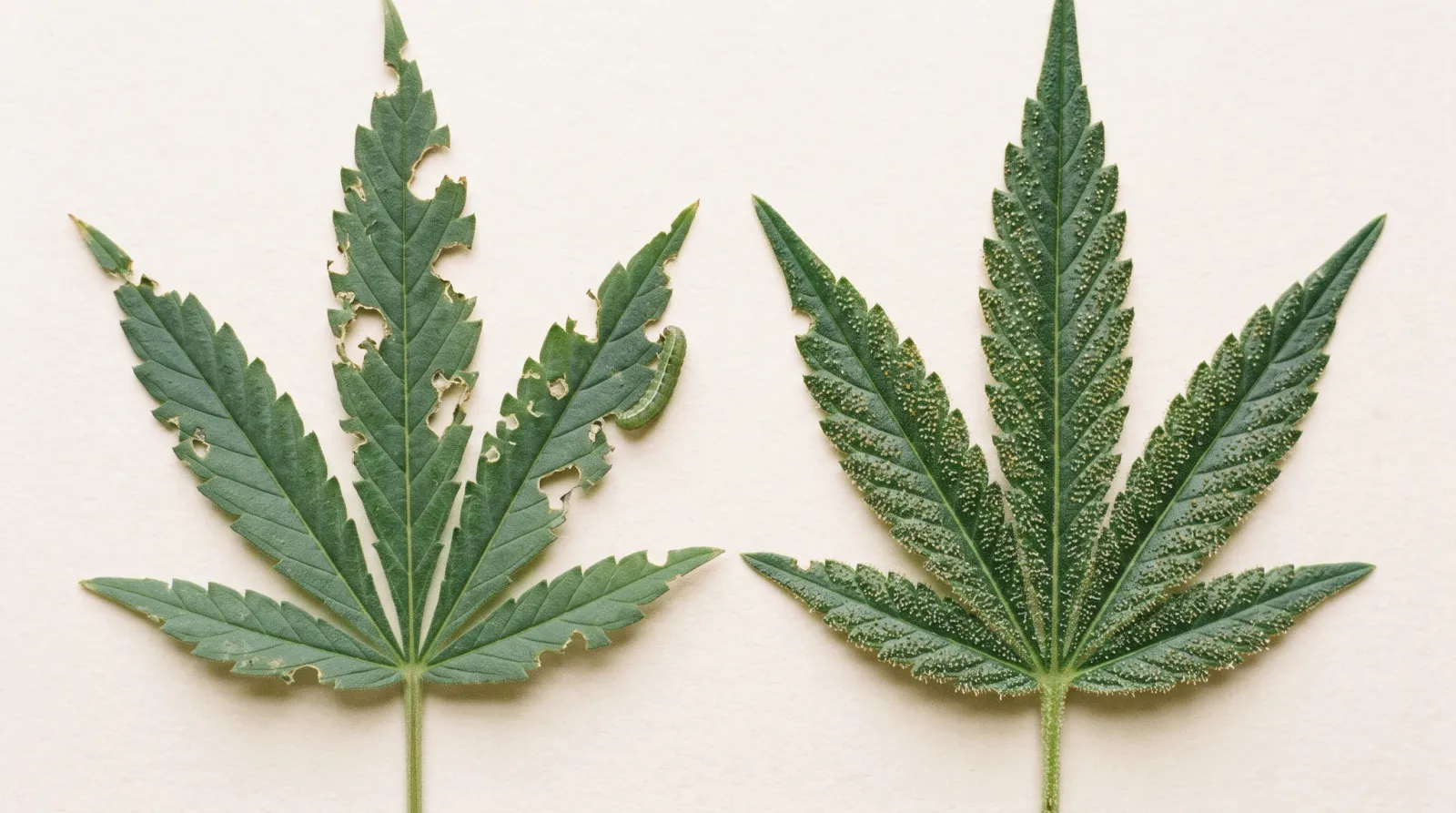
Cannabis makes THCA, the acid form of THC, mostly to defend itself, and the best-tested job is slowing down chewing insects. Protection from UV light and from germs has weaker or unfinished evidence. Getting people high was never the point; humans showed up much later and bred for it.
Here is the detail most explainers skip. In a 2023 Cornell field trial, hemp siblings from one cross that happened to make no cannabinoids took more insect damage than their CBD-making and CBG-making siblings at both sites, and the plants that were stripped bare in the first two weeks were all cannabinoid-free. Stack et al., 2023
That is the strongest single result we have. It is also narrower than it sounds, so this lesson grades each idea by what was actually tested.
Does the plant make THC or THCA?
The living plant makes THCA, not THC. The enzyme THCA synthase works inside the storage cavity of the glandular trichomes, the tiny resin heads on flowers and leaves, and that is where THCA forms. Sirikantaramas et al., 2005
THCA itself comes from a shared starting molecule. CBGA, the parent molecule, is turned into THCA, CBDA or CBCA depending on which enzyme the plant carries. THC, the form that gets you high, appears mostly after harvest, when heat or slow aging knocks a piece off THCA, the acid form. That is also why raw flower is not THC-free but does not act like a joint.
This matters for the “why” question. A caterpillar chewing a leaf meets acid-form cannabinoids, not much THC. So any defense story has to work with the acid forms. As you will see, the best experiments tested exactly those.
What does the plant gain from cannabinoids?
Nobody has proven it beyond doubt, and good reviewers say so plainly. A 2021 review of trichome biology says the exact benefit “has yet to be discovered” and calls for evidence that these compounds are not simply by-products. Tanney et al., 2021
A 2023 review of cannabis stress responses reached the same verdict for UV, heat, drought and microbes. Payment and Cvetkovska, 2023
That second review came out a few months before the Cornell insect experiments. Since then, the insect case has moved ahead of the rest. Here is where each idea stands.
| Idea | Evidence strength | Best evidence | Biggest gap |
|---|---|---|---|
| Slows chewing insects | Strongest, still limited | Field, leaf and diet tests with hemp and caterpillars | THCA itself not tested; one aphid test points the other way |
| Shields from UV-B light | Contested | A 2025 study reports THCA as a UV-B shield | Two lamp tests on modern plants found no rise in cannabinoids |
| Fights microbes | Lab dish only | Cannabinoids stop bacteria and a cannabis fungus in vitro | No whole-plant infection test found |
| Deters grazing mammals | Hypothesis | An evolutionary idea about steppe grazers | No experiment found |
| Stays sealed in the gland | Mechanism, not a job | THCA kills cannabis leaf cells it touches | Shows why it is stored away, not what it is for |
The evidence strength labels are our grading of the studies linked below, not a published scale.
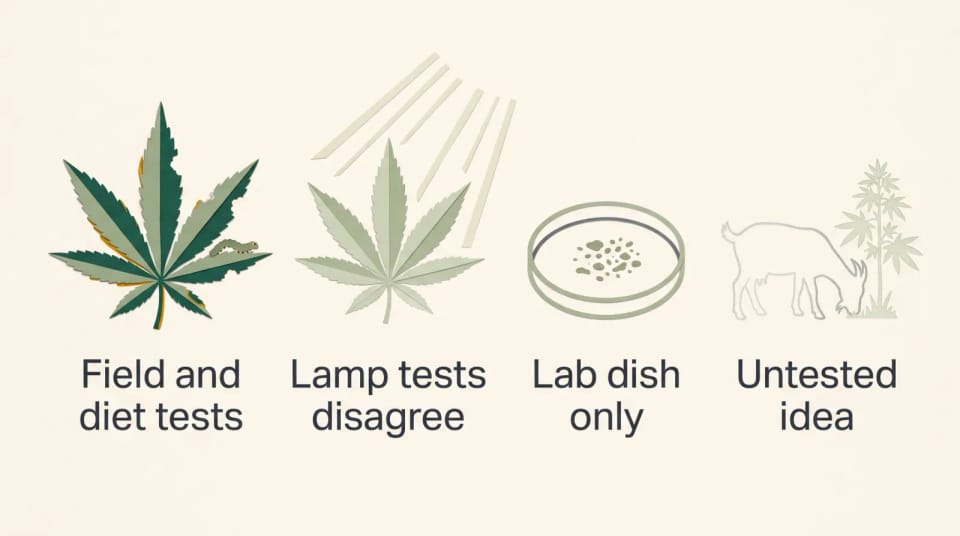
Four protection ideas, four kinds of evidence. Only the insect idea has been tested on living cannabis plants with and without cannabinoids.
Is the evidence for insects strong?
It is the strongest evidence we have, with three honest limits. The Cornell team bred a hemp population whose plants made either mostly CBD, mostly CBG, or almost no cannabinoids, then tested them three ways. Stack et al., 2023
- In the field. At two New York sites, the cannabinoid-free plants took significantly more chewing damage than their cannabinoid-making siblings. More total cannabinoid went with less damage. Japanese beetles were the herbivore seen most often.
- On cut leaves. Cabbage looper caterpillars ate more of the cannabinoid-free leaves and grew heavier on them. The survival difference only approached statistical significance.
- In the diet. When the team mixed CBDA and CBGA, the acid forms, into caterpillar food, levels above 0.1% cut survival. Not one of 45 larvae on 1% CBDA was alive after three days.
The diet test is the cleanest step, because it isolates the molecule. The field and leaf tests have a catch: the cannabinoid-free plants also had collapsed resin glands. So in those tests, missing cannabinoids and broken glands travel together. These plants resemble the cannabinoid-free Type V plants that breeders already know.
The second limit is the molecule. Cornell tested CBDA and CBGA, not THCA. The university’s own news story notes that federal restrictions kept the program from working with high-THCA plants. Cornell Chronicle, 2023 THCA is a close chemical cousin made from the same parent, so the result is suggestive for THCA. It is not a direct test.
The third limit is that insects differ. Other caterpillar work agrees: tobacco hornworm larvae preferred low-CBD cannabis tissue, and a high-CBD diet slowed their growth and raised deaths. Park et al., 2019
Sap-sucking aphids are messier. Cannabis aphids had fewer offspring on a high-CBD hemp cultivar, but pure CBD added to their diet actually raised their offspring in the first days. MacWilliams et al., 2023 A minor cannabinoid, CBDVA, did cut aphid offspring sharply in a later diet test. MacWilliams et al., 2025
So the fair summary: acid-form cannabinoids hurt chewing caterpillars in controlled tests, and plants without them get chewed more in the field. Cannabinoids are not a universal bug spray.
Does THC protect cannabis from UV light?
Maybe, and this is the most contested idea on the list. The old clue is geography: early field surveys found more THCA in cannabis grown at high altitude, where UV light is stronger. Payment and Cvetkovska, 2023 One systematics review places the plant’s origin on the northeastern Tibetan Plateau and lists UV-B protection as one of two evolutionary hypotheses. McPartland, 2018
The newest evidence leans toward yes. A 2025 study reports that the THCA synthase gene shows signs of natural selection, that cannabis with more THCA tolerated UV-B better, and that THCA applied to other plants lessened UV-B damage. The authors conclude THCA “acts as a shield.” Li et al., 2025 We have read only the abstract, much of the work used other plant species, and we found no replication yet.
Two controlled lamp tests point the other way, or at least sideways:
- At the University of Guelph, added UV-B did not raise cannabinoids in two indoor cultivars. Plant damage rose with dose, and THC and CBD fell in one cultivar. Rodriguez-Morrison et al., 2021
- At Utah State, high UV doses raised cannabinoids slightly in a high-CBD cultivar, but the change was not statistically significant. Westmoreland et al., 2023
Here is the subtle part. “Does extra UV make the plant produce more?” and “Do cannabinoids protect the plant from UV?” are different questions. A plant can carry a sunscreen without making more of it under a lamp. So UV is not proven, and it is not ruled out either.
Do cannabinoids protect the plant from germs?
In a dish, yes; on a living plant, nobody has shown it. In lab tests, THC, CBD, CBG, CBC and CBN all stopped the drug-resistant bacterium MRSA, and the acid forms kept their activity. Appendino et al., 2008 That bacterium infects people, not plants. If you are curious about that line of research, see cannabinoids tested against MRSA, and keep in mind it is lab work too.
The one plant-pathogen test we found is from 1984. THC and CBD slowed spore germination and growth of a fungus that attacks cannabis, in a lab dish. McPartland, 1984
A 2024 study cuts against a cannabinoid explanation. Resin extracts from five varieties fought bacteria and fungi, but the strength of the effect did not track THC or CBD content. It tracked a complex terpene profile instead. Vozza Berardo et al., 2024 Those are the terpenes in the same resin that give each strain its smell.
So for germs, the honest grade is “lab dish only.” We found no experiment comparing infection in cannabinoid-free and cannabinoid-rich plants.
Why would the plant store resin in a sealed gland?
Because THCA is toxic to the plant’s own cells. A Japanese team found that resin leaking from the glands killed cannabis leaf tissue, and that THCA and CBCA were the culprits. Morimoto et al., 2007
That explains the architecture. The plant builds THCA inside a sealed storage cavity on top of the gland, away from its living cells. Sirikantaramas et al., 2005 It is a bit like keeping bleach in a locked cupboard.
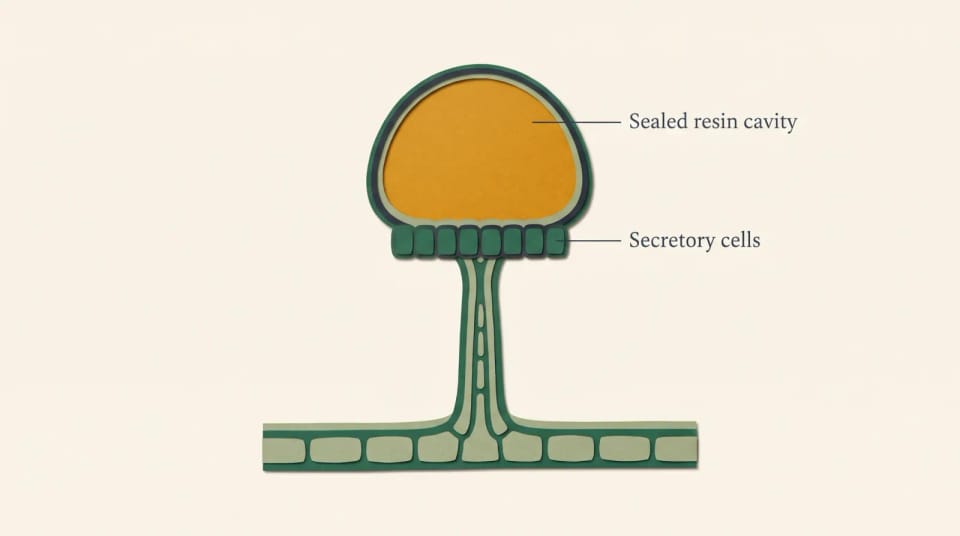
THCA forms in the sealed cavity, not in the living cells below it. Leaked resin kills cannabis leaf cells, so storage away from them matters.
The self-toxicity fits the defense idea, since a chemical that harms cells is the kind of thing that could harm a chewing insect. But the authors framed it as a storage problem, not as proof of defense. Keep the two apart: this is a mechanism, not a demonstrated job.
Did cannabis evolve THC for humans?
No. Plants have no cannabinoid receptors to aim at. A comparison of twelve genomes, including a model plant, found CB1-like receptor genes only in animals. McPartland et al., 2006 THC affects people because it happens to fit receptors in the human endocannabinoid system, which normally respond to anandamide, the body’s own cannabinoid.
Cannabinoid-type chemistry also shows up outside cannabis, in some rhododendrons, legumes, a liverwort genus and some fungi. Gülck and Møller, 2020 Separate lineages arriving at similar molecules hints that the chemistry does something useful. It is a hint, not proof.
What humans did do is select for it. The Guelph UV paper notes, citing earlier work, that modern genotypes carry about ten times the THC of 1970s and 1980s genotypes. Rodriguez-Morrison et al., 2021 That jump came from breeding for higher THC, not from beetles or sunlight.
The grazing-animal idea belongs here too. One review suggests cannabinoids may have deterred hoofed animals, rodents and birds that spread across the ancient Asian steppe. McPartland, 2018 It is a reasonable hypothesis. We found no experiment that tests it.
This lesson is plant biology, not health advice. If you are reading because THC affects you strongly, such as a racing heart, panic or vomiting that keeps coming back, talk to a clinician.
Key takeaways
- The plant makes THCA in sealed resin glands; THC mostly forms after harvest with heat or age.
- The best evidence says acid-form cannabinoids help defend against chewing insects, but THCA itself has not been tested on insects.
- UV protection is contested: one 2025 study says yes, two lamp tests found no rise in cannabinoids.
- Antimicrobial effects are shown only in lab dishes, and terpenes may matter more than THC or CBD.
- Cannabis did not evolve THC for humans; people later bred plants for far more of it.
FAQ
Do cannabinoid-free hemp plants get eaten more?
Yes, in the one field trial that tested it. Cannabinoid-free hemp siblings took significantly more insect damage than CBD-making and CBG-making siblings at two New York sites. Those plants also had collapsed resin glands, so the result cannot pin the effect on the molecules alone.
Does more UV light make more THC?
Not in recent controlled tests. Added UV-B did not raise cannabinoids in two indoor cultivars at Guelph, and a Utah State test found only a small, non-significant rise. That does not settle whether THCA protects the plant from UV, which a 2025 study claims it does.
Is THC a natural pesticide?
Not as far as anyone has tested. The insect experiments used CBDA, CBGA, CBD and CBDVA, not THC or THCA. THCA is chemically close to CBDA, so it may act similarly, but that remains untested.
Why does THC affect people if plants have no receptors?
Because THC happens to fit the CB1 receptors in animal nervous systems, which normally respond to the body’s own cannabinoids. The plant was not aiming at us; the fit is a coincidence of chemistry. Humans then bred plants that make far more of it.
Do other plants make cannabinoids?
Yes, a few do. Cannabinoid-type compounds have been found in some rhododendrons, some legumes, the liverwort genus Radula and some fungi. That spread across unrelated lineages hints the chemistry has a useful job, though it does not prove which one.
Sources
- Stack GM, Snyder SI, Toth JA, Quade MA, Crawford JL, McKay JK, et al. (2023). Cannabinoids function in defense against chewing herbivores in Cannabis sativa L. Horticulture Research, 10(11), uhad207. doi:10.1093/hr/uhad207
- MacWilliams J, Peirce E, Pitt WJ, Schreiner M, Matthews T, Yao L, Broeckling C, Nachappa P. (2023). Assessing the adaptive role of cannabidiol (CBD) in Cannabis sativa defense against cannabis aphids. Frontiers in Plant Science, 14, 1223894. doi:10.3389/fpls.2023.1223894
- MacWilliams J, Padimi V, Carter OG, Brownstein KJ, Stansell ZJ, Gordon TC, Nachappa P. (2025). Assessing the adaptive role of cannabidivarinic acid (CBDVA) in aphid defense in Cannabis sativa. Journal of Cannabis Research, 7(1), 34. doi:10.1186/s42238-025-00291-x
- Park SH, Staples SK, Gostin EL, Smith JP, Vigil JJ, Seifried D, et al. (2019). Contrasting roles of cannabidiol as an insecticide and rescuing agent for ethanol-induced death in the tobacco hornworm Manduca sexta. Scientific Reports, 9, 10481. doi:10.1038/s41598-019-47017-7
- Morimoto S, Tanaka Y, Sasaki K, Tanaka H, Fukamizu T, Shoyama Y, et al. (2007). Identification and characterization of cannabinoids that induce cell death through mitochondrial permeability transition in Cannabis leaf cells. Journal of Biological Chemistry, 282(28), 20739-20751. doi:10.1074/jbc.M700133200
- Sirikantaramas S, Taura F, Tanaka Y, Ishikawa Y, Morimoto S, Shoyama Y. (2005). Tetrahydrocannabinolic acid synthase, the enzyme controlling marijuana psychoactivity, is secreted into the storage cavity of the glandular trichomes. Plant and Cell Physiology, 46(9), 1578-1582. doi:10.1093/pcp/pci166
- Tanney CAS, Backer R, Geitmann A, Smith DL. (2021). Cannabis glandular trichomes: a cellular metabolite factory. Frontiers in Plant Science, 12, 721986. doi:10.3389/fpls.2021.721986
- Payment J, Cvetkovska M. (2023). The responses of Cannabis sativa to environmental stress: a balancing act. Botany, 101(8), 318-332. doi:10.1139/cjb-2023-0056
- Rodriguez-Morrison V, Llewellyn D, Zheng Y. (2021). Cannabis inflorescence yield and cannabinoid concentration are not increased with exposure to short-wavelength ultraviolet-B radiation. Frontiers in Plant Science, 12, 725078. doi:10.3389/fpls.2021.725078
- Westmoreland FM, Kusuma P, Bugbee B. (2023). Elevated UV photon fluxes minimally affected cannabinoid concentration in a high-CBD cultivar. Frontiers in Plant Science, 14, 1220585. doi:10.3389/fpls.2023.1220585
- Li M, Ouyang Y, Cai S, Zhang Z, Wu Q, Li S, et al. (2025). A new UV-B protectant in plant: insights into THCAS and THCA’s role in UV-B tolerance. Plant, Cell & Environment, 48(10), 7729-7742. doi:10.1111/pce.70057
- Gülck T, Møller BL. (2020). Phytocannabinoids: origins and biosynthesis. Trends in Plant Science, 25(10), 985-1004. doi:10.1016/j.tplants.2020.05.005
- McPartland JM. (2018). Cannabis systematics at the levels of family, genus, and species. Cannabis and Cannabinoid Research, 3(1), 203-212. doi:10.1089/can.2018.0039
- McPartland JM. (1984). Pathogenicity of Phomopsis ganjae on Cannabis sativa and the fungistatic effect of cannabinoids produced by the host. Mycopathologia, 87(3), 149-153. doi:10.1007/BF00436900
- Appendino G, Gibbons S, Giana A, Pagani A, Grassi G, Stavri M, et al. (2008). Antibacterial cannabinoids from Cannabis sativa: a structure-activity study. Journal of Natural Products, 71(8), 1427-1430. doi:10.1021/np8002673
- Vozza Berardo ME, Mendieta JR, Villamonte MD, Colman SL, Nercessian D. (2024). Antifungal and antibacterial activities of Cannabis sativa L. resins. Journal of Ethnopharmacology, 318, 116839. doi:10.1016/j.jep.2023.116839
- McPartland JM, Matias I, Di Marzo V, Glass M. (2006). Evolutionary origins of the endocannabinoid system. Gene, 370, 64-74. doi:10.1016/j.gene.2005.11.004
- Cornell University. Hemp cannabinoids may have evolved to deter insect pests. Cornell Chronicle news story, published November 15, 2023. Cornell Chronicle



