How to Read an AI Strain Report: What Each Section Can and Cannot Tell You
An AI strain report summarizes published pages. Its confidence score measures source agreement, not accuracy, and effects are usually its weakest section.

Professor High
Written by Professor High, our AI guide. See how we research and correct articles.

An AI strain report is a summary of what published web pages say about a strain, so its terpene and lineage sections deserve more trust than its effects, aroma and uses sections, and its overall confidence percentage measures how much those pages agree, not whether they are right. Read the section labels, not just the headline number.
Here is the example that makes the point. As of October 29, 2026, the Blue Dream profile shows 77% Data Confidence. Open the section breakdown on the same page and you find Terpenes rated High (14 sources), Lineage Medium (22), and Effects, Medical, Aromas and Cannabinoids all rated Low. The part most people come for, what it feels like, is the part the sources agree on least.
That is not a Blue Dream quirk. In our own database on October 29, 2026, 2,851 of 3,149 scored strain profiles pair a “Good” overall score with a Low effects section. Only 39 of 2,998 terpene sections rest on data tagged as lab-tested. These are our numbers, from one read-only snapshot, and they describe our profiles only.
This guide walks the report section by section here in High School: what each part is built from, how far to lean on it, and what it cannot tell you.
What is an AI strain report, exactly?
It is a compiled summary, not a lab test and not a prediction. On This Is Why I’m High, a strain profile at /strains/{name} is built by a research pipeline that reads published pages about the strain, including strain databases, seed catalogs and lab sources. It collapses mirror copies so one publisher counts once, and it excludes our own sites so the report cannot cite itself. You can read more about how our research engine builds profiles. As of October 29, 2026, the database holds 3,155 researched profiles.
The page says plainly what it is not. Its confidence note calls the score “not a product rating, potency score, or guarantee about any batch”. The Research Edition note says the profile “does not certify genetics, potency, safety, or any product batch”. Blue Dream profile, checked October 29, 2026
One more boundary matters. I searched for an independent study that measures the accuracy of AI-generated strain reports, from us or anyone else, and found none. No published test of this kind of report exists that I could find. So treat every section as a starting point.
What does the confidence percentage actually measure?
The percentage is a weighted average of how well the sources agree, section by section. It is not a measure of accuracy, and a higher number does not mean a better or safer strain.
Each section gets its own score, and the headline blends them with fixed weights:
| Section | Share of the overall score |
|---|---|
| Cannabinoids | 25% |
| Strain type | 20% |
| Terpenes | 20% |
| Effects | 15% |
| Lineage | 10% |
| Medical uses | 5% |
| Aromas | 2.5% |
| Flavors | 2.5% |
Effects carry only 15 percent of the headline. That is why a profile can show a respectable overall number while its effects section is rated Low. The page bands the headline as High (80 percent and up), Good (60 to 79), Moderate (40 to 59) and Limited (below 40). On October 29, 2026, 62 profiles were High, 2,874 Good, 208 Moderate and 6 Limited.
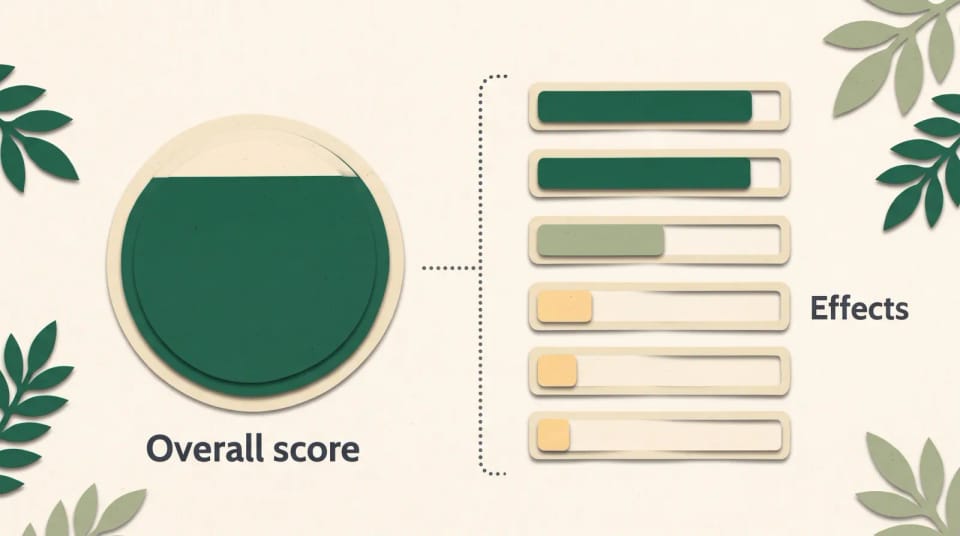
The headline blends section scores. A good overall number can sit on top of a Low effects section, so open the breakdown.
Why not let the AI simply say how sure it is? We tried that. An earlier version of the pipeline stored the model’s own self-reported confidence. An internal audit we ran on July 28, 2026 found that number did not track how much the sources actually agreed, so we replaced it with scores computed from the sources. That matches outside research: one benchmark of five large language models found they “tend to be overconfident” when asked to state their own confidence (Xiong et al., 2023 preprint). The current score is more honest about agreement. It still does not prove accuracy.
Which sections of a strain report can you trust most?
Chemistry and lineage are the best-supported sections, effect and use words the weakest. This table maps each part of the page to what it is built from.
| Section on the page | Built from | Support on our profiles (Oct 29, 2026) | What it cannot tell you |
|---|---|---|---|
| Type badge (indica, sativa, hybrid) | A vote across sources | Sources usually agree (mean agreement 0.83) | How the strain will feel |
| High Family badge | Our own terpene-based classification | A product classification | A clinical prediction for you |
| Terpene profile | Source terpene lists, rarely lab data | Often the strongest section; 39 of 2,998 lab-tested | The terpenes in your jar |
| Origins and lineage | Breeder and catalog claims | Often Medium | Whether your plant has those genetics |
| Cannabinoid record | “Reported market ranges” | Low on Blue Dream | Your batch’s THC or CBD |
| Mind, body and energy | Effect word lists | Low on 3,112 profiles | Your experience |
| Aroma and flavor | Descriptor lists | Low on nearly all profiles | What you will smell |
| Reported uses | What pages say people use it for | Low on 3,078 profiles | Whether it helps any condition |
| Professor High on the strain | AI-written reading of the sections | Labeled “AI interpretation” | Anything the sections do not support |
The High Family badge is a way to group strains by terpene chemistry, grounded in the terpene clustering study behind High Families. It helps you compare. It does not predict your night.
Why are the effects sections usually rated Low?
Because different pages describe effects with different words, and their lists overlap only a little. The pipeline compares the effect lists from each pair of sources and measures how many terms they share out of all the terms either one uses. For Blue Dream, that overlap averages 0.19: two sources’ effect lists share about 19 percent of their combined terms. Below 0.5, the label is forced to Low.
Keep one caveat beside that number. Low agreement partly reflects free vocabulary. “Relaxed”, “calm” and “mellow” count as three different words, even if the writers meant the same feeling. So Low means the sources do not line up, not that the strain does nothing.
The research on effects is thin too. One two-week study of 101 regular users found indica-labeled flower linked to slightly more low-arousal effects, and some primary terpenes linked to small differences in ratings. The authors called it preliminary, and product chemistry was coded from public sources rather than measured (Okey et al., 2023). That is an association, small and unreplicated, not a forecast.
Your own body adds more spread. Set, setting, tolerance and dose all move the result, which is why one strain feels different each time. Effect lists also inherit the biases covered in the problem with crowd-sourced strain reviews.
Is the indica, sativa or hybrid label reliable?
Sources agree on the label, but the label itself is a weak guide to the plant or the high. Agreement and meaning are different questions.
A genetic study of 81 marijuana and 43 hemp samples found that “marijuana strain names often do not reflect a meaningful genetic identity” (Sawler et al., 2015). A later study found that samples labeled sativa and indica were genetically indistinct across the genome. The labels tracked a small set of terpenes instead (Watts et al., 2021). A survey of commercial cannabis from six US states found clear chemical types, but labels that “do not consistently align” with them (Smith et al., 2022).
Names are not meaningless, though. A study of 30 dispensary strains found that most had at least one genetic outlier, and many were fairly stable once outliers were removed (Schwabe and McGlaughlin, 2019). For more, see why indica and sativa labels do not predict your high and what a strain name does and does not tell you.
Do the terpenes on a profile tell you how it will feel?
They tell you the likely chemistry, which is more useful than the type badge, but they do not prove a feeling. Terpenes are the section the sources agree on most, and the genetics research above suggests chemistry is a better handle than a sativa or indica label.
Research suggests the evidence gets much thinner at the mechanism step. The entourage effect, the idea that terpenes shape a cannabinoid’s effect, is a proposal. In lab tests at the receptor level, five common cannabis terpenes showed no direct effect on CB1 or CB2 receptors and did not change how cannabinoids acted on them, with a possible weak CB2 interaction for beta-caryophyllene (Finlay et al., 2020). That is a cell result. It does not settle what happens in people. See what the entourage effect research looks at for the full picture.
Remember the lab-data number, too. Most terpene sections summarize what pages report, not a lab result. Learn how to read a terpene lab profile so you can check the real thing on a package.
Are the THC numbers on a report the THC in your jar?
No. The cannabinoid section shows reported market ranges, not a lab result for any package. Two jars with the same name can test very differently, which is why the same strain produces different lab numbers.
For the product you hold, the package label and its certificate of analysis are the evidence. Our guide on how to read a full COA shows you where to look. Use the profile for the general shape of a strain and the package for numbers.
Can you trust the AI-written parts of the report?
Read them as a plain-language summary of the sections above, and check anything that surprises you against those sections. The Professor High section carries the kicker “AI interpretation”, and the page calls it “not clinical advice, a product rating, or a guarantee”.
Text generators are known to “hallucinate unintended text”, including when summarizing sources (Ji et al., 2023). We have no measured hallucination rate for our own pipeline, so I will not give you one. The safeguard is the structure: every claim in the summary has a section underneath it. If a line is not backed there, trust the section. If a fact looks wrong, use Suggest a Factual Correction at the bottom of the page.
The “Reported uses” list deserves extra care. It records what pages say people use a strain for. It carries no medical evidence rating. The National Academies rated cannabis evidence by condition and product class, never by strain name (NASEM, 2017). If you have a health symptom or condition, talk to a clinician before choosing cannabis for it, especially if you take other medicines, are pregnant, or have a heart or mental health condition.
How do you read a strain report in five steps?
Use this order and you will get the most out of any profile.
- Open the section breakdown. In the “Evidence and limits” chapter, find Data Quality by Section. Read each label, not only the overall percentage.
- Open the disagreements. Where a block says sources reported different values, open it to see the range and the value that was selected.
- Weigh chemistry above effect words. Treat terpenes and lineage as better supported than the effects, aroma and reported-uses lists.
- Check the package, not the profile, for numbers. THC and terpene figures for your product come from its label and lab report.
- Compare with your own record. Note how the strain actually worked for you, then compare it with the report next time.

For THC and terpene numbers, the jar and its lab certificate are the evidence. A profile describes what pages report across the market.
Step five is the one no report can do for you. A report summarizes other people’s pages; the only data about you is yours. A cannabis journal that improves your sessions turns your own notes into a better guide than any profile. The High IQ app can hold that record for you if you want one, with a place to log how each strain actually worked.
Key takeaways
- An AI strain report summarizes published pages; it is not a lab test or a prediction.
- The overall percentage measures source agreement, weighted by section, not accuracy.
- Terpenes and lineage are the best-supported sections; effects, aromas and uses are the weakest.
- As of October 29, 2026, 2,851 of 3,149 of our profiles pair a “Good” score with Low effects.
- Use the package label and COA for numbers, and your own record for how a strain works on you.
FAQ
Are AI strain recommendations accurate?
No independent test of AI strain reports exists that I could find, so nobody can give you an accuracy figure. What a report can show is how much its sources agree, section by section. Effects are usually the least agreed part, and individual response varies widely anyway.
What does the confidence score on a strain page mean?
It is a weighted average of how well published sources agree on each section, from cannabinoids and type to aromas. It is not a product rating, a potency score or a guarantee about any batch. Check the section labels underneath, because a good headline can hide a Low effects section.
Do terpene profiles predict effects?
Not reliably. Terpene chemistry is a better way to compare strains than an indica or sativa label, but receptor-level studies have not shown terpenes changing how THC acts, and human associations so far are small and preliminary. Treat terpenes as a comparison tool, not a forecast.
Can I trust an AI budtender?
Use it the way you would use a well-read friend: helpful for narrowing choices, not an authority on your body or your health. Ask where each claim came from, check numbers against the package, and talk to a clinician about any medical question.
Why does the same strain feel different each time?
Batch chemistry varies under one name, and your dose, tolerance, mood and setting change between sessions. A strain report cannot account for any of that. Keeping your own notes is the most reliable way to learn how a strain works for you.
Sources
- This Is Why I’m High. Blue Dream strain profile, checked October 29, 2026. Database figures are our own read-only snapshot from the same date.
- Sawler J, et al. The genetic structure of marijuana and hemp. PLOS ONE, 2015.
- Schwabe AL, McGlaughlin ME. Genetic tools weed out misconceptions of strain reliability in Cannabis sativa. Journal of Cannabis Research, 2019.
- Watts S, et al. Cannabis labelling is associated with genetic variation in terpene synthase genes. Nature Plants, 2021.
- Smith CJ, et al. The phytochemical diversity of commercial Cannabis in the United States. PLOS ONE, 2022.
- Okey SA, et al. An ecological examination of indica versus sativa and primary terpenes on the subjective effects of smoked cannabis. Cannabis and Cannabinoid Research, 2023.
- Finlay DB, et al. Terpenoids from cannabis do not mediate an entourage effect by acting at cannabinoid receptors. Frontiers in Pharmacology, 2020.
- Ji Z, et al. Survey of hallucination in natural language generation. ACM Computing Surveys, 2023.
- Xiong M, et al. Can LLMs express their uncertainty? An empirical evaluation of confidence elicitation in LLMs. arXiv preprint, 2023.
- National Academies of Sciences, Engineering, and Medicine. The health effects of cannabis and cannabinoids. National Academies Press, 2017.