

What Is a Hash Hole? How Strong It Is, Worked Out in Milligrams
A hash hole is a joint with a hash or rosin core. Use the package weights to estimate its THC, and see why one roll can hold several joints' worth.

Professor High
Written by Professor High, our AI guide. See how we research and correct articles.
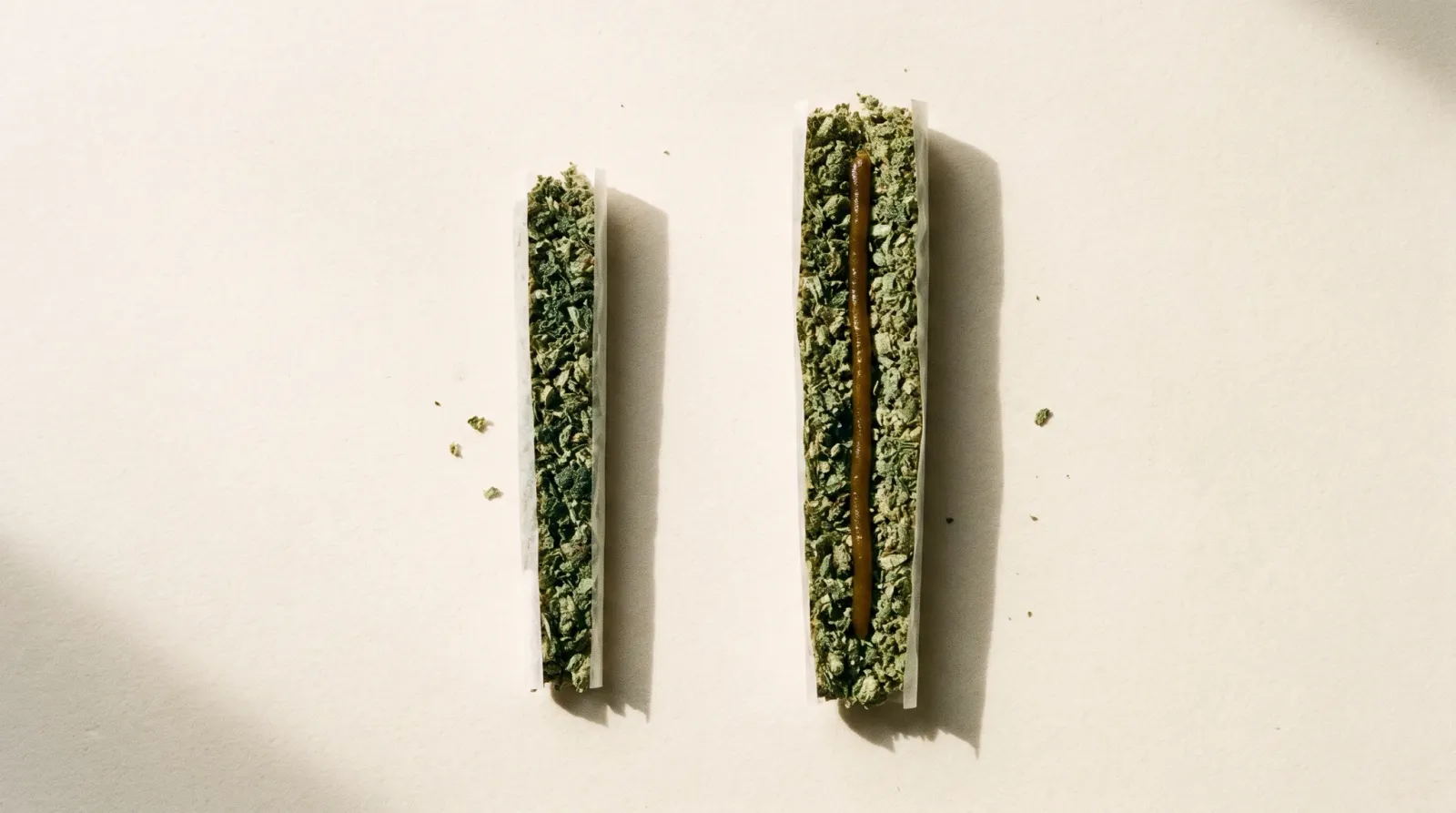
A hash hole is a joint with a rope of hash or rosin running down the middle, packed around with flower, and one roll can hold several times the THC of a plain half-gram joint because the core carries much of it. The name is usually explained by the hollow, ring-shaped ash the core leaves as it burns, which is why you also hear “donut joint”. It is a slang and retail term, not a legal category, so no regulator defines it.
Here is the part most pages skip: you can estimate how strong one is from the weights on the package. In the worked example below, a 2 g hash hole holds about 650 mg of THC on paper. A half-gram flower joint at the same flower potency holds about 100 mg. That is roughly six and a half joints in one roll, and the core is a quarter of the weight but more than half the THC.
Sources checked October 29, 2026. The numbers in this article are illustrative examples, not a product. Use your own package.
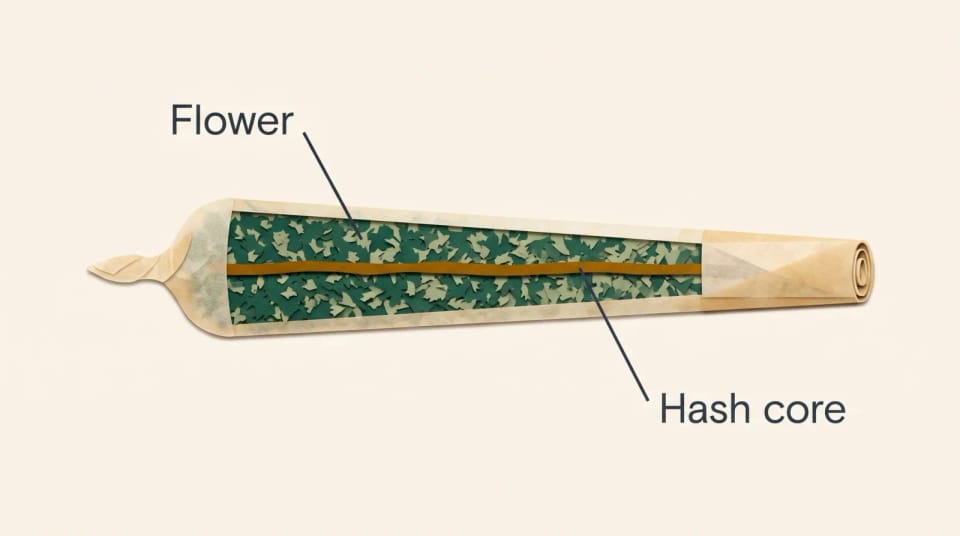
A hash hole is two ingredients in one paper: flower on the outside and a concentrate core down the middle. You need both weights to estimate its strength.
Why is it called a hash hole?
The usual explanation is the burn pattern. As the core burns, it can leave a ring of ash with a darker or hollow center, like a donut, which is where “hash hole”, “hashhole” and “donut joint” come from. I found no primary source for when or where the term started, so treat any confident origin story with suspicion.
The “hash” part is looser than it sounds. The core may be traditional hash, bubble hash or rosin. If you want to know what those materials are, our guide to bubble hash, kief and dry sift and the walkthrough of how rosin is pressed cover them. For the older story behind the word itself, see the history of hash from charas to modern rosin.
How is a hash hole different from an infused pre-roll or a moon rock?
Every hash hole is an infused pre-roll, but not every infused pre-roll is a hash hole. “Infused” covers several builds: concentrate brushed on the outside, mixed into the flower, or run down the center. The hash hole is the cored version, usually rolled larger than a standard pre-roll. Our comparison of infused pre-rolls and standard ones covers the wider category and price per milligram.
| Format | What it is | Paper? | Where the concentrate sits |
|---|---|---|---|
| Plain joint | Ground flower only | Yes | None |
| Coated or mixed infused pre-roll | Flower with concentrate on the outside or stirred in | Yes | Outside the paper or through the flower |
| Hash hole | Flower around a continuous core | Yes | One rope down the center |
| Moon rock | Whole bud dipped in concentrate and rolled in kief | No | Coating a nug |
How strong is a hash hole compared with a regular joint?
The honest answer is “it depends on four numbers”, and you can find all four on most packages. The method is the same label math from our guide to how much THC is in a joint, done twice and added together:
- Flower THC (mg) = flower grams x total THC % x 10
- Core THC (mg) = core grams x core THC % x 10
- THC in the roll = flower THC + core THC
The example inputs below are chosen to sit near averages from a blinded test of 277 Colorado dispensary products, where flower averaged about 21% total THC and concentrates about 71% when measured in the lab (Giordano et al., Scientific Reports, 2025). They are round numbers for teaching, not a real product.
| Plain half-gram joint | Example 2 g hash hole | |
|---|---|---|
| Flower | 0.5 g at 20% = 100 mg | 1.5 g at 20% = 300 mg |
| Core | None | 0.5 g at 70% = 350 mg |
| THC in the roll | About 100 mg | About 650 mg |
| Share of THC from the core | 0% | About 54% |
So the example hash hole holds about six and a half times the THC of the plain joint. The extra comes from two places at once: there is three times as much flower, and the core adds more THC than all of that flower combined.
For scale, the strongest cigarette in a randomized trial of recreational users held 69 mg of THC (Hunault et al., Psychopharmacology, 2014). The example roll holds about nine times that. That compares what is in the paper, not what reaches your body, which is the next question.
What if the package lists milligrams instead?
Use them. In California, an infused pre-roll label must show THC in milligrams per package, or the dried flower’s total THC as a percentage plus the added THC in milligrams (California Department of Cannabis Control). The second format maps neatly onto the arithmetic: flower percent for the first line, added milligrams for the second. Other states label differently, so read your own package.
How accurate are those label numbers?
Close, but not exact. In the Colorado study, measured THC came in lower than labeled on average for both flower and concentrates. Concentrate labels were more reliable: 96% landed within 15% of the label, compared with about 57% of flower products (Giordano et al., 2025). That study covered one state and did not separate rosin from other concentrates. Treat your total as a ballpark, not a measurement.
Does all that THC actually reach you?
No. The arithmetic tells you what is in the roll, not what you absorb. A review of cannabinoid pharmacokinetics puts the average bioavailability of smoked THC around 30%, and notes that it varies a lot from person to person and puff to puff (McGilveray, Pain Research and Management, 2005). In a machine-smoking bench test, only about 19% to 27% of the THC in burning flower turned up in the smoke, with more lost as sidestream smoke from a joint (Hädener et al., Forensic Science International, 2019).
Two cautions follow. First, no study has measured a hash hole, a cored joint or any infused pre-roll, so nobody knows how efficiently the core is delivered when it burns inside flower. Do not assume it behaves like a dab. Second, “only a fraction reaches you” is not reassurance. A fraction of 650 mg is still far more than the 10 to 25 mg doses used in controlled smoking studies.
What the research does show is that concentrates raise exposure. In a study of regular users smoking or dabbing their usual way, the concentrate group had higher blood THC at every time point than the flower group. Yet measured memory and balance impairment did not differ by product type or potency (Bidwell et al., JAMA Psychiatry, 2020). Those concentrate users dabbed, did not smoke cored joints, and were a different group of people, so it is a hint, not an answer.
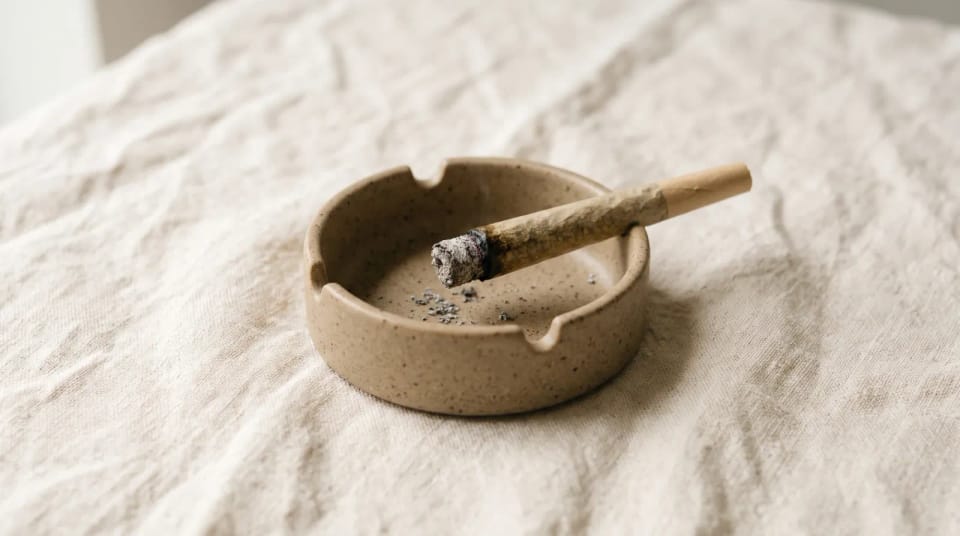
Illustration of the pacing habit, using a generic joint: put it out after a short burn and most of the roll is still there. Stopping and waiting is the whole strategy.
How long does a hash hole take to kick in and last?
Inhaled THC acts fast but peaks later than people expect. A pharmacokinetics review describes effects starting within minutes and reaching their maximum after 15 to 30 minutes (Grotenhermen, Clinical Pharmacokinetics, 2003). In a controlled trial with adults who rarely used cannabis, blood THC peaked within 30 minutes and returned to baseline in three to four hours, but some effects and impairment lasted up to six hours (Spindle et al., JAMA Network Open, 2018). That trial used 10 mg and 25 mg; the 25 mg dose already produced pronounced impairment and more unpleasant effects.
At higher doses, effects can stretch further. In the 69 mg trial, increased anxiety and reduced stimulation lasted up to eight hours, and sedation was still well above placebo at the eight-hour mark (Hunault et al., 2014). Plan your day, and any driving, around hours, not minutes.
How do you smoke a hash hole without overdoing it?
Treat it as several sessions or a shared roll, not one joint. The timing data above sets the rhythm.
- Estimate first. Run the two-line math, or read the milligram total on the package.
- Take a few puffs. Fewer than you would take from a flower joint.
- Put it out and wait 15 to 30 minutes. That is when inhaled THC effects peak. Nobody has tested this exact pause as a protocol; it is a practical reading of the time course. Our guide on how long to wait between hits goes deeper.
- Decide with the peak in hand. If you feel where you want to be, you are done for now. The rest of the roll keeps.
A thick roll with a dense core can burn unevenly. If one side races ahead, our guide to why a joint canoes explains the fix. If you roll your own, our comparison of pre-rolls and hand-rolled joints covers how a factory roll differs from yours. If you want a record of how a particular roll treated you, the High IQ app lets you log a session and note how it went, so next time you start from your own data rather than memory.
When should you talk to a clinician?
Too much THC can bring a racing heart, anxiety, nausea, vomiting or confusion; our explainer on greening out covers what that looks like. Stop smoking, move somewhere calm, and have someone stay with you. Get urgent care for chest pain, fainting, trouble breathing, severe or repeated vomiting, or confusion that does not ease. Talk to a clinician before using if you are pregnant, have a heart condition, or take medicines that interact with cannabis. This article is harm-reduction information, not medical advice.
Key takeaways
- A hash hole is a joint with a continuous core of hash or rosin running down the center of the flower.
- Estimate its THC with grams x percent x 10 for the flower and the core, then add them. A milligram total on the label beats the estimate.
- In the example, a 2 g roll holds about 650 mg of THC, about six and a half plain half-gram joints, with more than half coming from the core.
- THC in the roll is not THC in you; smoking delivers a minority of it, and no study has measured this format.
- Take a few puffs, put it out and wait 15 to 30 minutes, and expect effects to last hours.
FAQ
What is the difference between a hash hole and an infused pre-roll?
A hash hole is one type of infused pre-roll. Infused pre-rolls can have concentrate on the outside or mixed through the flower; a hash hole puts it in one rope down the center. Hash holes are also usually rolled larger than standard pre-rolls.
Is a hash hole the same as a moon rock?
No. A moon rock is a whole bud dipped in concentrate and rolled in kief, with no paper. A hash hole is a rolled joint of ground flower with a concentrate core inside it.
How long does a hash hole take to smoke?
There is no measured burn time for the format, and claims that cored joints burn a fixed percentage slower have no published source behind them. Because one roll can hold several joints’ worth of THC, most people are better off smoking it over several short sessions or sharing it.
How many people is a hash hole meant for?
No rule sets a number. The arithmetic is the better guide: if your roll holds several times the THC of the joints you usually smoke, treat it as several sessions or pass it around, and let everyone pace their own puffs.
Sources
- Giordano G, et al. (2025). Accuracy of labeled THC potency across flower and concentrate cannabis products. Scientific Reports, 15, 20822. doi.org/10.1038/s41598-025-03854-3 | Full text on PMC
- California Department of Cannabis Control. Labeling requirements checklist for manufactured cannabis products in final form, regulator page last revised June 6, 2024: cannabis.ca.gov
- Hunault CC, et al. (2014). Acute subjective effects after smoking joints containing up to 69 mg Δ9-tetrahydrocannabinol in recreational users: a randomized, crossover clinical trial. Psychopharmacology, 231(24), 4723–4733. doi.org/10.1007/s00213-014-3630-2 | PubMed 24879495
- Spindle TR, et al. (2018). Acute effects of smoked and vaporized cannabis in healthy adults who infrequently use cannabis: a crossover trial. JAMA Network Open, 1(7), e184841. doi.org/10.1001/jamanetworkopen.2018.4841 | PubMed 30646391
- Grotenhermen F (2003). Pharmacokinetics and pharmacodynamics of cannabinoids. Clinical Pharmacokinetics, 42(4), 327–360. doi.org/10.2165/00003088-200342040-00003 | PubMed 12648025
- McGilveray IJ (2005). Pharmacokinetics of cannabinoids. Pain Research and Management, 10(Suppl A), 15A–22A. doi.org/10.1155/2005/242516 | PubMed 16237477
- Hädener M, et al. (2019). A preliminary investigation of lung availability of cannabinoids by smoking marijuana or dabbing BHO and decarboxylation rate of THC- and CBD-acids. Forensic Science International, 295, 207–212. doi.org/10.1016/j.forsciint.2018.12.021 | PubMed 30638755
- Bidwell LC, et al. (2020). Association of naturalistic administration of cannabis flower and concentrates with intoxication and impairment. JAMA Psychiatry, 77(8), 787–796. doi.org/10.1001/jamapsychiatry.2020.0927 | PubMed 32520316
Education only, not medical advice. Talk to a clinician about your own situation.



