

Is Type V Cannabis Really Cannabinoid-Free?
Type V cannabis has very few cannabinoids, but studied samples still contained cannabinoid acids and other compounds. See what this chemistry label means.


Type V cannabis is a chemical category for plants largely depleted of cannabinoids, not a guarantee that every sample contains literally none. Scientists studying the Type V cultivar Ermo isolated trace cannabinoid acids alongside other plant compounds. That finding also shows why “terpene-only” is an incomplete description [Salamone et al., 2022].
The useful distinction is between a broad category and the chemistry of a particular sample. A category can describe a pattern. An analysis identifies what researchers found in the material they tested.
What does Type V mean?
A chemotype groups plants by their chemical makeup. In the five-type scheme described in the Ermo paper, the categories look like this [Salamone et al., 2022]:
| Chemotype | Broad cannabinoid pattern |
|---|---|
| Type I | THC predominates |
| Type II | THC and CBD occur in roughly balanced proportions |
| Type III | CBD predominates, with low THC |
| Type IV | CBG predominates |
| Type V | Cannabinoids are largely depleted |
These are broad descriptions, not five exact potency percentages. Type III and Type V therefore answer different questions: one identifies a CBD-dominant pattern; the other describes very limited cannabinoid production.
Type V remains cannabis. It describes chemistry within Cannabis sativa L., rather than a separate botanical species. Our explanation of cannabis botany and chemical labels gives more context for that distinction.
What did the Ermo study actually find?
The 2022 researchers examined identified Ermo plant material, including leaves and inflorescences. They separated and identified compounds from an extract. Their results included [Salamone et al., 2022]:
| Compound group | Examples found in the studied material |
|---|---|
| Cannabinoid acids | Trace CBDA and CBGA |
| Other phenolic compounds | Canniprene, cannflavin A, cannflavin B and additional phenolics |
CBDA is cannabidiolic acid. CBGA is cannabigerolic acid. Both belong to the cannabinoid family, even though their names differ from CBD and CBG. Those distinctions matter in analytical chemistry, as our guide to acid forms and cannabis lab methods explains.
Cannflavins are flavonoids, a group of phenolic compounds. Finding them does not establish a health benefit. Here, their importance is simpler: the studied material contained chemical groups beyond cannabinoids and terpenes.
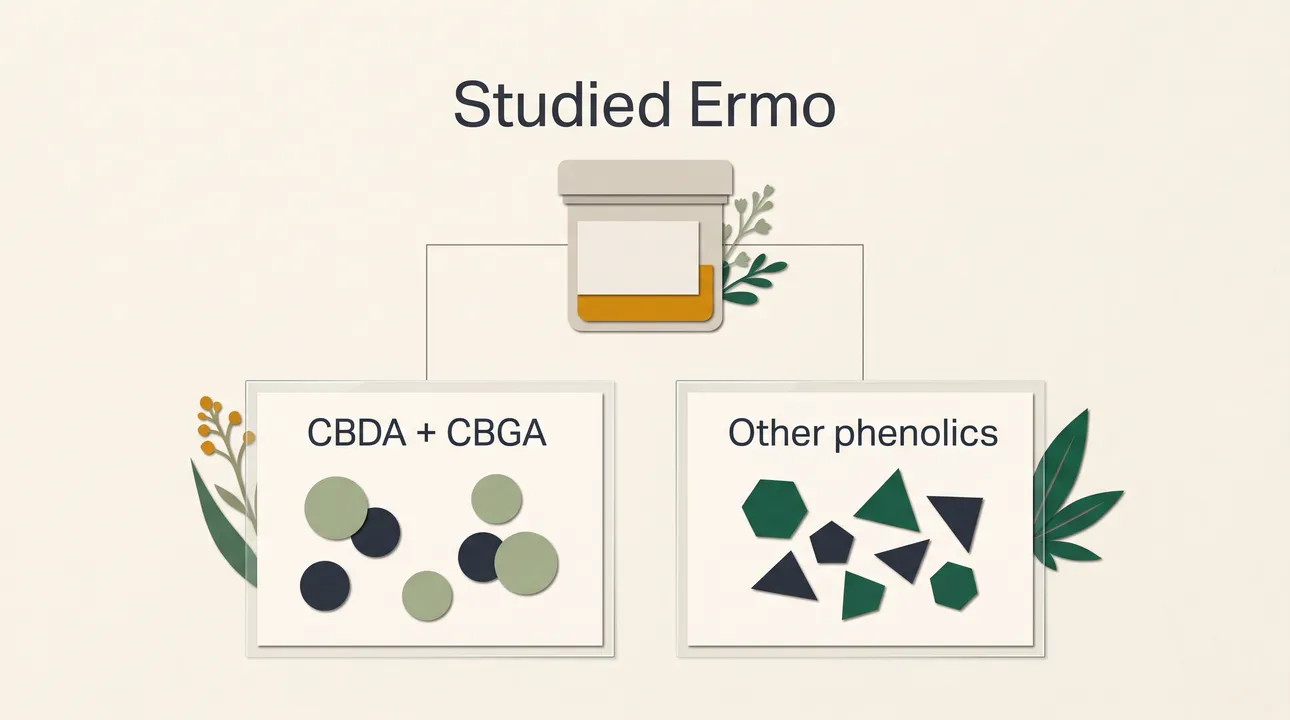
Schematic view of compound groups found in one Ermo study; symbols do not represent amounts or effects in people.
Why do some explanations say “terpene-only”?
GTR Seeds uses that phrase in its Type V heading, while its body qualifies the category as having little to no cannabinoids. Bunkerlinge likewise describes Type V as having virtually no detectable cannabinoids. Those qualifications matter: neither description should be reduced to a promise of absolute zero [GTR Seeds; Bunkerlinge].
The Ermo study adds a more specific answer. Very limited cannabinoids do not erase the rest of the plant’s chemistry, and the remaining compounds are not necessarily all terpenes. The paper does not establish a universal terpene concentration for Type V cannabis.
A later 2025 study offers another bounded example. Researchers analyzed a cannabinoid-depleted Type V extract and reported small amounts of several cannabinoids, including CBDA and CBGA, plus phenolic compounds. Its measurements describe an extract, not a universal concentration in Type V flower [Ceresa et al., 2025].
The two studies also shared an author, Federica Pollastro. The later paper is another chemical investigation, not an independent clinical confirmation.
What can the label leave out?
A Type V label alone does not specify which material was sampled, which compounds were measured, or the method’s reporting limits. A result below a method’s quantification limit also differs from proof that a compound is absent [Ceresa et al., 2025, Supplement 1].
Our guide to cultivars, chemovars, batches and samples explains why those levels should stay separate. A chemical category cannot supply every detail of a tested batch. Likewise, matching a laboratory report to its sample or batch establishes which material the report describes.
Neither study tested whether people benefit from consuming Type V cannabis. The 2022 work included enzyme experiments and cultured human macrophages; the 2025 work included chemical assays, bacteria and cultured mouse macrophages. Human-derived cells are not a human treatment trial. Our explanation of compound identity, batch testing and human evidence shows why those are separate questions.
The research context matters too. The 2022 study reported Italian public research funding and declared no conflicts of interest. Its material supplier, Canvasalus, was also an affiliation of author Gianpaolo Grassi; Stefano Salamone and Federica Pollastro listed PlantaChem affiliations. The 2025 study reported public research funding and no competing interests, and its supplement identified Canvasalus as the plant-material supplier [Salamone et al., 2022; Ceresa et al., 2025].
FAQ
Is Type V another name for CBD-rich hemp?
No. In this scheme, CBD-dominant cannabis is Type III. Type V describes plants largely depleted of cannabinoids, including CBD [Salamone et al., 2022].
Are CBDA and CBGA cannabinoids even before conversion?
Yes. They are cannabinoid acids. Finding either one is incompatible with describing that tested material as containing literally no cannabinoids [Salamone et al., 2022].
Does “below quantification limit” mean zero?
No. It means the method does not report a reliable amount below that limit. The 2025 supplement lists both quantified compounds and results below its quantification limit; those are different findings [Ceresa et al., 2025, Supplement 1].
Does Type V make a proven neutral placebo?
No. The 2022 paper discussed possible use in trial blinding, but it did not establish that Type V material has no biological activity or works as a neutral placebo in people. Its chemical and cell experiments cannot settle that question [Salamone et al., 2022].
Key takeaways
- Type V describes a broad low-cannabinoid pattern, not an absolute-zero certificate.
- A studied Ermo sample yielded cannabinoid acids and non-terpene phenolic compounds.
- Sample identity, analytical methods and human research answer different questions.
Sources
- Salamone, S., Waltl, L., Pompignan, A., Grassi, G., Chianese, G., Koeberle, A., & Pollastro, F. (2022). Phytochemical Characterization of Cannabis sativa L. Chemotype V Reveals Three New Dihydrophenanthrenoids That Favorably Reprogram Lipid Mediator Biosynthesis in Macrophages. Plants, 11(16), 2130. Full paper. Publisher PDF. DOI.
- Ceresa, C., et al. (2025). Targeting the antioxidant, antimicrobial and anti-inflammatory activity of non-psychotropic Cannabis sativa L.: a comparison with chemotype V. Journal of Cannabis Research, 7, 79. Full paper and supplements. DOI.
- GTR Seeds. Cannabis Chemotypes Explained (I–V). Commercial breeder explanation, accessed October 11, 2026. Type V heading and qualified description.
- Bunkerlinge. Chemotype. Published July 8, 2026; accessed October 11, 2026. Chemical-pattern explanation.




