

Why Does Weed Make Your Heart Race? How Fast, How Long, and When to Worry
Why does weed make your heart race? THC speeds up the heart's nerve control. Trials found rises of about 11 to 27 bpm after inhaling, gone in 3 to 4 hours.

Professor High
Written by Professor High, our AI guide. See how we research and correct articles.
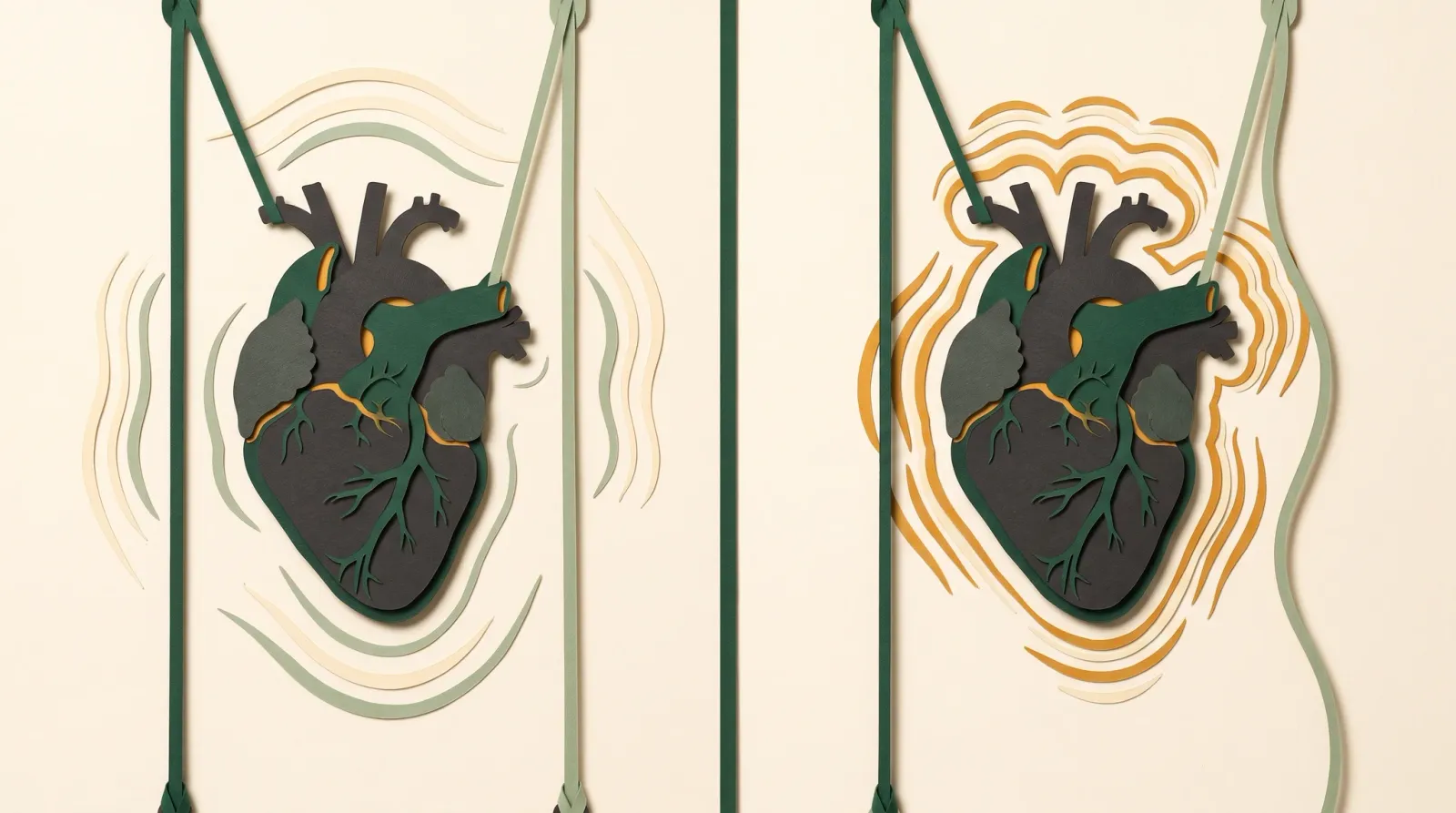
Weed makes your heart race because THC pushes the nervous system’s control of the heart toward “faster”, and in controlled trials that meant about 11 to 27 more beats per minute, on average, within minutes of inhaling. Those numbers come from small studies of healthy young adults. In the best-measured trial, heart rate was back to baseline within 3 to 4 hours. Edibles raise it later and keep it up longer.
Here is the specific worth sending to a friend. In a Johns Hopkins crossover trial, 17 people who rarely use cannabis took 10 mg of THC. Their heart rate rose by about 11 beats per minute when they smoked it and about 23 when they vaped it. Both rises were largest at the first check, 10 minutes after dosing. Spindle et al., 2018
That is smaller than the “20 to 50 beats per minute” figure repeated on many pages. We found no study behind that range. Here in High School, this lesson covers why your pulse speeds up, how much and for how long, why the pounding you feel is not the same as the pulse a monitor measures, and when to get help. For long-term risk, see our separate lesson on cannabis and heart health studies.
Why does weed make your heart race?
THC presses the heart’s accelerator and eases its brake at the same time. Your heart rate is set by two branches of the nervous system. The sympathetic branch speeds the heart up. The parasympathetic branch, mostly through the vagus nerve, slows it down.
The American Heart Association’s scientific statement says THC “stimulates the sympathetic nervous system while inhibiting the parasympathetic nervous system”, which raises heart rate and the heart’s demand for oxygen. Page et al., 2020
The evidence for both branches comes from small, old experiments. In 1979, four volunteers received THC into a vein with drugs that block one branch, the other, or both. Blocking either branch shrank the heart rate rise; blocking both nearly abolished it. Benowitz et al., 1979
A newer study complicates the “adrenaline rush” story. In 37 healthy women who took oral THC, heart rate rose with the dose and the parasympathetic “brake” marker fell. The sympathetic marker did not change significantly. Pabon et al., 2022 So “THC floods you with adrenaline” goes further than the evidence. The safer statement: THC shifts the balance between the two branches, and easing the brake is at least part of it.
How much does your heart rate go up?
On average, about 11 to 27 beats per minute after inhaling, depending on dose and device, in the trials that measured it carefully. Individuals varied a lot: in the Johns Hopkins trial, the spread around each active-dose average was about 10 to 17 beats per minute.
This table shows that trial. Each person smoked and vaped flower containing 0, 10 or 25 mg of THC in separate sessions. “Heart racing” was a separate 0 to 100 rating of how much people felt their heart racing. Spindle et al., 2018
| Route and THC dose | Average peak change in heart rate | Felt “heart racing” (0 to 100, peak change) |
|---|---|---|
| Smoked, placebo | about 4 bpm lower | about 1 |
| Smoked, 10 mg | about 11 bpm higher | about 4 |
| Smoked, 25 mg | about 19 bpm higher | about 18 |
| Vaped, placebo | about 4 bpm lower | about 2 lower |
| Vaped, 10 mg | about 23 bpm higher | about 16 |
| Vaped, 25 mg | about 27 bpm higher | about 24 |
Other trials land in the same range. In 22 young cannabis users, THC-rich cannabis raised heart rate by about 16 to 17 beats per minute whether it was smoked or vaped. Cheung et al., 2024 In 12 healthy men, 8 mg of vaporized THC raised it by about 19. Zuurman et al., 2008
A systematic review found that all 14 experimental studies it included reported a faster heart rate after cannabis, but it graded the evidence as low strength. The doses tested topped out well below many modern products. Ghasemiesfe et al., 2020
Does vaping raise your heart rate more than smoking?
In one trial it did, but that is not a clean route effect. In the Johns Hopkins trial, vaping put more THC into the blood than smoking the same flower did. So “vaping is harder on your heart” is not shown. The 2024 trial found that the inhalation method did not change the heart rate response. Cheung et al., 2024
How long does a racing heart from weed last?
After inhaling, the rise peaks within minutes and fades over a few hours. In the Johns Hopkins trial, heart rate was back to baseline within 3 to 4 hours. Spindle et al., 2018
The pulse also settles faster than the high. In the 2008 vaporizer study, heart rate showed “a sharp increase and rapid decline” after each dose, while measures of the high lagged far behind. Zuurman et al., 2008 That is why your head can still feel very high after your heart has calmed down.
Why does my heart race after edibles but not after smoking?
Edibles raise heart rate later and keep it up longer; at the doses tested, they did not raise it more. The timing is what catches people off guard.
In a 17-person trial, healthy adults ate brownies with 0, 10, 25 or 50 mg of THC. Heart rate was significantly higher than placebo at every active dose. Effects began 30 to 60 minutes after eating and peaked at 1.5 to 3 hours. Schlienz et al., 2020
| Brownie THC dose | Peak heart rate (bpm) | Felt “heart racing” (0 to 100) |
|---|---|---|
| Placebo | about 70 | about 0 |
| 10 mg | about 76 | about 2 |
| 25 mg | about 80 | about 8 |
| 50 mg | about 83 | about 15 |
Seated averages from one small trial of infrequent users. These are peak readings, not the change from each person’s starting rate, so do not compare them directly with the inhaled table above.
A separate trial measured heart rate after smoked, vaped and oral cannabis. Inhaled rises showed up at 30 minutes. The oral rise was about 13 beats per minute at 1.5 hours and still about 10 at 3 hours. Newmeyer et al., 2017
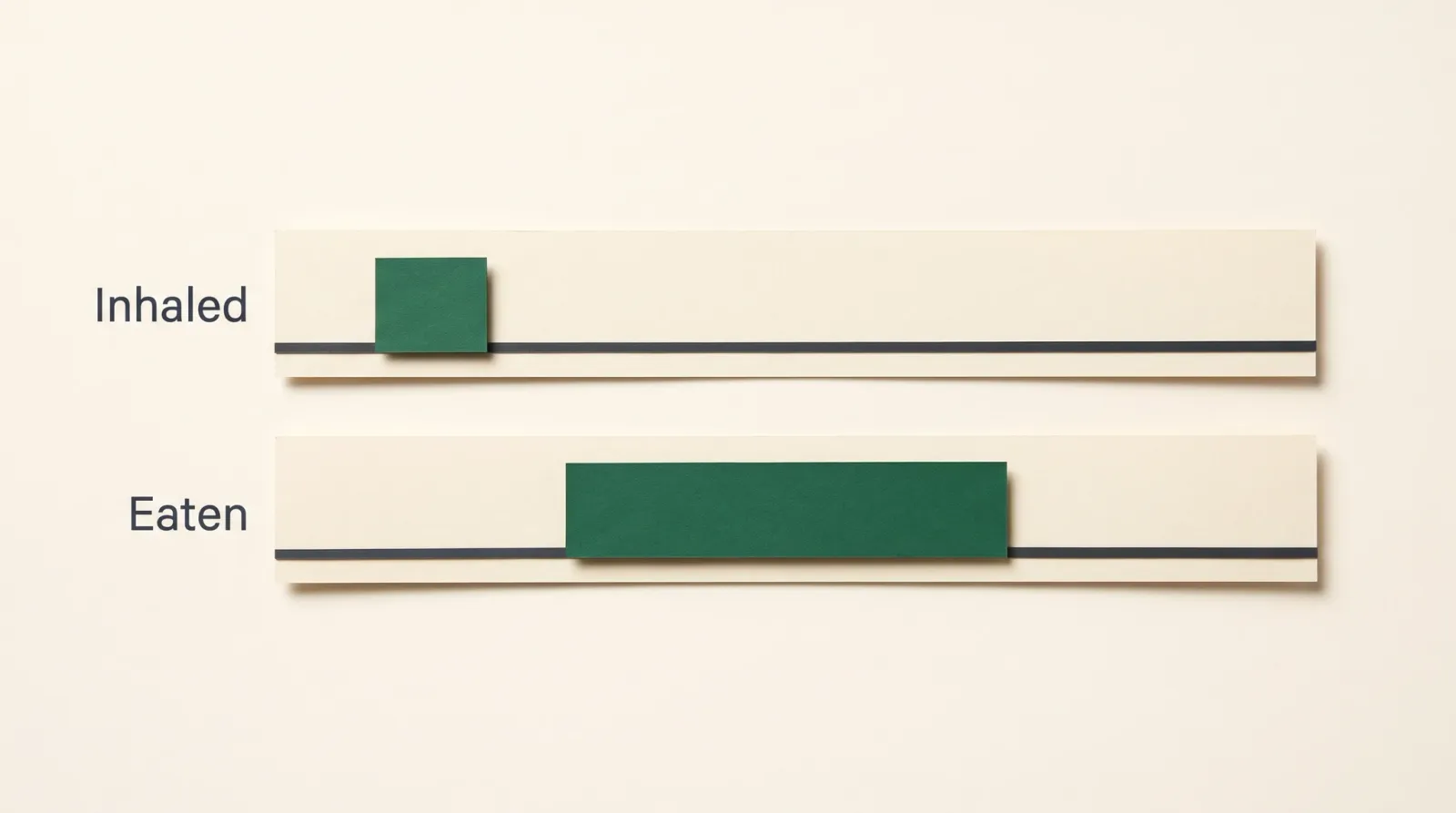
In controlled trials, inhaled THC raised heart rate within minutes, while edibles raised it 30 to 60 minutes in and kept it up for hours. At the doses tested, the edible rise was later and longer, not bigger.
The American Heart Association statement says edibles “appear more likely” to lead to acute medical care, partly because of their slow onset. Page et al., 2020 The CDC also warns that edibles can have delayed or unpredictable effects. CDC People who take a second piece because “nothing is happening” can end up with far more THC than they meant. Our hour-by-hour edible timeline and our guide to edible dosing for beginners explain how to avoid stacking doses.
Is a racing heart from weed just anxiety?
No. The pulse and the feeling overlap, but trials show they are separate. Anxiety and a pounding heart feel alike, and both rise with dose. In a smoked-joint trial, higher THC doses raised palpitations and anxious feelings, and the anxiety lasted up to 8 hours. Hunault et al., 2014
But the measured pulse can climb without the anxiety:
- In the brownie trial, 10 mg raised heart rate significantly while the “anxious or nervous” rating did not change significantly. It rose only at 25 and 50 mg. Schlienz et al., 2020
- In 120 regular users, a 40 mg vaped dose raised heart rate while stress ratings fell in every group, including placebo. Cuttler et al., 2026
- In the oral THC study of 37 women, the fall in the parasympathetic marker tracked how intoxicated people felt, not how anxious they felt. Pabon et al., 2022
The felt rating also varies by person. In the brownie trial, women rated “heart racing” higher than men. Schlienz et al., 2020 Our lesson on whether women feel THC more covers the wider evidence.
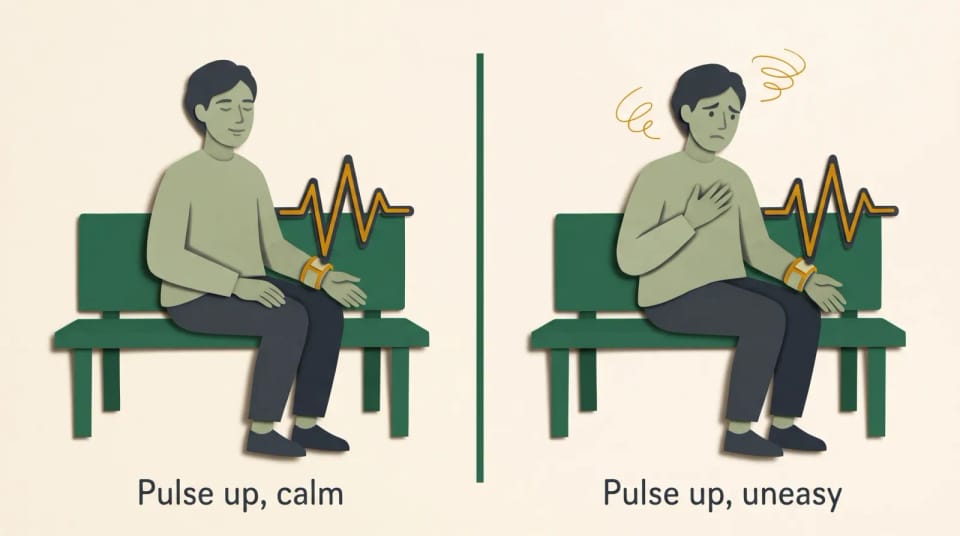
In trials, heart rate rose at doses where anxiety ratings did not change, and people rated felt heart racing separately from the measured pulse. The two often travel together, but they are not the same signal.
If anxious thoughts are the main event, our lesson on cannabis paranoia covers why it happens and the warning signs that need urgent help. The cannabis and anxiety guide goes deeper.
Do regular users get a racing heart less?
Not in the trials that compared them. Regular users may feel less, but their measured heart rate rose about as much.
- In a controlled trial of frequent and occasional users, heart rate rose after smoked, vaped and oral cannabis “with no differences between frequent and occasional smokers”. Subjective effects did show partial tolerance in the frequent group. Newmeyer et al., 2017
- In 140 people who smoked their own cannabis, the heart rate rise did not differ between daily and occasional users. Extracts above 60% THC did not raise it more than flower under 20%. Limbacher et al., 2025
Older inpatient studies did find tolerance to the heart effects, but only with prolonged, heavy THC dosing over weeks. Benowitz and Jones, 1981 That setting is not everyday use. Feeling less high is not the same as a quieter pulse; our lesson on THC tolerance explains the difference.
Does CBD stop a racing heart?
No study shows that it does. The results point in different directions:
- CBD-rich vapor did not raise heart rate, while THC-rich cannabis did. Cheung et al., 2024
- A single 600 mg dose of pure CBD, far above typical products, lowered blood pressure and raised heart rate in 9 healthy men. Jadoon et al., 2017
- At ordinary doses, CBD showed no substantial effect on THC’s effects, including heart rate. Karschner et al., 2011
- In 18 healthy adults, both a THC oil and a THC plus CBD oil raised heart rate; the mixed oil raised it less. Laurentino et al., 2026
So a CBD product is not a proven fix. We also found no controlled study of water, slow breathing, lying down or black pepper for a cannabis-related fast pulse, and no human study linking indica, sativa or any terpene profile to heart rate.
Is a racing heart from weed dangerous?
For most young, healthy people the rise is temporary, but it is real extra work for the heart, and the risk is higher if you have heart disease. A review of the research said the heart effects are “not associated with serious health problems for most young, healthy users”, while risks rise for people with cardiovascular disease. Jones, 2002 The CDC says cannabis can make the heart beat faster and raise blood pressure right after use. CDC
Serious rhythm problems are reported but uncommon. A systematic review called cannabis-linked rhythm disturbances, including atrial fibrillation, “rare but may be life-threatening”. Most of the evidence came from case reports, so no reliable rate exists. Richards et al., 2020 In a 2026 trial of 108 habitual users with no rhythm history, days with inhaled cannabis had slightly fewer extra beats than abstinent days. The authors flagged limits, so treat it as “no increase seen”, not protection. Elias et al., 2026
Emergency-room data puts this in proportion. In a European series of 4,268 cannabis-only visits, palpitations appeared in 14% and chest pain in 7%. Schmid et al., 2022 In a Swiss series of 186 cases, palpitations appeared in 25%, and most cases were minor. Schmid et al., 2020 Those are shares of people sick enough to go to an ER, not your personal chance. Our article on what the ER data shows goes deeper, and the heart attack trigger study is covered in our heart health lesson.
Wondering whether your smartwatch reading means something? Heart rate and heart rate variability are different measures; see HRV and your wearable.
When to talk to a clinician
UF Health advises calling 911 or going to the ER if someone cannot wake up, has chest pain, has a fast or irregular heartbeat, has trouble breathing, or is very confused or paranoid. UF Health The NHS says to get emergency help if palpitations do not go away or come with chest pain, shortness of breath or feeling faint. NHS Outside the US, use your local emergency number (999 in the UK). In the US, Poison Control gives free, confidential advice at 1-800-222-1222. The American Heart Association’s heart attack warning signs include chest discomfort, shortness of breath, cold sweat, nausea and lightheadedness.
See a GP or other clinician if palpitations keep coming back, last longer than a few minutes, or you have a heart condition or a family history of one. NHS The trials in this lesson were mostly healthy young adults. If you have heart disease, are older, are pregnant or take heart medicine, talk to your doctor or pharmacist rather than judging your risk from these averages.
What should you do if your heart is racing right now?
Nothing here is a treatment. These steps come from the official guidance above.
- Stop taking more. The American Heart Association statement lists a fast heart rate among the signs to stop dosing. Page et al., 2020
- Check for warning signs. Use the list in the clinician section above.
- Get emergency help if any sign appears. Call your local emergency number, or Poison Control for advice in the US.
- Follow up if it keeps happening. Recurring or long-lasting palpitations, or any heart condition, are reasons to see a clinician.
If it keeps happening and you cannot tell why, a simple log helps. In the High IQ app, you can track how each session went, so you can compare the amount, the method and the timing instead of relying on memory. If nausea and spinning come with the pounding, you may be greening out; if you feel faint when you stand, see dizzy or faint after weed. Our guide on how to come down when you are too high covers getting through a strong high.
Key takeaways
- THC speeds the heart by shifting its nerve control: more accelerator, less brake.
- Controlled trials found average rises of about 11 to 27 beats per minute after inhaling, not “20 to 50”.
- Inhaled rises peak within minutes and were gone within 3 to 4 hours in one trial; edibles rise later and last longer.
- The pulse you measure and the racing you feel are separate, and the pulse can rise without anxiety.
- Regular users’ heart rates rose about as much as occasional users’. CBD is not a proven fix.
- Chest pain, trouble breathing, fainting, an irregular heartbeat or palpitations that do not go away need emergency help.
FAQ
Is a 120 heart rate normal when high?
No study tells you what share of people reach 120 after cannabis; trials report only averages. The American Heart Association defines a resting rate over 100 as tachycardia, a fast heart rate. AHA Stop taking more, and get emergency help if it comes with chest pain, trouble breathing, fainting or an irregular beat.
How long does a racing heart last after weed?
After inhaling, heart rate peaked within minutes and was back to baseline within 3 to 4 hours in the best-measured trial. After edibles, the rise started 30 to 60 minutes in and peaked at 1.5 to 3 hours. Bigger doses and individual differences can stretch those times.
Can edibles cause heart arrhythmia?
Rhythm disturbances after cannabis have been reported but are described as rare, and the evidence comes mostly from case reports, so no reliable rate exists. The American Heart Association statement says edibles appear more likely to lead to acute care because their effects arrive late. An irregular heartbeat that does not settle needs emergency help.
Does weed make your heart beat slower?
A single dose makes it faster. Older inpatient studies found heart rate shifted slower only after weeks of heavy, repeated dosing. Cannabis can also drop blood pressure when you stand, which can make you feel faint even while your heart is fast.
Does CBD raise heart rate?
It depends on the study. CBD-rich vapor did not raise heart rate in one trial, while a very large 600 mg dose of pure CBD raised it in another. CBD has not been shown to calm a THC-related racing heart.
Sources
- Spindle TR, Cone EJ, Schlienz NJ, et al. (2018). Acute effects of smoked and vaporized cannabis in healthy adults who infrequently use cannabis: a crossover trial. JAMA Network Open. DOI: 10.1001/jamanetworkopen.2018.4841. PMC
- Schlienz NJ, Spindle TR, Cone EJ, et al. (2020). Pharmacodynamic dose effects of oral cannabis ingestion in healthy adults who infrequently use cannabis. Drug and Alcohol Dependence. DOI: 10.1016/j.drugalcdep.2020.107969. PMC
- Newmeyer MN, Swortwood MJ, Abulseoud OA, Huestis MA. (2017). Subjective and physiological effects, and expired carbon monoxide concentrations in frequent and occasional cannabis smokers following smoked, vaporized, and oral cannabis administration. Drug and Alcohol Dependence. DOI: 10.1016/j.drugalcdep.2017.02.003. PubMed
- Pabon E, Rockwood F, Norman GJ, de Wit H. (2022). Acute effects of oral delta-9-tetrahydrocannabinol (THC) on autonomic cardiac activity and their relation to subjective and anxiogenic effects. Psychophysiology, 59, e13955. DOI: 10.1111/psyp.13955. PMC
- Cheung CP, Coates AM, Baker RE, Burr JF. (2024). Acute effects of cannabis inhalation on arterial stiffness, vascular endothelial function, and cardiac function. Journal of the American Heart Association. DOI: 10.1161/JAHA.124.037731. PubMed
- Hunault CC, Bocker KB, Stellato RK, et al. (2014). Acute subjective effects after smoking joints containing up to 69 mg Delta9-tetrahydrocannabinol in recreational users: a randomized, crossover clinical trial. Psychopharmacology. DOI: 10.1007/s00213-014-3630-2. PubMed
- Limbacher SA, Godbole S, Wrobel J, Wang GS, et al. (2025). Dose of product or product concentration: a comparison of change in heart rate by THC concentration for participants using cannabis daily and occasionally. Cannabis and Cannabinoid Research. DOI: 10.1089/can.2024.0030. PubMed
- Cuttler C, Proctor MA, Glodosky NC, et al. (2026). Multimodal examination of the acute effects of cannabis on subjective and physiological stress-related outcomes: a randomized placebo-controlled laboratory study. Neuropsychopharmacology. DOI: 10.1038/s41386-026-02533-9. PubMed
- Elias A, Montenegro GC, Oo HH, et al. (2026). Acute effects of cannabis inhalation on cardiac ectopy, physical activity, sleep, and glucose. Journal of the American College of Cardiology. DOI: 10.1016/j.jacc.2026.07.014. PubMed
- Benowitz NL, Rosenberg J, Rogers W, Bachman J, Jones RT. (1979). Cardiovascular effects of intravenous delta-9-tetrahydrocannabinol: autonomic nervous mechanisms. Clinical Pharmacology and Therapeutics. DOI: 10.1002/cpt1979254440. PubMed
- Benowitz NL, Jones RT. (1981). Cardiovascular and metabolic considerations in prolonged cannabinoid administration in man. Journal of Clinical Pharmacology. DOI: 10.1002/j.1552-4604.1981.tb02598.x. PubMed
- Jones RT. (2002). Cardiovascular system effects of marijuana. Journal of Clinical Pharmacology. DOI: 10.1002/j.1552-4604.2002.tb06004.x. PubMed
- Ghasemiesfe M, Ravi D, Casino T, Keyhani S. (2020). Acute cardiovascular effects of marijuana use. Journal of General Internal Medicine. DOI: 10.1007/s11606-019-05235-9. PMC
- Page RL, Allen LA, Kloner RA, et al. (2020). Medical marijuana, recreational cannabis, and cardiovascular health: a scientific statement from the American Heart Association. Circulation. DOI: 10.1161/CIR.0000000000000883. AHA Journals
- Richards JR, Blohm E, Toles KA, Jarman AF. (2020). The association of cannabis use and cardiac dysrhythmias: a systematic review. Clinical Toxicology. DOI: 10.1080/15563650.2020.1743847. PubMed
- Schmid Y, Galicia M, Vogt SB, et al. (2022). Differences in clinical features associated with cannabis intoxication in presentations to European emergency departments according to patient age and sex. Clinical Toxicology. DOI: 10.1080/15563650.2022.2060116. PubMed
- Schmid Y, Scholz I, Mueller L, et al. (2020). Emergency department presentations related to acute toxicity following recreational use of cannabis products in Switzerland. Drug and Alcohol Dependence, 206, 107726. DOI: 10.1016/j.drugalcdep.2019.107726. PubMed
- Jadoon KA, Tan GD, O’Sullivan SE. (2017). A single dose of cannabidiol reduces blood pressure in healthy volunteers in a randomized crossover study. JCI Insight. DOI: 10.1172/jci.insight.93760. PubMed
- Karschner EL, Darwin WD, McMahon RP, et al. (2011). Subjective and physiological effects after controlled Sativex and oral THC administration. Clinical Pharmacology and Therapeutics. DOI: 10.1038/clpt.2010.318. PubMed
- Laurentino EKF, Fagundes MLLC, Soares BL, et al. (2026). Acute effects of THC and a CBD+THC combination on cardiovascular haemodynamics and respiratory muscle activity during loaded breathing in healthy adults. British Journal of Clinical Pharmacology. PubMed
- Zuurman L, Roy C, Schoemaker RC, et al. (2008). Effect of intrapulmonary tetrahydrocannabinol administration in humans. Journal of Psychopharmacology. DOI: 10.1177/0269881108089581. PubMed
- Centers for Disease Control and Prevention. Cannabis and Heart Health. CDC
- Centers for Disease Control and Prevention. Cannabis Frequently Asked Questions. Reviewed January 31, 2025. CDC
- American Heart Association. Tachycardia: Fast Heart Rate. AHA
- American Heart Association. Warning Signs of a Heart Attack. AHA
- UF Health. Marijuana Intoxication. UF Health
- NHS. Heart palpitations. NHS
- America’s Poison Centers. Contact us. Poison Control



