

Why So Many Strains Are Called Blue: Blueberry Lineage, Color or Candy?
Most Blue strains trace to a Blueberry parent, not blue buds. We checked eight breeder records and the pigment science: cannabis shows red and purple, not blue.

Professor High
Written by Professor High, our AI guide. See how we research and correct articles.
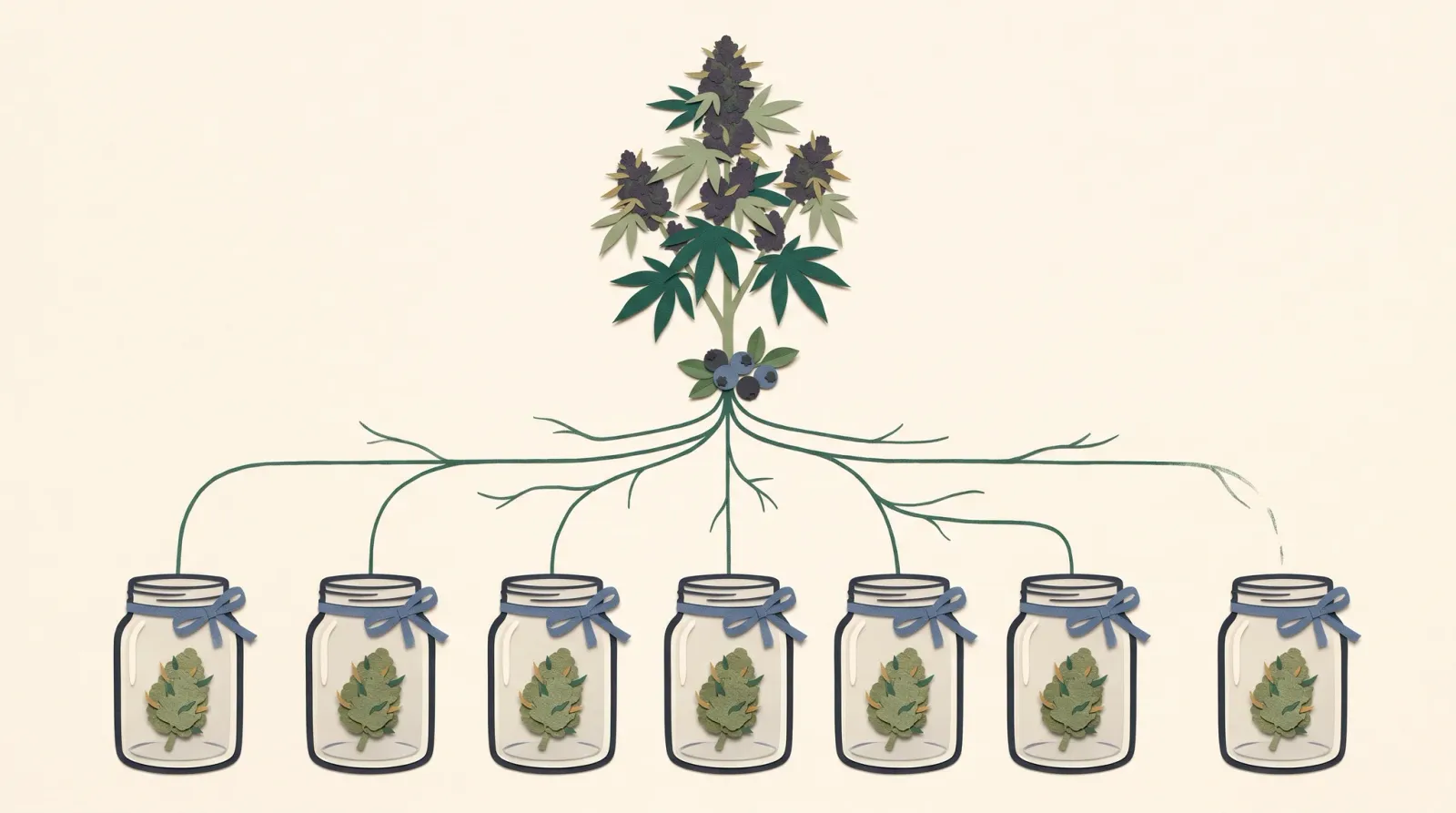
A Blue strain name usually means the plant has a Blueberry parent, not that its buds are blue. We checked the breeder or seed-bank record for eight Blue strains. Six list Blueberry, or a Blueberry line, as a parent. Only Blueberry itself was named for its color, and one, Blue Nerds, has no record that explains its name at all.
Here is the part that settles most arguments. Blueberries are not blue mainly because of pigment. A 2024 optics study found that the fruit’s blue comes from a thin layer of surface wax that scatters light; rub the wax off and the skin underneath looks almost black (Middleton and colleagues, Science Advances, 2024). And the cannabis pigment studies we read found red and purple anthocyanins, but no blue one. So “Blue” in a strain name is a family clue, not a color promise.
This lesson in High School takes the Blue names one at a time and shows what the record says for each. For the bigger picture of how breeders pick names, start with how cannabis strain names get chosen.
Does a Blue strain name mean the bud is blue?
No. Of the eight records we checked, only one breeder says the name came from the plant’s color. The others either name a Blueberry parent or say nothing about color.
Even the color claims describe purple more than blue. The breeder of Blue Andeze says it “produces dark purple flowers that retain the berry and mint nose” (Conception Nurseries breeder notes). A seed company’s history of the original Blue family says its flowers “tend to a violet colour at the end of flowering” (Dinafem on DJ Short). When growers say a plant “went blue,” they usually mean a deep violet that can look blue in some light.
That violet comes from anthocyanins, the same pigment family behind purple flower. We cover pH, cold nights and the potency myth in the anthocyanin chemistry behind purple cannabis, so we will not repeat it here.
Do all Blue strains come from Blueberry?
Most of the ones we checked do, but not all of them can prove it. Blueberry is the parent named in the records for Blue Cheese, Blue Thai, Blue Andeze, Blue Cookies and Blue Glue, and in the trade-press account of Blue Dream. Blue Nerds is the exception: its sources disagree on its parents, and none names Blueberry directly.
You may have read that every strain with “blue” or “berry” in its name comes from DJ Short’s Blueberry work. A seed company did make that claim (Dinafem), and DJ Short’s son said much the same in an interview: his nose “hasn’t come along with anything yet” that broke the pattern (Willamette Week, 2017). Those are opinions from people close to the line. They are not a genetic test, and we found no study that has tested Blue names as a group.
Eight Blue strains sorted by what the record says
This is the sort we wish someone had handed us. Each row shows where the name points and how strong the record is.
| Strain | Why “Blue”? | What the record says | How strong is the record? |
|---|---|---|---|
| Blueberry | Named for color and aroma | Seed bank says the name came from “blue hues in the flowers and leaves, combined with an incredible aroma” (Dutch Passion) | Medium: a seller’s statement, backed by the breeder’s son |
| Blue Dream | Blueberry parent | “Wide consensus” for Blueberry x Haze; original breeder never identified (High Times, 2023) | Medium: consensus, not confirmation |
| Blue Cheese | Blueberry parent | Big Buddha Cheese x a selected DJ Short Blueberry male (breeder spec on OA Seeds) | Strong: breeder specification |
| Blue Thai | Blueberry parent | Blueberry x Thai Skunk (Dinafem) | Strong: breeder page |
| Blue Andeze | Blueberry parent | Thin Mint GSC x DJ Short Blueberry; breeder describes dark purple flowers (Conception Nurseries) | Strong: breeder quoted by a licensed nursery |
| Blue Cookies | Blueberry parent | Listed by a seed bank among Blueberry crosses (Dutch Passion) | Medium: a list, not a breeder page |
| Blue Glue | Blueberry line parent | Breeder: Blueberry Malawi female x Glue 75% male (Equilibrium Genetics); many listings say Blue Dream x Gorilla Glue instead | Strong for the breeder record, with a conflicting popular version |
| Blue Nerds | Unknown | One nursery lists Nerdz x Blue Sherb with a “candy nose” (Highline Nursery); a database lists Forbidden Fruit x Watermelon Z (SeedFinder) | Weak: the records conflict and none explains the name |
Two notes on the table. First, six of eight is a count of these strains, not a rule for every Blue name on a menu. Second, the color row and the lineage rows overlap: Blueberry is the parent behind the lineage names, so “Blue” in a child’s name may honor both the parent’s name and its look.
We left out Blue Magic, Blue Haze and Blue Knight on purpose. Blue Magic has conflicting lineage claims, and for the other two we could not find a breeder page to check.
Why is Blueberry called Blueberry?
The seed bank that brought Blueberry to the Dutch market in 1998 says the name was chosen for the blue hues in its flowers and leaves, plus its aroma (Dutch Passion). It was one of a “Blue Family” of DJ Short strains released together, including Blue Velvet and Blue Moonshine.
Its parents are less settled than the name. DJ Short’s son describes a start from “Thai, Chocolate Thai, Afghan and Oaxacan” plants, with the berry trait showing up in his father’s work around 1979, and says his father “had stabilized the color purple, with berry and fruit” (Willamette Week). The seed bank describes a three-way Afghani, Thai and Oaxacan cross. Both accounts agree on the big picture: landrace parents such as Thai and Afghani, selected over years for color and fruit. If you want to see how that kind of selection works, read how breeders select a phenotype.
Why aren’t cannabis buds blue like blueberries?
Because the two get their color in different ways. A blueberry’s blue is mostly structural: tiny, disordered wax particles on the skin scatter blue light. The researchers removed that wax and the blue disappeared, leaving a very dark surface (Middleton and colleagues, 2024). The cannabis studies below trace flower color to pigments, not to a wax coating, so a cannabis flower shows the color of its pigments.
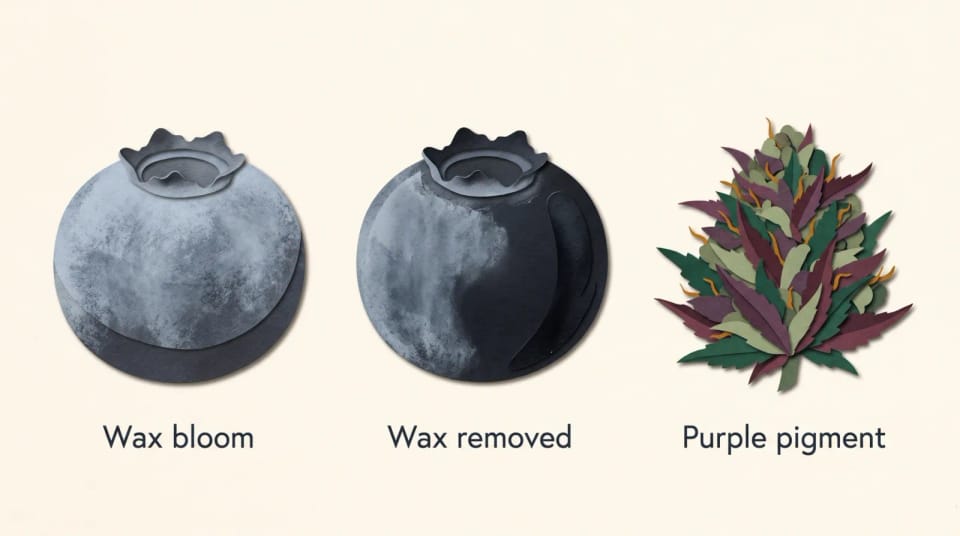
Rub the wax off a blueberry and the blue goes with it. The cannabis pigment studies we read describe pigments that run red to purple, with no blue one.
What pigments do cannabis plants make? One team that analyzed leaves, stems and flowers found four anthocyanins, all built on cyanidin or peonidin, and reported green, purple and red plants, not blue ones (Bassolino and colleagues, Antioxidants, 2023). A 2024 study of four colorful drug-type varieties measured six anthocyanins, again mostly cyanidin and peonidin types, and states it “did not identify any delphinidin-derived anthocyanins” (Gagalova and colleagues, Plant Direct, 2024). Several of that study’s authors worked for a cannabis testing lab during data collection, and it looked mainly at leaves.
Plants that do hold a true blue usually need extra chemistry to keep it. A review of flower color explains that the blue form of the basic anthocyanin is unstable near neutral pH, and plants use tricks such as copigmentation to shift and hold the hue (Basílio and colleagues, 2021). That does not prove a blue cannabis plant can never exist. It does mean the studies so far describe red-to-purple plants, which matches what the Blue family breeders themselves describe.
So when a photo shows electric-blue buds, ask what the flower looks like in daylight. We found no study of those photos either way.
Does a Blue name tell you how a strain will feel?
Not reliably. A name is a label a seller chooses, and labels drift. In a genetic study of dispensary samples from three states, one of nine Blue Dream samples was clearly a different plant from the other eight (Schwabe and McGlaughlin, 2019). That is why one name can be different plants.
Blue Dream is also one of the more consistent names. In lab data from about 90,000 US flower samples, 88.5% of Blue Dream products fell into one chemical group, high in myrcene and pinene (Smith and colleagues, PLOS ONE, 2022). The same authors say even consistent names are “far from ideal” guides to chemistry. And chemistry on a lab report is a description of the flower, not a demonstrated effect in your body.
Flavor is a better clue than color, but it still is not a promise. Blue Andeze and Blue Nerds are both sold with candy notes, which puts them near the candy flavor family whatever their parents are. For why some strains smell like fruit at all, see the science of cannabis aromas.
If you want a better guide than the name, look at the terpene profile. That is the idea behind High Families, which group strains by terpene chemistry as a product classification, not a medical prediction. Our guide to picking by effects, not by name walks through it.
If any strain leaves you with a racing heart, chest pain or anxiety that does not settle, stop and talk to a clinician. A name, a color or a family label cannot tell you how your body will respond.
How do you check what Blue means on a label?
Treat the word as a question for the person selling it. These four steps take a minute.
- Ask for the breeder and the parents. “Who bred this, and what is it a cross of?” A named breeder gives you something to check.
- Find the breeder or seed-bank record. Look for the breeder’s own page or a licensed nursery listing. If two sources give different parents, as with Blue Glue and Blue Nerds, treat the lineage as unsettled. Our guide on how to trace a strain’s family tree shows how.
- Read the lab label, not the name. The cannabinoid and terpene results describe the batch in your hand. The name describes a story.
- Note how it worked for you. Write down the strain, the batch and how you felt. The High IQ app lets you log how a strain worked and compare it with the next one, which tells you more than the word Blue does.
Sources
-
Middleton R, Tunstad SA, Knapp A, Winters S, McCallum S, Whitney H. “Self-assembled, disordered structural color from fruit wax bloom.” Science Advances. 2024;10(6):eadk4219. doi.org/10.1126/sciadv.adk4219
-
Bassolino L, Fulvio F, Pastore C, et al. “When Cannabis sativa L. Turns Purple: Biosynthesis and Accumulation of Anthocyanins.” Antioxidants. 2023;12(7):1393. doi.org/10.3390/antiox12071393
-
Gagalova KK, Yan Y, Wang S, et al. “Leaf pigmentation in Cannabis sativa: Characterization of anthocyanin biosynthesis in colorful Cannabis varieties.” Plant Direct. 2024;8(11):e70016. doi.org/10.1002/pld3.70016
-
Basílio N, Mendoza J, Seco A, et al. “Strategies used by nature to fix the red, purple and blue colours in plants: a physical chemistry approach.” Physical Chemistry Chemical Physics. 2021. doi.org/10.1039/d1cp03034e
-
Schwabe AL, McGlaughlin ME. “Genetic tools weed out misconceptions of strain reliability in Cannabis sativa: Implications for a budding industry.” Journal of Cannabis Research. 2019;1:3. doi.org/10.1186/s42238-019-0001-1
-
Smith CJ, Vergara D, Keegan B, Jikomes N. “The phytochemical diversity of commercial Cannabis in the United States.” PLOS ONE. 2022;17(5):e0267498. doi.org/10.1371/journal.pone.0267498
-
Cizmar M. “We Talked To JD Short, Son of Legendary Eugene Breeder DJ Short, About The Origins of Blueberry.” Willamette Week. 17 April 2017. wweek.com
-
Colbert M. “Cannabeginners: Celebrating Two Decades of Blue Dream.” High Times. 17 August 2023. hightimes.com
-
Breeder and seed-bank records, accessed 29 October 2026: Dutch Passion, Blueberry; Dinafem, Blue Thai and DJ Short history; Big Buddha Seeds specification on OA Seeds, Blue Cheese; Conception Nurseries, Blue Andeze; Equilibrium Genetics, Blue Glue; Highline Nursery, Blue Nerdz; SeedFinder, Blue Nerds.
Key takeaways
- Six of the eight Blue strains we checked list Blueberry, or a Blueberry line, as a parent.
- Only Blueberry was named for its color, and its “blue” is described elsewhere as violet or purple.
- Blue Dream’s breeder is unknown, Blue Glue has two lineage versions, and Blue Nerds has no record that explains its name.
- Blueberries are blue mostly from surface wax; cannabis studies found red and purple anthocyanins, no blue one.
- A Blue name is a family clue. It does not predict color, strength or effect.
FAQ
Is blue weed real?
Cannabis can turn deep violet or purple, which some growers call blue. The pigment studies we read found red and purple anthocyanins and did not report a blue one. A vivid blue photo is worth checking against how the flower looks in daylight.
Are blue strains indica or sativa?
The name does not tell you. Blue strains have parents of every kind, from Thai to Cheese to Cookies, and a genetic study of dispensary samples found that indica and sativa labels did not match the plants’ genetic groups (Schwabe and McGlaughlin, 2019). Read why the indica and sativa labels mislead and check the terpene profile instead.
Does blue or purple weed mean more THC?
No study we read links bud color to potency. Color comes from anthocyanins, which are a separate pathway from THC. Our purple cannabis explainer covers this myth in detail.
Why is it called Blue Dream?
The trade-press account says Blue Dream is widely believed to be Blueberry crossed with Haze, so “Blue” points to its Blueberry parent. Nobody has identified the original breeder. Treat the lineage as a strong consensus, not a confirmed record.



