Why Cannabis Turns Purple: The Anthocyanin Science
Anthocyanins make cannabis purple — the same pigments as blueberries and red cabbage. The real chemistry, and why purple never meant potent.

Professor High
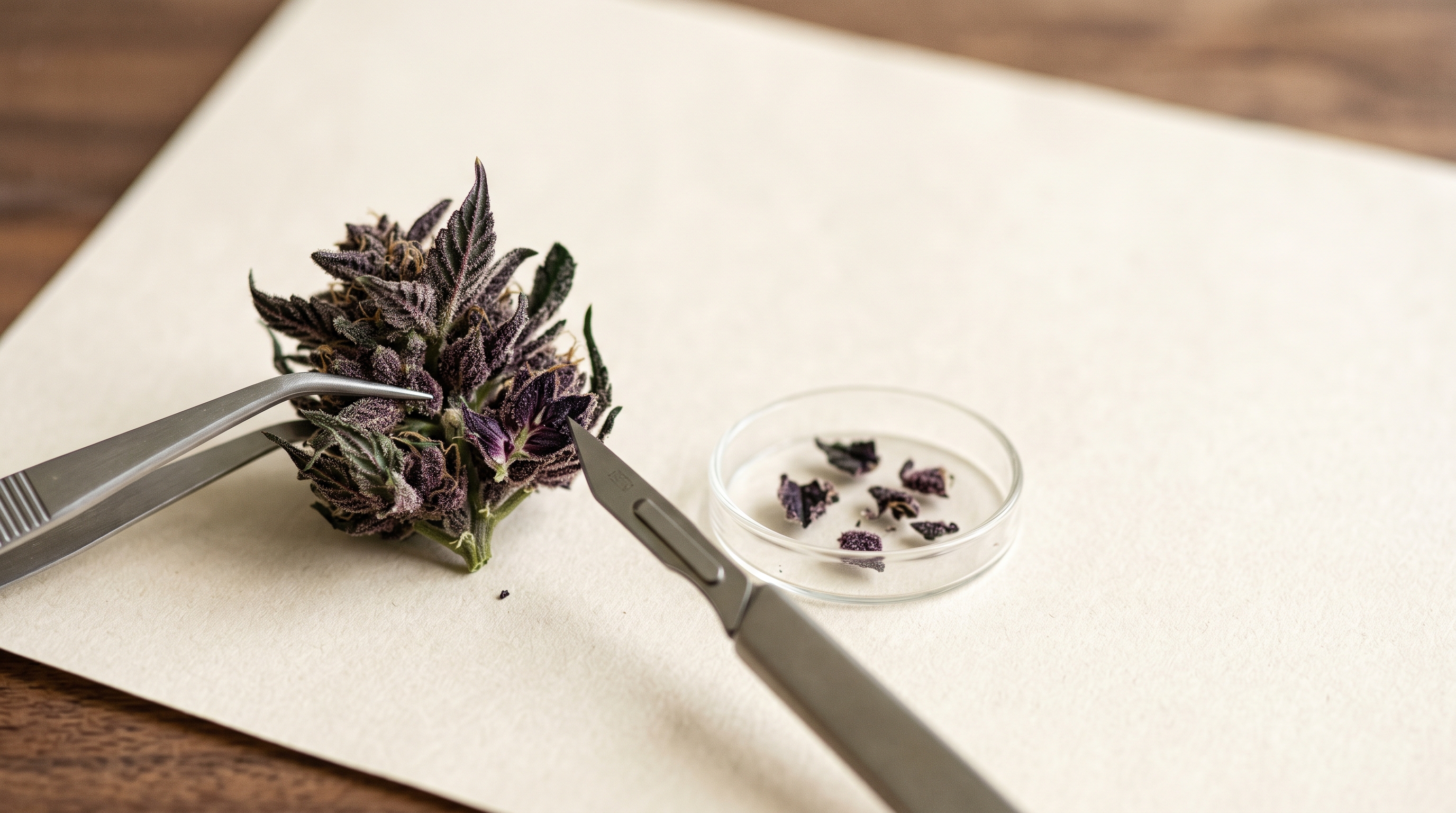
You paid the premium for the purple eighth. It looked incredible in the jar — that deep violet, almost black in the shadows, orange pistils cutting through it. Then you smoked it and it was… fine. Pleasant. Nothing like the experience the colour seemed to promise.
That gap between how a bud looks and how it works is one of the most reliable disappointments in cannabis retail, and purple is the best example. The colour is genuinely beautiful, genuinely chemical, genuinely interesting — and genuinely unrelated to how high you get. Here is what is actually happening inside a purple plant, and why the potency story attached to it has no chemistry behind it.
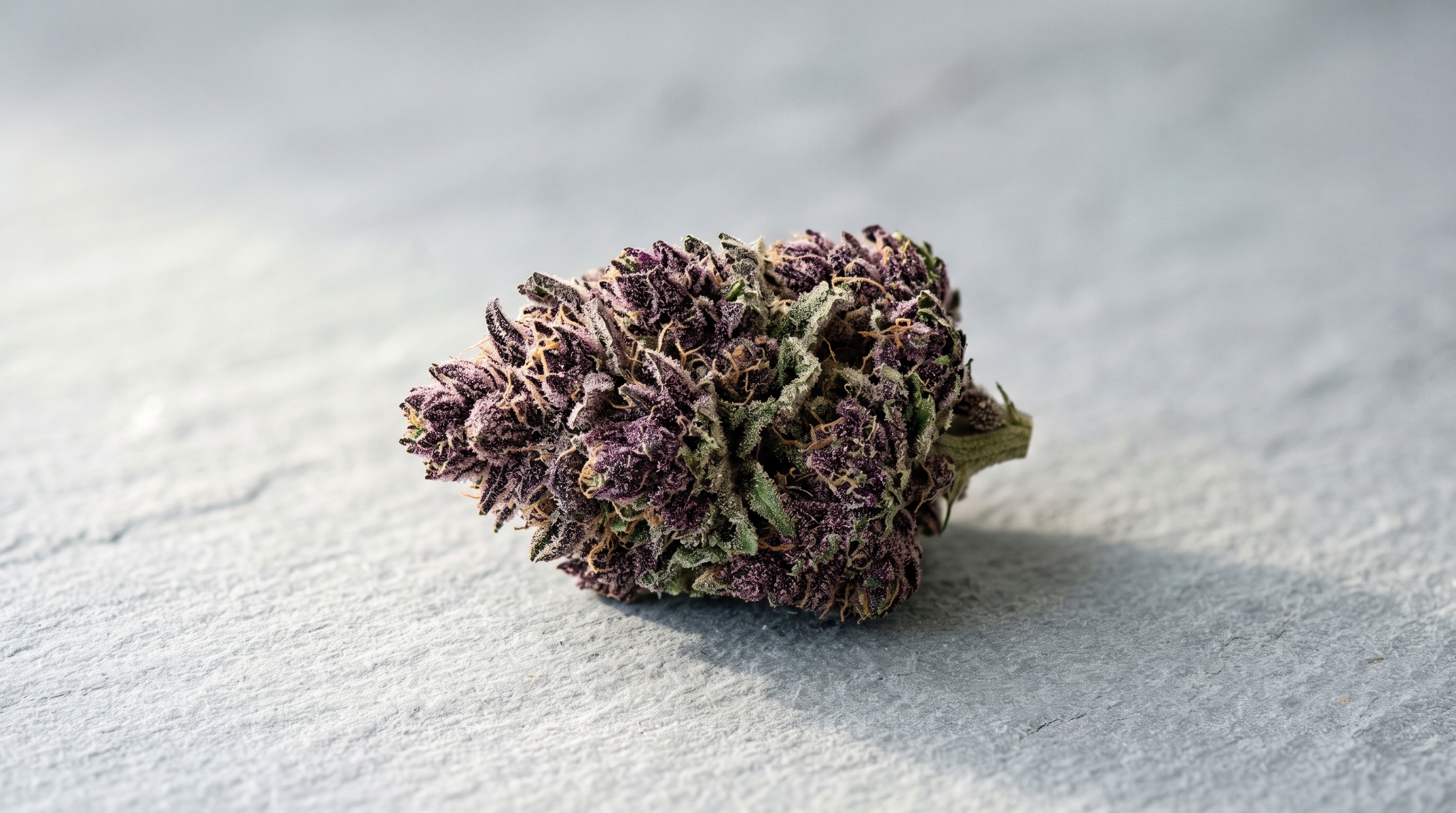
The pigment: anthocyanins
Purple cannabis is coloured by anthocyanins — a family of water-soluble plant pigments belonging to the flavonoids. They are the same class of molecule that makes blueberries blue, red cabbage red, blood oranges red, and maple leaves scarlet in October.
Flavonoids will already be familiar if you have read about cannflavins and the other anti-inflammatory flavonoids in cannabis. Anthocyanins are the pigmented branch of that same family. They live dissolved in the vacuole — the big fluid-filled sac that takes up most of the volume of a plant cell — which is why they are water-soluble and why the colour sits inside the tissue rather than on its surface.
For a long time nobody had properly measured which anthocyanins cannabis actually makes. In 2023, Bassolino and colleagues ran targeted HPLC-MS/MS quantification across different Cannabis sativa tissues and reported the first identification of cyanidin-3-rutinoside — also called keracyanin — as the major anthocyanin in both vegetative and floral tissue. The amounts they measured were higher than in small berries, which is both a fun fact and a reminder of how little basic pigment chemistry had been done on this plant. Cyanidin is the parent pigment; the attached sugar is what keeps it stable and water-soluble in the vacuole.
Why the same pigment gives different colours
This is the part that makes anthocyanins genuinely elegant chemistry, and it explains why “purple” strains range from wine-red through violet to almost blue-black.
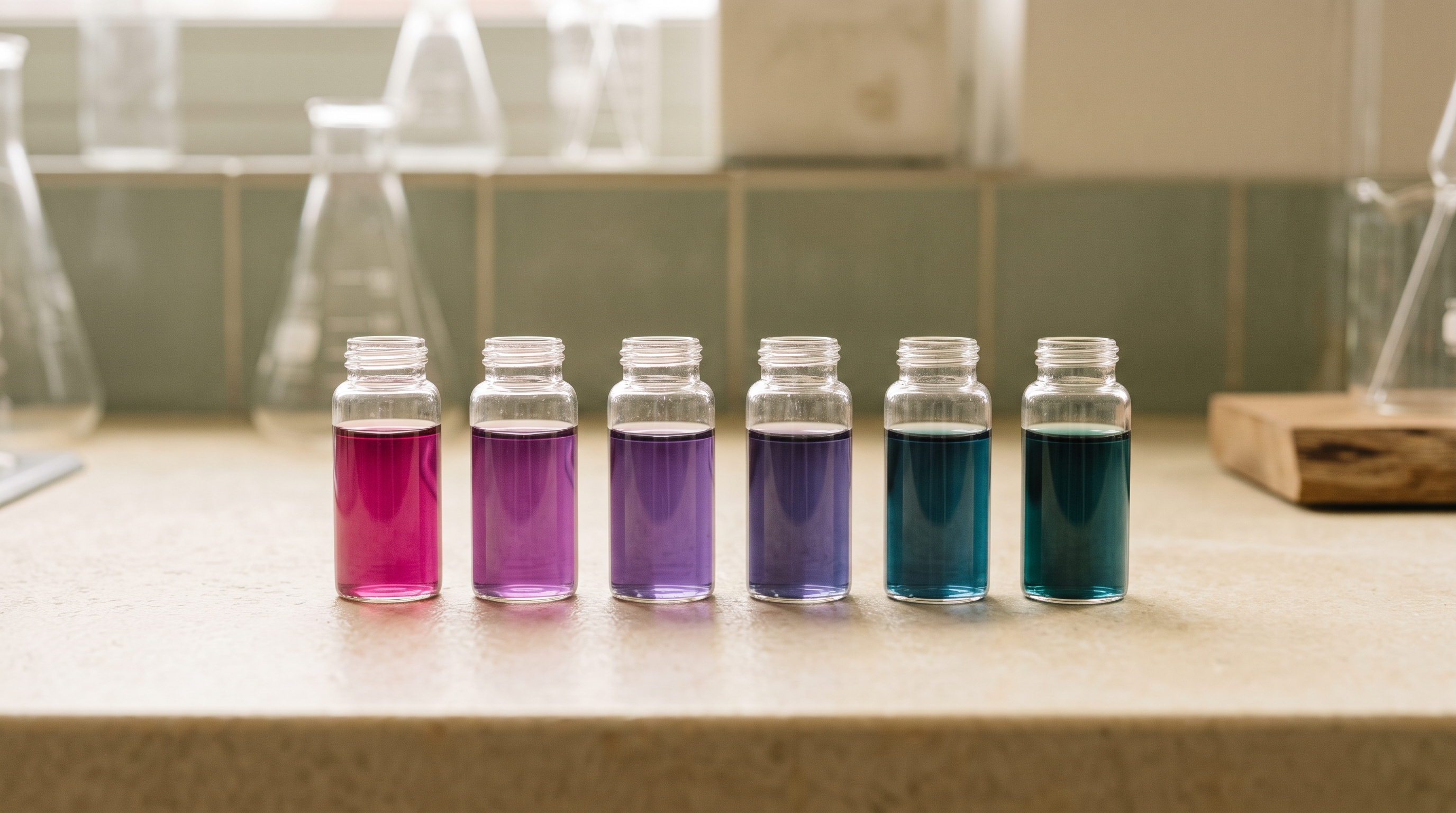
Anthocyanins are pH-sensitive. The molecule physically rearranges depending on how acidic its surroundings are, and each rearranged form absorbs light differently. Castañeda-Ovando and colleagues laid this out in a 2009 review in Food Chemistry:
| Approximate pH | Dominant form | Colour |
|---|---|---|
| 1–3 | Flavylium cation | Red |
| 4–5 | Carbinol pseudobase / chalcone | Nearly colourless |
| 6–7 | Quinoidal base | Purple / violet |
| 7–8 | Ionised quinoidal base | Blue |
You can watch this at home: boil red cabbage, keep the water, split it into three glasses, then add vinegar to one and baking soda to another. Pink, purple, blue-green. Same molecule, three colours.
Plant vacuoles are acidic — typically pH 3 to 6 — which puts cannabis anthocyanins in the red-to-purple part of that scale rather than the blue part. Two other factors push the colour around: co-pigmentation, where colourless flavonoids stack against the anthocyanin and deepen its colour, and metal complexation, where the pigment chelates ions such as aluminium and iron. That second one is why hydrangeas change colour with soil chemistry.
So when a grower says their flower “went blue,” they are describing a real optical phenomenon. It just is not a psychoactive one.
Genetics come first. Always.
Here is the single most important thing to understand, and the one that dismantles most of the folk wisdom around purpling:
A cannabis plant can only turn purple if it carries a functioning anthocyanin pathway. No amount of cold, stress, or clever trickery will purple a genotype that cannot make the pigment.
The pathway is a chain of enzymes, each encoded by its own gene. Gagalova and colleagues characterised this in 2024 in Plant Direct, comparing four differently pigmented cannabis varieties. They found that the genes 4CL, CHS, F3H, F3’H, FLS, DFR, ANS and OMT showed the strongest correlation with anthocyanin accumulation in cannabis leaves.
On top of those structural genes sits a regulatory layer — MYB and bHLH transcription factors plus a WD-repeat partner — that decides when and where the pathway runs. Bassolino’s team identified candidate regulators in cannabis and proposed the first model of anthocyanin regulation in the species.
The practical consequence is simple: environment is a switch, not a source. Drop Blue Dream into a cold October night and you get a cold Blue Dream. Do the same to Granddaddy Purple or Purple Urkle and you get colour, because those lines carry the machinery. This is exactly the kind of trait that phenotype hunting exists to isolate and lock in.
What temperature actually does
The most common claim in grow forums is that cold nights late in flower turn plants purple. That is directionally right and considerably more interesting than the shorthand suggests.
Two mechanisms are in play, and they are often conflated.
Mechanism one: unmasking
Chlorophyll is a dominant green. As a plant senesces — the natural winding-down at the end of its life cycle — chlorophyll is broken down and its nitrogen recovered. Pigments that were always present but visually overwhelmed become visible. This is the “unmasking” story, and it is real as far as it goes.
Mechanism two: active induction
Cold also switches the pathway on. Christie, Alfenito and Walbot showed this in maize seedlings back in 1994 in Planta: low-temperature stress increased transcript abundance across the general phenylpropanoid and anthocyanin pathways, and increased visible pigmentation. The plant is not merely revealing old pigment. It is manufacturing new pigment in response to the cold.
And the pigment is doing a job. Feild, Lee and Holbrook’s 2001 study of red-osier dogwood in Plant Physiology found that anthocyanins form a screening layer in the palisade mesophyll that reduces light capture by chloroplasts. Red-senescing leaves recovered their photosystem II photon yield after a high-light stress treatment; yellow-senescing leaves did not, which suggests photo-oxidative damage. The pigment appears to be sunscreen for a leaf that is dismantling itself and needs to protect the machinery long enough to finish recovering nutrients.
That is the honest version: purpling in late flower is part unmasking, part protective response to stress and light.
The temperature curve is not “colder is better”
This is where a 2025 study is genuinely useful. Kim, Basnet, Kovaleski and Ellison, publishing in the Journal of Cannabis Research, grew a day-neutral inbred population with uniform purple pigmentation across constant temperatures from 0.5 °C to 22 °C and measured anthocyanin concentration, CBD percentage and inflorescence dry weight.
Anthocyanin accumulation peaked at 8 °C and 15 °C — and dropped at both 0.5 °C and 22 °C. In other words, there is an optimum band. Freezing your plants harder does not make them more purple. It makes them less purple.
Meanwhile CBD concentration and inflorescence dry weight both increased with increasing temperature, which the authors attributed to plant maturity rather than to a direct temperature stimulus. Their conclusion is the interesting part: anthocyanin accumulation appears to be governed by regulatory pathways distinct from those controlling cannabinoid biosynthesis and yield.
Colour and chemistry are on separate circuits. That is a measured result, not a slogan.
Light, nutrients, and the purple that means something is wrong
Temperature gets the attention, but two other factors matter.
Light. Anthocyanins absorb strongly in the blue-green range, and their induction is light-responsive in most plants that make them. Outdoor and greenhouse plants often colour more dramatically than the same genetics run under a fixed indoor spectrum — one of several reasons sun-grown flower behaves differently from indoor flower.
Nutrients — and this one is a trap. Purple stems and purple petioles are a classic sign of phosphorus deficiency. So is purpling that starts at the leaf margins and creeps inward on lower growth. That is a stress symptom, not a trait. A grower chasing colour by starving the plant is producing a diagnosis, not an aesthetic. If you are troubleshooting your own grow, this belongs in the common growing problems column, not the win column.
The distinguishing question is simple: where is the colour? Genetic purpling tends to show up on the calyxes and sugar leaves of the flower itself, often symmetrically, often on schedule as the plant enters late flower. Deficiency purpling shows up on stems, petioles and older fan leaves, and it usually comes with other unhappiness.
Forced purpling, and what it costs
There is a set of techniques growers use to push colour on plants that would otherwise finish greener. All of them work by stressing the plant during the most metabolically important weeks of its life.
| Technique | What it does | The problem |
|---|---|---|
| Cold shocking | Drops night temperatures hard in late flower | Kim’s data show anthocyanin falls near freezing; the band is 8–15 °C |
| Nutrient starvation | Withholds phosphorus and nitrogen to force stress pigmentation | Produces a deficiency symptom, and starves the plant during peak resin production |
| Light deprivation | Cuts the photoperiod aggressively or extends darkness pre-harvest | Reduces the photosynthesis funding the last two weeks of maturation |
| Ice-water flushing | Cold root-zone shock in the final days | No evidence it improves anything; see the flushing debate |
To be precise about the evidence: no controlled study I could verify has directly measured “cold shock for colour” against a normal finish and quantified the quality cost. What we have is the temperature-optimum data above plus a straightforward physiological argument. The final weeks of flower are when trichome heads fill and cannabinoids and terpenes accumulate. Impairing a plant’s metabolism during that window for a cosmetic outcome is a strange trade, and growers who do it report yield losses.
The levers that actually matter are the ordinary ones: harvest timing read off the trichomes, a proper dry and cure, and knowing when to cut. Colour is downstream of genetics and the calendar. The rest is theatre.
The potency myth, dismantled
Now the central claim, stated plainly:
Purple cannabis is not more potent, not more sedating, and not higher in THC because it is purple.
Three independent reasons:
1. Anthocyanins are not cannabinoids. They are not structurally related. Cannabinoids are built from a polyketide and a terpenoid precursor; anthocyanins come from the phenylpropanoid pathway, an entirely separate branch of plant metabolism. They do not bind CB1 or CB2 receptors, and there is no mechanism by which a vacuolar pigment would.
2. They are in the wrong place. Cannabinoids and terpenes are produced and stored in the glandular trichome heads on the surface of the flower. Anthocyanins are dissolved in vacuoles inside the plant tissue underneath. Different factory, different warehouse.
3. The pathways are decoupled. This is Kim and colleagues’ actual finding: anthocyanin accumulation and CBD content had different temperature optima and appear to be under distinct regulatory control. Colour is not a readout of cannabinoid content.
Why does the myth persist? Partly because several well-regarded indica-leaning lines happen to be purple — Granddaddy Purple, Purple Kush, Purple Punch, Grape Ape — so people generalised from a correlation in their own bags. Partly because purple photographs beautifully and the industry noticed. Bag appeal is a marketing surface, and colour is the cheapest signal on it. Same distortion that made THC percentage a terrible way to choose cannabis; same logic driving the potency arms race. The name does not help either — as strain names decoded explains, “Purple” in a strain name is at least as often lineage or marketing as description.
What about the antioxidant angle?
Anthocyanins are legitimately interesting nutritionally. Khoo, Azlan, Tang and Lim reviewed the evidence in Food & Nutrition Research in 2017, covering the antioxidant activity of anthocyanidins and anthocyanins and the associations reported with cardiovascular and metabolic outcomes in dietary studies.
Two hard caveats.
That research is about eating them. Czank and colleagues traced a 13C-labelled anthocyanin through eight participants in a 2013 study in the American Journal of Clinical Nutrition and measured a relative bioavailability of 12.38 ± 1.38% for cyanidin-3-glucoside taken orally. Most of what reaches circulation does so as downstream metabolites — phenolic, hippuric, phenylacetic and phenylpropenoic acids — rather than intact pigment. This is oral, food-matrix pharmacology.
Smoking purple flower is not eating a blueberry. Anthocyanins are water-soluble, non-volatile and heat-labile. There is no evidence that any meaningful quantity of intact anthocyanin reaches you through a joint or a bowl. Nothing in the antioxidant literature transfers to smoking a purple strain. If you want the documented benefits, eat berries — that is where the evidence actually is.
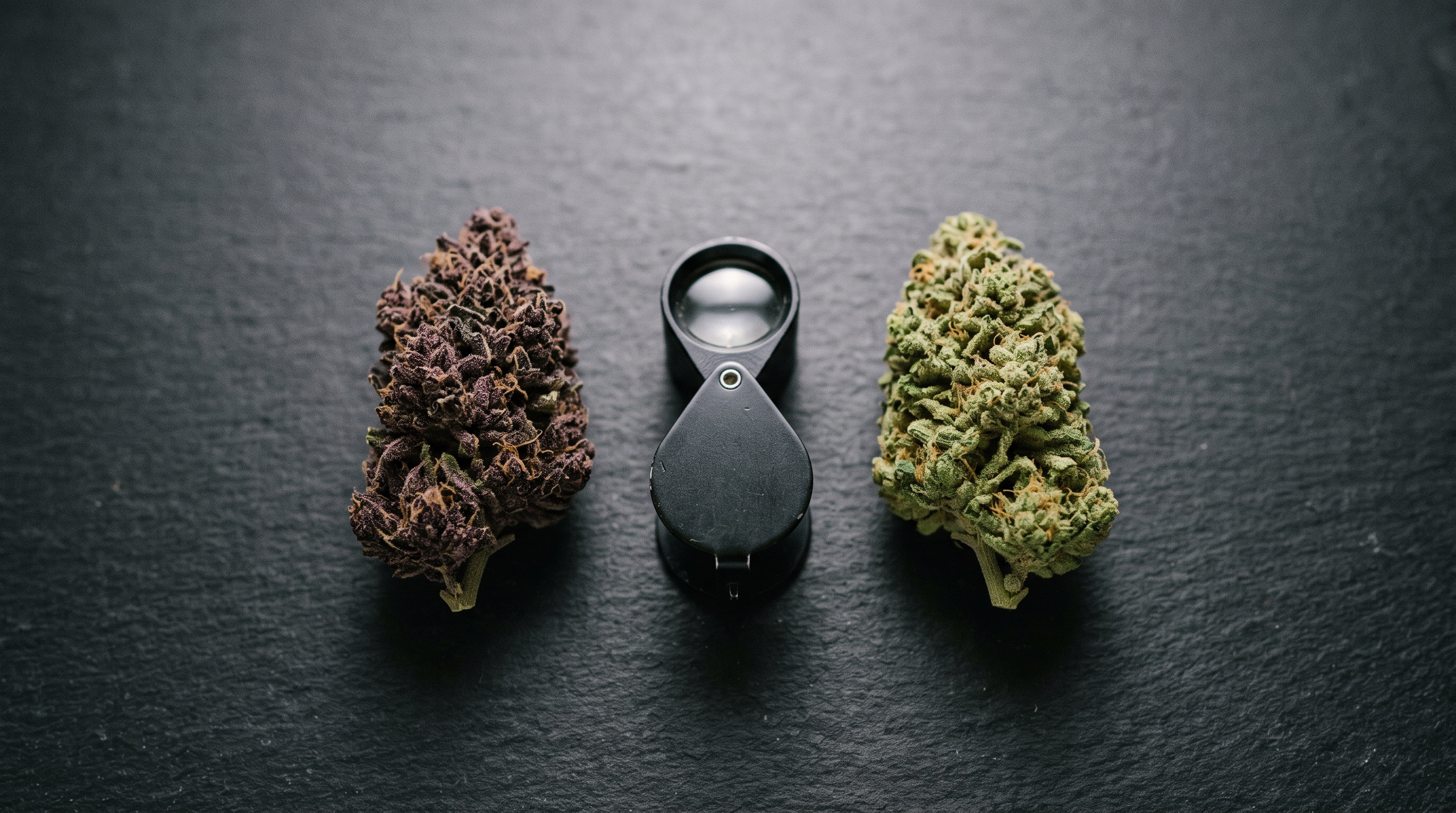
So what should you actually look at?
If colour is not a potency signal, what is?
Terpenes. The aromatic compounds are the strongest available predictor of how a given flower will feel. Many classic purple lines lean myrcene- and linalool-forward, which is a far better explanation for their relaxing reputation than the pigment ever was. Myrcene is associated with sedated and relaxed profiles; linalool with calm. Caryophyllene is unusual in that it genuinely does interact with a cannabinoid receptor, and limonene and pinene tend to pull in the other direction. Start with the terpene guide if this is new territory.
Cannabinoid ratio, not just THC. The lab results tell you more than the headline number — assuming you can trust them, which is its own messy topic. Your nose helps too, imperfectly: the terpene smell test is a better filter than the jar photo.
Your own record. This is the one that actually works. The same flower lands differently on different people, which is why finding your ideal high is not about a strain name and why budtender recommendations disappoint so consistently. Chemistry plus your individual response is the whole game. If you want to stop guessing, log what you consume and how it landed — the High IQ app makes that tracking painless, and after a dozen entries your own pattern will tell you more than any label.
Purple strains worth knowing (for the right reasons)
None of this means purple flower is bad. Some genuinely excellent cultivars happen to be purple. Just buy them for what they are.
| Strain | Why it is worth trying |
|---|---|
| Granddaddy Purple | The archetype. Grape-forward, heavily relaxed, a benchmark for the Relax High |
| Purple Punch | Dessert-sweet, commonly reported for evening use |
| Purple Urkle | Deep colour, classic West Coast indica lineage |
| Purple Kush | A landrace-adjacent Kush line, not a hype build |
| Grape Ape | Strong grape aroma, heavy body profile |
| Blackberry Kush | Berry-forward, often sleepy |
| Forbidden Fruit | Tropical-citrus over a purple base |
| Zkittlez | Candy terpene profile, colour varies by pheno |
| Mendo Breath | Vanilla-caramel funk, purple in cool finishes |
| Ice Cream Cake | Occasional purple expression, reviewed here |
| Black Cherry Soda | Named for the colour, and honest about it |
| Purple Haze | The outlier: purple, sativa-leaning, described as energising for fifty years |
Purple Haze is the row that matters most. It sits awkwardly against every claim that purple means sedation — and indica and sativa labels are already shaky before you add colour as a proxy. The Uplift High and Balance High profiles group flower by chemistry instead, which is the only grouping that survives contact with a real jar.
The bottom line
Anthocyanins are real chemistry doing a real job: pH-responsive pigments, built by a specific set of genes, switched on by cool temperatures in a surprisingly narrow band, doing photoprotective work while the plant finishes. Cannabis’s main one is cyanidin-3-rutinoside, and it was only properly identified in 2023.
What they are not is a potency signal. Colour and cannabinoid content run on separate regulatory circuits — a measured result, not an opinion. Purple tells you something true about a plant’s genetics and the nights it experienced. It tells you nothing about how you will feel in twenty minutes.
Bag appeal is not chemistry. Buy the flower, not the photograph.
FAQ
Does purple weed have more THC?
No. Anthocyanins are pigments from the phenylpropanoid pathway; cannabinoids come from a different pathway entirely and are stored in different structures. The 2025 temperature study found anthocyanin accumulation and CBD content have different temperature optima, indicating separate regulatory control.
Is purple cannabis more sedating?
Not because of the colour. Several well-known purple lines lean toward myrcene-rich, relaxing profiles, which is a plausible reason for the reputation — but Purple Haze is purple and has been described as energising for decades. The terpene profile does the work, not the pigment.
Can I make any strain turn purple with cold?
No. The plant needs a functioning anthocyanin biosynthesis pathway. Cold acts as a switch on genetics that are already there. A green genotype stays green.
Why are my plant’s stems purple?
If the colour is on stems, petioles and older fan leaves rather than the flowers, suspect a phosphorus deficiency rather than genetics — especially if the plant looks unhappy in other ways. Check common growing problems before celebrating.
Do anthocyanins survive smoking?
There is no evidence that they do in any meaningful quantity. They are water-soluble, non-volatile and heat-sensitive. The antioxidant research on anthocyanins is dietary — oral intake, food matrix — and does not transfer to combustion. Colour will also fade in the jar over months, since light, heat and oxygen degrade anthocyanins as they degrade everything else; standard storage practice applies.
Sources
-
Bassolino L, Fulvio F, Pastore C, Pasini F, Gallina Toschi T, Filippetti I, Paris R. “When Cannabis sativa L. Turns Purple: Biosynthesis and Accumulation of Anthocyanins.” Antioxidants (2023), 12(7):1393. doi:10.3390/antiox12071393
-
Gagalova KK, Yan Y, Wang S, Matzat T, Castellarin SD, Birol I, Edwards D, Schuetz M. “Leaf pigmentation in Cannabis sativa: Characterization of anthocyanin biosynthesis in colorful Cannabis varieties.” Plant Direct (2024), 8(11):e70016. doi:10.1002/pld3.70016
-
Kim SR, Basnet P, Kovaleski AP, Ellison SL. “Anthocyanin accumulation, inflorescence dry weight and total cannabidiol content have different temperature optima in Cannabis sativa.” Journal of Cannabis Research (2025), 7:51. doi:10.1186/s42238-025-00311-w
-
Castañeda-Ovando A, Pacheco-Hernández ML, Páez-Hernández ME, Rodríguez JA, Galán-Vidal CA. “Chemical studies of anthocyanins: A review.” Food Chemistry (2009), 113(4):859–871. doi:10.1016/j.foodchem.2008.09.001
-
Christie PJ, Alfenito MR, Walbot V. “Impact of low-temperature stress on general phenylpropanoid and anthocyanin pathways: Enhancement of transcript abundance and anthocyanin pigmentation in maize seedlings.” Planta (1994), 194:541–549. doi:10.1007/BF00714468
-
Feild TS, Lee DW, Holbrook NM. “Why leaves turn red in autumn. The role of anthocyanins in senescing leaves of red-osier dogwood.” Plant Physiology (2001), 127(2):566–574. PubMed 11598230
-
Khoo HE, Azlan A, Tang ST, Lim SM. “Anthocyanidins and anthocyanins: colored pigments as food, pharmaceutical ingredients, and the potential health benefits.” Food & Nutrition Research (2017), 61:1361779. doi:10.1080/16546628.2017.1361779
-
Czank C, Cassidy A, Zhang Q, Morrison DJ, Preston T, Kroon PA, Botting NP, Kay CD. “Human metabolism and elimination of the anthocyanin, cyanidin-3-glucoside: a 13C-tracer study.” American Journal of Clinical Nutrition (2013), 97(5):995–1003. doi:10.3945/ajcn.112.049247
