Cannabis and Perimenopause: Symptoms and Emerging Research
What the research really shows about cannabis for perimenopause symptoms like sleep, mood, and hot flashes during the hormone transition years.


If you are in your forties and your body suddenly feels like it belongs to someone else, you are not imagining it. The transition years before menopause have a name: perimenopause. And a growing number of women are reaching for cannabis to get through them.
Before we go one sentence further, let me be direct, because this is a medical topic and I take that seriously. Nothing here is medical advice, and cannabis is not a treatment for perimenopause. The honest headline of the science is that the evidence is thin, mostly survey-based, and there is not a single quality randomized trial testing cannabis for perimenopause symptoms. What follows is what we actually know, hedged exactly as hard as the data deserves.

Perimenopause vs. menopause: a quick, important distinction
People use “menopause” as a catch-all, but the two are not the same thing.
Menopause is a single point in time: the day that marks twelve full months without a period. Everything after that is postmenopause.
Perimenopause is the messy transition that leads up to it. It often starts in the early-to-mid forties, sometimes the late thirties. It can last a couple of years or close to a decade. The defining feature is not low estrogen. It is fluctuating estrogen. Hormone levels swing up and down without warning. That is exactly why the symptoms can feel so chaotic.
This distinction matters more than it sounds. In the largest survey on this topic, perimenopausal women reported a worse symptom burden than postmenopausal women. That was especially true for mood, anxiety, and hot flashes. We cover the later stage in our companion piece on cannabis and menopause. This article stays focused on the transition itself.
The perimenopause symptom cluster
Perimenopause rarely shows up as one tidy complaint. It tends to arrive as a cluster, and the items reinforce each other. The most commonly reported include:
- Sleep disruption — trouble falling asleep, fragmented sleep, and 3 a.m. wake-ups
- Mood swings, anxiety, and irritability — sometimes the first sign, often the most distressing
- Hot flashes and night sweats (the “vasomotor” symptoms)
- Joint and muscle aches that seem to appear out of nowhere
- Irregular cycles — shorter, longer, heavier, lighter, skipped
- Brain fog and difficulty concentrating
These feed one another. Night sweats wreck your sleep, poor sleep worsens your mood, and a low mood makes everything harder to cope with. That tangle is a big part of why women go looking for something that takes the edge off several symptoms at once.
The ECS-estrogen connection: a plausible mechanism, not a proven one
Here is where the biology gets genuinely interesting, and where I have to be careful not to oversell it.
Your body has an endocannabinoid system, or ECS. It is a network of receptors and signals that helps run sleep, mood, pain, appetite, and body heat. If that list sounds a lot like the perimenopause cluster, you are noticing something real. You can get a friendly primer in our explainer on anandamide, your body’s natural THC.
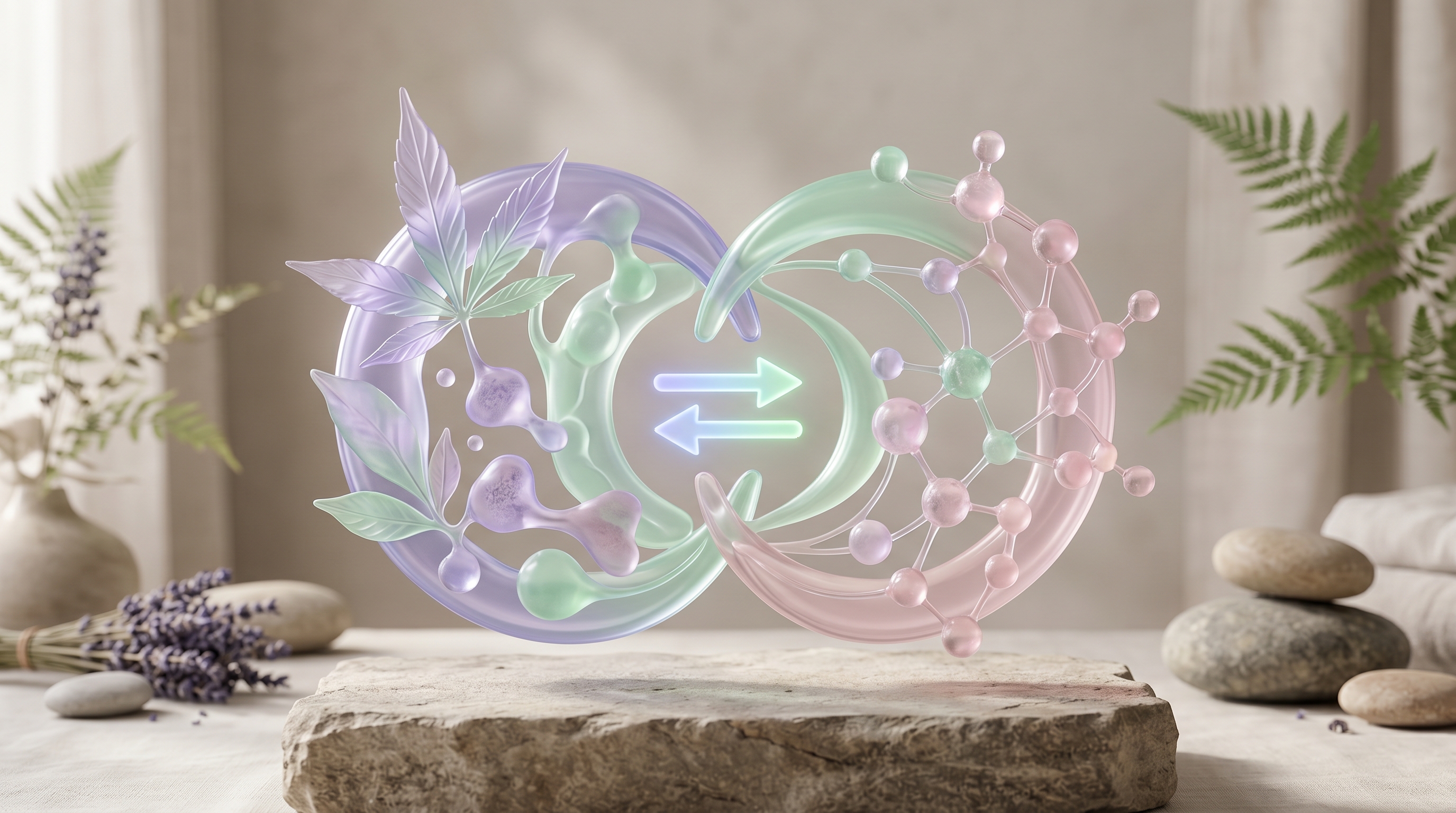
The twist is that the ECS and the estrogen system talk to each other. A 2021 review in the International Journal of Molecular Sciences [Cristino, 2021] mapped this “complex interplay” in detail. Estrogen helps regulate endocannabinoid levels (like anandamide), the enzymes that break them down (notably FAAH), and the density of cannabinoid receptors. The relationship runs both ways, and it changes from tissue to tissue.
So the working hypothesis goes like this. When estrogen swings and then declines during perimenopause, your endocannabinoid tone may shift too. That could leave the ECS less able to keep sleep, mood, and temperature in balance. In theory, adding cannabinoids could nudge that system. In theory.
The catch is the word theory. This idea is built mostly on cell and animal studies, plus some human correlation data. A plausible pathway is a reason to run a clinical trial. It is not proof that cannabis works.
What the research actually shows (and doesn’t)
Let me lay the evidence out plainly, because this is the part most articles skip.
Women are using it, and increasingly. The standout study is a 2022 survey published in Menopause [Dahlgren, 2022] of 131 perimenopausal and 127 postmenopausal women. A striking 86% were current cannabis users, and 78.7% said they used it specifically to manage menopause-related symptoms. The most common targets were sleep disturbance (67.4%) and mood/anxiety (46.1%). Notably, perimenopausal women used cannabis for mood and anxiety significantly more than postmenopausal women (p<0.05).
Why women turn to it. A 2025 national survey in the Journal of Studies on Alcohol and Drugs [Dahlgren, 2025] found that women with more severe symptoms — the ones not well controlled by usual treatments — were the most likely to use cannabis medically. In plain terms: many reach for it after other things have not worked.
What it feels like to them. A 2024 qualitative study in Menopause [Babyn, 2024] interviewed midlife women. They described cannabis as “a therapeutic agent” they figured out through trial and error and peer advice. They also reported a frustrating lack of guidance from healthcare providers, and a sense of stigma.
Now the part that gets buried: none of this proves cannabis works. Every study above is a survey or interview. They measure what women report. They do not measure what cannabis actually does in a controlled test. As the 2022 authors wrote, no research has yet tested whether medical cannabis truly works for these symptoms. As of 2025, there are still no published randomized controlled trials for perimenopause. A few observational studies are underway. But the gold-standard evidence does not exist yet.
So when you read “studies show cannabis helps perimenopause,” read it as this instead: surveys show many women believe it helps, and we badly need real trials to find out.
Symptom by symptom (handle with care)
With that giant caveat firmly in place, here is how the symptom-specific evidence stacks up. In every case the perimenopause-specific data is observational, so I am borrowing cautiously from broader research.
Sleep
Sleep is the most-cited reason women use cannabis in the transition, and the broadest cannabis-and-sleep literature is at least suggestive that some people fall asleep faster. We cover the nuances — and the real catch about REM sleep and tolerance — in cannabis and sleep: the science behind better rest, how THC affects REM sleep and dream recall, and the deep dive on the sleep-pressure pathway. The terpene angle matters too; see linalool, the lavender terpene for calm and sleep and the gentler reputation of CBN.
Mood and anxiety
This was the symptom most tied to perimenopausal cannabis use in the survey data. But cannabis and anxiety is a two-sided story. Low doses may calm. Higher doses can do the opposite. The why (serotonin and stress hormones) shows up in cannabis and serotonin: the mood connection beyond THC and cannabis and cortisol: how cannabinoids affect your stress hormone. Our full breakdown lives in the science-backed guide to cannabis and anxiety.
Hot flashes
This is where I get most cautious. In the 2022 survey, only 13% of women used cannabis for hot flashes. The vasomotor evidence is the weakest of the bunch. The ECS does help regulate body heat. But there is almost no quality human data showing cannabis reduces hot flashes. Treat any such claim with real doubt.
Joint and muscle pain
The aches that surface in perimenopause overlap with cannabis’s better-studied pain literature. That body of work is genuinely larger, though still imperfect — see cannabis for arthritis and joint pain, cannabis and osteoarthritis joint-pain research, and finding your THC-CBD sweet spot. The terpene caryophyllene is a frequent focus of anti-inflammatory interest.
Cycle-related symptoms
Because perimenopausal cycles are still happening (just erratically), the PMS and cramp literature is also relevant. We dig into it in cannabis for menstrual pain and PMS and the emerging work in cannabis and endometriosis.

The risks, and why cannabis is not HRT
This is the most important section, so read it twice.
Cannabis is not hormone replacement therapy. HRT (now often called menopausal hormone therapy) works on the root cause: declining estrogen and progesterone. Cannabis does nothing of the kind. At best it may dull how some symptoms feel. It does not touch the hormone shift underneath. It also lacks HRT’s separate, proven benefits, like bone protection. Swapping one for the other is not a fair trade. That decision belongs with your doctor, not a blog.
The other risks worth naming honestly:
- Masking, not fixing. If cannabis quiets a symptom, you might skip a check-up that would have caught something else. Changes in bleeding, for example, sometimes need a workup. Feeling better is not the same as being well.
- It cuts both ways. Cannabis can worsen anxiety, disrupt deep sleep over time, and build tolerance. More is not better. The data on knowing when not to increase your dose applies squarely here.
- Real interactions. Cannabis can interact with other drugs and conditions. Midlife is often when people start new prescriptions.
- The self-medication trap. The surveys show women often turn to cannabis because they feel unsupported. That gap deserves better care, not a workaround.
If you do explore it, the boring fundamentals matter most: start extremely low, go slow, and track your response carefully. Our beginner dosing chart is a sensible starting point.
Please talk to your doctor
I mean this genuinely. Perimenopause is under-discussed, and women are too often dismissed. The studies above document that frustration clearly. But the answer is a better medical conversation, not a substitute for one.
Bring it up directly. Ask about menopausal hormone therapy. Ask about non-hormonal prescription options. Ask where cannabis might, or might not, fit alongside them. Mention everything you already take. A clinician who knows your full history can weigh tradeoffs that no article ever can. This piece is education, not medical advice. It is not a recommendation to use cannabis.
Frequently asked questions
Does cannabis help perimenopause symptoms? Survey research shows many midlife women use it and report relief, especially for sleep and mood. But there are no randomized controlled trials proving it works for perimenopause. The honest answer is “we don’t know yet.”
Is perimenopause different from menopause for cannabis use? Yes. Perimenopause is the fluctuating-hormone transition, and in survey data perimenopausal women reported worse mood, anxiety, and hot-flash burden — and used cannabis for mood/anxiety more than postmenopausal women.
Can cannabis replace HRT? No. Cannabis does not address the underlying hormonal changes the way hormone therapy can, and it lacks HRT’s proven benefits. This is a decision for your doctor.
What symptom is cannabis used for most in perimenopause? In the largest survey, sleep disturbance (67.4%) and mood/anxiety (46.1%) were the top targets. Hot flashes were a far less common reason (about 13%).
Is it safe to try? That depends entirely on you — your health, your medications, your history. Talk to your doctor first, and if you proceed, start low and go slow.
Key takeaways
- Perimenopause is the transition, marked by fluctuating hormones, not the low, steady estrogen of postmenopause.
- Many midlife women use cannabis for the symptom cluster, most often for sleep and mood.
- The biology is plausible because the ECS and estrogen systems interact, but plausible is not proven.
- The evidence is thin. It is almost all surveys and interviews, with no randomized trials for perimenopause.
- Cannabis is not HRT, and it may mask symptoms rather than treat the cause.
- Talk to your doctor first. This is education, not medical advice.
In short: lots of women in the transition are using cannabis, the ECS-estrogen biology gives a plausible reason it might help with sleep and mood, and the lived-experience reports are real. But the rigorous evidence is not here yet. If perimenopause is making your life hard, that is worth a serious talk with a clinician about all your options, hormone therapy included.
If you want to understand the broader context of who is using cannabis and why during midlife, women and cannabis: the gender reversal in consumption trends is a good next read.
Sources
- Dahlgren MK, et al. A survey of medical cannabis use during perimenopause and postmenopause. Menopause. 2022;29(9):1028–1036. doi:10.1097/GME.0000000000002018
- Dahlgren MK, Kosereisoglu D, Sagar KA, et al. A National Survey Study of Cannabis Use During Menopause: Identifying Variables Associated With Recreational, Medical, and Hybrid Use. J Stud Alcohol Drugs. 2025;86(1):68–74. doi:10.15288/jsad.24-00014
- Babyn K, Quintanilha M, Ross S, et al. Women’s perceptions and experiences with cannabis use in menopause: a qualitative study. Menopause. 2024;31(9):781–788. doi:10.1097/GME.0000000000002388
- Cristino L, et al. The Complex Interplay between Endocannabinoid System and the Estrogen System in Central Nervous System and Periphery. Int J Mol Sci. 2021;22(2):972. doi:10.3390/ijms22020972
- Menopause and the Endocannabinoid System (book chapter synthesizing ECS, preclinical, and observational evidence on medicinal cannabis for menopausal symptoms). Springer Nature, 2025. doi:10.1007/978-3-032-01737-6_7


