Soft Cannabis Caramels: A Recipe With Built-In Dosing
Make soft, chewy cannabis caramels with cannabutter and a candy thermometer. Learn the soft-ball stage and how to dose every piece evenly.

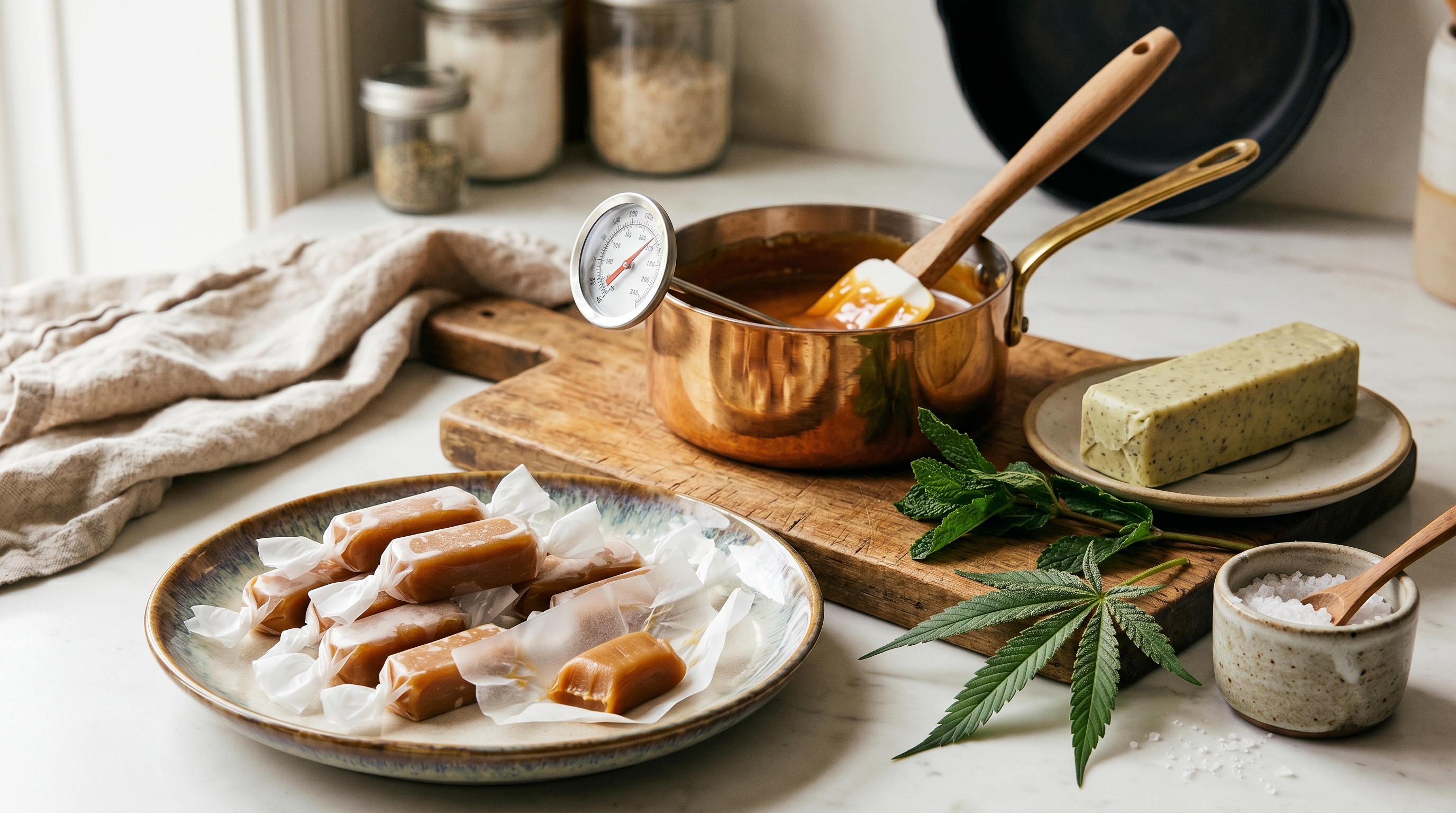
There is a special kind of heartbreak in homemade edibles: the batch where one bite does nothing and the next one flattens you for six hours. Caramels solve that problem better than almost any other treat in the kitchen. They start as one smooth, evenly mixed pool of infused candy, and you cut that pool into uniform little squares. If the batch is mixed well and the pieces are the same size, the dose is the same in every piece. That is the whole pitch.
In this guide I will walk you through soft, chewy cannabis caramels from the ground up: why cannabutter is such a friendly carrier for THC, the candy science that keeps your caramels chewy instead of rock-hard, the equipment you actually need, a step-by-step recipe, and the simple math that turns “I think these are pretty strong” into “each one is about 5 mg.” We will keep the health talk honest and hedged, because edibles are powerful and your safety matters more than your sweet tooth.
Why caramels are great for dosing
Most edible disasters come down to one thing: uneven distribution. When cannabis fat is not mixed thoroughly through a batter, the THC clumps in some bites and skips others. Caramel sidesteps this in two ways.
First, the infusion lives in fat, and caramel is a fat-rich candy. THC and the other cannabinoids are fat-soluble, which is exactly why infusing them into butter works so well in the first place. If you have not made your fat yet, start with our complete guide to cannabis butter (cannabutter) — it is the foundation for this whole recipe and for most of cannabis cooking 101. And before you infuse anything, make sure you understand decarboxylation, the gentle heating step that activates THC so your caramels actually do something.
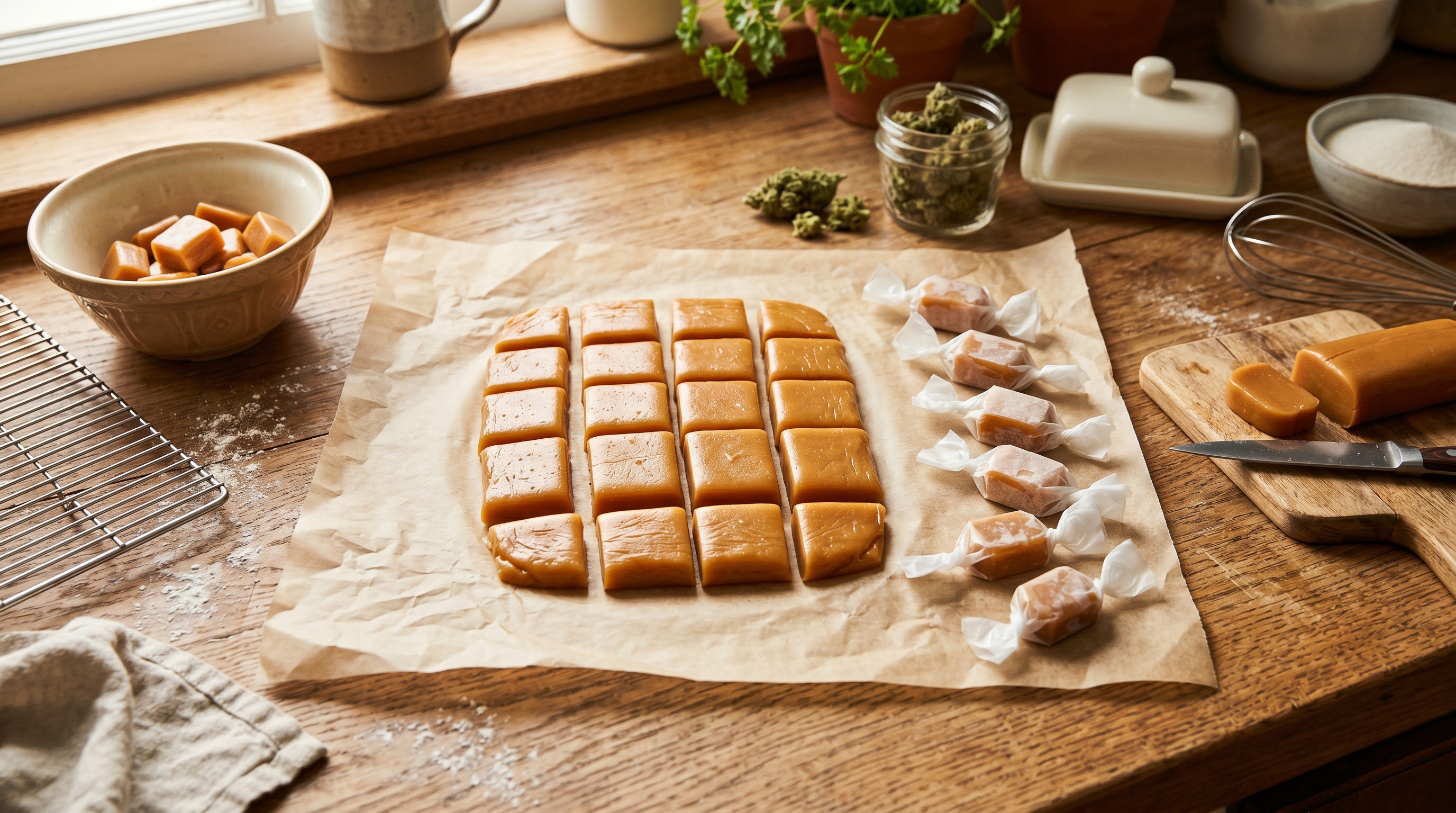
Second, caramel becomes a single homogeneous liquid before it sets. You stir the infused butter into a hot, fluid candy base and whisk until it is uniform. Then you pour it flat, let it set, and cut it into identical squares. Because the mixture was evenly blended, each square carries a roughly equal share of the total dose. That is far more reliable than scooping cookie dough or filling gummy molds at slightly different levels.
This is also why caramels make such good microdosing candy. Cut them small and you can land in the 2.5–5 mg range comfortably, which is a sensible starting point for most people.
The soft-ball stage: a little candy science
Caramel texture is dictated almost entirely by temperature. As sugar syrup boils, water evaporates and the sugar concentration climbs. Candy makers track this with named stages, and for chewy caramels you want the soft-ball stage, roughly 240–245°F (116–118°C).
Here is the rule of thumb that keeps confused cooks out of trouble:
- Under ~235°F: too much water remains; your caramel stays a sticky sauce that never sets.
- 240–245°F (soft-ball): that sweet spot — chewy, pliable, holds its shape but yields to a bite.
- Above ~248–250°F (firm to hard ball): the candy sets firm and eventually hard, more of a toffee than a caramel.
So if your caramels turn out like a sauce, you stopped too early. If they crack a tooth, you cooked too long. A few degrees genuinely matters, which is why a candy thermometer is non-negotiable here. (That hard candy guide leans on the much hotter hard-crack stage, around 300°F — useful context for how dramatically temperature changes texture.)
What about the cannabinoids?
A common worry: does 245°F destroy the THC? The reassuring answer, supported by edible educators, is no — that temperature is not hot enough to wreck your infusion [Kyle, 2021]. THC degradation becomes a real concern much higher, when sugar mixtures climb above roughly 300°F (150°C) with the infused fat already in the pot [Hartman, 2022]. Because soft-ball caramels top out near 245°F, your cannabutter sits in the safe zone.
Still, smart technique adds insurance. Whenever a recipe lets you, stir the infused fat in toward the end of cooking, after the candy has reached temperature and dropped off the boil. This minimizes the time your cannabinoids spend at peak heat. For more on what heat does to potency, see why some edibles hit harder thanks to 11-hydroxy-THC and how to test homemade edible potency at home.
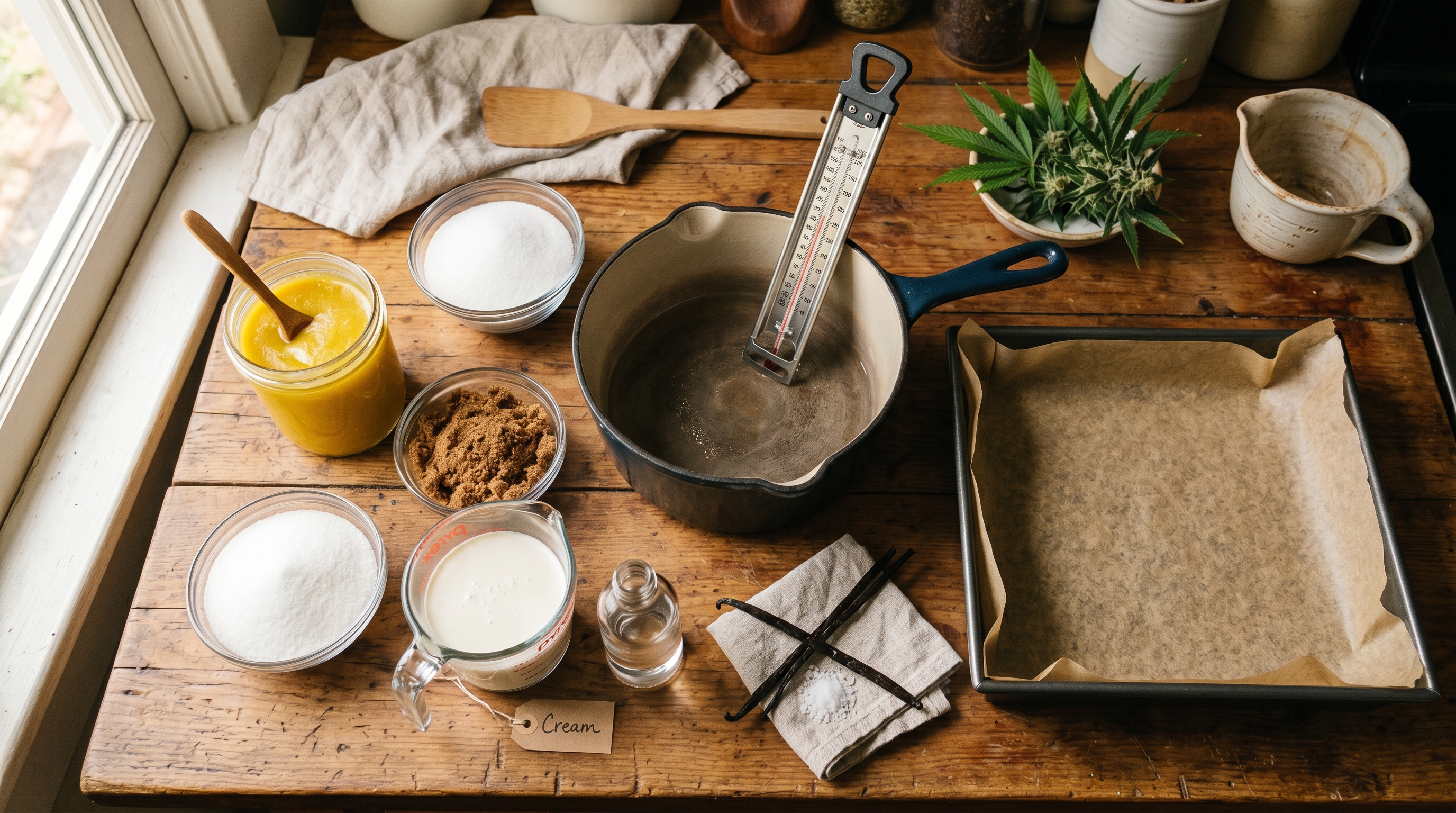
Ingredients and equipment
This makes roughly an 8x8-inch slab that you will cut into 36 or 64 pieces.
Ingredients
- 1/2 cup (about 113 g) cannabutter, at room temperature
- 1/2 cup (120 ml) heavy cream
- 1 cup (200 g) granulated sugar
- 1/2 cup (100 g) packed brown sugar
- 1/2 cup (120 ml) light corn syrup
- 1/2 teaspoon fine salt
- 1 teaspoon vanilla extract (added at the end)
- Flaky sea salt, for finishing (optional)
A note on potency control: if your cannabutter is strong, you can split the fat — half cannabutter, half plain butter — to gently lower the dose per piece without changing the texture.
Equipment
- A heavy-bottomed saucepan (thin pans scorch caramel)
- A candy thermometer — clip-on glass or a digital probe both work
- A small second pot for warming the cream
- 8x8-inch pan, parchment paper, a little plain butter for greasing
- Heatproof spatula or wooden spoon, plus a whisk
- A kitchen scale (optional but ideal for even cutting)
- Wax paper or cellophane for wrapping
Calibrate your thermometer. Drop it in boiling water; it should read 212°F at sea level. If it reads off, adjust your target by the same amount. And remember altitude: water boils about 1°F lower per 500 feet of elevation, so high-altitude cooks should subtract accordingly.
Step-by-step
- Prep the pan. Line your 8x8 pan with parchment, leaving an overhang so you can lift the slab out later. Lightly grease the parchment with plain butter.
- Warm the cream. In a small pot, gently heat the heavy cream until it just steams — do not boil it. Warm cream keeps the candy from bubbling over later. Set it aside.
- Build the sugar base. In your heavy saucepan over medium heat, combine the granulated sugar, brown sugar, corn syrup, and 1/2 teaspoon salt with about half of the butter. Stir until smooth and the mixture comes to a gentle boil.
- Add the warm cream. Slowly pour in the warm cream while stirring. It will bubble up — that is normal. Keep stirring until smooth.
- Clip on the thermometer. Position the probe so it sits in the liquid but does not touch the bottom of the pan. Cook over medium heat, stirring occasionally, and watch the temperature climb. Patience wins — this can take 10–20 minutes. Do not blast the heat or you will scorch it.
- Add your cannabutter near the finish. When the mixture nears the target, stir in the remaining cannabutter (and any you held back) so your infusion spends minimal time at peak heat.
- Hit the soft-ball stage. Cook to 240–245°F. The moment you reach it, pull the pot off the heat. For chewier caramels aim for 240°F; for a firmer chew, 245°F.
- Flavor and pour. Stir in the vanilla (it will sputter briefly). Whisk for a full minute or two to fully emulsify the fat — this is the step that guarantees an even dose. Pour into your prepared pan and tap it on the counter to level.
- Finish and set. Sprinkle flaky salt over the top if you like. Let the slab cool at room temperature for at least 2–4 hours, or chill it (covered) until firm.
Per-piece dosing math
Here is where caramels earn their reputation as the most controllable homemade edible. You only need two numbers: the total THC in the batch and the number of pieces.
Total batch THC comes from your cannabutter. A rough worked example from edible educators [Hartman, 2022]: if you infuse 1 cup of butter using 10 grams of flower at 15% THC, that flower holds about 1,500 mg of THC. Real-world losses during decarb and infusion mean you will not capture all of it — assume you keep a meaningful fraction — but it gives you a ceiling to reason from. This recipe uses 1/2 cup of cannabutter, so it carries roughly half of whatever your full cup contained.
Then divide by pieces:
| Estimated batch THC | Cut into 36 pieces | Cut into 64 pieces |
|---|---|---|
| 180 mg | ~5 mg each | ~2.8 mg each |
| 360 mg | ~10 mg each | ~5.6 mg each |
| 720 mg | ~20 mg each | ~11 mg each |
To make the per-piece number trustworthy, cut uniformly. Score a clean grid with a ruler, or weigh the cooled slab and divide its weight by the number of pieces so each square is the same mass. A 6x6 grid gives 36 pieces; an 8x8 grid gives 64 smaller ones. Smaller pieces give you finer control and are friendlier for new consumers.
For the full breakdown of these calculations, see edible dosing math for home cooks and the beginner’s dosing chart. If you are newer to edibles, please read edible dosing for beginners: start with one small piece, wait a full two hours before deciding to eat more, and respect the difference between a microdose and a high dose. Edibles may feel stronger and last longer than inhaled cannabis, and effects vary widely from person to person.
Salt, flavor, and variations
Caramel is a blank canvas. A few ideas:
- Salted caramel: finish with flaky sea salt while the slab is still warm. The salt-sweet contrast is classic for a reason.
- Espresso or cinnamon: stir in a teaspoon of espresso powder or a pinch of cinnamon with the vanilla.
- Chai or pumpkin spice: a small spoon of warming spice blend turns these into a cozy seasonal treat.
- Reduce the weedy taste: brown butter notes and good vanilla help mask herbal flavor — more tricks in how to make edibles without the weedy taste.
If the candy-making bug bites hard, branch into cannabis gummies for a chewy, fruit-forward alternative or hard candy for lozenges. The same infused butter that powers these caramels also unlocks savory projects like infused pasta sauce.
Wrapping and storage
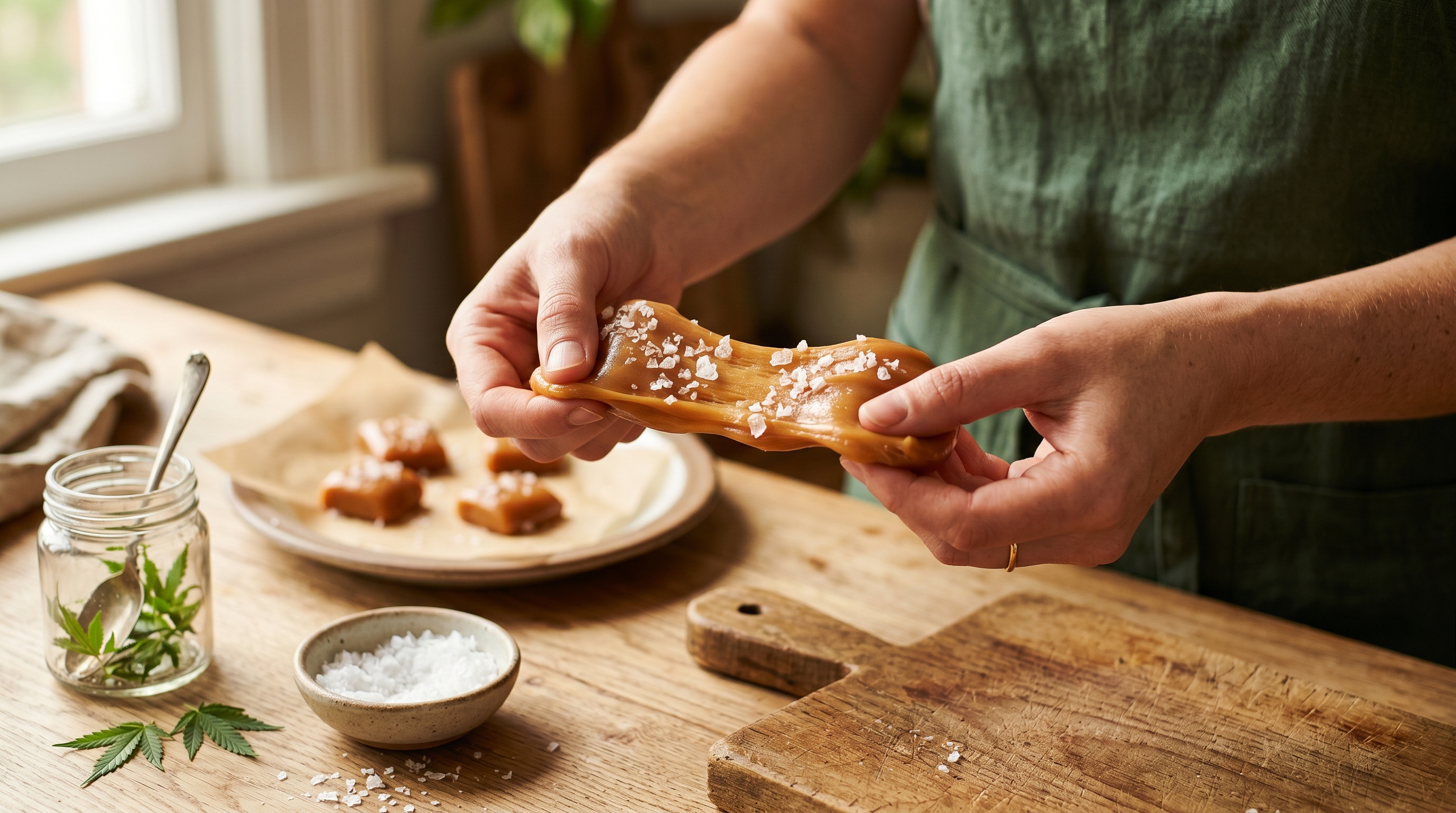
Caramels will fuse into one giant blob if you store them naked in a container. Wrap each piece individually in a small square of wax paper or cellophane, twisting the ends like a classic candy. This also lets you label the dose per piece — genuinely useful when you have guests or share a household.
For storage:
- Room temperature: about a week in an airtight container before texture softens.
- Refrigerator: a few weeks, individually wrapped.
- Freezer: several months; let them come to room temperature before unwrapping.
Keep them well away from heat and light, both for texture and to protect potency. And the obvious-but-important reminder: store labeled and out of reach of children and pets. For broader guidance, see our edibles shelf-life and storage guide.
Frequently asked questions
Do I really need a candy thermometer? Yes. A few degrees is the difference between sauce, chew, and tooth-cracking toffee. If you are in a pinch, the cold-water test works: drop a bit of syrup into ice water; at soft-ball stage it forms a soft, pliable ball you can flatten between your fingers.
Will cooking destroy my THC? At soft-ball temperatures (around 245°F) the risk is low; cannabinoid degradation becomes a real concern much higher, above roughly 300°F with the fat in the pot. Adding your cannabutter near the end of cooking adds a margin of safety.
My caramels came out too soft. Can I fix them? Yes — gently reheat the batch and cook a little longer until the thermometer reads 245°F, then re-pour. Too hard? Reheat with a splash of cream and stir until it loosens.
How strong should each piece be? For casual or newer consumers, many educators suggest keeping individual pieces in the 2.5–10 mg range. Cut smaller for finer control, and always start low.
Can I use tincture instead of cannabutter? You can dose with a tincture, but stir it in at the very end after the candy is off the heat, since added liquid and high heat both work against you. Cannabutter remains the most forgiving carrier for caramels.
What strains work best? Any decarbed flower works, but flavor carries through. If you care about the taste profile, browse our notes on the best strains for cooking.
Key Takeaways
Caramels reward patience and punish guesswork, which makes them a near-perfect teaching edible. A quick recap from Professor High:
- Cannabutter is the carrier. Fat-soluble cannabinoids ride along in a fat-rich candy, and a well-whisked batch spreads the dose evenly.
- Cook to the soft-ball stage (240–245°F). Lower and it stays a sauce; higher and it turns hard. A calibrated candy thermometer is non-negotiable.
- Heat is fine here. Soft-ball temps will not destroy your THC; trouble starts above ~300°F, so add infused fat near the end as insurance.
- Dose with arithmetic. Total batch mg divided by uniform pieces equals mg per piece. Cut a clean grid or weigh the slab.
- Start low, wait long. One small piece, then two hours before deciding on more. Wrap and label every piece.
Turn the scariest part of edibles — the not-knowing — into simple math, and let the candy meet you where you are.
Sources
- Leafly — Recipe: How to make cannabis-infused caramels
- Emily Kyle, MS, RDN — Chewy Homemade Cannabis Caramels
- The Cannigma — How to Make Cannabis Caramels At Home
- HowToEdibles — Cannabis Caramel & Confection Dosing Guide
- Zamnesia — Cannabis infused caramels (soft-ball stage notes)
This article is for educational purposes and is not medical advice. Cannabis affects everyone differently; consult a qualified professional about your situation, and follow the laws in your area.


