Cannabis Cooking 101: How to Make Infused Meals
Make an infused meal with a labeled oral product and a simple garlic-toast recipe. Learn why homemade cannabutter cannot guarantee precise THC servings.

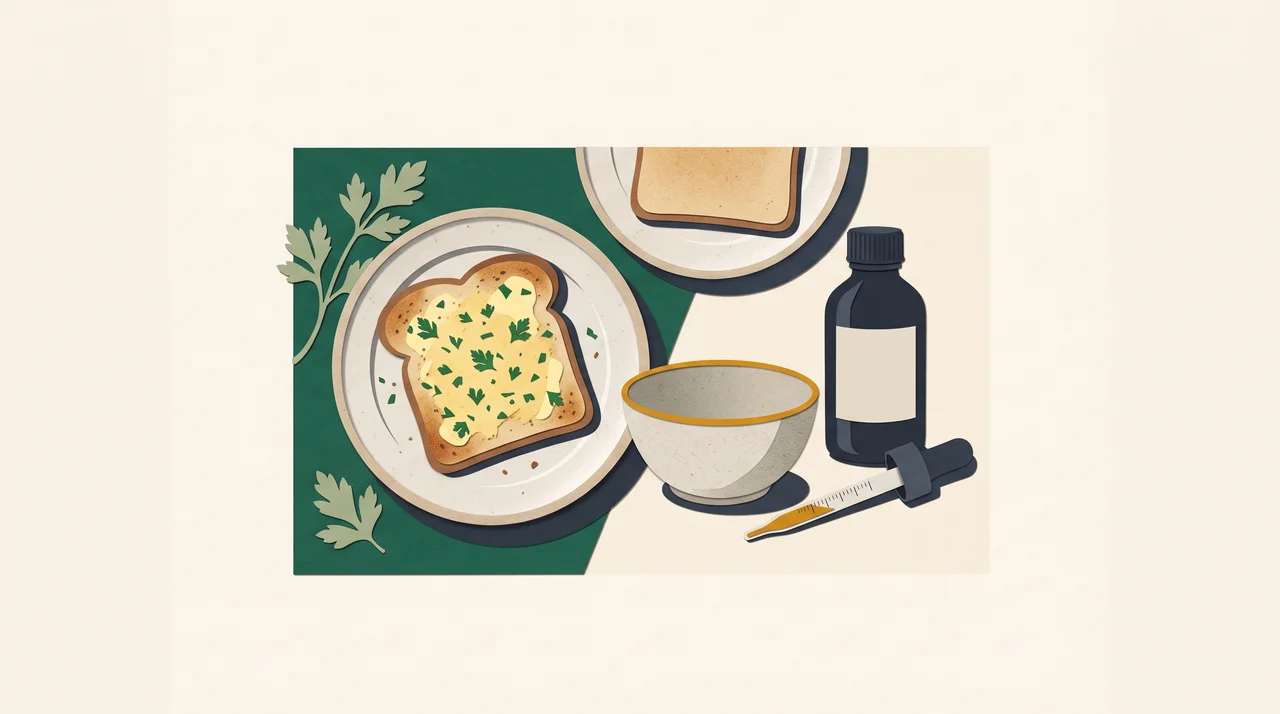
For a first infused meal, prepare ordinary food and finish one separate serving with a measured, labeled oral cannabis product—only if its instructions allow mixing with food. Homemade flower infusions have uncertain strength; a recipe or calculator cannot certify milligrams of THC in your butter. Health Canada warns that homemade extracts can have unexpected potency. Home-production guidance.
This guide gives you a small garlic-toast project, the arithmetic behind an oral-product label, and the limits of the flower-to-butter method. Keep the meal enjoyable by leaving the rest of the food uninfused.
Which cannabis ingredient should you use?
Choose an ingredient intended to be swallowed, with readable THC information and usable directions. Cannabis oils can have different intended uses; a vape liquid, topical oil, or mystery concentrate is not a substitute for an oral ingredient. Follow the product’s instructions rather than assuming every bottle belongs in food. Health Canada’s label guide distinguishes product classes and intended routes; its medical-use guide identifies oral oils separately from vaping products.
Before you cook, check:
- Does the THC number describe the whole container, one unit, or a concentration? These units answer different questions; a label does not remove all uncertainty.
- Is this the right product and batch? A matching certificate of analysis can document the tested sample. It does not measure your finished toast.
- Can the supplied device measure the amount you intend to use? If not, choose a product with clearer directions and a suitable measuring device. Do not estimate tiny amounts with a kitchen spoon.
A scale measures ingredient weight. It does not measure THC concentration; our grams and ounces guide explains why those units are different.
How do you calculate labeled THC in an oral oil?
When the label gives mg THC per mL, multiply that concentration by the measured volume:
Labeled THC added = mg THC/mL × mL added.
For a hypothetical oil labeled 10 mg THC/mL, 0.25 mL × 10 mg/mL = 2.5 mg labeled THC. This is an arithmetic example, not a product recommendation or a suitable amount for everyone. Use the concentration on your own product, not the example’s number.
Do not substitute CBD concentration, total bottle milligrams, or a flower’s THC percentage into that calculation. Label units matter. Health Canada.
The result describes labeled content added. It does not prove that all of it reaches the plate, that the label is exact, or how much your body absorbs. Adding product separately to one serving avoids relying on a large dish being evenly divided; it still requires careful measurement and mixing.
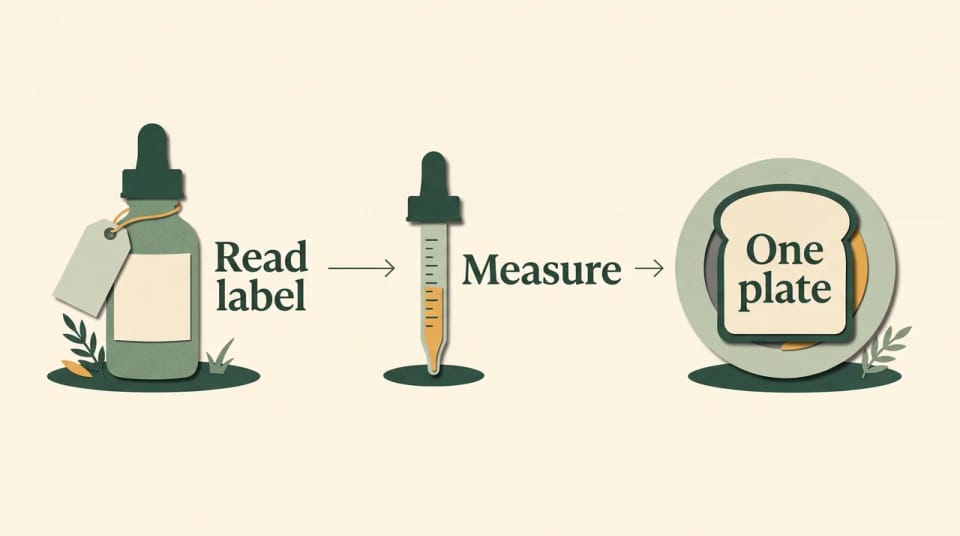
Read the product’s units and directions before measuring. A separate plate does not make an uncertain product precise.
A simple first recipe: individually finished garlic toast
For one slice, gather bread, one teaspoon of softened regular butter, a pinch of garlic powder, and chopped parsley if you like. You also need a small bowl, a clean spoon, and the oral product and its calibrated measuring device. The food quantities describe the recipe; they are not a THC serving recommendation.
1. Prepare the food before consuming
Toast the bread normally. Mix the regular butter, garlic powder, and parsley in the bowl. Finish hot-appliance work while sober. Keep the oral product away from the toaster and other food.
2. Check and measure the oral product
Read its ingredient list, route, concentration, and food-mixing directions. Follow its instructions about food temperature or other preparation restrictions. Measure the chosen amount with its calibrated device. If instructions are unclear, leave the toast plain rather than improvising.
3. Finish one separate plate
Combine the measured product with the garlic butter as the product permits, mix thoroughly, and spread it onto the toast. Keep the serving on its own clearly identified plate. Anyone eating cannabis must know it is present and agree to it; offer ordinary food as well.
For another meal, the same approach can work with an individual portion of a dressing or topping when the product instructions permit it. Do not pour an uncertain amount into a communal sauce and infer strength from the number of guests.
What about making cannabutter from flower?
Flower preparation involves two different jobs: decarboxylation converts acidic cannabinoids such as THCA into THC; infusion transfers cannabinoids into the cooking fat. Neither tells you the final milligrams per spoonful.
Wang and colleagues studied extracts in a vacuum oven. That chemistry experiment does not validate a universal home-cooking time, temperature, or recovery percentage. Wang et al., 2016.
A flower-to-butter calculation must account for starting composition, conversion, extraction, material left behind, and the amount of finished butter. Assuming “50% extraction” supplies a guess, not a measurement. Browning, smell, and how strong one portion feels cannot certify the batch’s THC concentration. Health Canada’s home-production guidance warns that there is no convenient way to test homemade extract potency at home.
If you already have homemade butter without finished-product testing, treat its strength as unknown. Do not label it with a calculated milligram claim or use it for a guest expecting a known amount. Laboratory testing of the finished infusion is needed to establish its concentration; a flower report alone does not do that.
Before eating and storing the meal
Swallowed cannabis can take up to four hours to reach full effects. Do not add more because dinner is over and you feel little. Health Canada advises new consumers to look for 2.5 mg THC or less to reduce risk; this does not make that amount safe for everyone. Consumer guidance.
The duration guide explains why there is no fixed “meal high” duration. Plan transport beforehand, avoid alcohol, and use our driving guide rather than treating elapsed time as clearance.
Label leftovers as containing cannabis, keep them separate from regular food, and store them locked away from children and pets. Follow the product’s storage instructions and the food’s own storage needs; cannabis does not establish a universal two-week shelf life. Health Canada storage guidance. Refrigerate perishable foods within two hours, or one hour above 90°F/32°C. FoodSafety.gov.
If someone feels unwell, our too-high guide explains comfort steps and when to get help. In the US, call 911 for breathing difficulty, unresponsiveness, or a seizure. For other suspected exposures, call Poison Control at 1-800-222-1222. America’s Poison Centers.
FAQ
Do I need to decarb a finished oral cannabis oil?
Do not assume so. Follow its directions; the flower-preparation process is not a universal instruction for finished oral products. Do not reheat a product to chase extra strength.
Can I calculate exact THC servings from flower percentage?
No. That number describes the starting material, not the tested concentration of the finished butter. Extraction and preparation introduce uncertainty. Testing the finished infusion is needed before claiming its concentration.
Does thorough stirring guarantee equal THC in a shared meal?
No. Mixing is useful, but it does not verify uniform distribution. Individually measuring an appropriate labeled product avoids depending on a communal dish splitting evenly.
Can I take more if I feel nothing after dinner?
Do not use the end of the meal as a signal to redose. Full effects can take up to four hours, and taking more during that delay can increase adverse effects. That timing is not permission to drive.
Key takeaways
- Read the oral product’s route, units and preparation directions.
- Measure for one identified plate; input arithmetic is not a potency test.
- Keep cannabis food labeled and locked away, and plan sober transport.
Sources
Wang et al. (2016). Cannabis and Cannabinoid Research, 1(1), 262–271. doi:10.1089/can.2016.0020.





