

Ducksfoot and Variegated Cannabis Leaves: What the Yield Evidence Says
No study has tested ducksfoot cannabis yield. The one published variegation trial found lower cannabinoid and terpenoid yield. Here is what the science shows.

Professor High
Written by Professor High, our AI guide. See how we research and correct articles.
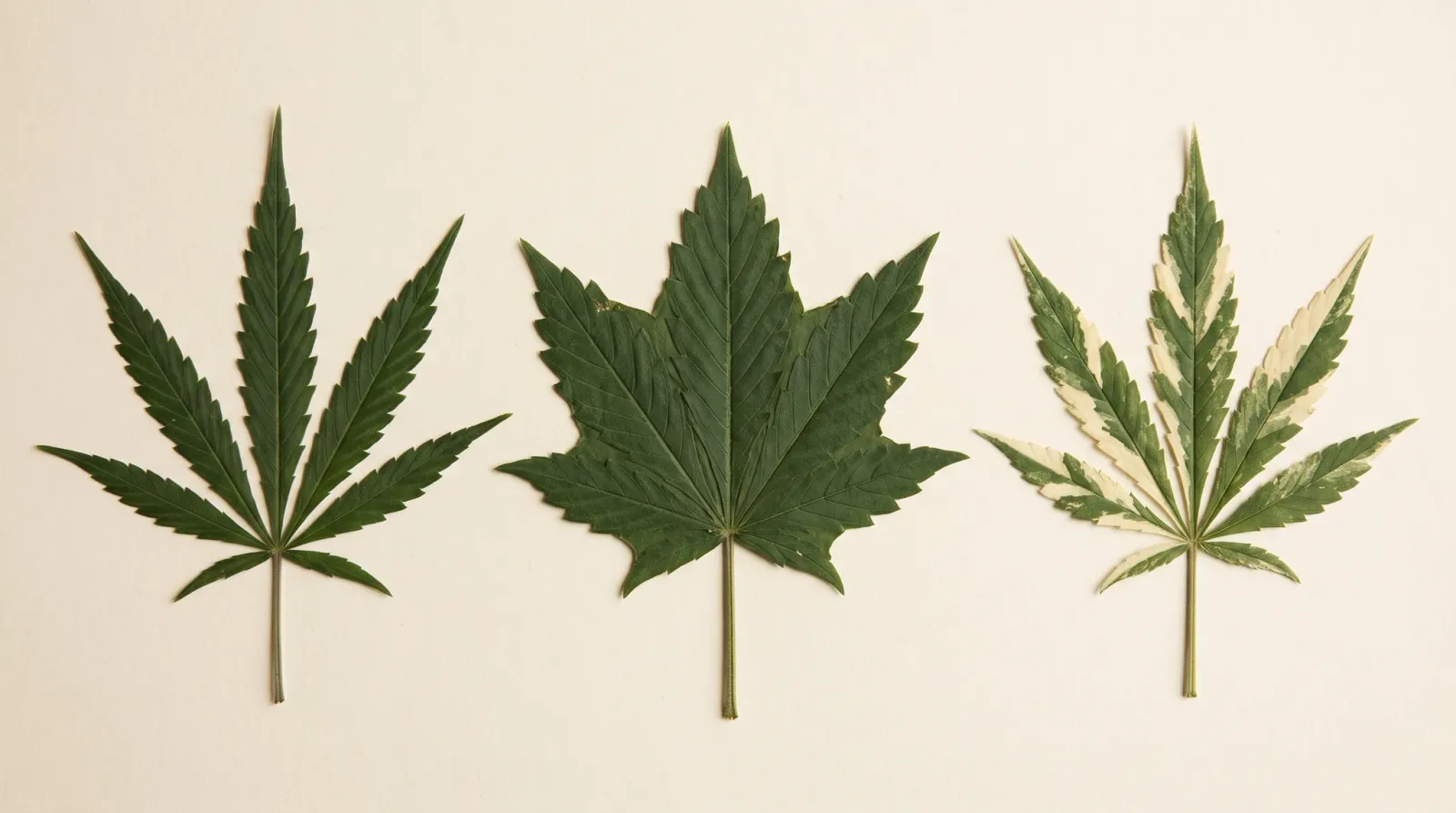
Nobody has published a yield study of ducksfoot cannabis, so the popular claim that webbed leaves cost nothing has no data behind it, while the one published variegation trial found that a variegated plant gave lower cannabinoid and terpenoid yield than its green parent. Both leaf types are real, named cannabis variants. Only one of the two yield claims you hear has any published cannabis evidence.
Here is the twist that settles most forum arguments. In that one trial, the variegated clone and its green parent matched on 15 DNA markers. They were the same plant line. The white-streaked one still grew more slowly and yielded less (Codesido et al., 2020; Casano, 2019). For ducksfoot, no gene, no inheritance test and no yield comparison has been published.
Sources checked October 29, 2026.
What is ducksfoot cannabis?
Ducksfoot is a leaf shape. Instead of separate, finger-like leaflets, the leaflets stay joined by webbing, so the leaf looks a bit like a duck’s foot. A 2022 peer-reviewed review of ornamental cannabis lists “Ducksfoot” with webbed leaves next to variegated foliage and whorled leaf arrangement. It calls these variants “presumably selected based on spontaneous mutations” (Hesami et al., 2022).
Note the word “presumably.” That review gives no primary study for the ducksfoot origin. So the honest description is this: ducksfoot is a named trait in the scientific literature, and its cause is still unstudied.
Normal cannabis leaves already vary a lot. A model of 341 leaves from 24 plants found that earlier work on the genetics of cannabis leaf shape “yielded inconclusive results,” partly because leaflet number changes from node to node on one plant (Balant et al., 2024). Leaflet width, the shape behind the old indica and sativa leaf labels, is a different trait from webbing.
Is ducksfoot recessive?
No one has shown it. You will read that ducksfoot is recessive and rarely shows in first-generation hybrids. We could not find an experiment behind that claim. PubMed searches for ducksfoot, duckfoot cannabis and fused cannabis leaflets returned no records on October 29, 2026. That is not proof that no data exists, but none is published where we looked.
Other plants give a clue, not an answer. In four compound-leaf plant species, turning down a family of leaflet-boundary genes (called NAM/CUC) produced “fewer and fused leaflets” (Blein et al., 2008). In mungbean, a mutant with fused leaflets mapped to one of those genes (Jiao et al., 2019). Whether ducksfoot involves the same genes is untested. Compare that with autoflowering, a cannabis trait with published genetics.
What causes variegated cannabis leaves?
Variegation means patches of a leaf lack green pigment. The green sectors have normal chloroplasts. The white or cream sectors have cells that lack those pigments (Yu et al., 2007).
There is no single cause. Variegation “can be caused by mutations in nuclear, chloroplast or mitochondrial genes,” according to that review. A 2026 study compared green and albino sectors in 46 variegated plants (not cannabis). In 35 of them, each plant had one mutation in the chloroplast’s own DNA in the pale tissue. The other 11 had none, which points to other routes (Qiu et al., 2026). In cannabis itself, one deliberate gene edit was enough to make albino hemp seedlings in a lab (Zhang et al., 2021). That was an engineered knockout, not how garden variegation arises.
Many variegated plants are chimeras. A chimera is one plant made of two kinds of tissue: some cells carry a change and some do not. The variegated cannabis cultivar ‘Divina’ came from “a mutated type chimera” found on a single greenhouse plant of the green cultivar ‘Pilar’ (Casano, 2019). Cannabis plants do pick up mutations that differ between parts of one plant. Whole-genome sequencing of one plant found that 34% of its variants were unique to the top (Adamek et al., 2022).
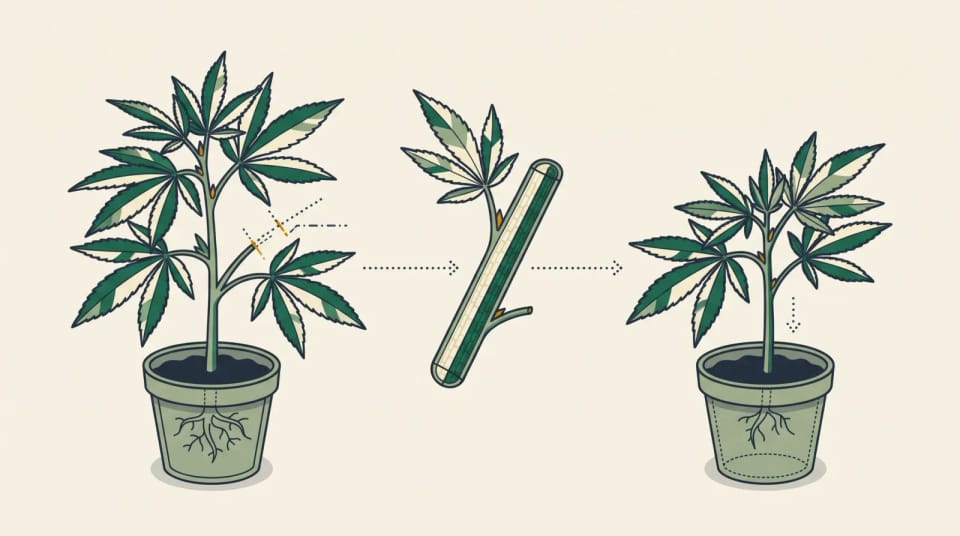
A chimera mixes changed and unchanged tissue in one plant. Cuttings copy that arrangement; the reported seed cross with a green male gave only green offspring.
Does variegation lower cannabis yield?
In the one published cannabis trial, yes. Researchers grew variegated ‘Divina’ beside its green parent ‘Pilar’ at the same site, under artificial growing conditions. ‘Divina’ had significantly less leaf chlorophyll. Its mother plants showed “slower growth rate and less total biomass.” And “‘Pilar’ achieved significantly higher cannabinoids and terpenoids yields than ‘Divina’” (Codesido et al., 2020).
Read that result with its limits in view:
- One pair of plants. One variegated cultivar against one green cultivar.
- CBD-dominant hemp. Both carry only CBDA synthase alleles. Nothing here covers THC-dominant plants or the character of a high.
- Abstract-level detail. The public abstract gives no sample sizes and no percentage loss. We did not read the paywalled full text, so we do not quote a number.
- Company authors. The authors work for the company that holds the plant breeder’s rights to ‘Divina’.
- A hypothesis on cause. The authors suggest the gap is “supposedly due to the inability to synthesize chlorophyll.” That is their explanation, not something the abstract shows was tested.
The rooting stage carried a cost too. ‘Divina’ cuttings were “more prone to fungal disease during in vivo rooting” (Casano, 2019).
Variegation does not cost growth in every plant, though. Under long nitrogen shortage, variegated Pelargonium kept making leaf biomass after green plants stopped (Abadie et al., 2015). In Dracaena, light-green sectors with 7.5-fold less chlorophyll photosynthesized at near-identical rates to dark-green ones (Chalenko et al., 2024). Those are other species. For cannabis, the ‘Divina’ trial is the only data, and it points down.
Does ducksfoot lower yield?
No one knows. Some grower pages say ducksfoot plants yield like their parents. Others say odd leaves mean less bud. Neither side cites a trial, and we found none.
There is a plausible reason leaf shape could matter, and a reason not to assume it. In two cannabis breeding populations, plants with wide leaflets had higher stomatal conductance and photosynthesis under chamber conditions. Yet basic photosynthetic traits were similar, and leaf appearance did not predict chemotype (Murovec et al., 2022). That study measured leaflet width and gas exchange, not webbing and not harvest weight. Leaves feed the plant, which is why removing fan leaves is a trade-off. But many things set how much one plant yields, and no study has isolated leaf shape from genetic background.
| Question | Ducksfoot (webbed leaflets) | Variegation (white or cream sectors) |
|---|---|---|
| What changes | Leaf shape | Leaf pigment in patches |
| Named in peer-reviewed literature | Yes, one review | Yes, plus a named cultivar |
| Gene or cause identified in cannabis | No | No, for ‘Divina’; several known routes in other plants |
| Inheritance tested | No | One reported cross: all offspring green |
| Cannabis yield trial | None found | One: lower cannabinoid and terpenoid yield |
| How the trait is kept in the trial plant | Not studied | Cuttings, as a chimera |
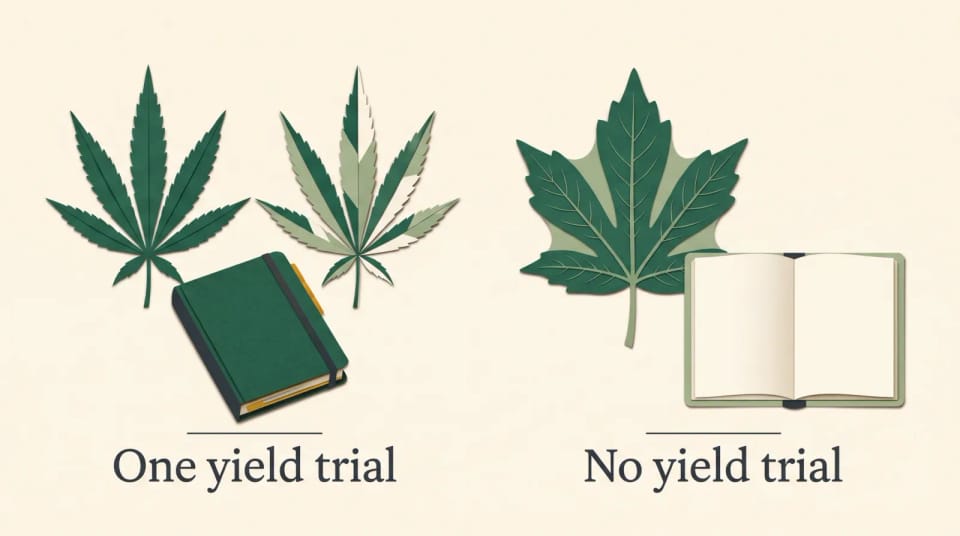
Variegation has one cannabis yield comparison, from one cultivar pair. Ducksfoot has none, so claims either way are untested.
Can a variegated plant pass the trait through seed?
Not in the one reported case. Breeders crossed a green-leaf male with a ‘Divina’ plant, and all the first-generation offspring were green (Casano, 2019). The abstract does not give the offspring count, and the cross went in one direction only. So treat it as one data point, not a rule.
It fits the chimera picture. If the change lives in some tissue layers and not others, seeds may never carry it. Cuttings copy the whole arrangement. That is the same reason a clone-only cut can hold a trait seeds may not. Breeders who want to keep a one-off plant use the same tools described in our guide to how breeders spot and keep a rare plant. Neither ducksfoot nor variegation is the same as chromosome doubling, which changes the number of whole chromosome sets.
Is it a mutation, or something normal or a deficiency?
Check the ordinary explanations first. Many odd-looking leaves are neither ducksfoot nor variegation.
Few-finger and single-finger leaves are normal at some nodes. In a life-cycle study of one cultivar, leaves went from serrated first leaves up to nine leaflets by the sixth leaf pair. They fell to eight and seven by the 14th and 15th, and the plant made single-leaflet leaves from the 25th node (Hesami et al., 2023). A three-finger leaf on a mature plant is not, by itself, a mutation.
Pale or mottled patches can come from feeding. Nutrient problems can blotch or pale leaves too, and a photo rarely settles which cause you are looking at. Our calcium and magnesium deficiency guide and feeding guide cover those patterns.
Virus-like symptoms are hard to read by eye. Sequencing of hemp plants with virus-like symptoms found several viruses, but “no clear association of any virus with symptoms was observed” (Miotti et al., 2023). We cannot tell these apart from a photo, and neither can a forum thread.
Purple is not variegation. Purple leaves come from added pigment, not missing chlorophyll. That is the pigment that colours leaves purple, a separate story.
Key takeaways
- Ducksfoot (webbed leaflets) is a named cannabis variant with no published gene, inheritance test or yield study.
- Claims that ducksfoot is recessive or yield-neutral are unsourced.
- The one cannabis variegation trial found lower cannabinoid and terpenoid yield in a variegated chimera than in its green parent.
- That trial covered one CBD-dominant pair, with company authors and no published percentage.
- Few-leaflet leaves near the top of a plant are normal; pale mottling often points to feeding before genetics.
FAQ
Are ducksfoot strains harder to grow?
There is no published evidence either way. No study has compared growing difficulty, flowering time or yield for ducksfoot plants. Grower statements that they grow “just like” their parents are reports, not trial results.
How rare is variegated cannabis?
We found no published estimate of how often variegation appears in cannabis. A 2022 review called ‘Divina’ “the only selected mutant introduced as an ornamental cannabis plant,” which suggests stable variegated cultivars are uncommon (Hesami et al., 2022). Single variegated plants can still turn up, since chimeras arise from changes in part of one plant.
Why is my cannabis plant growing leaves with only three fingers?
Leaflet count normally changes up the stem. In one life-cycle study, leaflet number peaked around the sixth leaf pair, then fell, and single-leaflet leaves appeared from the 25th node. A three-finger leaf on its own is not a sign of a mutation.
Is variegated cannabis less potent?
The published trial measured total cannabinoid and terpenoid yield, not potency, and it studied CBD-dominant hemp. ‘Pilar’ produced significantly more of both than variegated ‘Divina’. No study we found tested variegation in THC-dominant plants.
Sources
- Abadie C, Lamothe M, Mauve C, Gilard F, Tcherkez G. Leaf green-white variegation is advantageous under N deprivation in Pelargonium x hortorum. Functional Plant Biology. 2015;42(6):543-551. PMID 32480699
- Adamek K, Jones AMP, Torkamaneh D. Accumulation of somatic mutations leads to genetic mosaicism in cannabis. The Plant Genome. 2022;15(1):e20169. PMID 34806848
- Balant M, Garnatje T, Vitales D, Hidalgo O, Chitwood DH. Intra-leaf modeling of Cannabis leaflet shape produces leaf models that predict genetic and developmental identities. New Phytologist. 2024;243(2):781-796. PMID 38757746
- Blein T, Pulido A, Vialette-Guiraud A, et al. A conserved molecular framework for compound leaf development. Science. 2008;322:1835-1839. PMID 19095941
- Casano S. Development of ornamental Cannabis sativa L. cultivars: phytochemical, morphological, genetic characterization and propagation aspects. Acta Horticulturae. 2019;1263:283-290. Abstract
- Chalenko E, Lysenko V, Kosolapov A, Usova E, et al. Light green leaf sectors of variegated Dracaena fragrans plants show similar rates of oxygenic photosynthesis to that of normal, dark green leaf sectors. Plant Physiology and Biochemistry. 2024;215:109040. PMID 39142012
- Codesido V, Marín M, Sánchez-Carnerero Callado C, Ferreiro-Vera C, Casano S. Cannabinoids and terpenoids yields of the ornamental Cannabis sativa L. cultivar ‘Divina’ characterized by a variegated foliage as morphological marker. Acta Horticulturae. 2020;1287:161-168. Abstract
- Hesami M, Pepe M, Baiton A, Salami SA, Jones AMP. New insight into ornamental applications of cannabis: perspectives and challenges. Plants. 2022;11(18):2383. Full text
- Hesami M, Pepe M, Jones AMP. Morphological characterization of Cannabis sativa L. throughout its complete life cycle. Plants. 2023;12(20):3646. PMID 37896109
- Jiao K, Li X, Guo Y, et al. Regulation of compound leaf development in mungbean (Vigna radiata L.) by CUP-SHAPED COTYLEDON/NO APICAL MERISTEM (CUC/NAM) gene. Planta. 2019;249(3):765-774. PMID 30390139
- Miotti N, Sukhikh N, Laboureau N, Casati P, Pooggin MM. Cannabis virome reconstruction and antiviral RNAi characterization through small RNA sequencing. Plants. 2023;12(23):3925. PMID 38068561
- Murovec J, Eržen J, Flajšman M, Vodnik D. Analysis of morphological traits, cannabinoid profiles, THCAS gene sequences, and photosynthesis in wide and narrow leaflet high-cannabidiol breeding populations of medical cannabis. Frontiers in Plant Science. 2022;13:786161. PMID 35283868
- Qiu Z, Yi B, Feng H, Zeng Q, et al. Spontaneous plastome mutations in variegated plants occur predominantly in genes related to transcription and photosynthesis. Planta. 2026;264(1):9. PMID 42217055
- Yu F, Fu A, Aluru M, et al. Variegation mutants and mechanisms of chloroplast biogenesis. Plant, Cell & Environment. 2007;30(3):350-365. PMID 17263779
- Zhang X, Xu G, Cheng C, Lei L, et al. Establishment of an Agrobacterium-mediated genetic transformation and CRISPR/Cas9-mediated targeted mutagenesis in hemp (Cannabis sativa L.). Plant Biotechnology Journal. 2021;19(10):1979-1987. PMID 33960612



